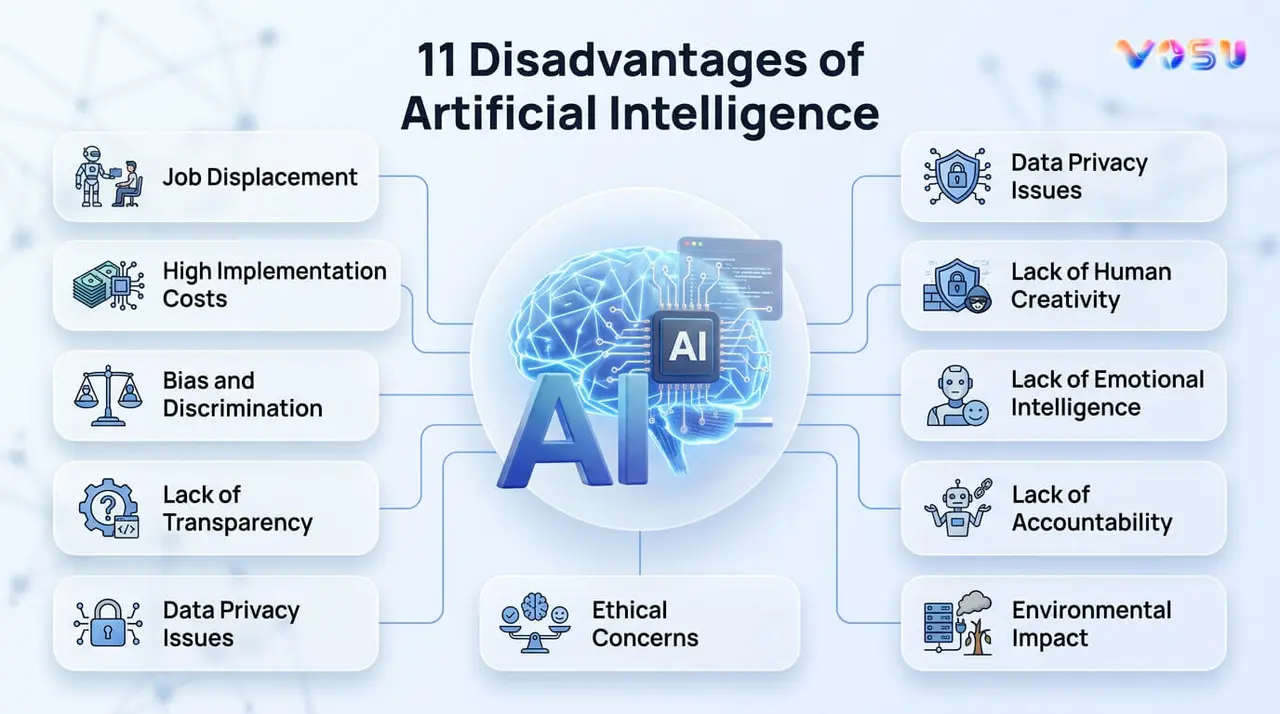
Artificial Intelligence creates several disadvantages like job displacement, high implementation costs, bias and discrimination, lack of transparency, data privacy issues and cybersecurity threats that affect work, society and daily life. It increases job displacement as machines replace routine work in manufacturing, customer service and data entry. It raises high implementation costs through expensive infrastructure, skilled workforce demands and continuous system maintenance. Artificial intelligence introduces bias and discrimination because models learn from historical datasets that contain human inequalities. Artificial intelligence limits trust through the lack of transparency, where decision processes remain unclear in complex systems.
Artificial intelligence creates disadvantages in daily life by exposing users to data privacy issues and unauthorized data usage risks. It creates cybersecurity threats by allowing automated attacks, deepfakes and adaptive malware. Artificial intelligence reduces originality through a lack of human creativity caused by over reliance on automated outputs. It weakens social interaction through the lack of emotional intelligence and limited empathy in responses. It also raises ethical concerns and the lack of accountability due to unclear responsibility in automated decisions. Artificial intelligence increases environmental impact through high energy consumption and resource usage.
11 Cons of artificial intelligence are listed below.
1. Job displacement
2. High implementation costs
3. Bias and discrimination
4. Lack of transparency
5. Data privacy issues
6. Cybersecurity threats
7. Lack of human creativity
8. Lack of emotional intelligence
9. Ethical concerns
10. Lack of accountability
11. Environmental impact
1. Job displacement
Artificial intelligence causes job displacement by automating repetitive tasks that humans used to perform every day. It eliminates roles in manufacturing, data entry and routine customer service as machines and algorithms handle these jobs faster and more cheaply than workers. AI creates economic consequences by shifting hiring away from routine roles toward high skill jobs, which reduces opportunities for lower skilled workers and widens income inequality across certain industries.
Artificial intelligence is expected to displace nearly 83 million jobs globally by 2027, according to World Economic Forum projections. It affects sectors differently, putting routine, rule‑based jobs in retail, logistics, and office work at the highest risk. It threatens roles that rely on predictable patterns rather than creativity, empathy, or complex judgment. It can deepen social divides over time and reduce incomes in vulnerable groups. It may also lead to long‑term unemployment for workers who lack access to retraining and new opportunities.
2. High implementation costs
Artificial intelligence causes high implementation costs through expensive infrastructure, advanced computing systems and continuous operational expenses. It requires expensive GPUs or TPUs and dedicated hardware that demand large scale data centers or cloud compute, which increases upfront investment and ongoing computational costs. It also needs upgraded networking, storage and power cooling infrastructure to support intensive training and inference workloads at scale.
AI raises expenses through data acquisition and management because high quality data collection, cleaning, labeling, governance and secure storage can consume 30 to 50% of a project’s total budget. It drives up talent costs because hiring AI specialists, data scientists and MLOps engineers commands premium salaries due to scarcity and specialized skills. AI increases costs in model development and integration, as designing, tuning and embedding models into existing systems requires custom engineering, API development and sometimes architectural changes. It introduces substantial maintenance and hidden costs that include continuous monitoring, periodic retraining, security patches, compliance checks and energy-intensive operations that persist over the system’s lifetime.
3. Bias and discrimination
Bias in AI means a systematic error where an AI system treats certain people or groups unfairly based on patterns learned from data instead of neutral judgment. It appears in facial recognition bias, hiring tools and loan approval systems, where some groups receive less accurate or unfair results. AI causes bias and discrimination by learning from flawed inputs that embed unfair patterns into its outputs.
AI perpetuates human prejudices through historical datasets that reflect societal inequities like facial recognition bias, where systems misidentify certain groups due to underrepresentation. Biased training data amplifies these issues, leading to discriminatory decisions in hiring, lending and policing.
Artificial intelligence worsens outcomes via algorithmic amplification, where AI reinforces and escalates human biases in feedback loops, like search engines prioritizing skewed results. Developer and deployment flaws that include untested models or misaligned objectives further entrench discrimination by overlooking edge cases. These factors deepen inequalities and erode trust in AI systems
4. Lack of transparency
Lack of transparency in AI refers to the difficulty in understanding how an AI system makes its decisions or arrives at specific outputs. This is often described as a black box problem, where the internal logic is not visible or easily interpretable, even to developers. It limits the ability to trace, explain or justify decisions made by the system
AI causes the lack of transparency because it relies heavily on deep learning models with millions of parameters that are extremely difficult to interpret or trace. It embeds reasoning across many hidden layers, so even developers cannot always explain a given decision. Complex neural networks deepen this opacity by obscuring how inputs are transformed into outputs. Opaque training processes worsen the problem because they hide which data was used, how it was labeled and what assumptions shaped the model’s learning. Proprietary secrecy reduces transparency further because companies often treat AI models, data pipelines and algorithms as confidential, which limits external review. It makes auditing, fairness testing and accountability checks harder, which weakens trust and raises risks in high stakes applications.
5. Data privacy issues
AI causes data privacy issues when personal information is collected, processed or used without proper security, transparency or meaningful user control. It depends on massive personal datasets gathered from online activity, devices and digital platforms, which increases the risk of unauthorized access and privacy violations in AI data privacy systems.
AI creates risks through advanced inference capabilities that analyze patterns in data and predict private traits such as behavior, preferences, health conditions or political views. It exposes sensitive information even when users never share it directly, increasing big data privacy concerns in large scale systems.
AI leads to data leakage and misuse risks because large systems are vulnerable to security breaches, weak access control and poor encryption. It increases threats like deepfake impersonation, where personal data is used to generate fake audio, video or identity content for fraud and manipulation.
6. Cybersecurity threats
AI causes cybersecurity threats by allowing attackers to automate and accelerate digital attacks with greater speed and accuracy. It increases security risks because cybercriminals use AI to automate and scale sophisticated phishing campaigns that are harder to detect. It supports malware creation by generating adaptive harmful software that bypasses traditional security tools. It raises concerns about the risks of AI in cybersecurity because AI powered attacks spread faster and target more users.
AI allows criminals to create deepfakes at unprecedented speeds, which are used for identity fraud, misinformation and social engineering attacks. It increases system weaknesses because attackers manipulate AI models using poisoned data, adversarial inputs or unauthorized access. It expands the attack surface because cloud systems, AI tools and automated platforms create more entry points for cyber threats. This increases the disadvantages of AI in cybersecurity through polymorphic code, which constantly changes to avoid detection by security systems.
7. Lack of human creativity
AI causes a lack of human creativity by encouraging people to depend on automated systems instead of developing original ideas and independent thinking skills. It creates homogenized ideas because AI generated outputs often follow similar patterns, structures and predictable styles based on existing data.
AI increases creative decline through over reliance on automated tools and reduced mental engagement in problem solving activities. It reduces practice in creative problem solving because users depend on instant AI generated answers instead of exploring ideas independently. It contributes to cognitive atrophy because continuous dependence on automation weakens imagination, critical thinking and experimentation skills. It suppresses risk taking because people avoid unconventional ideas when AI systems consistently suggest safe and predictable solutions.
8. Lack of emotional intelligence
Artificial intelligence causes the lack of emotional intelligence by giving replies through relying on data patterns instead of real emotions, lived experiences or human social connections. It creates emotional limitations because AI systems cannot truly understand empathy, trust, pain or personal human experiences in the way people naturally do. It struggles with emotional depth because it lacks biological consciousness, which prevents real emotional awareness and subjective understanding.
AI increases emotional intelligence concerns through the absence of subjective experience and the inability to empathize deeply in human interactions. It weakens emotional connection when people are dependent on AI for communication, advice or companionship. It contributes to the erosion of human emotional intelligence through over reliance on automated interaction systems that reduce direct human engagement. It leads to reduced resilience in human relationships because excessive dependence on AI can weaken empathy, emotional communication and interpersonal understanding over time.
9. Ethical concerns
Artificial intelligence causes ethical concerns by making decisions and generating outputs that can affect fairness, privacy, accountability and human rights. It creates bias amplification because AI systems can repeat and strengthen existing social inequalities through automated decision making. It leads to unfair outcomes in hiring when recruitment systems favor certain candidates while filtering out others. It can discriminate against marginalized groups because biased training data influences predictions related to social and demographic factors.
AI creates ethical concerns through privacy erosion, surveillance expansion and reduced human autonomy. It increases monitoring capabilities because AI powered systems can track personal behavior, online activity and facial recognition data at large scale. It can violate individual autonomy when algorithms influence choices, behaviors or access to opportunities without human control. It shows ethical risks through deepfakes for manipulation, where fake media content spreads misinformation, fraud or deception.
10. Lack of accountability
Artificial intelligence causes the lack of accountability when its decision making process becomes complex and hard to trace errors back to a single responsible person or organization. It happens because AI decisions involve multiple actors and automated systems, making responsibility unclear.
AI creates responsibility gaps where developers, companies and users share roles but no one fully owns the outcome. It increases issues in artificial intelligence accountability because responsibility becomes unclear across design, deployment and use stages. It leads to diffused responsibility chains involving developers, data providers, platform owners and users. It weakens ownership because automated systems make decisions instead of direct human control. It creates enforcement challenges because laws and regulations often lag behind AI's rapid evolution that makes accountability difficult to ensure in practice.
11. Environmental impact
Artificial intellignece causes environmental impact by increasing energy use, emissions and resource demand during large scale model training and deployment. It happens because AI systems require massive computing power, which puts pressure on electricity grids and natural resources. It is described as AI harming the environment due to its high carbon footprint.
AI is bad for the environment because training large models consumes huge amounts of energy. It increases emissions since models like GPT 3 emits 500 to 552 metric tons of CO₂ during training, according to a 2024 study published in Nature Scientific Reports. It increases environmental pressure because data centers run continuously and require a significant electricity supply. This highlights the disadvantages of AI in environm due to its heavy energy usage.
Artificial intelligence increases environmental damage through water use and cooling demands in data centers. It used about 700,000 liters daily in large facilities to prevent overheating. It harms the environment through hardware production and e-waste. It requires rare earth mining for chips, GPUs and servers, which damages ecosystems and increases electronic waste.
How to mitigate the disadvantages of AI?
To mitigate the disadvantages of AI, organizations and users can reduce bias, prevent over reliance, address job displacement, ensure transparency, manage security risks and adopt responsible ethical practices. These improve responsible AI development through technical safeguards, ethical frameworks and proactive human engagement that support fairness, accountability, security and balanced human control.
Strategies to overcome the disadvantages of AI.
- Mitigate bias and inequality: Deploy technical safeguards like diverse training datasets and regular audits, combined with ethical frameworks to ensure fair AI outcomes across demographics and reduce systemic inequalities.
- Prevent over-reliance and loss of skill: Foster proactive human engagement through hybrid workflows where AI augments human decision-making, alongside training programs to maintain critical thinking and expertise in users.
- Address job displacement: Develop reskilling initiatives and ethical frameworks for workforce transitions, using AI to identify new roles while governments implement policies like universal basic income pilots.
- Ensure transparency and accountability: Build explainable AI models with technical safeguards for traceability, enforce ethical frameworks mandating audits and hold developers legally accountable for harmful decisions.
- Manage security and privacy risks: Integrate strong technical safeguards such as encryption and adversarial training, paired with ethical frameworks for data minimization and proactive human engagement in oversight.
- Adopt ethical guidelines: Establish global ethical frameworks with proactive human engagement in governance, incorporating technical safeguards like value alignment to guide AI development responsibly.
How do we mitigate the disadvantages of AI in education?
8 steps to mitigate the disadvantages of AI in education are outlined below.
- Prevent overreliance on AI: Teach students to use AI as a support tool, not a replacement and encourage critical thinking when interpreting AI generated content.
- Strengthen AI literacy: Equip learners and educators with knowledge of AI capabilities, limitations and ethical implications to enable informed, responsible use.
- Protect academic integrity: Update plagiarism policies and assessment designs to discourage misuse of AI while still allowing its ethical, supervised use in learning.
- Reduce bias and misinformation: Require students and teachers to fact check outputs and critically evaluate AI generated information for accuracy and fairness.
- Safeguard privacy and data security: Adopt secure tools and clear data‑handling rules to protect student information and minimize exposure of sensitive data to AI systems.
- Address inequality of access: Provide equitable devices, connectivity and AI tools so all students can benefit from technology without deepening existing gaps.
- Support teachers rather than replace them: Design AI to allow personalized mentoring and analytics through freeing educators to focus on human centered instruction and feedback.
- Monitor emotional and social development: Ensure AI assisted learning does not replace peer interaction or teacher student bonding and actively monitor students’ socio‑emotional well being.
Can I prevent AI bias in healthcare?
Yes, you can prevent AI bias in healthcare because AI systems depend on careful data selection and balanced medical training processes. It increases healthcare fairness through diverse training datasets, continuous monitoring and transparent algorithms. It helps improve AI response accuracy by avoiding bias in diagnosis, treatment recommendations and patient decisions.
Can I prevent toxic responses from AI assistants?
Yes, you can prevent toxic responses from AI assistants because outputs depend on training data quality and system controls. It uses careful prompting, safer model selection, bias testing and safety training. It reduces harmful language and ensures more reliable and responsible AI behavior in real usage.
Is using AI chatbots bad?
No, using AI chatbots is not bad because they offer productivity gains and 24/7 support for learning and tasks. It helps users complete work efficiently, access quick information and improve daily productivity. It causes emotional dependency, privacy and safety concerns if users share personal data without awareness.
Is AI used to run social media algorithms?
Yes, AI is used to run social media algorithms because it analyzes user behavior to rank and personalize content while improving privacy and safety. It helps platforms offer productivity gains and 24/7 support through automation. It increases emotional dependency by continuously optimizing user engagement.
Is generative AI bad for the environment?
Yes, generative AI is bad for the environment because it involves high energy consumption, intensive data center operations and large scale computing systems. It increases carbon emissions due to continuous model training and usage.It requires significant water consumption for cooling and contributes to electronic waste from frequent hardware upgrades.
Does generative AI use too much water?
Yes, generative AI uses significant water because cooling data centers and generating electricity require large scale water to control heat in high performance computing systems. It increase pressure on water resources and contribute to local water scarcity in regions with limited or stressed supply infrastructure.
Is AI a threat to humanity?
No, AI is not a threat to humanity because it still operates under human control and lacks true autonomy in critical decisions. It becomes risky when people give it infrastructure control without enough rules or oversight. It stays safer when humans set limits, monitor systems and keep final authority over important choices.
Will AI take over data analytics?
No, AI will not fully take over data analytics because human judgment is still needed for strategic interpretation and business context understanding. It improves AI in data analytics by automating repetitive tasks, reducing manual data manipulation to strategic interpretation workflows. It transforms analytics roles by supporting professionals rather than replacing them, especially in complex decision making.
Are cybersecurity jobs safe from AI?
Yes, cybersecurity jobs are partially safe from AI because it automates routine tasks and entry level work still requires human experts to handle complex threats and strategic decisions. AI in cybersecurity improves efficiency through augmentation over replacement, as professionals use AI tools to detect attacks faster. It focuses on advanced threat analysis and critical security responses.
What are the uses of AI in daily life?
The uses of AI in daily life are widespread including virtual assistants, personalized recommendations, facial recognition and content creation. It makes daily tasks easier, faster and across communication, entertainment, security and productivity systems. It improves user experience by supporting smart automation, personalized services and intelligent decision making in everyday digital activities, which shows how AI is used in modern life.
Can I use AI in business?
Yes, you can use AI in business because it helps to enhance efficiency, reduce costs, and improve customer experiences through automation, data analysis and decision making. It supports faster workflows by handling repetitive tasks that focus on valuable and creative work.
Can I use AI for risk management?
Yes, you can use AI for risk management because it can enhance the identification of patterns and early warning signs that humans might miss. It supports mitigation of threats by analyzing data in real time so you can respond faster and make more informed decisions.