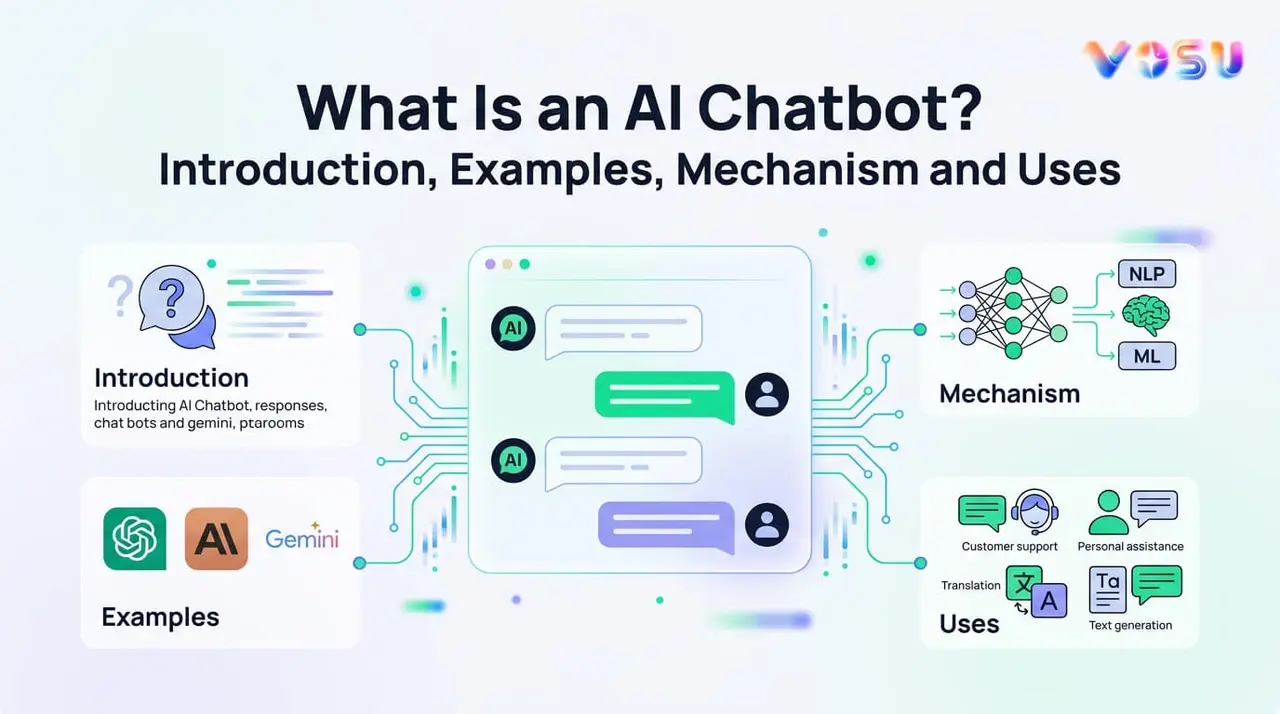
An artificial intelligence chatbot is a software system that simulates human conversation using ai chatbot technology across websites, apps and messaging channels. It acts as an AI powered chatbot that understands user intent and responds through text or voice so people get instant help online. It works by processing input with natural language processing, where it converts text into tokens, detects intent and prepares the next response. It uses neural networks and machine learning to match patterns from training data and generate answers that feel natural to read.
AI chatbot types are categorized in customer service, conversational, transactional, generative, voice, sales and hybrid models that support different workflows and automation needs. AI chatbot use cases appear in healthcare, education, e‑commerce, banking, recruitment and real estate, where they handle bookings, support tickets, sales guidance and information delivery in real time. These systems provide 24/7 availability, multilingual support, faster research, document creation, automation and cost efficiency that reduce workload and increase productivity.
AI chatbots have some limitations like hallucinations, bias, weak reasoning, privacy risks and limited emotional understanding during complex or sensitive situations. These weaknesses mean teams must stay careful when creating an AI chatbot and keep humans in the loop for high stakes or regulated decisions. AI chatbot development involves defining your goal and use case, choosing a no-code platform, feeding the bot information, customizing or branding and finally testing and deploying.
What is an AI chatbot?
An AI chatbot is a software application that uses artificial intelligence to simulate human conversation and provide helpful responses to users. It understands user messages, analyzes their intent and generates relevant responses on the spot.
An artificial intelligence chatbot communicates through text or voice while assisting users with questions, tasks, recommendations and information retrieval. AI chatbots such as ChatGPT, Google Gemini, Microsoft Copilot and Claude support users across education, business, customer service and content creation. These tools are important in 2026 because organizations use them to improve customer experiences, automate routine interactions and enhance productivity. They help users access information faster, receive instant support and complete tasks efficiently in a digital world.
How does an AI chatbot work?
An AI chatbot works by analyzing user input, predicting responses and improving performance through machine learning. AI chatbot technology combines blended language processing models, AI chatbot algorithms, natural language processing and a neural network to understand language and generate human like conversations. It breaks text into tokens during input analysis, which helps the system identify meaning, intent and contextual relationships within a message.
An AI chatbot uses prediction generation to evaluate patterns learned during training and select the most relevant response based on context. It also considers information from conversation histories to maintain continuity when applicable. It then creates a natural language reply and delivers it to the user. It supports continuous learning through machine learning techniques that help improve accuracy, adapt to language changes and improve future interactions over time.
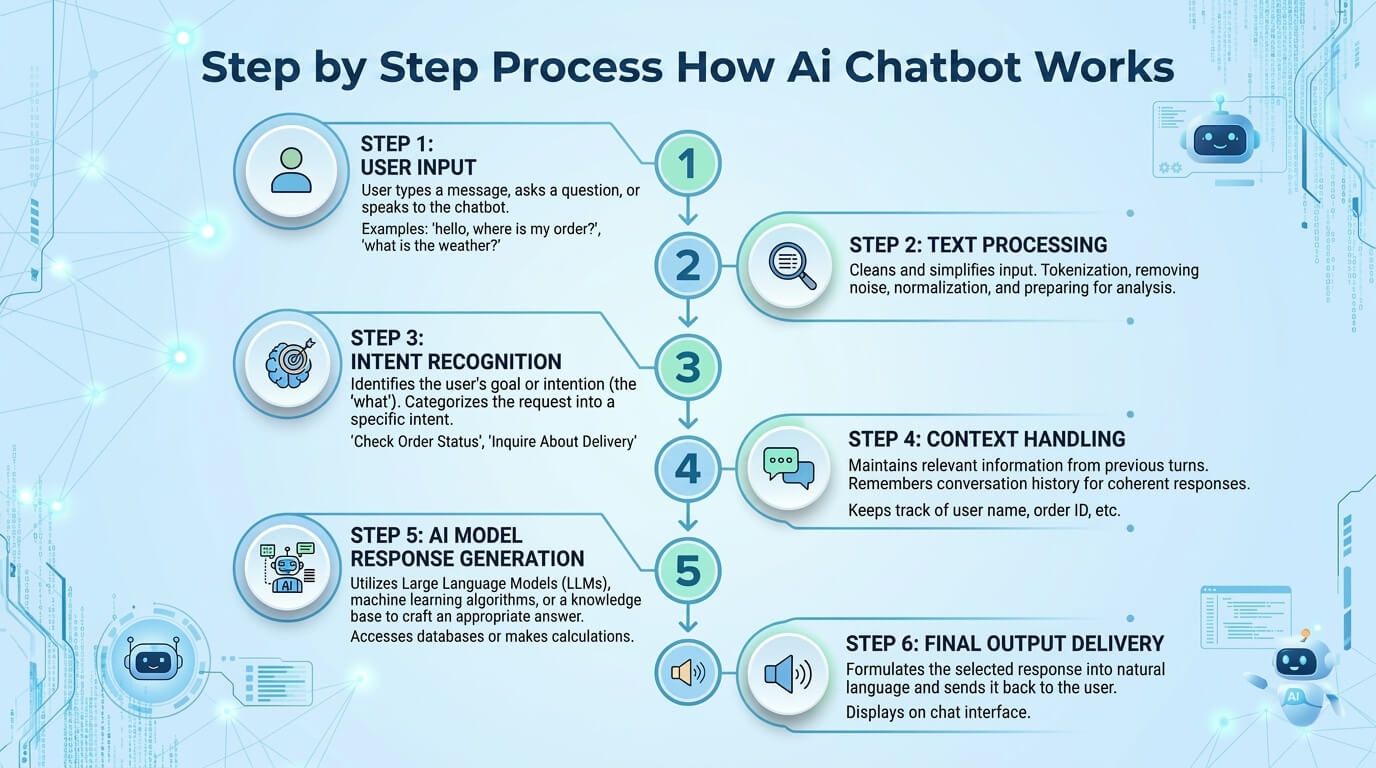
The step by step process of how na AI chatbot works is shown in the image below.
What are the types of AI chatbots?
AI chatbots are available in several types, including customer service, conversational, transactional, generative, sales and lead generation, workflow automation, voice and hybrid AI chatbots. These chatbot types serve different purposes, from answering customer questions and automating tasks to supporting web research, creative tasks, and business operations.
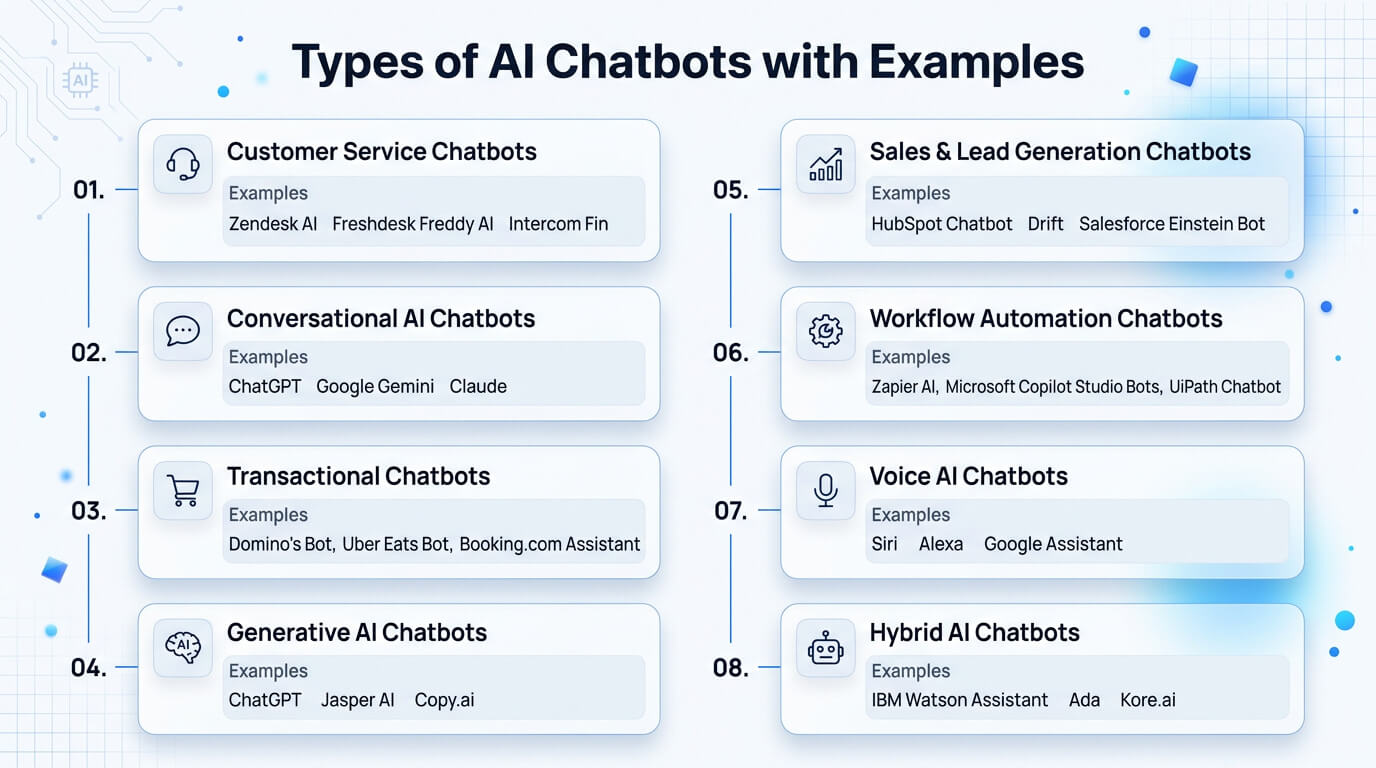
The top 8 types of AI chatbots are given below.
- Customer service AI chatbots: Customer service AI chatbots like Zendesk Answer Bot, Freshdesk Freddy and Intercom resolve support queries, pull from knowledge bases and escalate complex issues to human agents quickly.
- Conversational AI chatbots: Conversational AI chatbots like Google Dialogflow, Rasa and Microsoft Bot Framework maintain context across turns, handle open ended dialogue and enable natural language understanding for richer user interactions today.
- Transactional AI chatbots: Transactional AI chatbots like Twilio Autopilot, Stripe Checkout bots and Amelia complete tasks such as bookings, payments and order tracking by integrating securely with backend systems reliably.
- Generative AI chatbots: Generative AI chatbots like OpenAI ChatGPT, Anthropic Claude and Cohere generate original text, summaries and creative content, supporting drafting, ideation, and controllable tone or style adjustments easily.
- Sales and lead generation AI chatbots: Sales and lead generation AI chatbots like Drift, HubSpot Conversations and Tars qualify prospects, capture contact details, schedule demos, and sync leads to CRMs with scoring.
- Workflow automation AI chatbots: Workflow automation AI chatbots like Zapier Chat, Microsoft Power Virtual Agents and Workato orchestrate processes, trigger API calls, route tasks and reduce manual steps across multiple enterprise apps efficiently.
- Voice AI chatbots: Voice AI chatbots like Amazon Alexa, Google Assistant and Nuance Dragon handle spoken interactions using ASR, NLU and TTS, supporting IVR, hands free controls and conversational voice experiences well.
- Hybrid AI chatbots: Hybrid AI chatbots like Ada with human handoff, LivePerson AI plus agent and Kore.ai combine rule based flows, ML models and human oversight to balance deterministic responses and safety.
The types of AI chatbots with examples are visualized in the image below.
What are the use cases of an AI chatbot?
The use cases of an AI chatbot include healthcare, education, e-commerce, banking, hotels, lawyers, recruitment, social media, real estate and question answering. It holds 41.82% of the chatbot market share in customer support, making this segment the primary driver of overall chatbot revenue and adoption.
The use cases of an AI chatbot are given below.
- AI chatbot for healthcare: AI chatbot helps patients schedule appointments, receive medication reminders, access basic health information and get answers to common medical questions while reducing administrative workload.
- AI chatbot for education: AI chatbot improves learning experiences by assisting with coursework, clarifying concepts, supporting self paced learning and helping educators respond to student needs more efficiently.
- AI chatbot for e-commerce: AI chatbot assists shoppers with product recommendations, order tracking, customer support and purchase decisions, which helps online stores improve engagement and increase sales.
- AI chatbot for banking: AI chatbot helps customers check account information, monitor transactions, receive financial guidance and resolve common service requests through secure and convenient interactions.
- AI chatbot for hotels: AI chatbot manages reservations, answers guest inquiries, provides local recommendations and handles customer service requests to improve the overall guest experience.
- AI chatbot for lawyers: AI chatbot assists with client intake, appointment scheduling, document collection and answering general legal questions that allow legal professionals to save time.
- AI chatbot for recruitment: AI chatbot screens candidates, schedules interviews, answers applicant questions and streamlines hiring workflows that help recruiters manage recruitment processes more efficiently.
- AI chatbot for social media: AI chatbot responds to messages, engages followers, moderates conversations and supports brand communication across multiple social media platforms.
- AI chatbot for real estate: AI chatbot helps buyers and renters explore listings, schedule property viewings, answer property related questions and provide real-time assistance throughout the process.
- AI chatbot for answering questions: AI chatbot delivers instant responses to user queries, provides information on diverse topics and supports businesses by offering reliable self service assistance.
What are the benefits of an AI chatbot?
The benefits of an AI chatbot include 24/7 assistance to users, multilingual support, faster research, document creation, personalized learning, automating routine tasks, low cost scalability and easier planning. These benefits of chatbots for customers help users save time, improve productivity and get instant support when needed.
The benefits of an AI chatbot are given below.
- 24/7 availability: AI chatbots provide continuous support and deliver instant responses at any time, ensuring users get help without waiting for office hours.
- Helps with documents: AI chatbots create emails, reports and summaries from short inputs that reduce manual writing effort and improve document handling efficiency.
- Speeds up research: AI chatbots collect information, summarize sources and compare data quickly that help users complete research tasks in less time.
- Works like a personal tutor: AI chatbots explain topics clearly, adjust difficulty levels and guide learning step by step like an always available tutor.
- Handles repetitive tasks: AI chatbots automate routine tasks such as FAQs, form filling and tracking updates, saving time and reducing manual workload.
- Scales at a low cost: AI chatbots manage large volumes of conversations at once without extra staff, which makes customer support more cost efficient and scalable.
- Supports multiple languages: AI chatbots understand and respond in multiple languages, which helps global users communicate easily without language barriers.
- Helps with planning: AI chatbots organize schedules, create plans and structure tasks from simple prompts that make personal and professional planning easier.
How do AI chatbots help businesses?
AI chatbots help businesses by automating customer interactions, streamlining repetitive tasks and improving operational efficiency. They save time and money through handling routine processes that would otherwise require human intervention. They provide automated 24/7 customer support, answer common questions instantly and deliver personalized responses based on customer needs and preferences.
AI chatbots also help businesses generate qualified sales leads by engaging visitors, collecting relevant information and guiding prospects through the buying journey. They process orders, schedule appointments and support specialized applications such as an AI chatbot for e-commerce. They improve customer satisfaction through providing fast, consistent assistance while allowing employees to focus on higher value tasks that require human expertise.
What are the limitations of an AI chatbot?
The limitations of an AI chatbot include hallucinations, a lack of empathy and nuance, context and reasoning limits, bias and outdated data and privacy and security risks. These limitations affect accuracy, decision making and user experience in certain situations.
The limitations of an AI chatbot are given below.
- Hallucinations: AI chatbot produces factual inaccuracies when it misunderstands prompts or lacks sufficient information, which leads to incorrect answers that reduce reliability and user trust.
- Lack of empathy and nuance: AI chatbot demonstrates the inability to feel empathy and think critically like humans, which makes it less effective during emotional, sensitive or highly personal conversations.
- Context and reasoning limits: AI chatbot struggles with long conversations, multi-step tasks and complex logic problems that require a deeper understanding across multiple messages.
- Bias and outdated data: AI chatbot relies on training data that may contain bias or outdated information, which affects accuracy and creates inconsistent responses.
- Privacy and security risks: AI chatbot creates privacy and security risks when processing sensitive information if proper safeguards and data protection measures are insufficient.
How to build an AI chatbot?
Build an AI chatbot by defining your goal and use case, choosing a no-code platform, feeding the bot information, customizing or branding, testing and deploying. These steps help businesses create an AI chatbot that answers questions accurately, uses business knowledge effectively and delivers a consistent customer experience.
5 steps to build an AI chatbot are given below.
- Define your goal and use case: Define what you want the chatbot to accomplish, who will use it and which tasks it should handle. Clear objectives help create an AI chatbot that delivers meaningful results.
- Choose a no-code platform: Choose a no-code chatbot platform that matches your requirements, budget and integrations. The right platform simplifies the process of making an AI chatbot without programming expertise.
- Feed the bot information: Provide business knowledge, frequently asked questions, documents and other relevant resources. Add the bot’s instructions so it can generate accurate and context-aware responses.
- Customize and brand: Customize the chatbot’s appearance, tone and behavior to align with your brand identity. Configure welcome messages, response styles and user interaction settings.
- Test and deploy: Test the chatbot across different scenarios to identify errors and improve performance. Deploy it on your website, app or communication channels once it functions reliably.
How to choose the right AI chatbot?
Choose the right AI chatbot by identifying your core use case, comparing features and ecosystems, determining pricing and value and considering security and privacy. These four steps help evaluate functionality, integrations, cost effectiveness and data protection so you can select a chatbot that best matches your goals, workflow requirements and long-term usage needs.
4 steps to choose the right AI chatbot are given below.
- Identify your core use case: Define the main task you want the chatbot to handle, helping you identify the most popular AI chatbot that aligns with your specific goals and requirements.
- Compare features and ecosystems: Assess integrations, customization options and AI capabilities across platforms to determine which solution works as the most advanced AI chatbot for your workflow.
- Determine pricing and value: Analyze subscription costs, feature access and expected benefits to decide whether upgrading to premium features delivers sufficient value for your needs.
- Consider security and privacy: Examine security measures, privacy policies and data practices to test the user experience while selecting the most powerful AI chatbot safely.
What is the best AI chatbot for personal use?
ChatGPT is the best AI chatbot for personal use because it works as a flexible AI chatbot assistant for daily questions, learning and creativity. This chatbot runs on web platforms and gives fast, natural responses for different needs. It also supports use cases like an AI chatbot for emotional support, where users talk freely and get helpful replies. This system is designed to protect your data while keeping conversations safe and private, making it a reliable personal AI tool.
What is the best AI chatbot for customer service?
The best AI chatbot for customer service is Intercom Fin. It is designed specifically for customer support and helps businesses automate conversations, resolve customer inquiries, provide 24/7 assistance and seamlessly transfer complex issues to human agents. It also integrates with existing support systems that make customer service faster and more efficient.
Can AI chatbots improve customer service?
Yes, AI chatbots can improve customer service by providing instant responses, reducing response times and handling routine inquiries efficiently. They help businesses deliver consistent support around the clock while allowing human agents to focus on more complex customer needs.
Can AI chatbots integrate with my business systems?
Yes, AI chatbots can integrate with your business systems because they use APIs and middleware to connect with websites, CRMs, databases and other software platforms. AI chatbot integration for websites enables access to real time data that allows chatbots to automate workflows, retrieve information instantly and provide more accurate customer interactions.
Do AI chatbots understand natural language?
Yes, AI chatbots understand natural language because they use algorithms to analyze user text and detect intent in a flexible way. They send the interpreted meaning to large language models (LLMs), which generate context aware responses using learned patterns. This process lets them go past simple pre-programmed scripts, so conversations feel more natural, adaptive and human like.
What is the difference between AI chatbots and basic chatbots?
The difference between AI chatbots and basic chatbots is that AI chatbots understand context, learn from interactions and generate flexible responses, while basic chatbots rely on keyword matching and pre-set scripts. They differ in structure flexibility because AI chatbots adapt to varied conversations, whereas basic chatbots follow fixed flows. They are best used for complex support and simple routine inquiries, respectively.
What is the difference between AI chatbots and AI agents?
The difference between AI chatbots and AI agents is that chatbots focus on reactive responses in text based conversations, while AI agents work as goal driven systems that can plan and act independently. Chatbots handle simple questions and real time replies, whereas AI agents complete multi-step tasks with higher autonomy and broader problem solving capabilities.