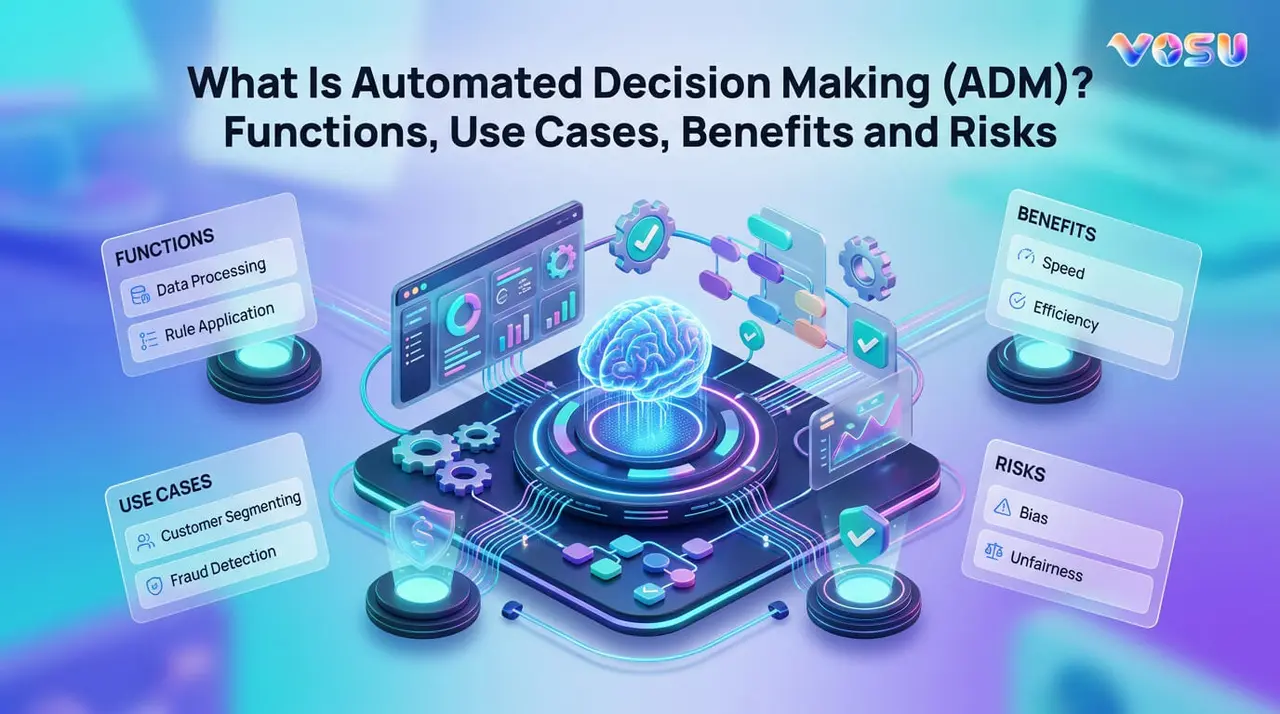
Automated decision making uses algorithms, data and predefined rules to evaluate information and produce recommendations, classifications or actions with minimal human involvement. It supports faster and more consistent outcomes across large volumes of decisions while operating within policies and governance frameworks established by organizations. It works through an adm process that includes collecting and preparing data, analyzing patterns, evaluating results through rules or models and executing actions such as approvals, alerts or recommendations. This approach is referred to as automated decisioning because it transforms data into timely and repeatable business outcomes.
Automated decision making supports a wide range of automated decision making applications across industries ike finance, healthcare, marketing and government services. These use cases include fraud detection, credit scoring, insurance underwriting, resume screening, interview assistance, AI chatbots, personalized marketing, pricing optimization and resource allocation. It improves speed and efficiency by processing information in real time, reduces human error through consistent rule application and enables data driven decisions based on structured and unstructured information. It also enhances customer experience with faster responses, increases reliability through predictable outcomes, lowers operational costs and allows organizations to test and refine decision strategies more easily.
Automated decision making also introduces risks like bias and discrimination, lack of transparency, operational errors, accountability gaps and regulatory compliance issues. Organizations can reduce these concerns by implementing human oversight for high impact decisions, conducting impact assessments before deployment and performing regular bias testing. They should continuously monitor system performance, audit outcomes and maintain clear processes for users to challenge decisions. This combination of governance, monitoring and accountability helps ensure that auto decisioning systems remain fair, reliable and compliant over time.
What is automated decision making?
Automated decision making is a process that uses algorithms, data, and computing systems to make or recommend decisions with minimal human intervention.
Automated decision making uses structured and unstructured data as inputs that algorithms transform into actionable outputs such as risk scores, classifications or recommendations. These systems execute decision logic at scale that allows large volumes of cases to be evaluated quickly, consistently and efficiently. They analyze patterns, apply predefined rules or leverage machine learning models to determine appropriate actions within business workflows. They operate according to objectives, constraints, policies and governance frameworks established by human experts, while automatically performing the operational decision making process within those parameters.
What is an example of automated decision making?
A bank's automated fraud system is a clear example of automated decision making in finance because it monitors transactions in real time, compares them against customer behaviour and known fraud patterns and calculates a risk score within milliseconds. This system approves normal payments, flags suspicious transactions for human review or blocks high risk attempts based on that score.
How does automated decision making work?
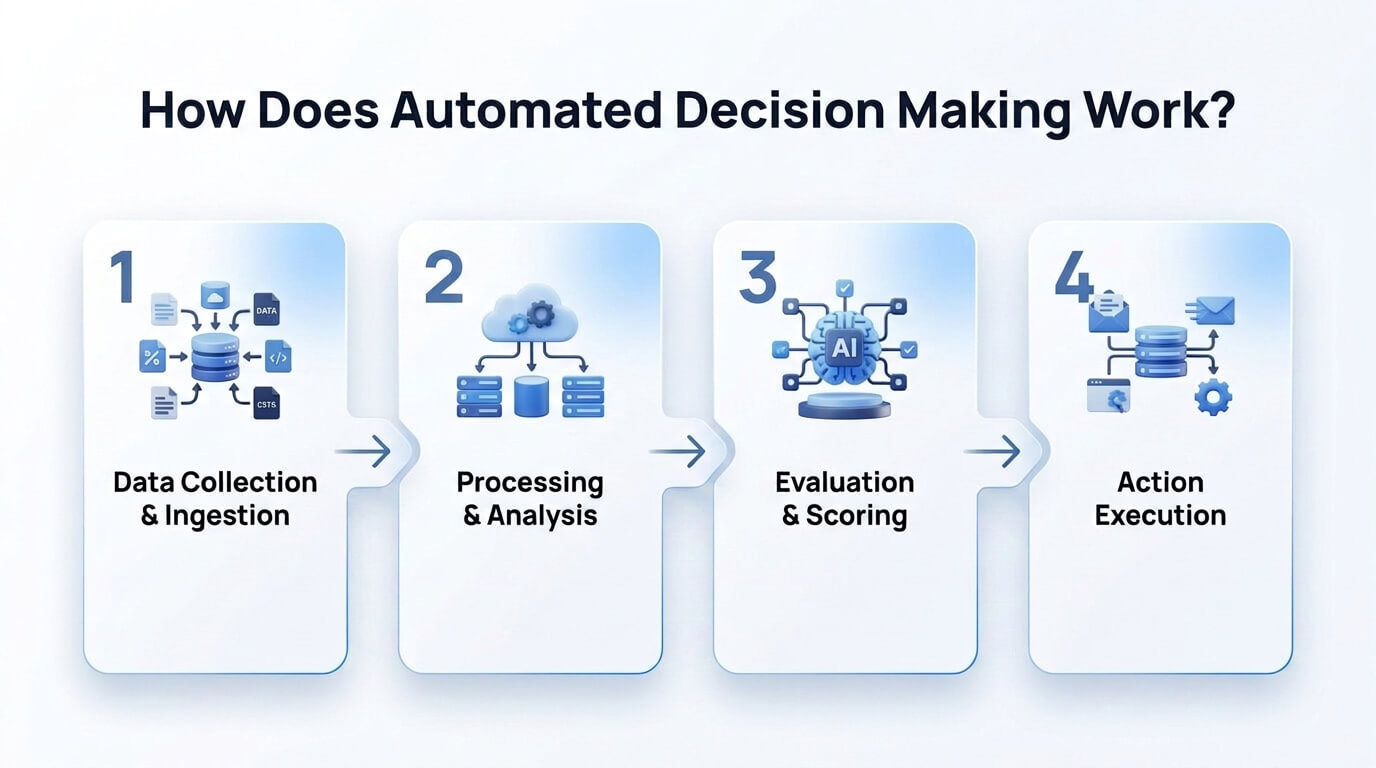
Automated decision making systems work in four steps, including data collection and ingestion, processing and analysis, evaluation and scoring and action execution. These systems repeat this process at a large scale, where automated decision making technology turns data into fast and consistent results for tasks like credit scoring, fraud detection and eligibility checks.
4 steps of how automated decision making works are given below.
- Data collection and ingestion: Automated decision making systems collect data from multiple sources, organize, clean and prepare the data for further use using artificial intelligence and structured data pipelines.
- Processing and analysis: Automated decision making technology processes data using algorithms, machine learning and analytical methods, identifies patterns and extracts insights needed to support accurate and timely decisions.
- Evaluation and scoring: Automated decision making systems evaluate processed data, apply rules and models or classifications using artificial intelligence to determine outcomes such as risk, priority or eligibility.
- Action execution: Automated decision making technology executes decisions by triggering actions such as approvals, alerts or recommendations, ensuring consistent and real time outcomes without requiring manual intervention.
Automated decision making technologies are visualized in the image below.
What are the use cases of automated decision making?
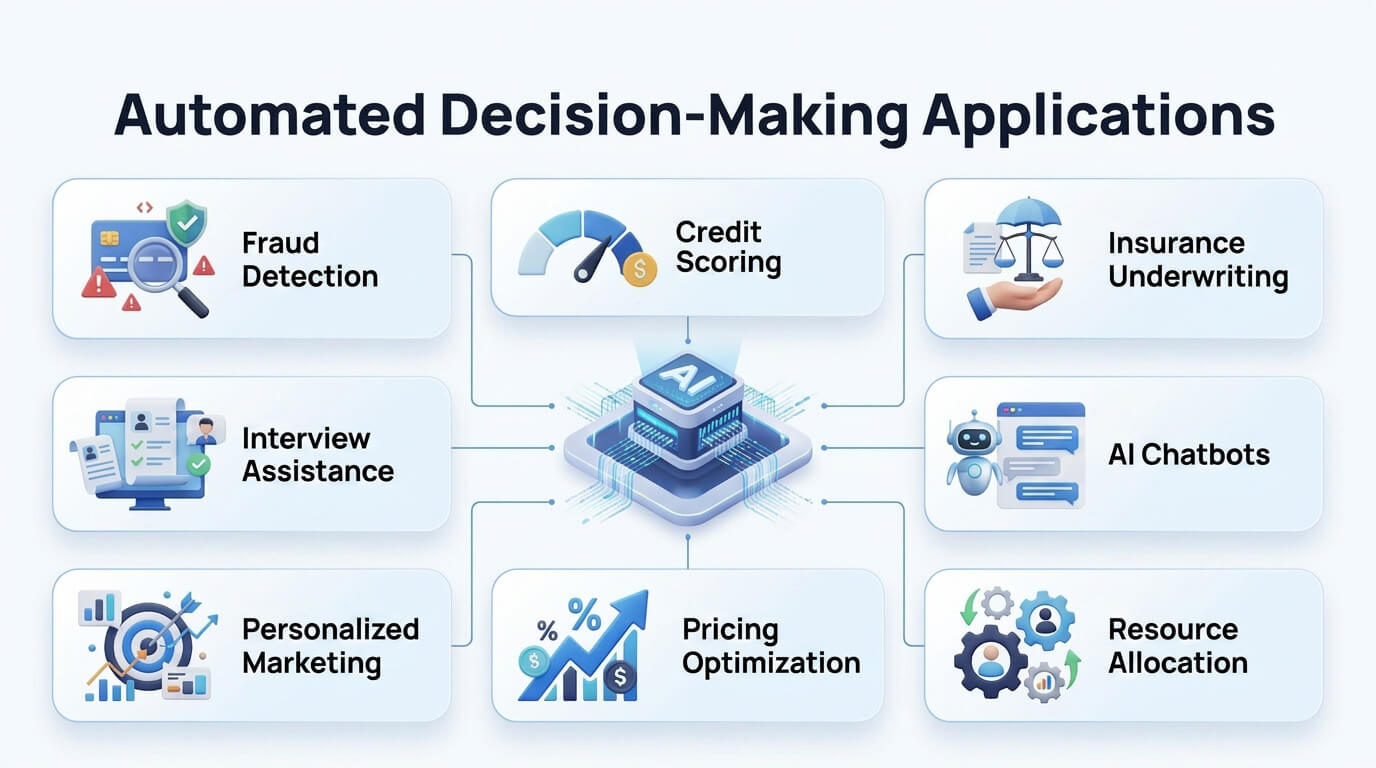
The use cases of automated decision making include fraud detection, credit scoring, insurance underwriting, resume screening, AI Chatbots, personalized marketing, pricing optimization and resource allocation, depending on business needs. These systems execute actions in real time, helping organizations make decisions that are consistent, scalable and aligned with business needs.
The use cases of automated decision making are given below.
- Fraud detection: Automated decision making system analyzes real time transaction patterns, identifies anomalies and prevents financial losses by triggering instant actions to safeguard customers and institutions.
- Credit scoring: Automated decision making evaluates borrower data and generate risk scores, enabling faster, fair and scalable lending decisions for financial institutions.
- Insurance underwriting: Automated decision making system combines applicant details, claims history and risk indicators to estimate exposure levels and streamline policy approvals with accurate premium recommendations.
- Resume screening: An automated decision making system matches candidate qualifications and experience with job requirements that help recruiters shortlist suitable applicants from large talent pools using consistent criteria.
- Interview assistance: Automated decision making system reviews candidate responses and behavioral signals to generate structured insights, allowing hiring teams to compare applicants more objectively.
- AI Chatbots: Automated decision making system interprets user queries and deliver relevant responses instantly, which improves service efficiency while escalating complex issues to human agents when needed.
- Personalized marketing: Automated decision making uses customer behavior and preferences to deliver customized campaigns, increasing engagement and improving conversion rates across multiple channels.
- Pricing optimization: Automated decision making system adjusts prices dynamically based on demand, competition and market trends, helping businesses maximize revenue while staying competitive.
- Resource allocation: Automated decision making system distributes budgets, workforce and inventory using predictive insights to improve utilization and overall operational performance.
Automated decision-making applications are visualized in the image below.
What are the benefits of automated decision making?
The benefits of automated decision making are improved speed, reduced human error, data driven decisions, better customer experience, reliability, lower cost, easier experimentation, good governance and scalability. These benefits enable organizations to handle large scale data processing, apply decisions consistently and improve everyday operations.
The benefits of automated decision making are given below.
- Speed and efficiency: Automated decision making processes information in real time, reducing delays and shortening decision cycles from hours to seconds, enabling organizations to respond quickly and improve operational performance.
- Less human error: Automated decision making minimizes manual tasks and subjective judgments that reduce clerical mistakes and increase accuracy, consistency and reliability in routine decisions across different organizational processes
- Data driven decisions: Automated decision making analyzes structured and unstructured information to support objective choices based on evidence that help organizations make informed decisions and improve performance.
- Better customer experience: Automated decision making delivers instant responses, personalized interactions and 24/7 availability, improving service quality and ensuring faster, more convenient experiences across digital platforms.
- Reliability and predictability: Automated decision making applies consistent rules and thresholds, ensuring similar cases receive fair and predictable outcomes, which increases trust and stability in decision processes.
- Less operational cost : Automated decision making reduces repetitive work and resource usage, which lowers expenses while allowing employees to focus on strategic responsibilities and higher value organizational tasks.
- Easier experimentation: Automated decision making allows rapid testing of rules and models that help organizations evaluate alternatives, optimize processes and adopt more effective decision strategies.
- Support for good administration in government: Automated decision making improves public services through consistent policy application, faster case handling and greater transparency that improves efficiency and accountability in government administration.
What are the risks of automated decision making?
The risks of automated decision making include bias, lack of transparency, operational errors, accountability issues and regulatory non compliance, which reduce fairness and increase legal and organizational risk. These risks require strong governance, continuous monitoring and human oversight so that automated decisions remain fair, accountable and compliant with legal and ethical standards.
The risks of automated decision making are given below.
- Bias and discrimination: An automated decision making system learns unfair patterns from historical data that produce biased outcomes, so organizations use audits and data corrections to improve fairness and reduce discrimination in the system.
- Lack of transparency: Automated decision making reduces explainability when decision logic is unclear, which makes it difficult for users and stakeholders to understand how outcomes are generated.
- Operational and data errors: An automated decision making system amplifies incorrect inputs or flawed models at scale, so continuous monitoring, testing, and validation are needed to prevent failures.
- Accountability gaps: Automated decision making blurs responsibility for outcomes, making it unclear who is responsible for decisions and how to assign accountability for system impacts.
- Regulatory and compliance liability: Automated decision making violates legal or data protection requirements, exposing organizations to regulatory penalties, audits and significant reputational damage risks
How to manage the risks of automated decision making?
Manage the risks of automated decision making through a structured approach across design, deployment and monitoring. Implement human oversight with human intervention to review high impact decisions when necessary. Conduct impact assessments before deployment to identify potential harms and operational risks. Apply bias testing to detect and reduce discriminatory outcomes and improve fairness across datasets and models. Monitor system performance continuously to ensure ongoing reliability and safety and detect anomalies.
Maintain periodic auditing using random sampling to evaluate accuracy, fairness and system reliability over time and ensure continuous improvement. Provide clear grievance mechanisms for users to report issues, challenge outcomes and seek timely resolution and accountability. Enforce continuous monitoring in real world use to detect data drift, errors and performance degradation.
Does automated decision making involve privacy risks?
Yes, automated decision-making involves privacy risks because it analyzes personal data to make decisions, which can expose private information if data handling practices are weak or unclear. It processes vast amounts of sensitive data and poor security, bias or unauthorized access increase the risk of data misuse and privacy violations.
Can I mitigate the risks of automated decision making?
Yes, you can mitigate the risks of automated decision making because you can design a layered strategy that combines technical controls with clear governance and review. Automated decision making becomes safer when teams use algorithmic oversight, strengthen data quality assurance and implement human in the loop processes to review critical decisions before harmful outcomes occur.
Can AI legally make automated decisions for you?
Yes, AI can legally make automated decisions for you because data protection and AI laws allow this when strict safeguards protect your rights. These rules cover high stakes automated decisions, push organisations to prevent bias in AI models and demand clear human oversight so people can review and challenge important results.
Are there legal restrictions on the use of automated decision making?
Yes**,** there are legal restrictions on automated decision making because data privacy laws limit when organisations use algorithms for important decisions. These rules protect rights to information and challenge, while targeted AI legislation adds extra safeguards for high risk automated uses.
Is automated decision making allowed under GDPR?
Yes, automated decision making is allowed under GDPR because the General Data Protection Regulation (GDPR) lets organisations use it in certain cases with safeguards. The organisation must have a clear legal basis such as consent, a contract or a law. The rules also give people the right to get information, challenge decisions and involve humans in reviewing important outcomes.
Are children protected from automated decision making under GDPR?
Yes, children are protected from automated decision making under GDPR because the law sees them as vulnerable and adds extra safeguards. The rules against automated decision making create strong protections for children by requiring human checks on important AI decisions.
Does automated decision making use AI?
Yes, automated decision making uses AI because it combines basic rule based software with artificial intelligence systems to handle decisions without constant human input. It applies AI technologies like machine learning, neural networks and predictive algorithms to learn from data patterns and update future choices. It improves decision quality by analyzing data and delivering faster, more consistent automated outcomes.
Is automated decision making the same as profiling?
No, automated decision making is not the same as profiling because profiling focuses on the analysis of data to evaluate characteristics and predict behavior. Automated decision making uses profiles to apply predefined rules or machine learning models and produces concrete outcomes like approval, rejection, scoring, ranking or prioritization in real situations.