
Artificial intelligence (AI) in cybersecurity strengthens digital defenses by analyzing large volumes of security data, identifying suspicious behavior and supporting faster security decisions. It helps prevent cyberattacks through AI based threat detection, automated threat hunting and rapid response actions that detect unusual activities before they escalate into serious incidents. It continuously learns from security data and improves its ability to recognize emerging threats across networks, devices and applications.
AI applications in cybersecurity include threat detection, automated incident response, phishing and malware prevention, vulnerability management, identity and access management, user authentication, threat intelligence and shadow data discovery. AI powered tools such as Microsoft Defender for Endpoint, Darktrace, Vectra AI, Microsoft Sentinel, Splunk Enterprise Security, Snyk and Lakera Guard help organizations improve visibility, identify threats faster and strengthen overall security operations. AI cybersecurity also enhances operational efficiency by reducing manual workloads and accelerating security investigations.
AI benefits in cybersecurity offering faster threat detection, continuous monitoring, predictive threat modeling, adaptive protection, vulnerability discovery, improved authentication, reduced human error and cost savings. It also presents risks such as machine learning poisoning, evasion techniques, deepfake fraud, autonomous attack bots, adversarial attacks, privacy violations, shadow AI and biased decision making. Organizations can mitigate these risks through strong access controls, secure infrastructure, privacy safeguards, data governance frameworks and AI specific monitoring. They should also follow best practices such as secure training pipelines, explainable AI, continuous monitoring, adversarial testing, API security, workflow integration and human oversight to ensure reliable and effective security outcomes.
What is AI in cybersecurity?
AI in cybersecurity is the use of artificial intelligence to protect digital systems through threat identification, risk assessment and security decision support. It applies intelligent algorithms and machine learning to analyze network activity, user behavior, application events and security logs for detecting security risks. Artificial intelligence in cybersecurity works by processing large volumes of security data and matching it with learned patterns to identify abnormal behavior. AI helps organizations detect malware, block phishing attempts, uncover vulnerabilities and automate defensive actions to reduce response time and improve security outcomes.
What are the technologies of AI for cybersecurity?
The technologies of AI for cybersecurity are given below.
- Machine learning: Machine learning learns from historical and real time security data to identify attack patterns, anomalies and emerging risks.
- Deep learning: Deep learning analyzes large and complex datasets to uncover sophisticated cyber threats that traditional methods may overlook.
- Generative AI: Generative AI creates realistic attack simulations and security scenarios that improve testing, training and preparedness efforts.
- Natural language processing: Natural language processing (NLP) interprets threat reports, alerts and security logs to extract meaningful intelligence for analysts.
- Autonomous AI agents: Autonomous AI agents handle routine security tasks and response actions automatically, which helps organizations with scaling defensive operations.
- Behavioral analytics: Behavioral analytics monitors user and device behavior continuously to detect suspicious activities and potential account misuse.
- Predictive analytics: Predictive analytics estimates potential threats by analyzing security data, attack behaviors and risk indicators.
How does AI help prevent cyberattacks?
AI helps prevent cyberattacks by rapidly analyzing security data, identifying malicious patterns and automating defensive actions in real time. AI based threat detection processes logs, network traffic and user activity to quickly identify unusual behavior. It uses AI driven threat hunting to uncover hidden risks by detecting subtle patterns that traditional tools may miss. AI also strengthens threat response through automatically triggering defensive actions when suspicious activity is detected within systems. It continuously improves its ability to identify evolving threats. AI reduces response times, increases visibility across environments and helps stop attacks before significant damage occurs.
What are the applications of AI in cybersecurity?
The applications of AI in cybersecurity include threat detection, automated incident response, phishing prevention, vulnerability management and threat intelligence. These AI systems support modern security operations by identifying risks, preventing attacks and responding faster than traditional methods.
The applications of AI in cybersecurity are given below.
- Threat detection: AI analyzes network activity and system logs in real time to identify unusual behavior and recognizes hidden attack patterns early, so security teams stop breaches before they spread across systems.
- Automated incident response: AI reacts immediately when a security breach occurs by isolating affected systems, reducing response time and limiting damage through predefined security actions without waiting for manual intervention.
- Phishing and malware prevention: AI examines emails, files and links to detect harmful content using behavioral signals and blocks suspicious activity to protect users from evolving digital deception techniques.
- Vulnerability management: AI scans digital environments to identify system weaknesses and prioritizes security risks based on severity, so organizations can fix critical gaps before exploitation.
- Identity and access management (IAM): AI monitors user identities and access behavior to secure system entry and detects unusual login patterns to prevent unauthorized access to sensitive information.
- User authentication and access control: AI strengthens verification systems using contextual signals and behavioral patterns to secure users' access to protected resources through adaptive security checks.
- Threat intelligence: AI collects and processes global security data to understand emerging attack trends, which helps predict future threats and allows proactive defense planning for organizations.
- Shadow data discovery: AI identifies hidden or unmanaged data and enterprise systems, which reduces security risks by exposing unknown data sources that remain unprotected.
What are the benefits of using AI in cybersecurity?
The benefits of using AI in cybersecurity include faster threat detection, automated incident response, improved user authentication, reduced human error, cost savings, adaptive protection and vulnerability discovery. These capabilities strengthen security operations, reduce manual effort and improve how organizations respond to threats.
The benefits of using AI in cybersecurity are given below.
- Faster threat detection: AI reviews large amounts of data and identifies unusual patterns early, so security teams recognize potential threats quickly before they develop into serious security incidents**.**
- Automated incident response: AI responds instantly to security events, limits harmful actions before they spread across systems and affect normal operations, which reduces pressure on analysts during critical situations.
- 24/7 continuous monitoring: AI observes network traffic, connected devices and user behavior continuously, so security teams notice unusual behavior whenever it appears across networks, devices and user accounts.
- Protection against zero day attacks: AI recognizes hidden indicators of previously unknown threats, so organizations take preventive action before attackers exploit weaknesses and cause significant damage.
- Predictive threat modeling: AI analyzes historical records and current threat trends to forecast possible risks, which allows organizations to strengthen defenses before security challenges emerge.
- Improved user authentication: AI evaluates login patterns and verification details to confirm user identities, which improves account security and unwanted access becomes harder.
- Reduced human error: AI automates repetitive security processes and follows established procedures consistently, which exposes systems to unnecessary risks.
- Cost savings: AI makes security operations efficient and lowers administrative effort, which helps organizations maintain effective protection while reducing overall spending on cybersecurity activities.
- Adaptive protection: AI adjusts defensive measures according to emerging attack techniques, which ensures security controls remain relevant as cyber threats continue to evolve.
- Vulnerability discovery: AI scans systems for weak points and security issues, so organizations resolve issues before attackers have opportunities to exploit them.
What are the risks of using AI in cybersecurity?
The risks of AI in cybersecurities include machine learning poisoning, evasion techniques, deepfake fraud, autonomous attack bots, adversarial attacks, data poisoning and bias in AI decision. These threats weaken detection accuracy, enable stealthy malware, manipulate security models, increase privacy exposure and introduce biased or unmonitored AI systems that expand the overall cyberattack surface.
The risks of using AI in cybersecurity are listed below.
- Machine learning poisoning: AI corrupts training datasets with malicious or mislabeled samples, degrading detection accuracy, creating blind spots for real threats and causing security tools to trust attacker-controlled behaviors over time.
- Evasion techniques: AI allows attackers to automatically mutate malware, command and control traffic and payloads so they mimic benign patterns, slipping past signature-based tools and behavior analytics tuned on static threat models.
- Deepfake fraud: AI generates hyper realistic voice and video deepfakes of executives or trusted partners, driving convincing social engineering, fraudulent payments and disclosure of secrets that traditional verification cannot reliably stop.
- Autonomous attack bots: AI powers self learning malware and bots that independently scan, exploit and laterally move across networks, continuously adapting to defenses and scaling attacks far faster than human directed operations.
- Adversarial attacks: AI manipulates model inputs with tiny, crafted perturbations so security classifiers mislabel malware as safe, bypass authentication or leak sensitive data, which undermines confidence in AI driven defense decisions.
- Data poisoning: AI becomes unreliable when attackers inject skewed or backdoored data into logs, telemetry or threat feeds that cause defensive models to learn biased patterns, ignore true positives, and misprioritize incident response.
- Privacy violations: AI aggregates and analyzes vast security datasets that increase the risk of exposing personal or sensitive information through model leakage, misconfigured logging, or secondary uses that exceed original consent.
- Shadow AI: AI tools adopted informally by teams without security vetting create unmonitored data flows, weak access controls and unmanaged model endpoints that expand the attack surface beyond established cybersecurity governance.
- Bias in AI decisions: AI embeds and amplifies biases present in training data, which leads to systematically uneven threat scoring, false positives against certain users or regions and blind spots where attacks consistently evade monitoring.
How to mitigate AI cybersecurity risks?
AI cybersecurity risks can be mitigated through a combination of technical controls, governance frameworks and organizational policies that secure the entire AI lifecycle. Model and infrastructure security help protect against AI exploits by securing APIs, enforcing strong access controls and deploying AI specific threat detection within hardened environments. AI cybersecurity data governance and privacy ensure that sensitive information is properly classified, securely stored and strictly controlled during training and inference to prevent data leakage or misuse. Governance and organizational policies promote responsible AI use by establishing clear acceptable use guidelines that define permitted and restricted activities across systems and users. Organizations should also implement security measures for conversation intelligence to monitor risky interactions in real time and enable early responses to emerging threats.
What are the AI powered cybersecurity tools?
The AI powered cybersecurity tools are categorized into endpoint and device security tools, threat detection and network monitoring tools, application security and AI security and governance tools. These tools use machine learning and behavioral analytics to improve visibility, identify threats faster and strengthen security operations across modern digital environments.
The AI powered cybersecurity tools are given below.
- Endpoint and device security tools: Microsoft Defender for endpoint protects devices from malware, ransomware and other cyber threats by using machine learning to detect suspicious activities and strengthen endpoint security.
- Threat detection and network monitoring tools: Darktrace, Vectra AI and ExtraHop monitor network activity, identify unusual behavior and use behavioral analytics to detect cyber threats at an early stage.
- SIEM and security operations center (SOC) assistants: Microsoft Sentinel, Splunk Enterprise Security and IBM QRadar collect and analyze security data, prioritize alerts, automate routine tasks and support faster incident response.
- Application security and developer tools: Snyk, GitHub Advanced Security and Checkmarx identify software vulnerabilities, analyze source code for security risks and improve application security throughout the development lifecycle.
- AI security and governance tools: Lakera Guard, IBM Guardium AI Security and Microsoft Purview help organizations monitor AI systems, enforce security policies, maintain regulatory compliance and manage AI-related risks effectively.
What are the best practices for implementing AI in cybersecurity?
The best practices for implementing AI in cybersecurity include secure training pipelines, strict privacy protocols, data governance frameworks, adversarial testing and API security. These structured methods ensure safe, effective, and reliable adoption of AI in security systems while improving accuracy in real world environments.
The best practices for implementing artificial intelligence in cybersecurity are given below.
- Secure training pipelines: Protect data ingestion, preprocessing, checkpoints, and compute with encryption, access controls, immutable logs and integrity checks to prevent poisoning, tampering or supply chain compromises
- Strict privacy protocols: Use differential privacy, federated learning, strong anonymization and minimal data retention to safeguard telemetry and user information while preserving model effectiveness for threat detection.
- Data governance frameworks: Define provenance, labeling standards, quality controls, retention policies and auditable access logs so training and inference datasets remain trustworthy, compliant and reproducible.
- Explainable AI (XAI): Deploy interpretable models or post‑hoc explanation tools so analysts can understand alerts, validate decisions and meet regulatory and operational transparency requirements.
- Continuous monitoring: Track model performance, concept drift, input distributions and security metrics with alerts, retraining triggers and rollback plans to sustain detection accuracy.
- Adversarial testing: Perform adversarial evaluations, red team exercises and simulated evasion attacks regularly to reveal weaknesses, improve robustness and guide defensive hardening.
- API security: Secure model and telemetry endpoints with authentication, rate limiting, input validation, logging and anomaly detection to prevent abuse, data leakage and inference attacks.
- Human-in-the-loop: Retain human analysts for triage, high risk decisions and feedback loops to correct errors, refine models and handle context sensitive judgments AI may miss.
- Workflow integration: Embed AI outputs into SOC processes, SIEMs and orchestration tools with clear escalation paths, explainability and feedback channels for continuous operational improvement.
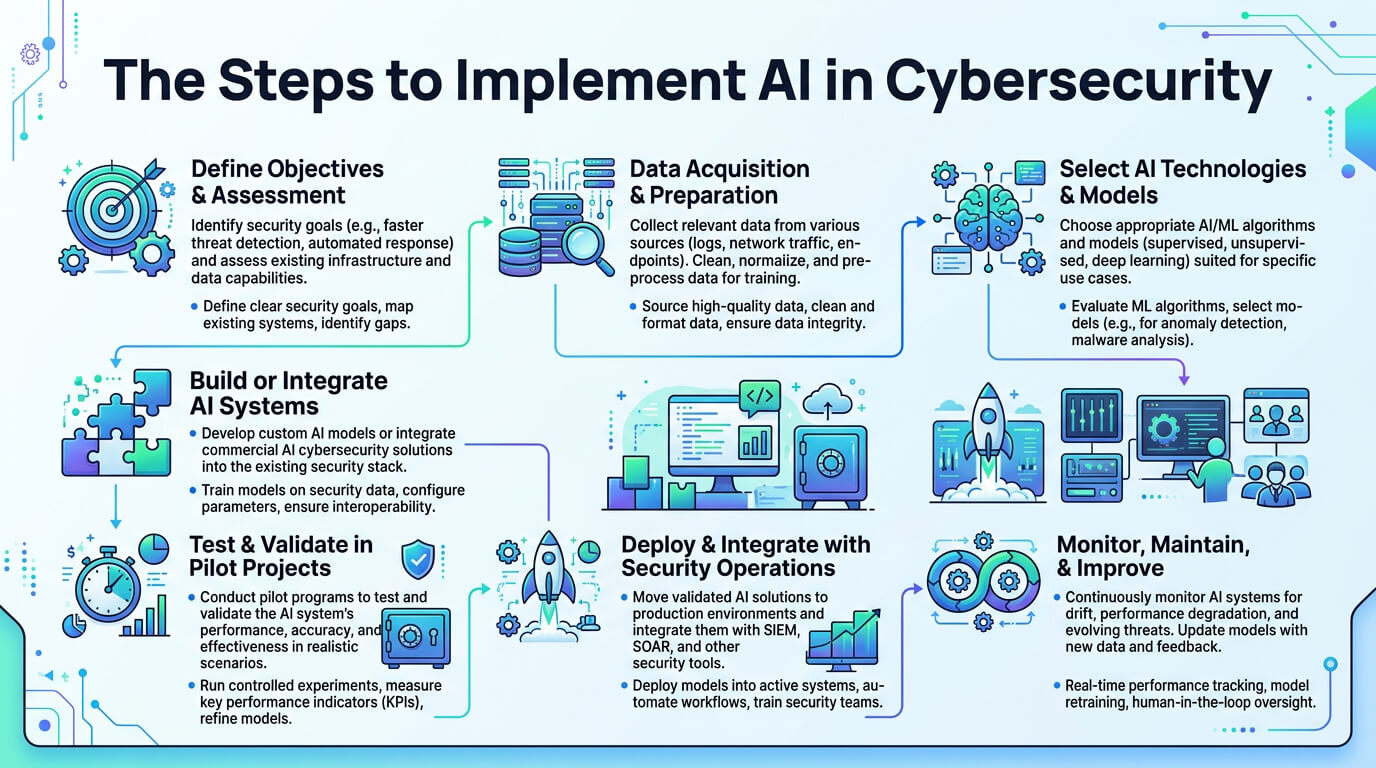
The steps to implement AI in cybersecurity are given in the image below.
Should AI be used in cybersecurity?
Yes, AI should be used in cybersecurity because it helps security teams detect and respond to threats faster than traditional methods. It improves protection against high speed attacks by analyzing large volumes of data quickly and identifying risks in real time. AI strengthens modern cybersecurity operations and supports more effective defense strategies.
Can generative AI be used in cybersecurity?
Yes**,** generative AI can be used in cybersecurity because it helps security teams detect, analyze and respond to complex threats in new ways. It is, however, a double edged sword because both attackers and defenders use generative AI for automation, content creation and attack simulation.
Should businesses use AI for cybersecurity?
Yes, businesses should use AI for cybersecurity because it helps detect and respond to threats faster than manual security processes. Cybercriminals are also using AI to automate attacks and exploit vulnerabilities at machine speed, which increases overall risk. AI improves protection by analyzing large volumes of data and highlighting threats quickly for security teams.
Will AI replace cybersecurity professionals?
No, AI will not replace cybersecurity professionals because security teams still need human expertise to understand business context and make final risk decisions in real time. Cybersecurity professionals handle complex threat hunting, investigate unusual activity and evaluate risks that AI alone cannot fully manage. They also use AI tools to detect, analyze and respond to threats more efficiently.
Can AI ethics be ensured in cybersecurity?
Yes, AI ethics can be ensured in cybersecurity through clear rules, human review and structured oversight of how systems make decisions. AI ethics becomes effective when organizations follow transparent practices and regularly assess system behavior. It also relies on TEVV (Testing, Evaluation, Validation and Verification) to ensure that AI systems operate as intended and align with ethical standards.
Does implementing AI in cybersecurity require any skill?
Yes, implementing AI in cybersecurity requires skill because teams need to understand cybersecurity principles and how AI tools operate in real environments. Artificial intelligence in cybersecurity course helps professionals learn how to manage AI models, data and security risks effectively. This field requires a highly specialized skill set, which creates a massive skills gap for many organizations as AI use increases.
Is AI a threat or a benefit to cybersecurity?
Yes, AI is both a threat and a benefit to cybersecurity because it makes security systems smarter while also giving attackers more advanced tools. It provides benefits by helping systems detect problems quickly and respond automatically. AI, at the same time, increases cybersecurity risks by enabling more advanced and automated cyberattacks, making it a powerful but double-edged technology.
What is the future of cybersecurity with AI?
The future of cybersecurity with AI will be more automated, with smarter defense systems and adaptive threat response that quickly adjust to new risks. AI will help detect and stop attacks earlier by analyzing large volumes of data in real time. It will also reduce routine security tasks, which allows professionals to focus on advanced threat analysis and strategic decision-making.