An AI assistant is a software system that uses artificial intelligence to interpret user input, understand intent and context and execute tasks. It works by receiving input, interpreting it, planning actions and delivering structured outputs. AI assistants include conversational assistants, task oriented assistants and autonomous agents designed for different levels of interaction and autonomy. They are used in customer support, productivity, e commerce, healthcare, enterprise automation, coding, writing, education, legal, finance and research to improve efficiency and decision support.
An AI assistant offers automation, multitasking, improved efficiency, enhanced accuracy, scalability and better user engagement across digital systems. It still has some limitations, like hallucinations, limited understanding, dependence on prompt quality, restricted autonomy and potential data privacy risks requiring human oversight. You should choose the right assistant by defining goals, evaluating capabilities, checking integrations, ensuring security, testing accuracy and considering pricing.
AI assistants in 2026 include VosuAI, Lindy, ChatGPT, Claude, Perplexity, Microsoft Copilot, Google Gemini and Amazon Alexa, each optimized for different use cases. You can use an AI assistant by selecting a platform, setting it up securely, creating prompts, building workflows, training with examples, testing performance and refining outputs. The future of AI assistants is toward proactive, autonomous systems with deeper integration, improved reasoning and more personalized, context aware assistance across digital environments. They allow advanced capabilities across industries.
What is an AI assistant?
An AI assistant is a software system that uses artificial intelligence to understand user requests, provide information, automate tasks and assist with decision making through natural language interactions. It interprets human instructions and performs tasks through natural language or structured commands. It also bridges user intent and digital execution through combining understanding, reasoning and tool use.
AI assistant examples include VosuAI, ChatGPT, Perplexity, Claude, Amazon Alexa and Microsoft Copilot. They understand natural language to identify intent, entities and context and they leverage capabilities such as retrieval, reasoning and personalization to generate useful outputs. They also execute tasks by calling APIs, triggering automations and connecting with external tools and integrations, while maintaining privacy and safety controls.
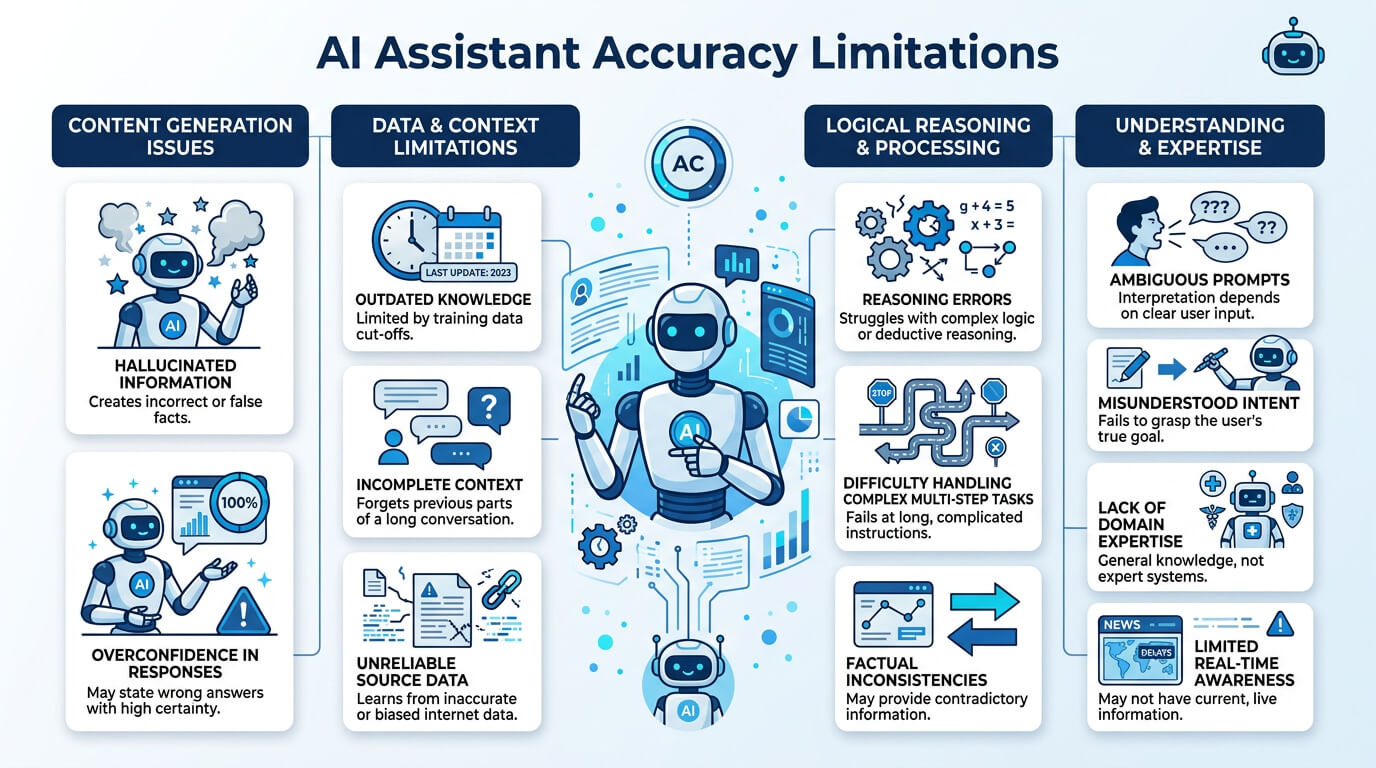
The image below shows what an AI assistant does.
How does an AI assistant work?
An AI assistant works by receiving input, understanding and processing, taking action and delivering output. It uses artificial intelligence models trained on large amounts of data to interpret user requests and generate relevant responses or perform tasks.
4 steps of how an AI assistant works are outlined below.
- Receiving input: AI assistant accepts user queries via text, voice or files, preprocesses signals into tokens or features and captures context for downstream AI assistance and routing to services.
- Understanding and processing: AI assistant uses language models and machine learning to parse intent, extract entities, retrieve relevant knowledge and form a plan for response or action based on the user’s context.
- Taking action: AI assistant executes AI powered assistance by calling APIs, running automations, updating databases or invoking tools and plugins while applying safety checks and business rules.
- Delivering output: AI assistant post processes results into natural language or structured responses, formats or vocalizes them for the user and logs interactions for feedback, improvement and audit.
What are the core AI assistant technologies?
5 core AI assistant technologies are given below.
- Natural language processing (NLP): NLP extracts intent, entities and context from user input, which allows AI assistant models to understand and interpret human language effectively.
- Natural language generation (NLG): NLG converts model outputs into fluent, context aware text or speech, which allows AI assistants to communicate naturally with users.
- Large language models (LLMs): LLMs provide broad knowledge, contextual understanding and reasoning capabilities, which serve as the core generative engine behind modern AI assistants.
- Machine learning (ML): Machine Learning trains, fine tunes and adapts models over time, which improves performance through supervised, reinforcement and continual learning techniques.
- Application programming interfaces (APIs): Application Programming Interfaces connect AI assistants to external services, tools and data sources, which allows real world integrations and action execution.
What are the types of AI assistants?
The types of AI assistants include conversational AI, task oriented assistants and autonomous AI agents. These are designed for different purposes, ranging from answering questions and assisting with specific tasks to independently planning and executing complex actions.
The 3 main types of AI assistants based on function are given below.
- Conversational AI (chatbots): Conversational AI functions as a communication assistant and voice assistant, which manages multi-turn conversations, answers questions, provides support and escalates complex issues to human agents when necessary.
- Task oriented assistants: Task oriented assistants act as AI content assistants, coding assistants or workflow assistants by executing tasks such as scheduling meetings, updating CRM records and automating routine business processes.
- Autonomous AI agents: Autonomous AI agents operate as proactive agents that plan, reason and execute multi step tasks using tools, memory and retrieval systems with minimal human intervention.
What are the applications of AI assistants?
The application of AI assistants includes customer support, personal productivity, e-commerce and retail, healthcare, writing and content creation and education. AI assistants use artificial intelligence technologies across various industries to manage information, improve communication, automate tasks and provide decision support for both individuals and organizations.
The applications of AI assistants are given below.
- Customer support: AI support assistants handle queries, provide instant responses and resolve common issues efficiently. They improve service quality while reducing workload on human support teams.
- Personal productivity: AI assistants help manage schedules, set reminders and organize tasks effectively. They improve time management and reduce cognitive load in daily activities.
- E-commerce and retail: AI assistants guide product discovery, provide recommendations and support purchasing decisions. They enhance customer experience and improve sales conversion rates.
- Healthcare: AI assistants support diagnosis, appointment scheduling and patient monitoring. They assist medical professionals by improving efficiency and reducing administrative burden.
- Enterprise automation: AI assistants streamline workflows, manage internal communication and automate administrative duties. They improve coordination and operational efficiency across departments.
- Coding and development: AI assistants help write, debug and optimize code efficiently. They accelerate software development and reduce repetitive programming tasks.
- Writing and content creation: AI assistants boost writing and content creation that helps users brainstorm ideas, create outlines, draft content and refine materials across multiple formats and tones.
- Education: AI assistants support education as an AI communication assistant by providing tutoring, adaptive learning exercises, personalized feedback and on demand explanations while teachers retain control over instruction.
- Legal and financial services: AI assistants augment legal and financial work by drafting standard documents, summarizing regulations and reviewing information that highlights potential risks and opportunities.
- Research: AI assistants advance research by synthesizing large volumes of information, summarizing literature and generating hypotheses that turn complex findings into clear, actionable insights.
What are the benefits of AI assistants?
The benefits of AI assistants include task automation, multitasking, improved efficiency, enhanced accuracy, scalability and better customer engagement. These advantages help individuals and organizations save time, reduce operational costs, increase productivity and deliver more consistent and personalized services.
The benefits of AI assistants are outlined below.
- Task automation: AI assistants automate repetitive tasks, streamline workflows and reduce manual effort, which allows employees to focus on higher value and more strategic work.
- Multitasking: AI assistants manage multiple conversations, workflows and requests simultaneously, which maintains context across tasks that would otherwise require significant human effort.
- Improved efficiency: AI assistants accelerate responses, process large volumes of information and shorten operational cycle times, which helps organizations work faster and more effectively.
- Enhanced accuracy: AI assistants use pattern recognition, validation checks and retrieval systems to improve consistency and reduce errors, although human oversight remains important.
- Scalability: AI assistants allow organizations to handle growing workloads and demand spikes without proportional increases in staffing or operational costs.
- Better customer engagement: AI assistants provide faster, more personalized and consistent support, which improves customer satisfaction while allowing human agents to focus on complex issues.
What are the limitations of AI assistants?
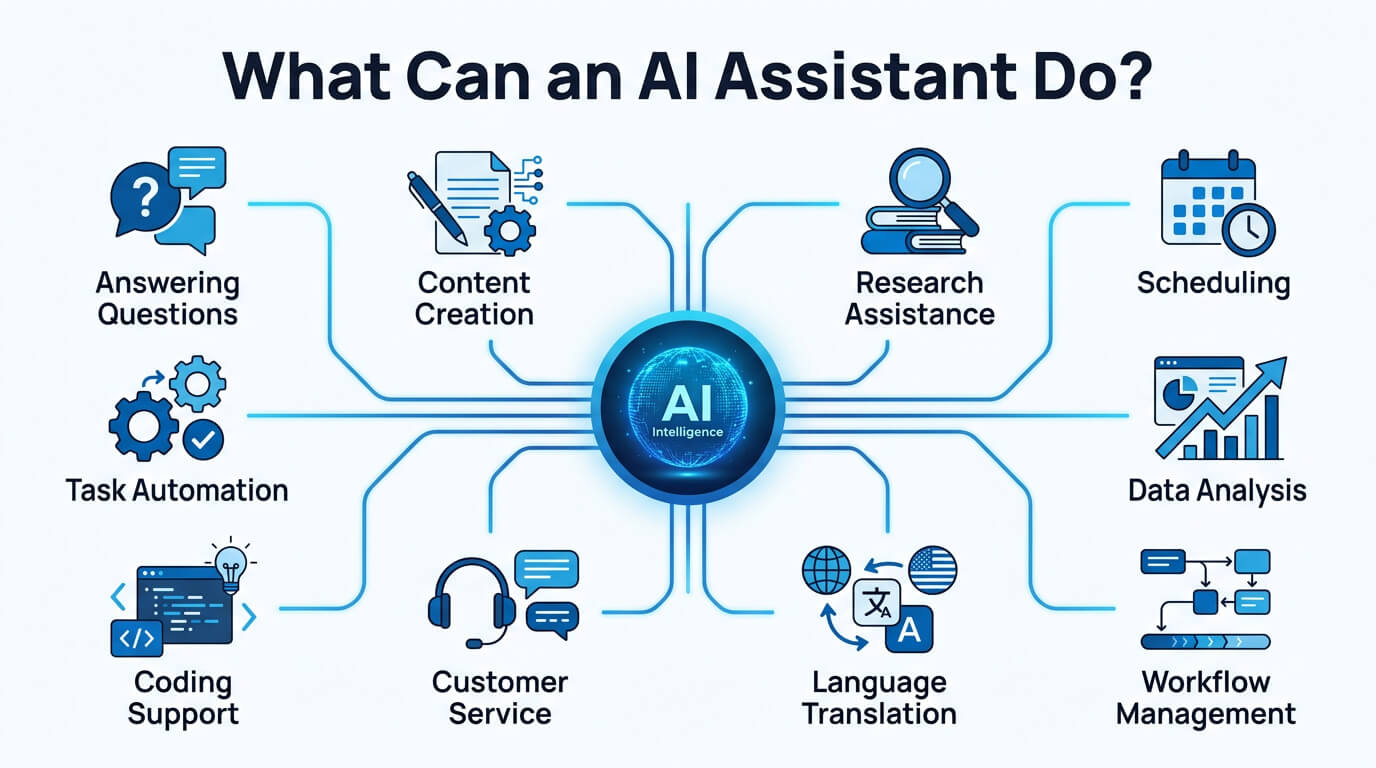
The limitations of AI assistants include hallucinations and accuracy issues, a lack of true understanding, dependence on prompts, limited autonomy and data privacy risks. These challenges affect the reliability, security and effectiveness of AI assistants, making human oversight important in many situations.
The limitations of AI assistants are given below.
- Hallucination and accuracy issues: AI assistants generate confident but incorrect, misleading or outdated information, which makes verification and human review essential for important decisions.
- Lack of true understanding: AI assistants rely on pattern recognition rather than genuine comprehension, which limits their ability to fully understand context, emotions and nuanced situations.
- Dependence on prompts: AI assistants depend heavily on the quality of user prompts and vague, unclear or biased instructions lead to inaccurate or incomplete responses.
- Limited autonomy: AI assistants operate within predefined rules and permissions, which restricts their ability to make independent decisions or perform sensitive actions without human approval.
- Data privacy risks: AI assistants expose sensitive information if data is not managed properly, which highlights the need for strong governance, encryption and access controls.
AI assistant accuracy limitations are visualized in the image below.
How to choose the right AI assistant for you?
To choose the right AI assistant for you, define goals, evaluate capabilities, check integrations, test accuracy and consider pricing. AI assistants vary widely, so you should align selection with use cases, risk tolerance and your expectations for the most advanced AI assistant in your context.
6 steps to choose the right AI assistant for you are outlined below.
- Define goals: Identify what you want the AI assistant to do such as general research, creative writing, coding, customer support or personal productivity. Clear goals make it easier to compare suitable options.
- Evaluate capabilities: Compare features, reasoning quality, content generation and task automation abilities. The most advanced AI assistant should handle your primary tasks accurately and efficiently without unnecessary complexity.
- Check integrations: Review whether the AI assistant connects with your existing tools, apps and workflows. Strong integrations improve productivity by reducing manual work and simplifying information access.
- Review security and privacy: Examine how the platform stores, processes and protects data. Security features, privacy controls and compliance standards are especially important when handling sensitive or business information.
- Test accuracy: Try real world tasks and assess the quality of responses. Accuracy testing helps determine whether the AI assistant delivers reliable information, relevant outputs and consistent performance.
- Consider pricing: Compare subscription plans, usage limits and included features. Pricing should align with your budget while providing the capabilities and value needed for long term use.
What are the best AI assistants in 2026?
The best AI assistants in 2026 include VosuAI, Lindy, ChatGPT, Claude, Perplexity and Google Gemini. These tools are designed to support users in different ways such as productivity, research, automation and creative tasks.
The 7 best AI assistants in 2026 are given below.
- Vosu AI: Vosu AI functions as an AI assistant for content creation, prompt generation, and workflow automation. It helps users create prompts, images, videos and marketing assets while simplifying complex tasks through a single conversational interface.
- Lindy: Lindy automates scheduling, follow-ups and business workflows through customizable AI agents. It is a valuable option for users who want efficient task and process automation.
- ChatGPT: ChatGPT is one of the most accurate AI assistants for writing, coding, research and problem solving. It supports diverse use cases across personal, educational and professional environments.
- Claude: Claude excels at reasoning, long context analysis and content creation. It is considered one of the top tier AI assistants for handling complex documents and detailed conversations.
- Perplexity: Perplexity combines AI assistance with real time web research and cited answers. It is well suited for users who need reliable information discovery and general research support.
- Microsoft Copilot: Microsoft Copilot is embedded in Microsoft 365, which makes it a leading AI assistant for organizations using Word, Excel, Outlook and Teams to integrate AI into daily documents and communication.
- Google Gemini: Google Gemini integrates deeply with Gmail, Docs and Drive, which acts as a powerful AI assistant for search, writing and analysis within Google Workspace.
- Amazon Alexa: Amazon Alexa leads voice first assistants, which makes it a top tier AI assistant for smart homes, offices and hands free device control through routines and voice commands.
How to use an AI assistant?
To use an AI assistant, pick the right platform, set up securely, craft prompt templates, create workflows and triggers, train with examples and review and refine. This process helps you get more accurate, relevant and efficient responses for your specific goals.
7 steps to use an AI assistant are outlined below.
- Pick the right platform: Choose an AI assistant that matches your goals, budget and required features. Consider its strengths in content creation, automation, research, customer support or productivity before making a decision.
- Set up securely: Configure account settings, access permissions and security controls before use. Connect only trusted tools and data sources while following organizational policies for privacy and information protection.
- Craft prompt templates: Create reusable prompts with clear objectives, context rich instructions and desired output formats. Well structured templates improve consistency, reduce manual effort and help generate more accurate responses.
- Create workflows and triggers: Design automated processes that define when and how the AI assistant performs tasks. Connect triggers, actions and integrations to streamline repetitive work across different systems.
- Train with examples: Provide sample inputs, expected outputs and relevant documents to guide performance. Examples help the assistant understand preferred formats, terminology and task requirements more effectively.
- Test end to end: Run complete workflows from start to finish using realistic scenarios. Verify that prompts, integrations, triggers and outputs function correctly while identifying any gaps or errors.
- Review and refine: Monitor results regularly and update prompts, workflows and training materials as needed. Continuous refinement improves accuracy, efficiency and overall performance as requirements evolve.
How to use an AI assistant in business?
5 steps to use an AI assistant in business are outlined below.
- Identify the problem: Identify key inefficiencies such as delays, errors or repetitive administrative tasks affecting overall business productivity.
- Map human processes and create SOPs: Document existing workflows clearly so specialized AI tools accurately replicate real operational processes.
- Upload knowledge base: Upload structured policies, FAQs and documents so the AI assistant for customer service delivers accurate responses.
- Test outputs and connect to tools: Test AI outputs carefully and integrate with CRM systems like Salesforce AI assistant.
- Integrate into workflows and monitor ROI: Deploy across teams, track performance metrics and optimize results from automation over time.
What is the future of AI assistants?
The future of AI assistants will be defined by greater intelligence, deeper personalization and stronger integration with everyday tools and digital environments. AI assistants are evolving from simple conversational systems into capable digital partners that can support research, creative work, decision making and productivity tasks. Next generation AI assistant platforms will offer more natural interactions through text, voice, images and video while delivering responses that better reflect user preferences and context.
AI assistants will also be shaped by the emergence of proactive, autonomous agents that can plan, execute and monitor tasks with limited human involvement. The most advanced AI assistant systems will connect seamlessly with business software, smart devices and automated workflows to handle increasingly complex responsibilities. These trends will make AI assistants more efficient, adaptive and valuable across personal and professional use cases.
Will AI assistants replace human personal assistants?
No, AI assistants will not replace human personal assistants because human roles require judgment, emotional intelligence and relationship building that current systems do not replicate. AI assistants instead act as powerful force multipliers, taking over repetitive administrative tasks so human assistants can focus on strategic coordination and high touch work.
Do AI assistants continuously learn and adapt?
No, AI assistants do not continuously learn and adapt because most deployed systems use fixed AI assistant models that only update when retrained or reconfigured, not from every single interaction. AI assistants sometimes rely on in-context adaptation and dynamic refinement at runtime, while next generation AI assistant platforms experiment with controlled continual learning pipelines for safer updates.
Can AI assistants handle complex queries?
Yes, AI assistants can handle complex queries by breaking down tasks and using tools to cross reference information from multiple sources. These capabilities of AI assistant architectures are still imperfect, but already support planning, sub querying and synthesis for research, analytics and troubleshooting tasks.
Can AI assistants improve productivity?
Yes, AI assistants can improve productivity because AI powered assistance excels at automating routine processes, summarizing information and organizing work so people spend more time on creative or strategic tasks. These tools also lower mental resistance to getting started, since users can offload blank page work, prioritization and coordination to always available helpers.
Is VosuAI an AI assistant?
Yes, VosuAI is an AI assistant because it integrates multiple creative functions into a single system that supports content generation and task automation. It allows users to produce prompts, visuals, videos and marketing materials through conversational input, reducing effort and simplifying the overall creative workflow process.
Is ChatGPT an AI assistant?
Yes, ChatGPT is an AI assistant because its capabilities include answering questions, drafting content, coding and reasoning across domains, far beyond a simple FAQ bot. These AI assistant features position ChatGPT between a traditional chatbot and an advanced AI agent, especially when integrated with tools or plugins.
Is there any difference between an AI assistant and an AI agent?
Yes, there is a difference between an AI assistant and an AI agent because they operate with different levels of autonomy and decision making. An AI assistant model responds to a user request and requires ongoing guidance, while an AI agent independently plans, executes and adjusts an action to achieve a specific goal with less direct supervision.
Is there any difference between an AI assistant and an AI chatbot?
Yes, there is a difference between an AI assistant and an AI chatbot because they are designed for different levels of capability and interaction. An AI chatbot functions as a digital receptionist that uses natural language processing (NLP) to answer questions and handle conversations, while an AI assistant performs complex tasks, manages workflows and supports broader productivity needs.