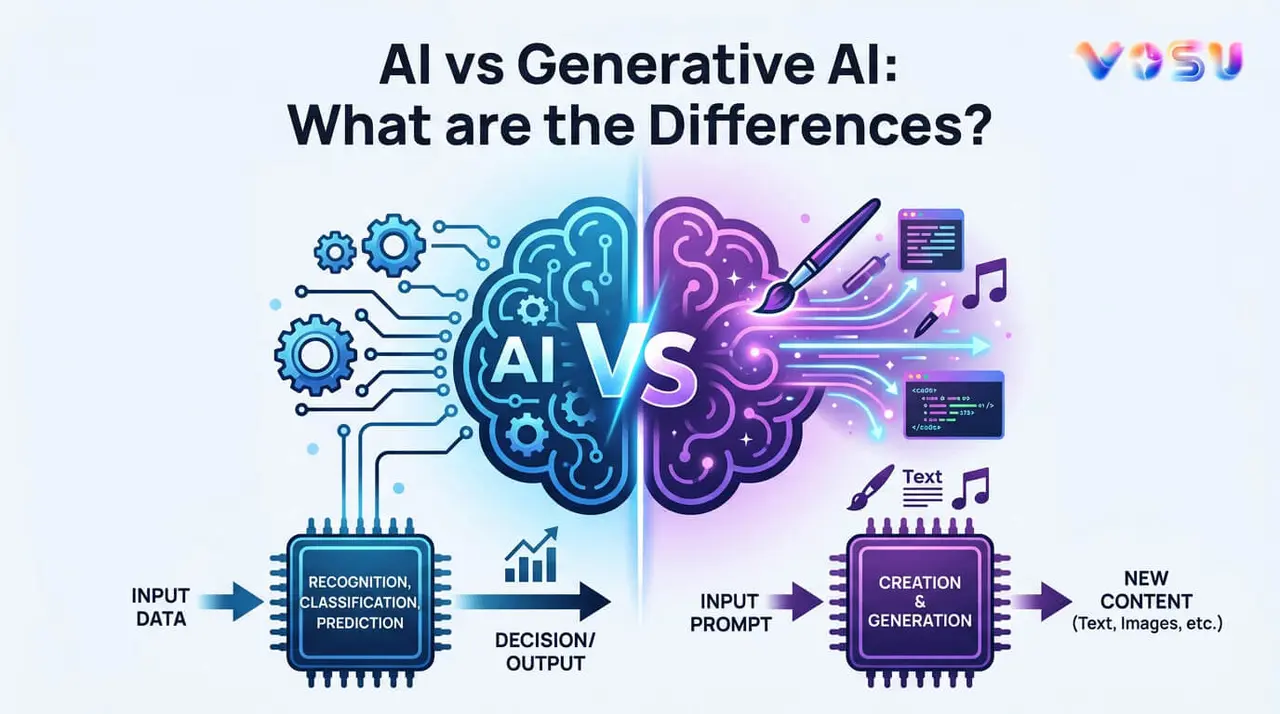
Artificial intelligence allows machines to simulate human intelligence through data driven learning, pattern recognition and decision making across tasks. It improves efficiency, automation, accuracy, personalization and continuous operation, while drawbacks include bias, privacy risks, job displacement, misinformation, errors and high implementation costs. Generative AI extends these capabilities by creating original text, images, audio and code through deep learning models trained on large datasets. It boosts content creation speed, productivity, creativity, research and accessibility, though it has risks like false information, copyright issues, inconsistent outputs, deepfakes and environmental impact.
AI and generative AI differ in purpose, approach, output, training and transparency, where AI focuses on prediction and structured insights, while generative AI focuses on creative content generation using complex neural networks. It is less interpretable but more flexible for unstructured tasks. Generative AI should be chosen when tasks require personalized content, summarization, natural language interaction, rapid prototyping, language heavy work and open ended creativity with adaptable outputs.
What is AI?
AI allows machines to simulate human intelligence using neural networks, machine learning algorithms and data driven training. AI systems use machine learning to recognize patterns in structured and unstructured data. This allows decisions, predictions and classifications across diverse tasks. AI analyzes information through three primary learning modes like supervised learning with labeled data, unsupervised learning with unlabeled clusters and reinforcement learning through rewards. AI is categorized into four capability tiers such as Narrow AI (task specific), General AI (human equivalent) and Super AI (beyond human).
What are the benefits of AI?
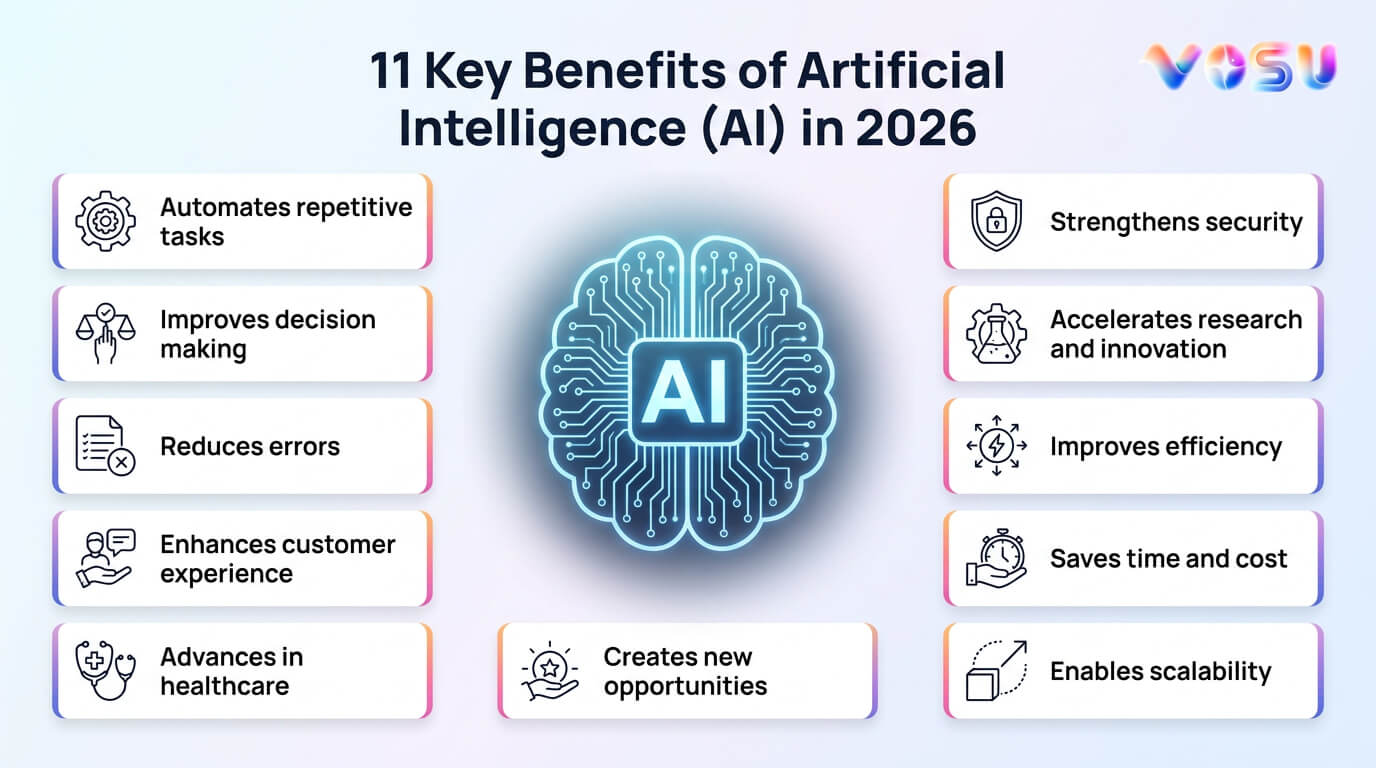
The benefits of AI are given below.
- Automation: AI automates repetitive tasks such as data entry, scheduling and report generation, which reduces manual processing time.
- Higher efficiency: AI processes large datasets 10x faster than manual methods, which allows higher efficiency across finance, logistics and healthcare workflows.
- 24/7 availability: AI systems operate continuously without fatigue, which delivers 24/7 availability for customer service, monitoring and transaction processing.
- Reduced human error: AI analyzes existing data with consistent algorithms, which reduces errors in clinical diagnostics, financial audits and legal review.
- Personalization: AI models generate personalized recommendations based on user behavior data across e-commerce, streaming and healthcare platforms.
- Better customer support: AI powered chatbots resolve queries within two minutes, which reduces human agent escalation across customer service operations.
- Stronger forecasting: AI models make predictions and decisions from historical data, which improves supply chain, sales and financial risk outcomes.
- Safer handling of dangerous tasks: AI robotic systems perform bomb disposal, deep sea exploration and nuclear inspection without human exposure.
- Continuous improvement: AI systems refine accuracy through iterative training cycles in medical imaging, fraud detection and NLP classification.
What are the drawbacks of AI?
The drawbacks of AI are given below.
- Bias and discrimination: AI models trained on biased datasets amplify discrimination in hiring, lending and facial recognition at scale.
- Privacy risks: AI systems collect and analyze user data across domains like behavioral tracking, biometric identification and predictive profiling.
- Job displacement: AI automation displaces 85 million roles in data processing, manufacturing and tasks that require human critical thinking.
- Misinformation and deepfakes: AI generates synthetic media and textual misinformation that bypasses standard fact checking frameworks in journalism and finance.
- Hallucinations and errors: AI language models produce factual hallucinations in up to 20% of outputs in medical and legal applications.
- High implementation costs: AI deployment costs range from $300,000 to $1 million per enterprise rollout, which limits adoption to large scale organizations.
What is generative AI?
Generative AI uses deep learning architectures to create original text, images, audio and code from input prompts. It trains on huge amounts of existing data to learn statistical patterns and reconstruct those patterns as new, context aware outputs. Generative AI processes user inputs through three sequential stages, which include encoding the input, sampling from a learned distribution and decoding to produce a final output.
Generative AI systems include three primary types like large language models for text, diffusion models for images and generative adversarial networks for synthetic media. Its examples include GPT 4, Claude, Midjourney and DALL-E, each trained on large datasets to generate text, images, video or code.
What are the benefits of generative AI?
The benefits of generative AI are given below.
- Faster content creation: Generative AI reduces content production time by 70%, while generating drafts, scripts and visual assets in minutes rather than hours.
- Higher productivity and efficiency: Generative AI automates repetitive tasks across document creation, code review and data summarization, which boosts efficiency by 30 to 45%.
- improved creativity and brainstorming: Generative AI produces 3 to 5 concept variations per prompt, which allows faster ideation in design, copywriting and product development.
- Improved research and development: Generative AI accelerates literature review, hypothesis generation and synthetic data creation across pharmaceutical and engineering R&D.
- Better personalization: Generative AI generates individualized content, product recommendations and communication styles across over 1,000 user segments.
- Greater accessibility: Generative AI produces text, images, code and music from natural language inputs, which lowers the skill barrier for content creation.
- Accelerated software development: Generative AI generates boilerplate code, test suites and documentation, which reduces software development time to 55%.
- Stronger workflow efficiency: Generative AI integrates into approval, summarization and reporting workflows, which reduces task completion time up to 40%.
What are the drawbacks of generative AI?
The drawbacks of generative AI are given below.
- False information: Generative AI produces hallucinations and creates inaccurate information in up to 27% of factual queries across tested language models.
- Privacy risks: Generative AI models trained on personal data expose privacy risks through memorization, reproduction and unauthorized inference of sensitive information.
- Copyright issues: Generative AI replicates copyrighted training materials, which raises ethical issues in publishing, music and visual art.
- Inconsistent results: Generative AI outputs vary in accuracy and quality across repeat queries, which requires human review in regulated industries.
- Deepfakes: Generative AI synthesizes photorealistic deepfake images and videos used in fraud, disinformation campaigns and identity based attacks.
- Environmental impact: Generative AI training demands high energy consumption, with GPT 3 requiring 1.3 GWh per training run.
What are the differences between AI and generative AI?
The differences between AI and generative AI remain in purpose, approach, output, training, transparency and use cases. Traditional AI focuses on analysis, prediction and decision making using structured data with supervised or reinforcement learning models like decision trees and SVMs. Generative AI focuses on creating new content such as text, images and code using deep learning models like transformers trained on large unstructured datasets. Traditional AI produces structured outputs like predictions, while generative AI produces creative content. AI is more interpretable, while generative AI is less transparent but more creative.
The image below shows the difference between traditional AI and generative AI.
What are the differences in purpose between AI and generative AI?
The differences in purpose between AI and generative AI separate analysis and decision making from creation and innovation, which defines two distinct operational objectives. Traditional AI automates repetitive workflows through reasoning and problem solving, which applies classification, regression and recommendation to structured data inputs. Generative AI drives content creation across text, images and code, which targets open ended innovation rather than predefined classification outputs.
What are the approach differences between AI and generative AI?
The approach difference between AI and generative AI lies in technical architecture and data processing methodology across two distinct learning paradigms. AI systems use structured pattern recognition with supervised or reinforcement learning, which processes labeled datasets through decision trees, SVMs and gradient boosting models. Generative AI systems apply deep learning architectures using self supervised learning across primary modalities. Generative AI architectures include transformers and diffusion models, each optimized for text, image, audio and code generation.
What are the output differences between AI and generative AI?
The output difference between AI and generative AI separates data derived insights from creative artifacts, which creates two structurally distinct result categories. AI outputs integrate into technical workflows as predictions, classifications and recommendations, which form the basis of fraud detection, churn modeling and clinical triage. Generative AI outputs emulate complex human expression through synthesized text, photorealistic images, functional code and multimodal audio. AI and generative AI outputs differ in human interpretability, as AI produces scalar scores, while generative AI produces consumable artifacts.
What are the training and data differences between AI and generative AI?
The training and data difference between AI and generative AI separates structured and labeled datasets from large unstructured corpora as two distinct data requirements. AI uses supervised learning with labeled data, training decision trees, logistic regression and ensemble models on predefined categorical outputs. Generative AI trains advanced neural network architectures using self supervised or unsupervised learning on unstructured corpora, which allows parameter scales of up to 1.7 trillion. The training gap between AI and gen AI spans four structural dimensions like dataset type, parameter count, training objective and computational cost.
What are the transparency differences between AI and generative AI?
The transparency difference between AI and generative AI separates interpretable predefined rules from opaque complex neural network structures as two explainability tiers. AI operates through predefined decision boundaries that produce traceable audit trails, which allow rule based compliance documentation in financial and healthcare sectors. Generative AI functions as a black box, which generates outputs from billions of weighted parameters without human readable decision pathways. Watermarking AI generated content addresses three regulatory transparency requirements documented in the EU AI Act, China's AI regulations and the US Executive Order on AI.
What are the use case differences between AI and generative AI?
The use case difference between AI and generative AI separates structured prediction tasks from open ended generative applications across two primary deployment categories. AI use cases include predictive maintenance, fraud detection and supply chain optimization across manufacturing, banking and logistics industries. Generative AI applications span content generation, visual prototyping, code synthesis and natural language processing across media, software and healthcare sectors. Generative AI use cases expand with three emergent categories such as scientific simulation, synthetic data generation and conversational AI assistants.
When should you choose generative AI over traditional AI?
You should choose generative AI over traditional AI when the task involves personalized content creation, document summarization, natural language chatbots, rapid prototyping, open ended creative tasks. This is useful when the output needs to be flexible and adapted to unstructured or evolving user inputs.
The conditions for choosing generative AI over traditional AI are outlined below.
- Personalized content generation: Choose generative AI when tasks require personalized content generation across text, images, code and music at scale for multiple user segments.
- Document summarization: Choose generative AI for document summarization tasks where AI condenses 50 page reports into structured three paragraph summaries for legal, finance or medical review.
- Natural language chatbots: Choose generative AI when building natural language chatbots that handle open ended customer queries without predefined decision trees or scripted response flows.
- Rapid prototyping: Choose generative AI for rapid prototyping when product teams need interface mockups, functional code or marketing copy generated within 2 hour design sprints.
- Unstructured data tasks: Choose generative AI for unstructured data tasks, which involve data analysis, image annotation and free text processing requiring contextual language understanding.
- Language heavy work: Choose generative AI for language heavy work, which involves translation, summarization, content editing and technical writing across over 100 language pairs.
- Open ended creative tasks: Choose generative AI for open ended creative tasks where originality, stylistic variation and iterative concept development define the required output quality.
- Fast deployment without a custom model: Choose generative AI when a pre-trained LLM covers the use case without dedicated fine tuning or custom training infrastructure.
- Human reviewed output workflows: Choose generative AI for human reviewed output workflows in legal, medical and editorial contexts where AI drafts need expert validation.
Which industries should choose generative AI the most?
Industries that should choose generative AI the most are outlined below.
- Healthcare and life sciences: Generative AI accelerates research in drug discovery and automates clinical documentation, which reduces documentation time by 45% for physicians.
- Financial services and banking: Generative AI generates real time fraud detection summaries and compliance documentation, which cuts 60% financial report generation time.
- Marketing and advertising: Generative AI produces personalized marketing campaigns across over 50 audience segments, which reduces content production timelines from weeks to two days.
- Retail and e-commerce: Generative AI powers AI powered chatbots for customer service, which generate product descriptions and recommendations across 1 million SKU catalogs.
- Manufacturing: Generative AI compresses product design cycles from 6 months to 6 weeks through synthetic prototyping, simulation and generative design iteration.
- Software development and IT: Generative AI accelerates code generation, test writing and documentation, which reduces development timelines to 55% in documented enterprise deployments.
How can generative AI tools help you?
Generative AI tools can help you improve productivity, creativity and automation across four workflow categories like drafting, editing, summarization and translation. They produce 3 to 5 concept variations per prompt, which allows faster ideation. Generative AI tools handle repetitive tasks such as data annotation, email drafting and report generation, which recovers 3 to 5 hours per knowledge worker weekly.
Can generative AI create videos for you?
Yes, generative AI creates video for you because they generate AI video from text prompts without requiring existing video footage or manual production assets. It creates high quality video from text prompts through motion generation, lighting simulation and scene composition.
Does generative AI have a bright future?
Yes, generative AI has a bright future driven by expanding enterprise adoption and growing multimodal capabilities, with use across about 65% of Fortune 500 companies. The future of generative AI extends to autonomous agentic systems and real time multimodal generation for enterprise and consumer platforms like VosuAI.
Is generative AI a part of AI?
Yes, generative AI is a part of AI because it is a specialized subset of artificial intelligence, not a separate technology category distinct from the broader AI field. It uses deep learning models, which include transformers and diffusion architectures, while traditional AI covers broader techniques like classification, regression, clustering and reinforcement learning, but not all AI qualifies as generative AI.
Can AI reduce your workload?
Yes, AI reduces individual task workload by automating repetitive tasks like data entry, scheduling and report generation. AI automation recovers up to 40% of individual processing time but expands total workload through increasing output expectations. It intensifies demands in quality control, model monitoring and output review, which offset manual reductions with new oversight requirements.
What are the differences between generative AI and other types of AI?
The differences between generative AI and other AI types lie in output intent and architecture across traditional, predictive, conversational, agentic, process and regenerative systems. Predictive AI generates risk scores from labeled datasets while generative AI creates new content from self supervised learning on unstructured corpora. Conversational AI focuses on dialogue based interaction, whereas generative AI produces open ended outputs. Regenerative AI optimizes systems and resources, while generative AI emphasizes content creation and innovation.