The future of Generative AI is a shift from content generation to agentic systems that execute complex workflows across domains. It transforms the future of work through task automation, hyper personalization and human AI collaboration that reshapes roles, workforce displacement and skill expectations. It most strongly affects technology, healthcare, financial services, legal services and compliance, media, marketing, e-commerce, education and customer service through integrated, data-driven workflows. It reshapes creative industries through roles as ideation partner, brainstorming co-pilot, rapid prototyping engine, production assistant and a dynamic world building and narrative systems.
Generative AI embeds in business operations as autonomous operations, AI agent networks, digital employees and decision support layers across generative AI tools for business. It uses multimodal AI, domain-specific models, multi-agent systems and edge deployments to create highly specialized systems that integrate with legacy architectures and digital twins. It relies on ChatGPT, Claude, Gemini, GitHub Copilot, Midjourney and Runway as key tools that anchor generative AI technology across communication, coding, design and production.
Generative AI delivers benefits such as boosted productivity and efficiency, accelerated research and development, democratization of skills, enhanced creativity and data driven decision making. It improves education through customized educational support while amplifying human potential through autonomous assistants capable of handling complex tasks. It also creates risks through misinformation and deepfakes, workforce displacement, data leakage and privacy risks, cybersecurity threats, bias and discrimination and pressure regarding energy consumption.
What is the future of generative AI?
The future of generative AI defines the next phase of digital systems and intelligent production. Generative AI marks the future of gen AI through full multi-modal integration across text, image, video and code environments. Generative AI enables systems that execute complex workflows across platforms and domains. It shifts roles from passive tools toward active, decision driven entities and represents future facing generative AI through structured reasoning and adaptive outputs.
Generative AI establishes core infrastructure across business, science and daily operations. It manages enterprise pipelines, updates internal databases with real time inputs and supports research modeling, product design and automated service layers. It transforms workflows into autonomous agentic AI systems with persistent context and goal tracking and integrates into global systems as a foundational productivity layer.
How will generative AI transform the future of work?
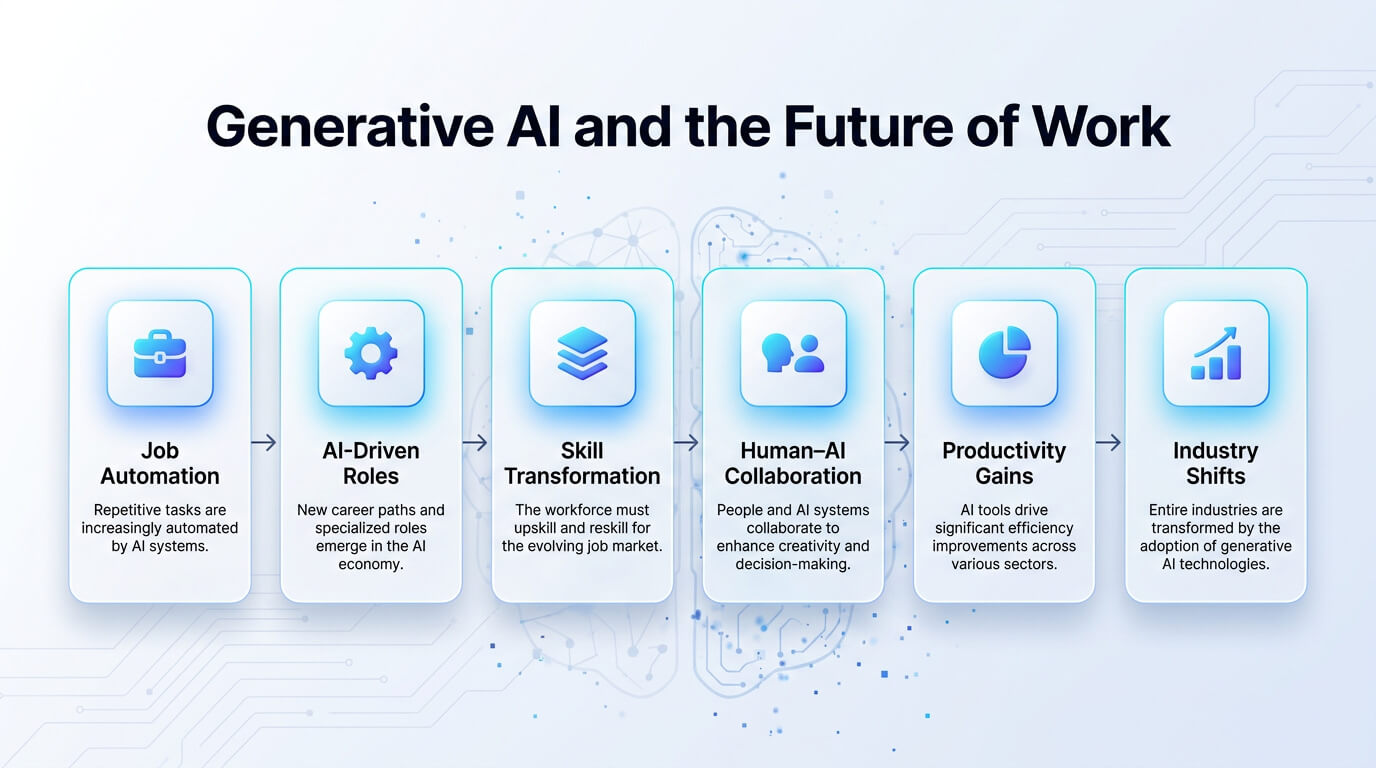
Generative AI transforms the future of work by redefining roles, outputs and task, handling routine and time consuming tasks across data entry and content production. It reduces manual effort, increases operational consistency and enables human AI collaboration through shared task environments and aligned goal execution. It enhances augmented collaboration between teams and intelligent systems across functions.
Generative AI expands access to advanced capabilities by skill democratization across industries. It provides tools that support design, coding, analysis and communication without barriers to specialized training. Generative AI reshapes job structures toward oversight, strategy and creative direction. It integrates into workflows as an active system that supports decision cycles and the generation of outputs. It establishes a work environment driven by intelligence, adaptability and continuous learning.
The infographic below shows Generative AI and the Future of Work.
Which industries will be most affected by generative AI in the future?
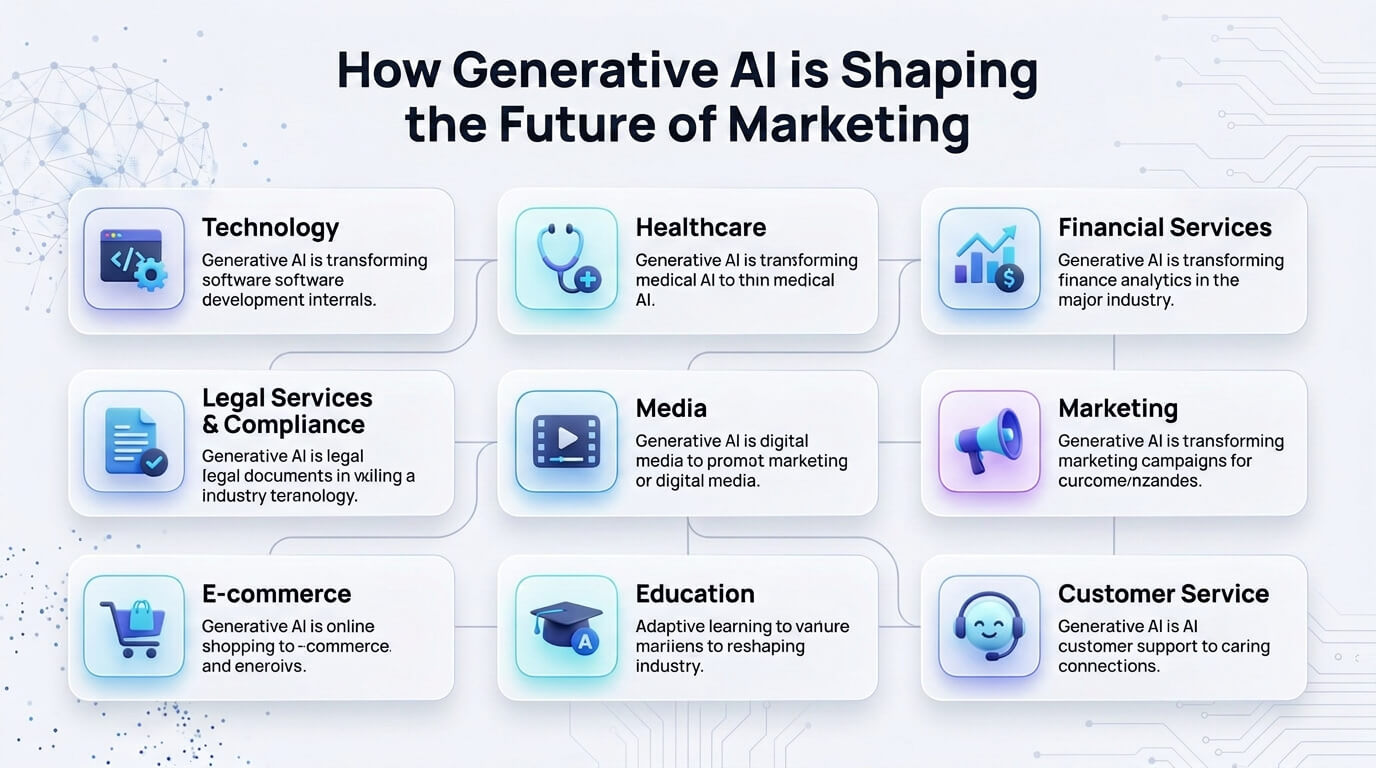
Industries that will be most affected by generative AI in the future are technology, healthcare, financial services, legal services and compliance and media. Generative AI supports data intensive workflows, complex decision cycles and scalable content operations in these sectors. It reshapes processes, job structures and value delivery through automation, augmentation and intelligent orchestration.
The sectors that will be most affected by generative AI in the future are given below.
- Technology: Generative AI accelerates software development, automates debugging, enhances code generation and optimizes system architecture, fundamentally reshaping how tech companies build and deploy digital solutions.
- Healthcare: Generative AI supports diagnostics, treatment planning and patient engagement while enhancing clinical workflows with safety practices and augmenting human expertise in care delivery across institutions and health systems.
- Financial services: Generative AI powers risk modeling, fraud detection and investment analysis while structuring reports, compliance evidence and personalized customer experiences across portfolios, advisory journeys and operational processes.
- Legal services and compliance: Generative AI analyzes contracts, case histories and regulatory texts while strengthening matter management, compliance monitoring and legal research workflows across jurisdictions and organizational structures.
- Media: Generative AI produces content, tests formats and scales distribution while maintaining audience data, narrative consistency and brand integrity across platforms, campaigns and creative ecosystems.
- Marketing: Generative AI generates campaign assets, segmentation insights and performance narratives while harmonizing channels, messaging and experimentation frameworks across lifecycle stages and growth initiatives.
- E-commerce: Generative AI drives product discovery, merchandising experiences and adaptive pricing while connecting catalogs, logistics and transaction data across storefronts, regions and customer journeys.
- Education: Generative AI and the future of education create lessons, assessments and feedback flows while it reconfigures classrooms and lifelong learning systems worldwide through adaptive, data driven instructional experiences.
- Customer service: Generative AI delivers conversational support, self service experiences and escalation context while optimizing knowledge bases, workflows, satisfaction outcomes and continuous improvement cycles across service operations.
The process of how generative AI is shaping the future of marketing is shown in the image below.
What future roles will generative AI play in creative industries?
The future roles that generative AI will play in creative industries are ideation and concepting partner, brainstorming co-pilot, rapid prototyping and production assistant. Generative AI is transforming creative work across design, storytelling and production pipelines. It supports the future of creativity through collaborative co-pilot experiences and works by rapidly generating variations and providing intelligent assistance.
The future roles that generative AI will play in creative industries are given below.
- Ideation and concepting partner: Generative AI expands idea exploration, moodboarding and thematic directions across projects while grounding concepts in audience insights, brand narratives and the future of creativity initiatives.
- Brainstorming co-pilot: Generative AI changes creative work as a collaborative co-pilot that proposes prompts, angles and creative twists while refining directions through continuous feedback loops with human teams.
- Rapid prototyping: Generative AI produces draft visuals, storyboards, mockups and layouts while rapidly generating variations that reduce iteration cycles and clarify stakeholder expectations early across programs.
- Production assistant: Generative AI automates asset resizing, versioning, formatting and adaptation while maintaining consistency across platforms, campaigns and integrated production environments for organizations.
- Dynamic world-building: Generative AI constructs settings, characters and aesthetic systems while linking visual, narrative and interactive elements into coherent universes for media, games and immersive experiences.
- Real time narrative generation: Generative AI creates adaptive stories, dialogue and branching paths while responding to user input and contextual signals in immersive, interactive environments and applications.
- Personalization engine: Generative AI tailors content, experiences and interfaces while unlocking the future of fashion, media and entertainment personalization across audiences, segments and channels worldwide.
- Workflow orchestrator: Generative AI, the future of ux ui design, coordinates tools, assets and task sequences while shaping cohesive, user centered creative pipelines across platforms and collaborative teams.
- Creative direction: Generative AI surfaces patterns, references and strategic options while supporting leaders in setting vision, guidelines and long term creative roadmaps for organizations.
How will businesses use generative AI in the future?
Businesses will use generative AI in the future through autonomous operations, AI agent networks, hyper personalization, decision support and digital employees. Generative AI for business restructures processes, experiences and outcomes across sectors. Generative AI in business relies on systems that augment human workers and streamline decisions.
The ways businesses will use generative AI in the future are given below.
- Autonomous operations: Generative AI manages workflows, decisions and exception handling across departments while sustaining operations and reducing manual intervention. It enables continuous, policy aligned oversight and adaptive responses to changing business conditions.
- AI agent networks: Generative AI coordinates specialized agents across tasks, systems and channels while maintaining shared context, governance rules and aligned objectives. It supports orchestrated, multi agent collaboration in complex business environments.
- Hyper-personalization: Generative AI tailors experiences, offers and communications while aligning customer data, behavioral signals and real time feedback into unified profiles. It enables targeted, context aware engagement across journeys and segments.
- Decision support: Generative AI surfaces insights, scenarios and recommendations while grounding choices in structured data, historical patterns and defined performance metrics. It helps leaders make informed strategic and operational decisions.
- Digital employees: Generative AI performs repeatable tasks, frontline interactions and internal support while expanding organizational capacity and preserving consistent service quality standards. It augments teams by handling routine, knowledge intensive activities.
- Legacy system modernization: Generative AI interprets documentation, interfaces and data structures while reshaping outdated systems into integrated, flexible and resilient architectures. It accelerates modernization without requiring complete system replacement.
- Synthetic data generation: Generative AI creates training datasets, simulation inputs and test cases while protecting privacy, reducing bias and expanding experimentation capacity. It strengthens analytics, modeling and product testing capabilities.
- Digital twins and market testing: Generative AI models operations, customers and markets while simulating strategic moves, outcome ranges and scenario specific responses. It informs planning, innovation and investment decisions before execution.
- Dynamic content production: Generative AI produces messages, assets and variants while aligning brand voice, channels and performance signals for ongoing optimization. It supports scalable, data driven communication across campaigns and touchpoints.
- Predictive business planning: Generative AI forecasts trends, demands and risks while supporting scenario planning, resource allocation and long term strategic roadmapping. It allows proactive, evidence based planning for leadership teams.
What are the future trends in generative AI?
The future trends in generative AI are Agentic AI, multimodal AI, domain-specific models, edge and decentralized AI and AI governance and regulation. Generative artificial intelligence future trends highlight autonomous agents, highly specialized systems and intelligent infrastructure embedded directly into products and services. It reshapes architectures, workflows and governance that align experimentation, deployment and oversight with scalable intelligence across cloud, edge and regulated environments.
The future trends in generative AI are given below.
- Agentic AI: Generative AI manages autonomous agents, goal directed tasks and adaptive workflows across dynamic environments. It coordinates decisions aligned with organizational priorities, constraints and evolving cross functional conditions for complex missions.
- Multimodal AI: Generative AI connects text, images, audio and video into unified representational spaces like VosuAI. It synchronizes understanding, generation and interaction across formats, contexts and user intent signals for richer experiences.
- Domain specific models: Generative AI builds highly specialized systems grounded in industry knowledge, terminology and workflows. It delivers precise, regulation aware outputs tailored to niche use cases, compliance requirements and expert decision making.
- Edge and decentralized AI: Generative AI runs embedded directly on local devices, networks and infrastructure close to data. It enhances responsiveness, privacy, resilience and independence from centralized compute bottlenecks.
- AI governance and regulation: Generative AI supports transparency, compliance and auditing across lifecycle stages. It aligns systems with legal standards, ethical guidelines, risk controls and evolving policy frameworks for responsible adoption.
- AI driven scientific discovery: Generative AI accelerates hypotheses, simulations and experiment design across disciplines. It expands research possibilities using complex datasets, exploratory scenarios and automated reasoning to uncover patterns and candidate breakthroughs.
- Multi agent systems: Generative AI coordinates specialized agents, roles and negotiations within shared environments. It manages collaboration, conflict resolution and collective outcomes for intricate problem spaces and distributed workflows.
- Digital employees: Generative AI performs operational tasks, service interactions and coordination duties as persistent teammates. It integrates into organizational structures, accountability models and performance metrics while scaling capacity.
- Human like interfaces: Generative AI delivers natural conversations, adaptive guidance and context-aware assistance across channels. It bridges accessibility needs and machine capabilities through expressive, responsive interaction patterns shaped by trends in generative AI.
Which generative AI tools will change the future?
Generative AI tools that will change the future are ChatGPT, Claude, Gemini, GitHub Copilot, Midjourney and Runway. Generative AI tools for preparing your team for the future reshape skills, workflows and decision structures across organizations. Gen AI technology transforms communication, coding, design and production environments. Generative AI tools for business align human expertise, automation layers and platform ecosystems around scalable, adaptive intelligence.
The generative AI tools that will change the future are given below.
- ChatGPT: ChatGPT supports conversation, research, content drafting and explanation across domains while integrating with communication and documentation workflows. It connects teams, processes and knowledge flows into adaptive decision environments.
- Claude: Claude enables extended context handling and safety focused responses while supporting compliant enterprise interactions. It provides dependable assistance for regulated environments requiring transparent outputs and stable knowledge intensive operations.
- Gemini: Gemini connects text, code and multimodal understanding while enhancing productivity and collaborative workspace experiences. It acts as a connective layer that orchestrates insights, tasks and assets across cloud ecosystems.
- GitHub Copilot: GitHub Copilot assists coding, refactoring and documentation while guiding developers through inline suggestions aligned with existing repositories. It improves engineering velocity by reinforcing architectural decisions, implementation patterns and shared practices.
- Midjourney: Midjourney creates visual concepts, styles and compositions while broadening creative exploration for branding, marketing and design teams. It supports designers by translating prompts into iterative options that refine aesthetics.
- Runway: Runway powers video editing, asset generation and visual effects while simplifying motion content workflows for creators and production teams. It equips organizations with accessible pipelines that connect ideation and delivery.
What are the benefits of generative AI for the future?
The benefits of generative AI for the future are boosted productivity and efficiency, accelerated research and development, democratization of skills and enhanced creativity. Generative AI benefits for business include amplifying human potential through autonomous assistants capable of strengthening the global economy through Gen AI impact across sectors.
The benefits of generative AI for the future are given below.
- Boosted productivity and efficiency: Generative AI streamlines workflows, automates repetitive tasks and standardizes outputs across functions. It frees humans for higher value initiatives that demand judgment, coordination, creativity and complex problem solving.
- Accelerated research and development: Generative AI explores design spaces, tests hypotheses and proposes alternatives faster than traditional cycles. It compresses iteration timelines and supports researchers in validating ideas and scaling promising innovations.
- Democratization of skills: Generative AI provides expert level capabilities and structured support across domains. It provides access to people without formal training, which helps them complete specialized tasks with higher confidence and quality.
- Enhanced creativity: Generative AI produces ideas, variations and stylistic options across formats and media. It helps creators experiment more widely and refine concepts into distinctive outputs that match evolving audience expectations.
- Data driven decision making: Generative AI synthesizes information, surfaces patterns and explains scenarios from complex datasets. It supports leaders in framing options, evaluating trade offs and selecting directions grounded in transparent, interpretable analysis.
- Economic growth: Generative AI increases output, allows new products and services and unlocks additional revenue streams. It supports productivity gains, investment flows and ecosystem development across the global economy.
- Strategic decision-making: Generative AI models scenarios, clarifies implications and structures recommendations around competing choices. It helps organizations navigate uncertainty, align stakeholders and adapt strategies as markets and technologies shift.
- Custom educational support: Generative AI tailors explanations, practice activities and learning paths to individual learners. It helps people progress, strengthen core skills and retain knowledge through ongoing, contextual feedback.
What are the risks generative AI creates for the future?
The risks generative AI creates for the future include misinformation and deepfakes, job displacement, data leakage and privacy risks and cybersecurity threats. Generative AI exposes limitations of Gen AI across governance, oversight and control as it expands reach and autonomy. It raises data privacy and security threats, workforce stability concerns and existential dimensions that shape the long term generative AI outlook.
The risks that generative AI creates for the future are given below.
- Misinformation and deepfakes: Generative AI fabricates convincing narratives, impersonations and synthetic media that distort events and identities. It undermines verification processes, public trust and institutional credibility across digital and real world contexts.
- Job displacement: Generative AI automates routine, repetitive and some knowledge tasks across industries. It disrupts workforce stability by pressuring vulnerable roles, widening skill gaps and shifting bargaining power in labor markets.
- Data leakage and privacy risks: Generative AI reveals sensitive patterns, training data traces and confidential details through outputs and interactions. It erodes privacy boundaries between individuals, organizations and platforms, complicating compliance and accountability structures.
- Cybersecurity threats: Generative AI generates realistic phishing content, exploit code and adaptive attack strategies that overwhelm traditional defenses. It accelerates threat evolution, forcing security teams to respond to rapidly changing, machine augmented adversaries.
- Bias and discrimination: Generative AI encodes historical biases, skewed datasets and dominant perspectives into outputs and recommendations. It reproduces discriminatory outcomes at scale, affecting access, representation and fairness across critical decision systems.
- Intellectual property theft: Generative AI imitates styles, proprietary assets and protected expressions without clear attribution or consent. It blurs ownership boundaries, intensifying legal disputes and ethical tensions around authorship and derivative works.
How will generative AI affect jobs?
Generative AI affects jobs by restructuring the Artificial Intelligence job scope through automation of routine tasks and transformation of many knowledge roles. It primarily augments human workers in complex decision environments while reducing entry level hiring and making human oversight critical. Generative AI impact expands into new functions, which create effects across industries and job categories.
Will generative AI bias affect the future of society?
Yes, generative AI bias will affect the future of society because it shapes information flows, representations and decision support systems. Generative AI profoundly affects society by reinforcing cultural homogenization in media, education and automated decision environments. It marginalizes minority perspectives and normalizes skewed norms because bias in generative AI drives repeated skewed outputs and feedback loops.
Does generative AI have a bright future?
Yes, generative AI has a bright future because it positions itself as a foundational technology expected across industries. Generative AI delivers a massive economic boost by reshaping productivity, innovation and decision making. It integrates the future of generative AI into core systems, workflows and daily experiences at a global scale.
Will generative AI improve marketing performance?
Yes, generative AI will improve marketing performance because it reshapes how teams plan, execute campaigns and measure outcomes across channels. Generative AI focuses on accelerating content production while maintaining brand consistency and creative variation. It supports better audience segmentation and targeting, driving higher returns through more relevant messaging, offers and experiences across the customer journey.
Will generative AI improve customer connections?
Yes, generative AI will improve customer connections by delivering more relevant and timely interactions across channels. Generative AI strengthens relationships by automating routine queries and freeing human teams for complex, high value conversations. It drives the future of generative AI in customer engagement by reshaping customer connections through personalized experiences.
Will businesses save money by using generative AI in the future?
Yes, businesses will save money by using generative AI in the future through leaner workflows and better use of human talent. Generative AI benefits businesses by streamlining operations and reducing waste. It reduces costs by automating repetitive tasks and replacing expensive support centers with scalable, always available assistance for generative AI business operations.