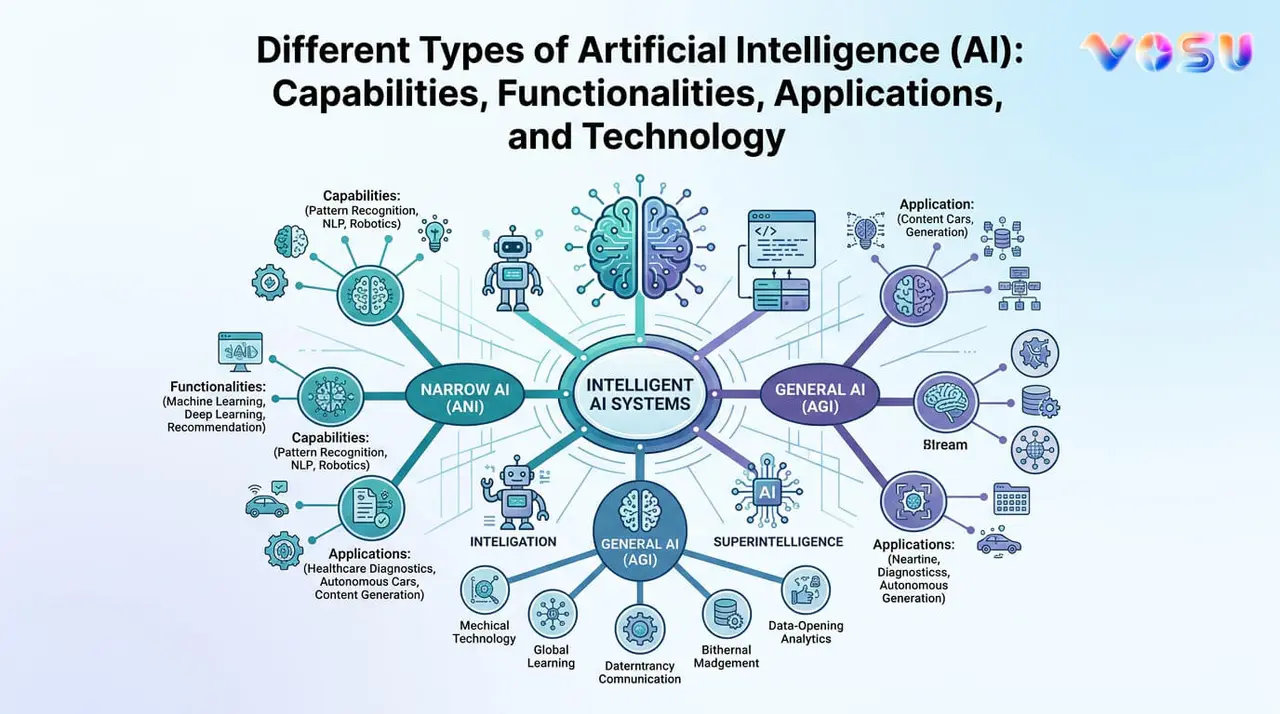
The types of artificial intelligence are categorized based on capabilities, functionalities, applications and technology. These systems include traditional machine learning models and advanced forms capable of complex automation and human like intelligence.
AI based on capabilities includes Narrow AI, General AI and Super AI. Narrow AI performs specific tasks within limited scopes, General AI is designed for human like intelligence across multiple tasks and Super AI represents a future concept that could surpass human intelligence. AI based on functionalities includes Reactive Machine AI, Limited Memory AI, Theory of Mind AI and Self Aware AI, which range from simple real time systems to advanced hypothetical models with emotional understanding and self awareness.
AI based on applications includes Generative AI, Agentic AI, Natural Language Processing, Computer Vision and Robotics. These systems support content generation, autonomous task execution, language processing, visual analysis and machine automation across industries. AI based on technology includes Machine Learning, Deep Learning, Symbolic AI and Rule Based Systems, which use different approaches for learning, reasoning and decision making.
Businesses and developers choose the right type of AI by defining goals, assessing data quality, evaluating complexity, reviewing resources and testing scalability, explainability and performance before deployment.
What are the types of AI based on capabilities?
The types of AI based on capabilities are Narrow AI, General AI and Super AI. Narrow AI refers to currently existing systems designed to perform specific tasks efficiently within a limited scope. General AI is a theoretical form of intelligence that would match human-like cognitive abilities and perform a wide range of tasks. Super AI represents a future stage of AI that could surpass human intelligence in all aspects like creativity, reasoning and decision-making.
3 types of AI based on capabilities are listed below.
- Narrow AI (weak AI)
- General AI (strong AI)
- Super AI (super intelligent AI)
1. Narrow AI (weak AI)
Narrow AI is an artificial intelligence system that focuses on a single or narrow task within existing systems. It performs tasks faster and better than humans in specific conditions. It works by analyzing large amounts of data and following patterns learned during training. It is trained to perform specific functions instead of general thinking or reasoning across different tasks. It is used in real world applications like voice assistants, recommendation systems, spam filters and navigation apps. It improves efficiency, saves time, increases accuracy and automates repetitive tasks. Narrow AI handles only specific tasks, lacks general reasoning, struggles with unfamiliar situations, depends on quality data and cannot think, learn, or adapt independently.
2. General AI (strong AI)
General AI, Artificial General Intelligence, is a system designed to perform any intellectual task with human like cognitive abilities and transferable learning across different tasks. It works using advanced machine learning and reasoning models to simulate human thinking. It is used in healthcare, education, robotics and research as future deployed AI systems. It helps in flexible learning, better automation and improved decision making. General AI remains hypothetical, lacks real world existence, faces ethical and technical challenges, requires massive computational resources and still cannot fully replicate human intelligence or emotions.
3. Super AI (super intelligent AI)
Super AI is a form of artificial superintelligence where machines surpass human intelligence including creativity and the ability to make decisions in complex situations. It processes information, learns patterns and solves challenges at superhuman levels. It works by processing massive data, identifying deep patterns, and improving through self learning systems. It is used in advanced research, healthcare, space exploration, climate prediction and global problem solving. It solves complex problems, improves innovation, and supports decision making. Super AI lacks real world existence, raises major ethical and safety concerns and could become uncontrollable beyond human understanding or supervision.
What are the types of AI based on functionalities?
The types of AI based on functionalities are Reactive Machine AI, Limited Memory AI, Theory of Mind AI and Self Aware AI. Reactive Machine AI operates only on current data without using past experiences, which makes it suitable for simple rule based or real-time tasks. Limited Memory AI can use recent past data to improve decision making and is widely used in systems like self driving cars and recommendation engines. Theory of Mind AI is a developing concept that aims to understand human emotions, intentions and social behavior for more natural interactions. Self Aware AI is a hypothetical form of intelligence that would possess consciousness and self-understanding, which allows highly advanced autonomous decision making.
4 types of AI based on functionalities are listed below.
1. Reactive machine AI
2. Limited memory AI
3. Theory of mind AI
4. Self aware AI
1. Reactive machine AI
Reactive Machine AI is a type of artificial intelligence that operates solely on current data and does not use past experiences for decision making. It performs specific tasks like playing chess or making instant predictions using only real time information. It works by analyzing input data at the moment without storing memory of previous interactions. It is used in systems like game playing AI, basic recommendation tools and simple rule based machines. It delivers fast responses, simple operation and reliable performance in controlled tasks. It cannot store memories, learn from past experiences or adapt to new situations and it only responds to current inputs without understanding context or improving over time.
2. Limited memory AI
Limited memory AI is a modern type of AI that recalls past events and uses them to inform future decisions. It analyzes recent data to improve predictions and make safe driving decisions. It works by storing short term data, learning patterns and updating outputs based on new inputs. It is used in self driving cars, recommendation systems, virtual assistants and fraud detection tools. It improves decision accuracy by using past data, adapts to changing patterns, enhances prediction quality, and supports real-time intelligent responses in dynamic environments. It depends on recent data, needs large training datasets, struggles with unpredictable situations and lacks true long term understanding or deep reasoning ability.
3. Theory of mind AI
Theory of mind AI is an advanced AI capability that understand human emotions, beliefs, intentions and attribute mental states during interactions with people. It focuses on emotions, social behavior and unique emotional needs in different situations. It improves communication by understanding human reactions and human behavior patterns more accurately. It works by analyzing facial expressions, speech patterns and emotional signals through learning systems. Theory of mind AI is not yet fully developed, but it is expected to be used in advanced human robot interaction, emotional AI assistants, social robots, healthcare support and personalized education systems. It improves understanding of human emotions and intentions that allow natural communication, better interaction and more personalized responses. It is difficult to build, may misread emotions and intentions and raises ethical concerns about privacy and manipulation.
4. Self aware AI
Self aware AI is a hypothetical form of artificial intelligence that understands its own internal states and possess super AI capabilities similar to human self awareness. It thinks, learns, understands emotions and makes independent decisions with self conscious awareness. It works by processing information, analyzing experiences and recognizing its own actions. Its expected uses include advanced decision making, autonomous research, strategic planning, self improvement systems and highly adaptive human level problem solving. It allows highly intelligent decision making, autonomous learning and improvement, deep problem solving, better adaptation to new situations and advanced support for complex human tasks. It is purely hypothetical, extremely difficult to create, raises serious ethical and safety risks, and could become uncontrollable or act beyond human intentions.
What are the types of AI based on applications?
The types of AI based on applications are categorized into Generative AI, Agentic AI, Natural Language Processing, Computer Vision and Robotics, each designed for specific real world uses. Generative AI focuses on creating new content such as text, images, code and media from learned patterns. Agentic AI autonomously plans and executes multi step tasks. NLP allows machines to understand human language, while Computer Vision interprets visual data. Robotics integrates AI with machines to perform physical tasks across industries that improve automation and efficiency.
5 types of AI based on applications are listed below.
1. Generative AI
2. Agentic AI
3. Natural language processing (NLP)
4. Computer vision
5. Robotics
1. Generative AI
Generative AI is a type of artificial intelligence that uses neural networks to create new content by learning patterns from large training datasets to generate text, images, audio, code and other digital outputs. It works by processing training data and identifying patterns using deep learning models. Generative AI is used in content creation, text and image generation, chatbots, code writing, marketing, design, education and creative media production. It speeds up content creation, boosts creativity, automates repetitive tasks, personalizes outputs, supports learning and improves productivity across writing, design or coding tasks. It can produce inaccurate or biased content, lacks true understanding, depends on training data quality and raises concerns about misuse, copyright and misinformation.
2. Agentic AI
Agentic AI is a type of artificial intelligence that independently plans and executes multi step actions with minimal human intervention. It can analyze goals, break them into steps and complete tasks autonomously. It works by combining reasoning, decision-making, memory and tool use to follow plans and adjust actions. Agentic AI is used in autonomous workflows, customer support automation, research assistance and business process optimization. Its benefits include faster task completion, reduced human effort, improved efficiency, and better scalability. It can make errors in complex environments, depend on data quality, raise safety concerns and sometimes act unpredictably without strong human oversight.
3. Natural language processing (NLP)
Natural Language Processing (NLP) is **a branch of artificial intelligence that enables computers to understand and generate human language for communication between humans and machines.**It allows machines to generate human language and interpret text in a meaningful way.It works by analyzing text and speech data using algorithms that detect patterns, grammar and context. It is used in sentiment analysis, machine translation, automated text summarization, chatbots, virtual assistants and search engines to understand and process human language. It improves communication, automates language tasks and makes information processing faster and easier. It has some limitations because it struggles with complex context, ambiguity and cultural differences in language understanding.
4. Computer vision
Computer vision is a prominent AI application that enables machines to analyze visual data and understand images and videos in real time. It allows systems to detect objects, recognize faces and interpret scenes using algorithms trained on visual datasets.It works by processing images through neural networks that extract patterns, shapes and features from visual input. It is used in self driving cars, facial recognition, healthcare imaging, surveillance systems and manufacturing quality control. It improves image and video analysis, enables object detection and recognition, enhances automation, supports medical diagnosis, strengthens security systems and powers autonomous vehicles. It struggles with poor image quality, lighting changes, and occlusion, requires large labeled datasets, can be biased, and often fails in unfamiliar real-world conditions.
5. Robotics
Robotics is a field of artificial intelligence that combines machine learning and autonomous systems to design machines capable of performing physical tasks.
It performs tasks like manufacturing, surgery assistance, warehouse management, exploration and service operations. It works by using machine learning, sensors, control systems and programming so machines sense, think and act. It is used in industries like healthcare, automotive production, defense systems, space exploration and logistics. It increases efficiency, improves precision, automates repetitive or dangerous tasks, reduces human labor, enhances productivity, and supports applications in healthcare, manufacturing and exploration. It is expensive to develop and maintain, lacks flexibility in complex tasks, depends on programming accuracy and struggles in unpredictable real-world environments.
What are the types of AI based on technology?
The types of AI based on technology are categorized into Machine Learning, Deep Learning, Symbolic AI and Rule-Based Systems, each representing different approaches to building intelligent systems. Machine Learning enables systems to learn from data and improve predictions automatically. Deep Learning uses neural networks to process large, complex datasets for high accuracy tasks. Symbolic AI relies on logic and human readable symbols for reasoning, while Rule Based Systems operate using predefined IF-THEN rules to make structured decisions in a specific domain
4 types of AI based on technology are listed below.
1. Machine learning
2. Deep learning
3. Symbolic AI
4. Rule based systems
1. Machine learning
Machine learning is a branch of artificial intelligence that enables systems to learn from labeled data, mapping and improve performance without explicit programming. It learns patterns from data and makes predictions or decisions automatically.
Machine learning works by analyzing datasets, identifying relationships and improving accuracy through training models using labeled data mapping and reinforcement learning methods. It is used in powering applications like recommendation systems, fraud detection, speech recognition and image classification.
It improves prediction accuracy, automates data analysis, enables personalized recommendations, detects patterns in large datasets, and continuously improves performance with experience. It depends on large, high quality data, can produce biased results, struggles with unfamiliar situations, lacks a true understanding and requires significant computational resources.
2. Deep learning
Machine learning is a branch of artificial intelligence that enables systems to learn from data and improve performance without being explicitly programmed. It learns complex patterns in data beyond traditional rule based methods and improves accuracy over time. It uses convolutional neural networks and other deep neural structures to analyze large datasets step by step. It is applied in image recognition, speech recognition, language translation and self driving systems. It provides high accuracy, handles complex unstructured data, improves recognition tasks, and automatically learns features from large datasets. Deep learning requires large datasets and high computing power, is hard to interpret, and may overfit or fail on new data.
3. Symbolic AI
Symbolic AI is a type of artificial intelligence that represents knowledge using human readable symbols and solve problems through structured rules. It is also known as good old fashioned AI (GOFAI), which refers touse logical rules and symbolic representations learning from data. It performs reasoning and solves logical problems in a clear and structured way. It works by using symbols and rule based logic to represent knowledge and draw conclusions. It is used in expert systems, mathematical reasoning and planning systems. It offers clear reasoning, easy interpretability, rule-based decision making, reliable logic handling, and strong performance in structured problem-solving tasks. It struggles with uncertainty, lacks learning ability, depends on predefined rules, is inflexible, and performs poorly with real-world noisy data.
4. Rule based systems
Rule based systems are a type of artificial intelligence that uses predefined rules and logic to solve problems within specific domains. They make decisions, classify information and solve problems within specific domains by following set rules. They work by using production systems and logic programming systems where IF-THEN rules guide every action.They are applied in expert systems, decision support tools and simple automation tasks in business and technology. They provide clear and predictable decision making, easy debugging, consistent outputs and reliable performance in structured tasks. They lack learning ability, behave rigidly, depend on predefined rules, and handle complex or uncertain situations poorly.
How to choose the right types of AI?
Choose the right types of AI by defining business goals, assessing data quality, considering task complexity, evaluating resources and budget, checking explainability needs and testing before committing.
7 steps to use the right types of AI are given below.
- Define your goal first: Clearly outline what you aim to achieve, such as generating creative content or automating analysis, to match AI types like generative models for new content creation while prioritizing strong data protection from the start.
- Assess your data: Evaluate data volume, quality and sensitivity to select AI suited for tasks needing strong data protection, which confirm inputs support reliable outputs that maintain acceptable quality without privacy risks.
- Consider task complexity: Analyze if the task is a simple classification or a complex pattern recognition. Opt for narrow AI for straightforward jobs. Use advanced models to create new content. Avoid compromising quality standards.
- Evaluate resources and budget: Review available hardware, skills and costs to pick cost effective AI solutions that deliver high performance for creating new content while upholding strong data protection within your financial limits.
- Check explainability needs: Determine if decisions must be interpretable for compliance. Choose transparent AI models over black-box ones to maintain acceptable quality and trust, especially in regulated fields handling sensitive data.
- Think about scalability and integration: Ensure the AI scales with growing demands and integrates seamlessly into existing systems that support the ongoing creation of new content with robust data protection as usage expands.
- Test before committing: Run pilots or prototypes to validate performance by confirming the AI creates new content effectively, enforces strong data protection and sustains acceptable quality before full scale deployment
What are the factors to consider while choosing the right type of AI?
The factors to consider while choosing the right type of AI are given below.
- Data privacy and security requirements: Protect sensitive data by selecting AI systems that follow required security standards and secure data handling practices.
- Regulatory and legal compliance: Follow industry regulations and legal policies when choosing AI systems for regulated business and organizational environments.
- Risk level and safety sensitivity: Evaluate risk level and safety sensitivity before using AI systems in critical healthcare, finance or security operations.
- System performance requirement: Measure system performance requirement to ensure accurate outputs, fast processing speed and reliable operational efficiency.
- Deployment environment compatibility: Ensure deployment environment compatibility with existing hardware, software infrastructure, cloud platforms and operational workflows.
- Maintenance and lifecycle management needs: Manage maintenance and lifecycle management needs for regular updates, monitoring, scalability and long term AI system performance.
- Integration and ecosystem compatibility: Support integration and ecosystem compatibility with existing applications, databases, communication tools and enterprise technology systems.
What is the most common type of AI used today?
The most common type of AI used today is Narrow AI, which performs specific tasks in consumer applications globally through data driven automation and intelligent responses. It is used the most because it delivers fast results, supports everyday digital services and handles tasks without requiring complex logical reasoning or human level intelligence.
What are the main approaches to artificial intelligence?
The main approaches to artificial intelligence are acting humanly, thinking humanly, thinking rationally and acting rationally. These approaches define how AI systems operate, solve problems and make decisions. AI models mimic human thought and behavior, while others focus on logical reasoning and optimal actions to complete tasks efficiently and accurately.
Is artificial intelligence the same as machine learning?
No, artificial intelligence is not the same as machine learning because machine learning is a specific subset of the broader field of AI. Artificial Intelligence covers many methods for machines acting intelligently, while machine learning focuses on learning patterns from data to improve performance.
Is artificial general intelligence different from narrow AI?
Yes, artificial general intelligence is different from narrow AI because their scope and adaptability are completely different in design and purpose. Artificial general intelligence performs any intellectual task, but narrow AI is limited to predefined and controlled functions.
What are the types of data used in generative AI?
The types of data used in generative AI are text data, image data, structured data and unstructured data, which help large language models process information and simulate future outcomes. Generative AI uses these data types because they help models learn patterns from different formats and improve prediction accuracy.
What types of AI are used in video creation?
Types of AI used in video creation include generative AI, computer vision, machine learning and natural language processing. AI in video creation helps automate tedious editing, improve complex scene handling and generate realistic visuals, animations and voiceovers. These AI technologies also enhance video personalization, editing speed and overall production efficiency.
Which is the best artificial intelligence tool?
ChatGPT is the best artificial intelligence tool for everyday generative tasks. It is the best because it delivers superior writing quality, understands user intent clearly and generates accurate responses. It helps users automate complex tasks like content creation, coding, and research support, making workflows faster, easier and more efficient in daily use.
Which is the best artificial intelligence tool for image generation?
Nano Banana Pro is the best artificial intelligence tool for image generation because it supports photorealistic image generation, adding text and natural language prompts for creative control. It uses advanced AI models to create high quality, detailed and customizable visuals.
Will AI shape the future?
Yes, AI will shape the future because it acts as a transformative force across industries by automating routine tasks and improving how people and systems work. It will support innovation, productivity and smarter decision making across different sectors. It automates routine tasks, improves efficiencyand changes how businesses interact with technology in daily life.