Generative AI uses machine learning systems to generate text, images, video and audio from natural language prompts for content creation. It relies on natural language processing, large language models, diffusion models and multimodal transformers to produce AI generated content across formats such as blogs, product descriptions, marketing visuals, emails and videos. Generative AI for content creation offers faster production, cost savings, scalability, enhanced creativity, data driven optimization and a consistent brand tone. It accelerates AI content creation by up to 10x while reducing production costs and improving workflow efficiency across digital platforms.
Generative AI also has some challenges like accuracy issues, originality limitations, reduced emotional depth, intellectual property risks and job displacement concerns. These challenges require human oversight, fact checking and editorial review to secure quality AI generated content. You can use gen AI by defining a content goal, selecting an appropriate AI tool, writing structured prompts, refining outputs, optimizing formatting and finally publishing the generated content. This structured process improves output accuracy and guarantees alignment with business objectives. Generative AI tools for content creation include ChatGPT, Claude, VosuAI, Canva AI, Adobe Firefly, Runway, Midjourney and ElevenLabs.
You have to choose the right generative AI tool by evaluating content goals, quality, customization options, pricing, data privacy and testing performance before adoption to make the best fit for AI content creation needs. VosuAI aggregates leading generative AI models on a unified platform, which makes content generation across text, images, video and music accessible from a single interface.
What is generative AI for content creation?
Generative AI for content creation is a class of machine learning systems that process input prompts to produce original text, images, video and audio. It relies on large language models for text synthesis, diffusion networks for image rendering and multimodal transformers for video and audio output. It uses natural language processing to interpret prompts and teams use AI to generate content for 6 specific output formats. It supports core content formats like blog articles, product descriptions, email campaigns, social media posts, visual artwork and marketing videos.
What are the benefits of generative AI for content creation?
The benefits of generative AI for content creation are enhanced speed, cost reduction, scalability, improved personalization, creativity augmentation, data driven insights and brand consistency. These improve speed, reduce cost and increase scalability across digital workflows.
The advantages of generative AI for content creation are given below.
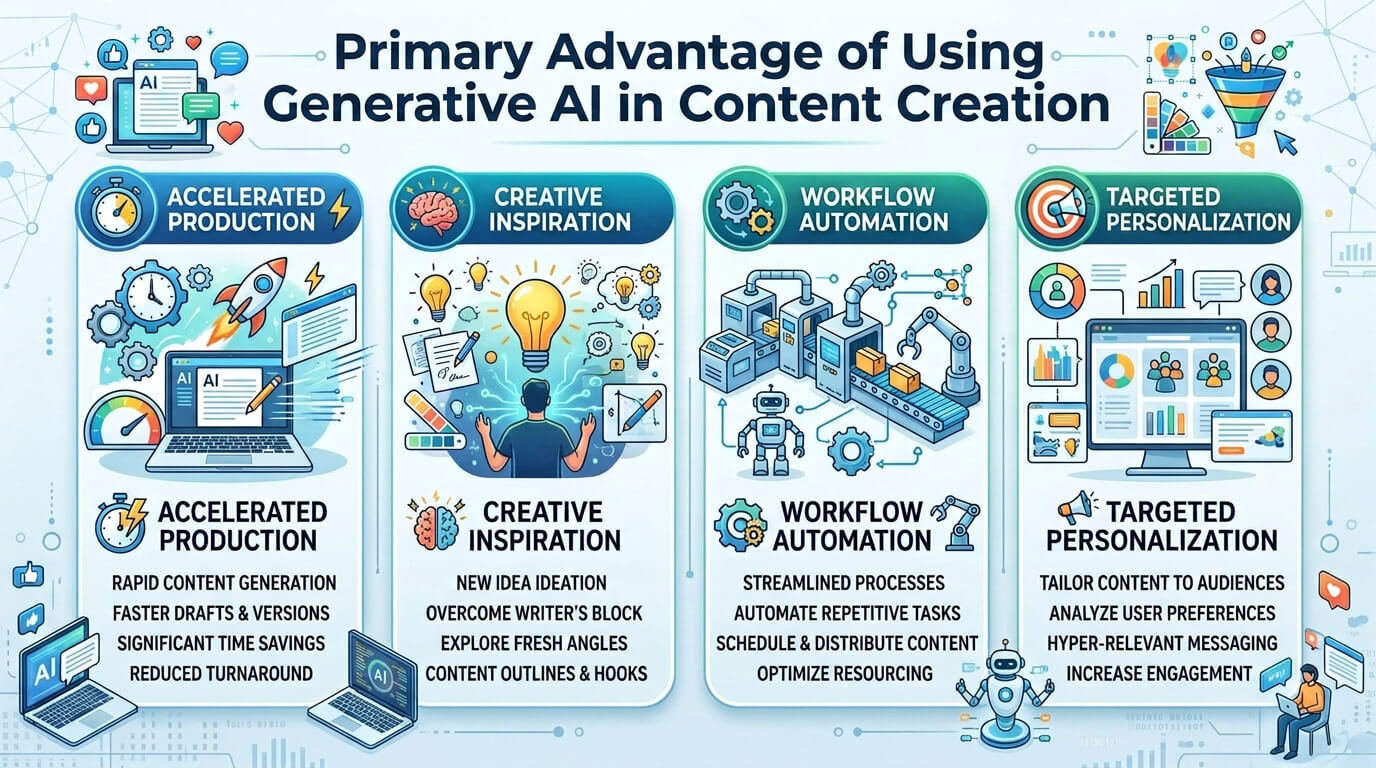
- Enhanced speed and efficiency: Generative AI boosts content production speed by up to 10x, which delivers high quality written and visual drafts within minutes and improves workflow efficiency.
- Significant cost reduction: Generative AI reduces content creation costs by up to 4x compared to traditional human driven production, while still maintaining consistent quality and scalable output across multiple formats.
- Scalability and high volume: Generative AI allows large scale content generation, which produces hundreds of high quality pieces efficiently without requiring additional workforce, time or infrastructure expansion in production pipelines.
- Improved personalization: Generative AI creates highly personalized content by adapting tone, format and messaging for thousands of audience segments using a single base input or template structure.
- Data driven insights integration: Generative AI leverages performance analytics and search data to optimize content creation, which secures outputs that align closely with audience behavior and engagement trends.
- Consistent brand tone: Generative AI maintains a consistent brand voice across all content formats like text, image and video, which secures uniform messaging and identity with minimal manual editing effort.
The primary advantages of using generative AI in content creation is shown in the image below.
What are the challenges of generative AI for content creation?
The challenges of generative AI for content creation are accuracy gaps, originality issues, creative limitations, intellectual property concerns, job displacement risks and measurable environmental impact.
The challenges of generative AI for content creation are mentioned below.
- Accuracy and reliability: Generative AI for content creation produces hallucinated facts in up to 20% of outputs, which requires human fact checking before publication.
- Originality and authenticity issues: Generative AI produces generic outputs based on historical data, which lack true creativity and a unique human perspective in content creation.
- Creative limitations: Generative AI lacks human emotional depth in content creation, which produces outputs that follow existing patterns rather than developing truly original or novel conceptual ideas.
- Intellectual property concerns: Generative AI creates copyright risks when outputs resemble training data, which lacks proper licensing, attribution or clear ownership in commercial content creation.
- Deepfakes and misinformation: Generative AI creates highly realistic but fake images, videos and audio, which manipulate public opinion, damage reputations and create confusion when content is shared without verification.
- Job displacement: Generative AI automates copywriting, graphic design and video editing roles for content creation, which reduces demand for traditional content production job categories.
- Environmental impact: Generative AI requires significant computational resources with large model training for content creation, which generates CO₂ emissions equivalent to five transatlantic flights per training run.
How to use generative AI for content creation?
To use generative AI for content creation, define the content goal, choose an AI tool, write a prompt, generate a draft, optimize the format and publish content. Generative AI follows a structured workflow for content creation that maximizes output accuracy when teams use generative AI platforms with structured prompt frameworks.
10 steps to use generative AI for content creation are given below.
- Define content goal: Select the content format, audience and channel before starting generative AI for content creation to align every subsequent step with measurable output objectives.
- Choose AI tool: Select generative AI tools aligned with your content type, covering text, image and video generation based on documented security and integration requirements.
- Write prompt: Create a structured prompt that clearly defines the content format, tone, target audience and key message to guide the generative AI toward accurate and relevant output.
- Generate draft: Submit the prompt to a selected AI platform to produce initial AI generated written and visual content as draft outputs for review and refinement.
- Refine output: Adjust the prompt parameters, temperature settings or seed values to improve draft accuracy when the initial AI generated content output requires modification.
- Edit content: Use human editorial judgment to fix factual errors, improve sentence structure, improve clarity and guarantee accuracy by verifying information against trusted and documented source standards.
- Optimize format: Structure the AI generated content into the correct format for each publication channel, which include SEO optimized headers, appropriate image dimensions and platform specific character limits.
- Add branding: Integrate brand specific visual elements, tone guidelines and logo placements into the AI generated draft before final review to maintain identity consistency across content.
- Review quality: Assess the completed draft against the original content goals, editorial accuracy standards and brand guidelines before approving any generative AI output for distribution.
- Publish content: Upload the approved final draft to the target platform, scheduling AI generated content for distribution at peak audience engagement times to maximize reach.
What are the best generative AI tools for content creation?
The best generative AI tools for content creation are ChatGPT, Claude, VosuAI, Canva AI, Adobe Firefly, Runway, Midjourney and ElevenLabs. These tools support creative content generation across writing, visual design, video production and audio synthesis for enterprise and individual creator workflows.
The best generative tools for content creation are outlined below.
- ChatGPT: ChatGPT is versatile AI writing tools that generate text, code and ideas quickly, which makes it among the best AI tools for content creators seeking cost effective solutions.
- Claude: Claude is a cost effective AI tool by Anthropic that streamlines workflows for generating research summaries, code and long form content through a transformer based architecture.
- VosuAI: VosuAI is a top generative AI tool that streamlines content creation workflows by providing access to leading models across text, image, video and music formats.
- Canva AI: Canva AI generates branded social media visuals, presentation decks and marketing graphics through integrated AI design tools within a drag and drop platform.
- Adobe Firefly: Adobe Firefly produces high resolution commercial images, text effects and vector graphics using generative AI trained on licensed Adobe stock assets.
- Runway: Runway is among the best AI tools for video editing, motion graphics and AI filmmaking. It allows creators to produce cinematic videos with automated visual effects and editing features.
- Midjourney: Midjourney is widely recognized for artistic AI image generation and concept visualization. It helps designers and creators develop unique visuals, illustrations and creative assets efficiently.
- ElevenLabs: ElevenLabs delivers realistic AI voice synthesis, dubbing and narration tools. It supports podcasts, audiobooks, videos, and multilingual content production with natural sounding speech generation.
How to choose the right generative AI tool for content creation?
Choose the right generative AI tool for content creation by evaluating content goals, output quality, workflow integration, customization, pricing, scalability, privacy and testing. Effective AI content creation requires matching platform capabilities with content formats, editorial standards, production workflows, security requirements and long term business needs.
8 steps to choose the right generative AI tool for content creation are outlined below.
- Define your content creation goals: Establish whether AI content creation requires text generation, image production, video synthesis or audio output before evaluating platforms.
- Identify the type of content you create: Classify each required content format like blog, social media post, video or audio, to match the tool's documented output capabilities.
- Evaluate the quality of AI generated content: Create a content outline and review the first draft output against documented editorial accuracy and brand style standards.
- Check ease of use and workflow integration: Verify that the tool's API, native integrations and interface reduce friction across your primary content production systems.
- Compare customization and editing features: Assess the tool's prompt control depth, style parameter range and manual override options to confirm alignment with complex editorial requirements.
- Review pricing and scalability: Calculate the per output cost at your projected monthly volume and compare across at least 3 competitive platforms before committing to a subscription.
- Assess data privacy and security: Confirm that the tool's data retention policies, encryption standards and user consent mechanisms comply with your organization's regulatory framework before deployment.
- Test the tool before making a final decision: Run 3 production scenarios using the free trial, assessing output speed, quality, accuracy and format compliance before purchasing.
What mistakes should you avoid when choosing an AI tool for content creation?
Mistakes you should avoid when choosing generative AI tools for content creation are outlined below.
- Choosing the wrong tool for the job: Match AI tools to specific content needs such as text, image, video or audio production.
- Ignoring workflow and integration fit: Increase manual effort by 40% when using AI tools without API or CMS integration.
- Relying on popularity over real use cases: Focus on actual output quality instead of market hype when selecting AI tools for workflows.
- Overlooking data quality and training recency: Produce inaccurate results when using AI tools trained on outdated datasets.
- Setting unrealistic expectations: Expect AI to reduce production time rather than fully replace human editorial review and fact checking.
- Neglecting privacy and data security: Expose sensitive content to security risks when using tools without proper data protection policies.
- Skipping fact checking workflows: Allow factual errors in up to 20% of outputs without human verification before publication.
- Underestimating the need for human voice: Lose brand identity when relying on AI generated content without human editing and refinement.
Can generative AI optimize internal content workflows?
Yes, generative AI optimizes internal content workflows by automating content creation tasks, including ideation, drafting and publishing coordination across team based production systems. Generative AI workflow tools generate creative ideas, produce draft content and schedule outputs that reduce manual coordination effort by up to 40%.
Can you maximize content quality with generative AI?
Yes, you can maximize content quality with generative AI by combining structured prompt engineering, editorial review and data driven optimization to produce quality content at scale. Generative AI leverages diverse media formats, creates content outlines to guide structure and delivers personalized content experiences across four distinct audience segments.
Can generative AI create images?
Yes, generative AI can create images because advanced text to image or image to image models transform prompts into detailed visuals, illustrations and realistic AI image outputs. VosuAI supports AI image generation through models like Nano Banana Pro and Flux 2 that help creators produce artistic, cinematic and professional quality images efficiently.
Can generative AI create videos?
Yes, generative AI creates videos by processing text and image inputs through video generation models that produce cinematic clips with synchronized audio and frame level motion consistency. VosuAI supports text to video and image to video generation through models like Veo 3, which allows AI video output at 4K from a single prompt.
Which is the best generative AI model for video?
The best generative AI model for video is Kling 3.0, which delivers multi-shot consistency, advanced motion control and synchronized audio across cinematic clip sequences up to 10 seconds in duration.
Can I create music using generative AI?
Yes, you can create music using generative AI by generating background tracks from text prompts that describe musical style, instrumentation and mood. Generative AI accepts style descriptions and mood inputs to compose tracks in specific genres within 30 seconds per generation. VosuAI supports royalty free music generation for video, podcast and social media content from structured prompts.
Which is the best generative AI model for music?
The best generative AI model for music is Suno v5.5. It generates studio quality tracks with vocals, harmonies and multi instrument arrangements from style descriptions and mood inputs in under 60 seconds.
How much does generative AI for content creation cost?
The cost of generative AI for content creation ranges from 10 USD to 100 USD per month. It depends on the pricing model, use case, token cost, content quality, generation speed, and the type of media, such as images, videos, or music. VosuAI offers multiple pricing tiers, including Starter, Pro, and Enterprise plans ranging from 10 USD to 99 USD per month, making AI production up to 4x cheaper than human content.
What is the future of generative AI for content creation?
The future of generative AI for content creation will make automated content creation faster and more personalized across AI generated articles, social media posts and AI image, video and music production. Businesses will be able to scale and bulk create content efficiently while delivering audience specific campaigns customized to different platforms, preferences and trends in the evolving marketing landscape.