
Artificial intelligence (AI) is a field of technology that enables computer systems to perform tasks that require human-like reasoning, learning, perception and decision making. It provides systems that process language understanding, pattern recognition and intelligent decision making to support automation and data driven outcomes in complex environments. It is widely applied across sectors such as healthcare, finance, manufacturing and education to improve efficiency, accuracy and scalability of operations.
AI works through a structured pipeline including problem definition, data collection, data preparation, algorithm selection, model training, evaluation, deployment and monitoring. It transforms raw data into structured inputs and learns patterns from training data to generate predictions and decisions. It improves continuously by testing performance on unseen data and refining models based on error reduction and feedback loops that ensure better accuracy and adaptability in real world applications.
Artificial Intelligence relies on key technologies like machine learning, deep learning, neural networks, reinforcement learning, natural language processing, computer vision and generative AI. It powers use cases such as customer support automation, healthcare diagnosis, fraud detection, retail personalization, content creation, transportation systems, manufacturing optimization, recruitment, marketing and cybersecurity, improving speed, accuracy and decision making across multiple industries and enabling scalable intelligent systems.
What is artificial intelligence?
Artificial intelligence (AI) is a technology discipline that replicates human cognitive abilities, including reasoning, learning and perception, inside computational systems. It encompasses functions which require human intelligence such as language understanding, pattern recognition and decision making. AI systems use algorithms to handle complex tasks that previously required direct human judgment. Artificial intelligence supports cognitive tasks across more than 20 documented industry sectors, from healthcare and finance to manufacturing and education.
How does AI work?
AI works through several stages, which include problem definition, data collection, model training, AI deployment and monitoring and improvement to achieve accurate and efficient results. It allows machines to learn from data, recognize patterns and perform tasks that usually require human intelligence.
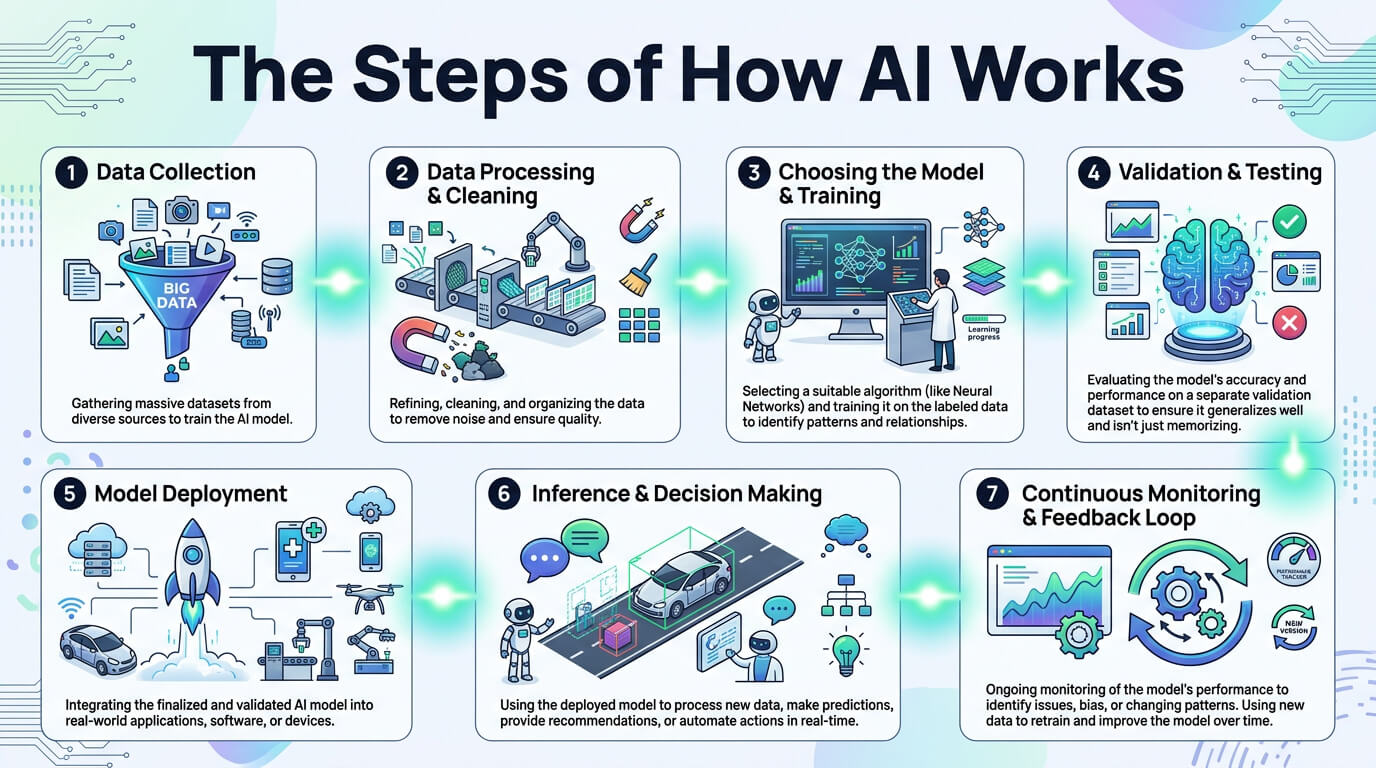
8 steps of how AI works are outlined below.
1. Problem definition
2. Data collection
3. Data preparation
4. Algorithm selection
5. Model training
6. Evaluation and testing
7. Deployment
8. Monitoring and improvement
The steps of how AI works are shown in the image below.
1. Problem definition
Artificial Intelligence frames a problem by mapping a human-led process into structured elements, translating vague goals into analyzable components and recognizing constraints from data and context. It identifies the goal through specifying a target state, measuring desired outcomes and aligning objective functions with stakeholder intent.
AI turns the goal into a clear task through decomposing objectives into subproblems and actionable steps suitable for Machine Learning workflows. It defines inputs and outputs by selecting features, labels and evaluation metrics and sets a success area, converting performance thresholds and trade offs into a model ready problem.
2. Data collection
Artificial intelligence collects data from multiple sources to train and improve machine learning models. It extracts public data, analyzes user interactions and gathers information through web scraping, surveys, APIs, transaction records and connected devices.
Artificial intelligence processes collected information through a data processing pipeline that includes cleaning, handling missing values and transforming raw information for analysis. It identifies patterns, while GANs supplement real data in some cases. GANs generate up to 100,000 synthetic samples from a seed distribution of fewer than 1,000 real examples. AI requires ethical data collection practices that address privacy, consent, transparency, security and bias reduction.
3. Data preparation
Artificial intelligence prepares data by organizing raw datasets into a structured format suitable for machine learning models. It cleans data through correcting errors, handling missing values and eliminating duplicates and outliers to improve data quality and consistency.
Artificial intelligence applies data transformation techniques such as normalization, encoding and dimensionality reduction to make datasets easier to analyze. It also uses feature engineering to create meaningful variables from existing data, which boosts model performance about 30% to 70% and helps algorithms identify patterns more accurately.
4. Algorithm selection
Artificial intelligence selects algorithms by analyzing problem characteristics, objectives and available data before training a model. It evaluates data characteristics such as size, structure, quality and complexity to match specific algorithms with the task and expected outcomes.
Artificial intelligence considers computational constraints, accuracy requirements and processing speed when choosing an approach. It uses algorithm categories such as decision trees, neural networks, clustering methods and regression models depending on the problem type. Automated machine learning (AutoML) further streamlines this process by testing and selecting suitable algorithms with minimal human intervention.
5. Model training
Artificial intelligence trains a model by learning from curated data and analyzing relationships within examples. It compares data with the correct answers during supervised learning to measure errors and understand how well its predictions match the expected outcomes.
Artificial intelligence learns by adjusting internal parameters to reduce errors and improve accuracy over time. It can also use unsupervised learning to identify complex patterns in data without labeled answers. It makes predictions though applying learned patterns to new information, often utilizing probabilistic models to estimate the most likely outcomes.
6. Evaluation and testing
Artificial intelligence evaluates and tests models by measuring how accurately they perform on tasks after training. It tests unseen data to determine whether learned patterns generalize beyond the training dataset and to identify potential weaknesses.
AI uses core testing methods such as train-test splits, validation datasets and performance metrics to assess reliability. It also applies advanced evaluation techniques to address biases, examine unusual cases and measure robustness under different conditions. It can further evaluate ensemble models to determine whether combining multiple models improves overall accuracy, stability and predictive performance.
7. Deployment
Artificial intelligence deployment is the process of making a trained AI model available for real world use in applications, websites or business systems. It involves containerizing the model, integrating it with production environments and preparing it to handle live data and user requests.
AI deployment uses strategies such as cloud, on-premises, edge and hybrid deployment depending on performance and infrastructure needs. It may use tools and platforms such as Kubernetes and TensorFlow Serving to manage, scale and deliver predictions efficiently. It also requires teams to validate new model versions, monitor performance and ensure security throughout the deployment lifecycle.
8. Monitoring and improvement
Artificial intelligence is monitored and improved by continuously tracking how well it performs in real world environments after deployment. It detects performance issues through measuring error rates, prediction accuracy and other key metrics that reveal declines in model effectiveness.
Artificial intelligence adapts to changing customer behavior by collecting new data and analyzing emerging patterns. It uses this information to retrain the model so it can maintain accuracy and relevance over time. It then tests the updated model on validation datasets before deployment to confirm that performance, reliability and prediction quality have improved.
What are the key technologies that work behind artificial intelligence?
The key technologies that work behind artificial intelligence involve machine learning, deep learning, neural networks, reinforcement learning, natural language processing, computer vision and generative AI. These technologies allow AI systems to learn from data, recognize patterns, analyze images and generate human like content across different applications.
The key technologies that work behind artificial intelligence are given below.
- Machine learning: Machine learning trains AI systems on labeled datasets to identify patterns and make predictions without explicit programming for each new input type.
- Deep learning: Deep learning uses layered neural networks to analyze complex data that includes images and speech, which extracts hierarchical features with increasing abstraction at each layer.
- Neural networks: Neural networks process input data through interconnected nodes arranged in layers, where each node applies a weighted function and passes the result forward.
- Reinforcement learning: Reinforcement learning trains AI agents through a reward and penalty system, where the agent selects actions that maximize cumulative reward across repeated interactions.
- Natural language processing: Natural language processing equips AI systems to understand, interpret and generate human language from text and speech inputs across translation, summarization and sentiment analysis tasks.
- Computer vision: Computer vision allows AI systems to interpret visual data from images and video, which supports tasks like object detection, facial recognition and autonomous navigation.
- Generative AI: Generative AI creates new data like text, images, audio and video, by learning the statistical distribution of training data and sampling from that distribution.
What are the use cases of artificial intelligence?
The use cases of artificial intelligence include customer support, retail personalization, healthcare, fraud detection and content creation. These cover industries where artificial intelligence delivers documented productivity improvements through pattern recognition and intelligent automation processes.
The use cases of artificial intelligence are given below.
- Customer support: AI powers chatbots and virtual assistants that provide instant support, answer common questions and reduce response time while improving service availability.
- Retail personalization: AI analyzes customer behavior to personalize customer experiences, recommend products and increase engagement through customized offers and intelligent shopping journeys.
- Healthcare: AI supports diagnosis, treatment planning, and medical imaging analysis that helps professionals handle highly specialized tasks more accurately and efficiently.
- Fraud detection: AI monitors transactions and patterns to spot suspicious activity quickly, strengthening security and reducing financial losses through Intelligent Automation Processes.
- Content creation: AI assists with writing, image generation and video production that allows faster creative workflows and scalable content output.
- Transportation: AI improves navigation, route optimization, and autonomous systems, which makes travel safer, smarter and more efficient.
- Manufacturing: AI powers predictive maintenance, quality control and robotics, improving productivity and reducing downtime in industrial operations.
- Recruitment: AI screens resumes, matches candidates, and streamlines hiring by helping teams identify suitable talent faster and more consistently.
- Marketing: AI improves targeting, campaign optimization and customer insights, which allows brands to deliver more relevant messages and measure performance better.
- Cybersecurity: AI detects threats, analyzes anomalies and responds to attacks faster that helps organizations protect systems and data continuously.
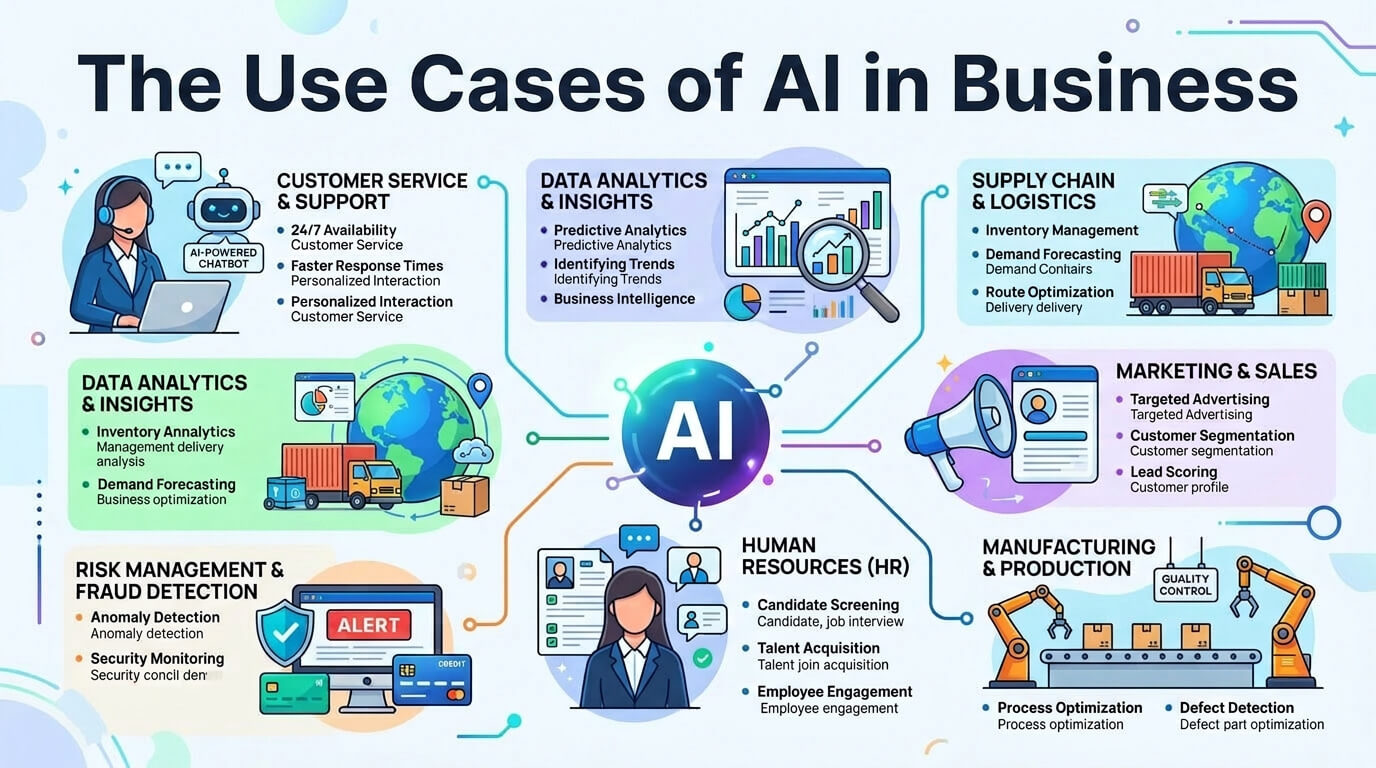
The use cases of AI in business are shown in the image below.
Is it beneficial to use artificial intelligence?
Yes, it is beneficial to use artificial intelligence because it improves efficiency by automating repetitive tasks and reducing human error, which allows faster and smarter decisions. This leads to innovation across industries, improved safety protocols through better monitoring and prediction and broad benefits of artificial intelligence for businesses and society.
Does using artificial intelligence have challenges?
Yes, using artificial intelligence does have challenges because it creates serious data privacy risks when vast amounts of personal information are collected, stored and analysed. AI systems also introduce security vulnerabilities that attackers can exploit and rely on high environmental energy use, which increases emissions and pressure on natural resources.
Does AI make mistakes?
Yes, AI does make mistakes**, as AI systems generate entirely fabricated information when training data contains gaps, conflicts or underrepresented domains.** AI models can not independently verify factual truth, with documented hallucination rates that range from 3 to 15% across major language model evaluations. AI output errors require human review and post deployment monitoring to prevent incorrect downstream decisions.
Can AI think like humans?
No, AI can not think like humans because it processes information differently from our biological cognition and only mimics human like reasoning based on patterns in data. It follows programmed algorithms without consciousness, emotions or lived experience, while human thought is intuitive, self aware and grounded in complex brain biology.
How does AI learn from data?
AI learns from vast datasets by detecting statistical patterns that connect inputs like images or text to desired outputs or labels. It repeatedly compares its predictions with the correct answers and measures the error. AI improves performance through adjusting internal parameters such as neural network weights, so its responses become more accurate and generalize better to new, unseen data.
Does AI need large amounts of data to learn well?
Yes, AI needs large amounts of data to learn well, though new research indicates over 90% accuracy in specialized domains.
What is the difference between AI and machine learning?
The difference between AI and machine learning is that artificial intelligence is the broader discipline and machine learning is one method within that discipline. Machine learning learns from data patterns to improve accuracy in AI models across supervised, unsupervised and reinforcement learning. Artificial intelligence also includes rule based systems and expert systems alongside machine learning as documented implementation categories.
How does generative AI work?
Generative AI works by learning statistical patterns in training data through neural networks and generating new content from a text prompt. It identifies patterns in training data and makes predictions about the most probable output sequence through autoregressive decoding. This model uses data collection, pattern learning, prompt processing and content generation to create text, images or audio from user requests.