Generative AI learns patterns from large datasets and generates new content like text, images, audio or code that resembles human created outputs. It uses deep learning models, especially transformer based neural networks, trained on vast amounts of data to predict and construct likely outputs based on user prompts. It analyzes context, identifies patterns and generates consistent responses to prompts through sampling from learned probabilities. It is widely used in business, education and creative industries to automate workflows, support innovation and improve customer experiences.
Generative AI improves data analysis and decision making by turning complex data into clear insights and supporting faster AI powered decisions. It automates repetitive tasks and improves communication, which streamlines operations and workflows. It helps reduce costs and save time through automating routine work, which lowers operational expenses and shortens business process cycles. It improves creativity and content creation through generating ideas and supporting AI driven content across text, images, audio and video formats. It also allows new product development and customization by accelerating prototyping and design while delivering customized solutions for specific user needs.
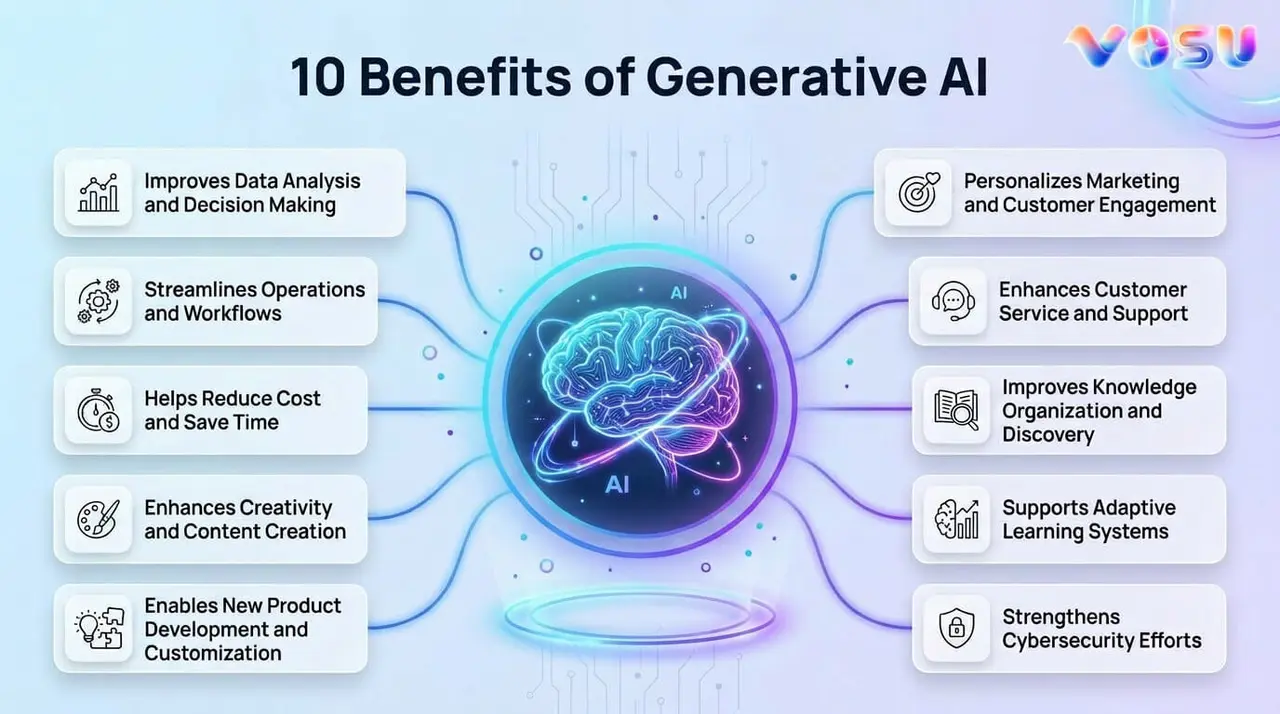
10 benefits of generative AI are listed below.
1. Improves data analysis and decision making
2. Streamlines operations and workflows
3. Helps reduce cost and save time
4. Enhances creativity and content creation
5. Enables new product development and customization
6. Personalizes marketing and customer engagement
7. Enhances customer service and support
8. Improves knowledge organization and discovery
9. Supports adaptive learning systems
10. Strengthens cybersecurity efforts
1. Improves data analysis and decision making
Generative AI improves data analysis and decision making through turning complex data into clear, narrative style insights that even non‑technical users understand. It acts like an AI powered analyst that speeds up analysis and response in the range of 15 to 20%, which simplifies tasks such as summarizing reports and spotting trends. Generative AI makes data accessible with natural language queries, which allow users to interpret data without needing SQL. It improves data quality and depth by cross checking patterns, filling gaps and surfacing hidden signals. It supports better and faster decisions through combining descriptive and predictive analytics and risk assessments, which amplifies the real world benefits of generative AI in data analysis.
2. Streamlines operations and workflows
Generative AI streamlines operations and workflows by automating routine tasks that would otherwise consume large amounts of manual effort. It handles repetitive, language heavy tasks such as drafting emails, generating reports and organizing files, which cuts hours of manual work from daily processes. Generative AI also connects and simplifies cross team communication through turning meetings, notes and chats into structured summaries and action items. It interprets unstructured data, suggests next steps and adjusts to changing priorities, which makes workflows smarter and adaptive. Generative AI reduces bottlenecks and improves clarity, which speeds up decision making and boosts productivity across the organization through process automation.
3. Helps reduce cost and save time
Generative AI helps reduce cost and save time by automating repetitive, manual tasks that teams previously handled one by one. It automates routine work such as drafting responses, classifying documents and generating reports, which shortens workflows and cycle times across departments. It powers chatbots and helpdesk agents that resolve common queries without human intervention, which reduces operational and support costs. This reduces related expenses by around 10 to 20% and, in focused areas, leads to organizations reaching 25 to 40% savings in specific functions. It improves accuracy and throughput while catching errors early, which reduces rework. This also boosts productivity, which supports the scaling of generative AI automation across processes.
4. Enhances creativity and content creation
Generative AI enhances creativity and content creation by expanding idea generation through diverse perspectives and the ability to connect distant concepts. It suggests fresh angles, headlines and story structures that spark human imagination, which helps break creative blocks. Generative AI supports automated content production, which drafts blogs, scripts and social posts quickly while maintaining consistency and style. It works across multiple creative formats such as text, images, audio and video, which allows teams to repurpose core messages into rich multimedia assets. It combines speed, variety and consistency, which gives creators more freedom to experiment and produce higher quality work in less time.
5. Enables new product development and customization
Generative AI enables new product development and customization by accelerating both idea generation and design creation. It analyzes market data, feedback and competitor products to generate product ideas and customized variants that align with real world demand. Generative AI then turns ideas into mock ups and prototypes, which boost prototyping and optimization speed. It customizes features, designs and interfaces to match individual user preferences at scale, which powers mass personalization. Generative AI deepens customer centric innovation and ensures that offerings match precise needs. It accelerates product development cycles, improves quality outcomes and allows more personalized experiences, which brings products to market faster and more effectively.
6. Personalizes marketing and customer engagement
Generative AI personalizes marketing and customer engagement by customizing content for each customer based on signals such as browsing history and purchase behavior. It uses data to cluster customers into micro-segments with highly specific preferences, which improves segmentation and targeting. It adjusts website layouts, product recommendations and messaging to match individual intent, which personalizes customer journeys. Generative AI models like chatbots and virtual assistants deliver 24/7 personalized support through answering questions and guiding users in real time. Generative AI increases engagement, loyalty and conversions across customer interactions, which leads to stronger marketing results.
.
7. Enhances customer service and support
Generative AI enhances customer service and support by acting as a 24/7 assistant for customers, providing faster responses and round the clock availability. It adapts responses and offers based on past conversations, user profiles and language preferences, which enables personalized and context aware interactions. Generative AI suggests replies, summarizes cases and surfaces relevant information that improves agent productivity. It analyzes tickets, feedback and patterns to generate insights and help continuously improve answer quality and workflows. These capabilities improve generative AI in customer service, which increases resolution speed, satisfaction and efficiency.
8. Improves knowledge organization and discovery
Generative AI improves knowledge organization and discovery by turning unstructured information into a smart knowledge base that is easy to search and maintain. It summarizes documents, meeting notes and emails into organized, searchable entries, which automates knowledge capture and structuring. It lets users ask questions in natural language and get direct answers instead of browsing folders, which makes discovery fast and conversational. Generative AI connects related concepts across different sources and highlights hidden patterns, which surface insights that were previously buried. It also identifies gaps and suggests updates that keep knowledge fresh and relevant and improve how organizations store, find and use information across teams.
9. Supports adaptive learning systems
Generative AI supports adaptive learning systems by turning all courses into personalized learning paths customized to each student’s level, pace and learning style. It generates personalized content on demand such as examples, practice questions and explanations that match individual needs. Generative AI diagnoses errors and suggests next steps in real time to provide instant and adaptive feedback. It adjusts the learning path dynamically as performance changes and helps learners progress without frustration. Generative AI supports different learning styles and needs by acting like an AI tutor and generating simpler analogies. This makes learning more engaging, accessible and effective for students.
10. Strengthens cybersecurity efforts
Generative AI strengthens cybersecurity efforts by improving threat detection and anomaly analysis that flags subtle deviations and indicates phishing, malware or zero day attacks. It automatically surfaces suspicious patterns, which accelerates incident response and remediation while reducing mean time to detect (MTTD) and mean time to respond (MTTR). Generative AI automates routine security tasks such as log analysis, alert triage and report generation that frees analysts for complex work. It simulates realistic tactics, techniques and procedures (TTPs) and generates training scenarios for red team exercises, which strengthens threat intelligence and preparedness. Generative AI strengthens cybersecurity in prevention, detection and response through improving access control and data protection through context aware policies.
What are the limitations of generative AI?
The limitations of generative AI are hallucinations and inaccuracy, bias and misinformation, data privacy and security, outdated information and ethical and legal issues. These challenges make it important to use generative AI with proper oversight, validation and human judgment.
The limitations of generative AI are outlined below.
- Hallucinations and inaccuracy: Generative AI produces plausible but false outputs, which produce hallucinations when the model guesses instead of recalling facts, especially when the training data quality is weak or incomplete.
- Bias and misinformation: Generative AI reflects biases present in its training data, which amplify stereotypes and spread misinformation if not carefully monitored and filtered.
- Data privacy and security: Generative AI exposes proprietary or personal data because prompts and interactions can be stored and used to retrain future models, which raises serious privacy and compliance concerns.
- Lack of context and true understanding: Generative AI lacks genuine comprehension and misinterprets nuanced or domain specific context, which leads to shallow or irrelevant responses.
- Outdated information: Generative AI relies on its training data cut off and does not reliably account for events or knowledge that emerged after that date.
- Ethical and legal issues: Generative AI raises ethical and legal challenges around copyright, deepfakes, accountability and misuse, with unclear ownership of AI generated content.
- High resource consumption: Generative AI demands large computational power and energy, which makes training and deployment expensive and environmentally taxing.
How does poor data quality limit generative AI performance?
Poor data quality limits generative AI performance by poisoning the model’s ability to learn accurate patterns from its training data. It causes the model to learn inconsistencies and gaps in training data, which produces biased outputs. It degrades generative AI reliability, where 85% of projects fail because the underlying data does not support trustworthy outputs.
Is generative AI beneficial for businesses?
Yes, generative AI is beneficial for business because it drives increased productivity, improves customer experience and reduces operational costs. It automates repetitive tasks while reducing labor and infrastructure costs across marketing, support and operations, which helps organizations deliver faster results.
What industries benefit most from generative AI?
Industries that benefit most from generative AI are healthcare and life sciences, financial services, retail and e commerce, manufacturing and technology and software. These sectors use generative AI for drug discovery, personalized banking, dynamic product recommendations, smart design and maintenance and accelerated coding and testing. These sectors gain advantages in innovation, efficiency and customer experience.
Can I create an AI image using generative AI?
Yes, you can create an AI image using generative AI because it learns patterns from large datasets and generates new visuals from text or visual inputs. Generative AI models like Nano Banana 2 and Flux 2 allow high quality, detailed image creation with speed, consistency and creative flexibility.
Can I create an AI video using generative AI?
Yes, you can create an AI video using generative AI because modern tools generate videos from text prompts or images. These models turn descriptions of scenes, actions or moods into short AI video clips. They also animate still images into dynamic sequences, which allows creators to produce engaging content without complex editing or filming.
What are the common generative AI tools?
The common generative AI tools are ChatGPT (OpenAI), Claude (Anthropic), Kling AI and Sora. ChatGPT excels at conversational text, coding and multi-purpose content. Claude is strong at long document reasoning and nuanced writing. Kling AI generates high quality AI video from text prompts or images for social and marketing use. Sora creates realistic, cinematic video clips from natural language descriptions.
What is the future of generative AI?
The future of generative AI is shifting from simple content generation to autonomous agentic AI systems that plan, decide and act across tasks. Generative AI is shaping the future by embedding multimodal capabilities into everyday workflows. This allows seamless creation and interaction across text, images, audio and video, while driving economic impact in sectors such as healthcare, finance and manufacturing.