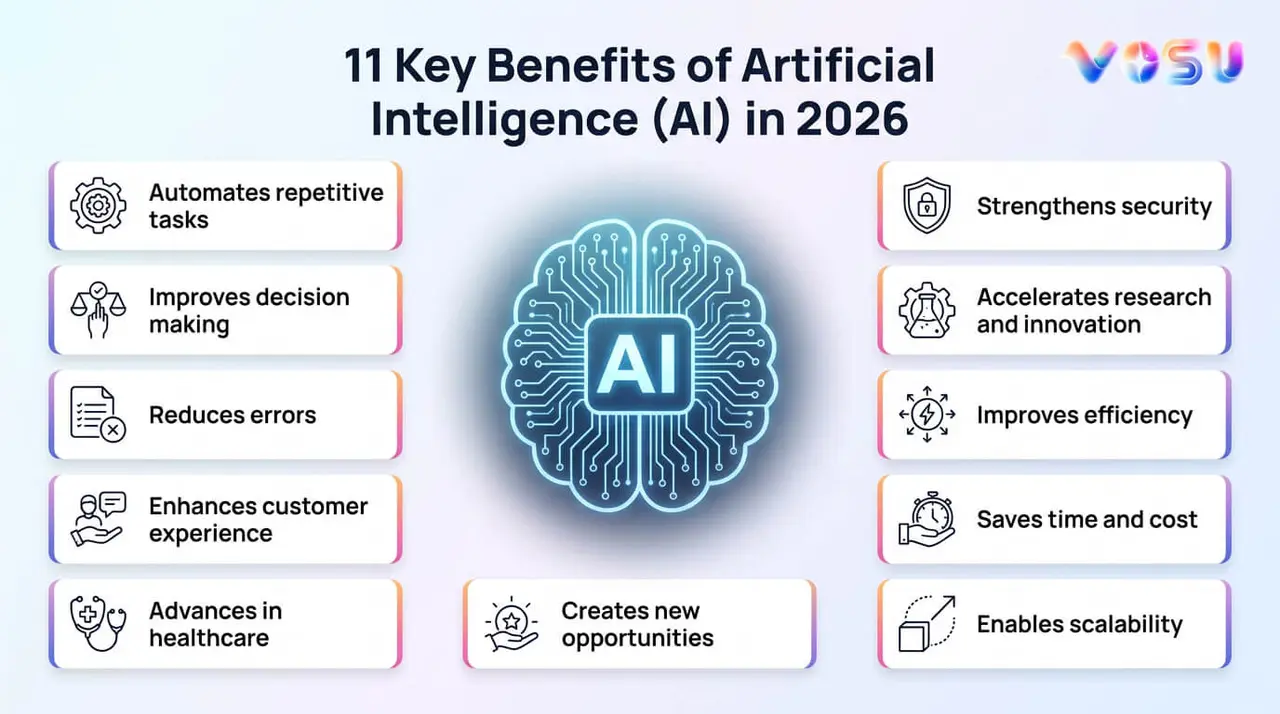
11 key benefits of artificial intelligence include automating repetitive tasks, improving decision making, reducing errors, enhancing customer experience and advances in healthcare. AI uses technologies like machine learning, robotic process automation and language models to handle repetitive work such as data entry, scheduling and customer support. It analyzes large volumes of data and generates insights, which improve decision making and help organizations respond faster and more effectively. It minimizes errors through validation systems, standardized processes and real time monitoring, which help detect and prevent issues early.
AI improves customer experience through personalized interactions, 24/7 support and seamless interactions across multiple channels. It improves diagnosis, supports personalized treatments, accelerates drug discovery and improves patient care. These advantages of AI make systems more efficient, reliable and scalable across industries. AI also produces inaccurate results, reflects data bias, lacks true understanding, shows limited creativity and relies on outdated knowledge. These highlights the limitations of AI.
11 advantages of artificial intelligence are listed below.
1. Automates repetitive tasks
2. Improves decision making
3. Reduces errors
4. Enhances customer experience
5. Advances in healthcare
6. Strengthens security
7. Accelerates research and innovation
8. Improves efficiency
9. Saves time and cost
10. Enables scalability
11. Creates new opportunities
1. Automates repetitive tasks
AI automates repetitive tasks by using robotic process automation (RPA), machine learning and language models to execute routine operations without constant human input. It works through predefined rules and structured workflows to perform data entry and form filling with speed and accuracy. AI automates business processes such as invoice processing, customer query handling, scheduling, report generation, resume screening and employee onboarding. These tasks are completed through automated systems that reduce dependency on manual labor and assure consistent output.
AI reduces manual work by processing large volumes of data, identifying patterns, organizing information and making simple decisions automatically through machine learning. It further improves communication based operations using language models for customer support and email handling that increases efficiency, speed and operational consistency.
2. Improves decision making
AI improves decision making by using data, automation and real time insights to allow faster and more accurate choices. It applies AI algorithms to analyze patterns in customer behavior, sales trends and market changes, which supports data driven decisions instead of guesswork. AI accelerates decision making through real time data processing from multiple sources, which allows organizations to respond quickly to changing conditions. It reduces the impact of cognitive biases that distort human judgment, which improves accuracy and leads to fairer, more reliable outcomes.
AI strengthens prediction and scenario planning by analyzing historical trends and forecasting possible future outcomes. It also automates routine, rule based decisions such as approvals, transaction sorting and workflow management using generative AI, which reduces manual effort and increases efficiency. It improves speed, accuracy and overall efficiency that supports AI in decision making.
3. Reduces errors
AI reduces errors through automation, validation and real time monitoring, which improves accuracy and keeps business operations stable. It removes human weaknesses in routine work such as fatigue, distraction and manual oversight to help minimize mistakes in repetitive tasks. AI applies consistent rules and strict validation checks so that accurate data enters the system, which helps prevent defective or inaccurate data. It reduces manual intervention and runs processes in a controlled, standardized way that cuts operational errors.
AI uses real time monitoring to track activities as they happen, detect issues early and allow quick corrections. It learns from historical error patterns to improve future performance and avoid repeating the same mistakes. It uses prediction to identify risks in advance so that problems can be fixed before they grow. It analyzes past data and trends to anticipate potential failures or inconsistencies, which allows proactive action.
4. Enhances customer experience
AI enhances customer experience by understanding customer behavior and interactions. It analyzes customer data and provides recommendations customized to each customer's interests and purchase history. AI personalizes interactions at scale through changing messages, offers and support based on users’ needs, which makes customer experiences more relevant and effective. It provides 24/7 fast support through chatbots and virtual agents, which allow instant responses to customer queries. It cuts wait times through the handling of multiple requests without delay.
AI creates smooth omnichannel journeys by integrating interactions across websites, apps, email and social media. This allows customers to continue conversations smoothly without repeating information. It anticipates customer needs through the analysis of past behavior and the prediction of future actions, which helps prevent issues before they occur. It makes customer service faster, smarter and more proactive, which further strengthens AI in support systems.
5. Advances in healthcare
AI advances healthcare by supporting frontline clinical work, automating repetitive tasks and analyzing complex medical data. This improves diagnosis, treatment and patient care. It helps doctors analyze medical images such as X-rays, MRI, CT scans and pathology slides with better accuracy. It spots early signs of cancer and detects abnormal heart rhythms from reports and test results, which improves early diagnosis and allows faster medical decisions.
AI allows personalized care through analyzing patient history, genetics and lifestyle data. It helps doctors choose treatments that better match each patient’s condition, reduces trial and error and improves recovery outcomes. AI accelerates drug discovery as it analyzes biological data and estimates how medicines may work. It improves hospital operations and remote care through better monitoring, faster workflows and virtual health support, which strengthens the role of AI in healthcare.
6. Strengthens security
AI strengthens security through faster threat detection, smarter access control and automated protection across digital systems. It analyzes network traffic, system logs, user behavior and access patterns to detect suspicious activity early, which is the main benefit of AI in cybersecurity. It finds patterns linked to known attacks and spots unusual behavior that deviates from normal usage, which improves threat detection. It helps security teams signal a cyberattack even when attackers use new methods that traditional rule based systems may miss.
It also automates routine protection work such as machine learning, behavioral analytics and natural language processing to monitor systems in real time. It verifies identity through behavior patterns, device signals and contextual risk analysis, which strengthens access control and authentication. It also analyzes context, user history and risk levels before flagging suspicious activity that helps improve alert triage. This process reduces false alerts and improves security team efficiency, which strengthens AI in cybersecurity.
7. Accelerates research and innovation
AI accelerates research and innovation through faster information processing, automated analysis and better prediction of future outcomes. It helps researchers save time, improve accuracy and turn ideas into real results more quickly. AI scans millions of papers, patents and reports in a short time, which makes literature review faster and supports better idea generation. It summarizes key findings and extracts relevant data from large sources that help researchers find information without delay.
AI automates experiments and data analysis through fast pattern recognition and continuous monitoring. This process reduces manual work, improves accuracy and helps researchers manage complex data more efficiently. AI analyzes past data and identifies possible future outcomes, which improves predictive modeling and simulation. It allows virtual testing before real experiments, which supports shrinking discovery timelines and lowering research costs. It also allows faster product development and R&D cycles, which is one of the major benefits of AI research.
8. Improves efficiency
AI improves efficiency through faster task completion, better resource use and smarter decision making in daily operations. It helps businesses save time, reduce costs and improve workflow performance with less manual effort. AI automates repetitive, low value work such as data entry, scheduling, report generation and customer support. This process helps reduce hours of manual effort and allows employees to focus on strategic and creative responsibilities.
AI speeds up tasks and workflows through quick information processing while handling multiple operations at the same time. It delivers 5 to 66% productivity gains because routine work finishes faster with fewer delays. AI also improves decision making because it analyzes large datasets and finds useful patterns that people may miss. This helps managers use time, staff and budget more effectively, which strengthens operational efficiency through AI.
9. Saves time and cost
AI saves time and cost through faster task completion, lower operating expenses and better use of business resources. It handles repetitive work quickly, which improves efficiency and supports smarter business growth. AI completes routine tasks like data entry, customer support, scheduling and report creation without constant human effort that saves time through automation. This process helps employees save 3 to 5 hours per week and focus on more important responsibilities.
AI brings 66% productivity gains for many companies because daily operations become faster and more organized. It reduces labor and operating costs through less manual work, fewer human errors and smoother workflow management. This leads to 10 to 25% cost reductions in areas like finance, customer service, supply chain and manufacturing. AI allows companies to grow and handle increasing workloads without a proportional increase in costs or staff, which supports scalability. This combination of automation, efficiency and resource optimization saves time and reduces expenses in modern business environments.
10. Enables scalability
AI enables scalability through faster processing, automated workflows and better resource management as business demand grows. It processes large and continuously growing volumes of data, which makes it capable of scaling with data and users while maintaining speed and accuracy. It serves millions of users at once and maintains smooth performance during peak demand, which helps support fast growing markets.
AI extends across departments such as customer service, sales, operations and fraud detection. It allows businesses to use one intelligent system instead of paying for separate tools. AI automates routine work like customer responses, report generation and system monitoring as demand increases. This secures that growing workloads are managed smoothly without requiring a proportional increase in human labor. It also optimizes infrastructure and costs through smart resource allocation, which improves efficiency and reduces unnecessary spending.
11. Creates new opportunities
AI creates new opportunities by transforming how people work, build businesses and access advanced technology. AI creates new industries and business models such as personalized healthcare, AI assisted creative tools, intelligent automation services and data driven platforms. These innovations expand the opportunities of artificial intelligence across global markets and open entirely new areas for economic growth.
AI also creates new job roles such as AI prompt engineers, AI product managers and MLOps engineers. It reshapes career paths and will create millions of new jobs by 2030 as organizations increasingly adopt AI systems. AI supports individuals and small teams by helping them create content, design products and automate tasks without heavy resources. It also makes advanced capabilities like automation, analytics and intelligent decision making systems more affordable and accessible, which supports growth in emerging markets.
What are the limitations of AI?
The limitations of AI include accuracy and reliability, data bias and quality, lack of context, limited creativity and reasoning and the black box problem. These limitations affect reliability in real world tasks and decision making, which reduces trust in AI because users can not verify results or see how outputs are produced.
The limitations of AI are outlined below.
- Accuracy and reliability: AI sometimes produces incorrect answers because it relies on data patterns and hallucinates. It produces confident but wrong outputs when the input is unclear or incomplete.
- Data bias and quality: AI learns from training data, so low quality or biased data lead to unfair or imbalanced results. It performs poorly when the input data is inconsistent or unreliable.
- Lack of context and true understanding: AI struggles with context because it does not truly understand meaning as humans do. It misreads situations and responds in ways that feel off in complex or nuanced conversations.
- Limited creativity and reasoning: AI relies on patterns in past data, so it struggles with deep thinking and original ideas. It can not fully match human judgment, intuition or emotional understanding.
- Data cutoffs and currency: AI does not always have the latest information because its training data can be outdated. It misses recent events or changes in fast moving situations.
- Black box problem: AI systems are difficult to fully explain because users cannot clearly see how decisions are made. It is hard to understand or trust the reasoning behind some outputs.
- Narrow expertise: AI performs well in specific tasks but does not have broad general intelligence. It struggles when facing unfamiliar problems outside its trained area.
How to overcome limitations of AI?
Strategies to overcome the limitations of AI are outlined below.
- Improve data quality: Use clean, accurate and well structured datasets to reduce errors and support reliable predictions in real world applications.
- Implement human in the loop (HITL): Include human oversight to review AI outputs, handle complex cases and improve accuracy, safety and contextual understanding in decisions.
- Use retrieval augmented generation (RAG): Connect AI systems to external knowledge sources to improve factual accuracy, provide updated information and reduce outdated or incorrect responses.
- Adopt explainable AI (XAI): Ensure AI decisions are transparent and understandable so users can trust outputs, identify errors and recognize possible biases in results.
- Continuous monitoring and updating: Regularly test, evaluate and retrain AI models to maintain accuracy, reduce errors and adapt to changing real world data and conditions.
- Leverage task specific prompts: Use clear, structured prompts to guide AI systems toward accurate, relevant and context aware responses for specific tasks and goals.
- Establish ethical frameworks: Apply fairness guidelines, bias reduction strategies and responsible AI principles using diverse data to secure safe, fair and accountable systems.
- Upskill human workforce: Train employees to effectively use AI tools, interpret outputs and integrate AI into workflows to improve productivity, efficiency and decision making.
Is artificial intelligence beneficial for business?
Yes, artificial intelligence is beneficial for business because it improves efficiency, supports better decisions and creates strong advantages in productivity. It helps through cost reduction, better customer service and faster operations, which shows the real benefits of AI in business for long term growth.
What industries benefit most from AI?
The industries that benefit most from AI are healthcare, finance, manufacturing, retail and transportation because it improves speed, accuracy and decision making. It supports diagnosis in healthcare, fraud detection in finance, automation in manufacturing, customer experience in retail and route planning in transportation. It improves content creation and design through generative AI in the creative industry.
Is AI good for society?
Yes, AI is good for society because it improves healthcare advancements, increases operational efficiency and supports environmental solutions across industries, which highlights the positive impact of AI. AI helps people work faster, make better decisions, and solve real-world problems more effectively.
What is AI?
Artificial intelligence (AI) is a branch of computer science focused on creating systems that perform tasks that require human intelligence such as learning, problem solving and perception. Its purpose is to build machines capable of performing tasks, automating routine work and supporting complex decision making so people and organizations work more efficiently and effectively.
Why is artificial intelligence important?
Artificial intelligence is important because it is reshaping how we interact with technology by enabling machines to learn, adapt and respond to complex situations. It supports smarter systems, enhances digital capabilities and drives continuous innovation across industries like healthcare, education and manufacturing, which reflects the importance of AI in modern development and everyday life.
How does artificial intelligence work?
Artificial intelligence works through processing vast amounts of data using algorithms to identify patterns and learn through machine learning or neural networks. It analyzes information step by step to improve accuracy over time. This system allows artificial intelligence to work through continuous learning from data, which makes smarter decisions in real world tasks.
What is AI used for?
AI is used for generative content creation, medical diagnostics, autonomous transportation and cybersecurity threat detection. These key uses of AI help automate complex tasks and improve decision making across industries. It supports faster content production, accurate disease detection, safer self driving systems and stronger protection against digital threats in real world applications.
How does AI help us in everyday life?
AI helps us in everyday life by making daily tasks faster, easier and more convenient through smart digital tools. It supports us with digital assistants, smart home devices and text editing and autocorrect features, which improve communication, save time and simplify routine activities in modern life.
What is the future of AI?
The future of AI involves ubiquitous integration across everyday life, where intelligent systems become part of almost every industry and process. AI is shaping the future through hyper personalization and autonomous agents that adapt to user needs in real time. It has already revolutionized healthcare and is expected to drive a major shift in work and labor through increased automation and human AI collaboration.