Artificial Intelligence (AI) is a branch of computer science that allows machines to mimic human intelligence, which includes learning, reasoning, problem solving and decision making. AI systems process vast amounts of data, identify patterns and perform tasks that require human cognition, driving efficiency, personalization and predictive insights across industries. AI has revolutionized business operations through numerous applications that improve efficiency, decision making and customer engagement.
Artificial Intelligence (AI) in business applications includes AI-powered chatbots, sentiment analysis, AI-driven personalized marketing campaigns, AI for content development, AI-powered product recommendations and automating repetitive tasks. AI business applications optimize operations, improve customer experiences and support data driven decisions.
Top 16 applications of Artificial Intelligence (AI) in business are given below.
- AI-powered chatbots
- Sentiment analysis
- AI-driven personalized marketing campaign
- AI for content development
- AI-powered product recommendations
- Automating repetitive tasks
- AI-powered human resources
- AI-driven data analysis
- Supply chain optimization
- Quality control and defect detection
- AI-powered predictive maintenance
- Market research
- Dynamic pricing strategies
- Fraud detection
- Algorithmic trading
- Financial reporting automation
1. AI-powered chatbots
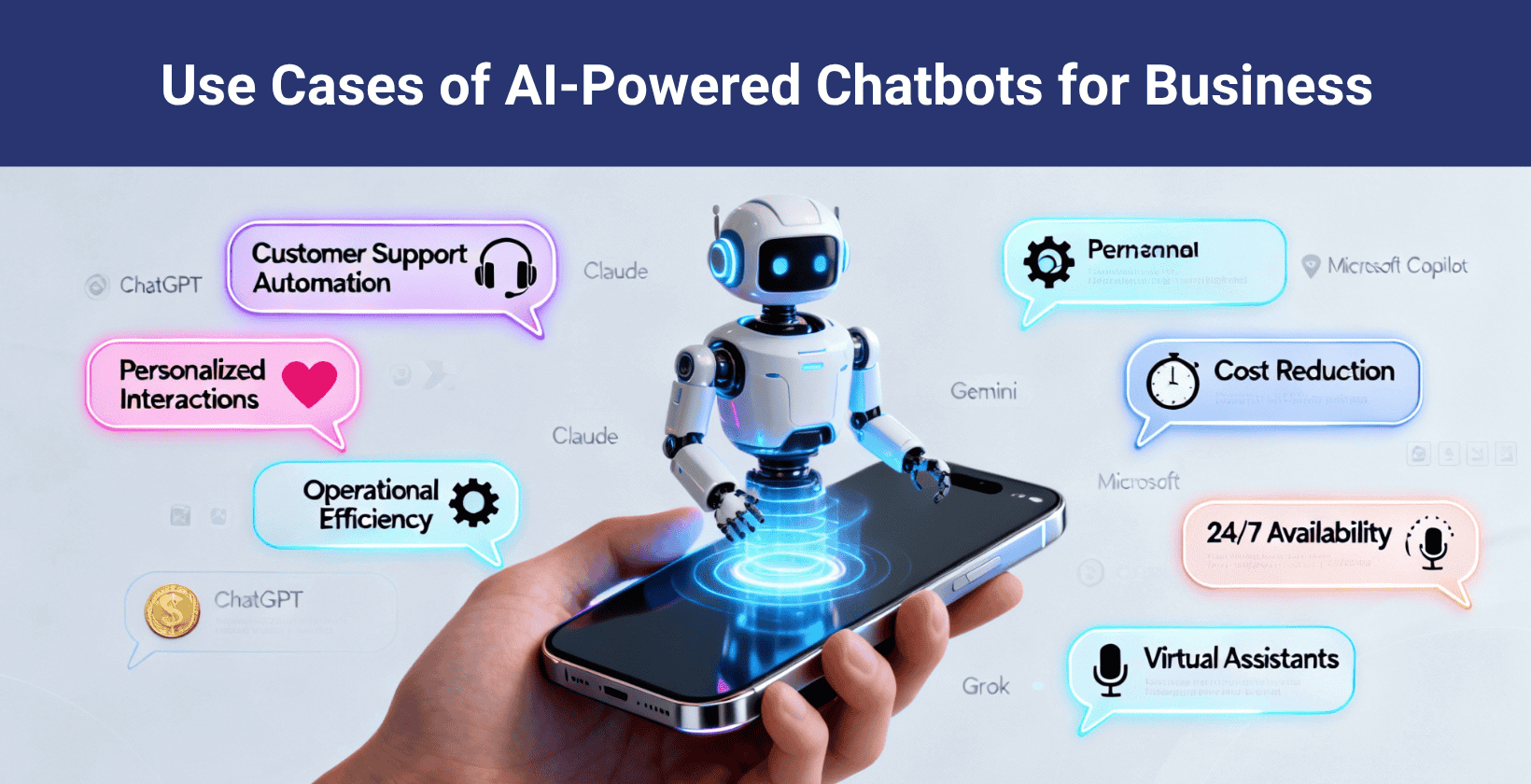
AI-powered chatbots automate customer support, manage multiple inquiries and reduce staff costs at any scale. They personalize each interaction by remembering preferences and delivering targeted responses, which improves satisfaction across experiences to scale chatbots. AI-powered chatbots lower expenses through efficient ticket resolution, optimize operational processes and handle peak volumes without extra team resources, virtual chatbot assistants. They add value by providing voice assistance and acting as digital assistants, streamlining both customer and employee experiences with chatbots. Some of the most popular AI-powered chatbots in 2026 include ChatGPT (OpenAI), Claude (Anthropic), Gemini (Google), Microsoft Copilot and Grok (xAI), which are widely recognized for their advanced language models and versatility in tasks.
Use cases of AI-powered chatbots for business are shown in the image below.
2. Sentiment analysis
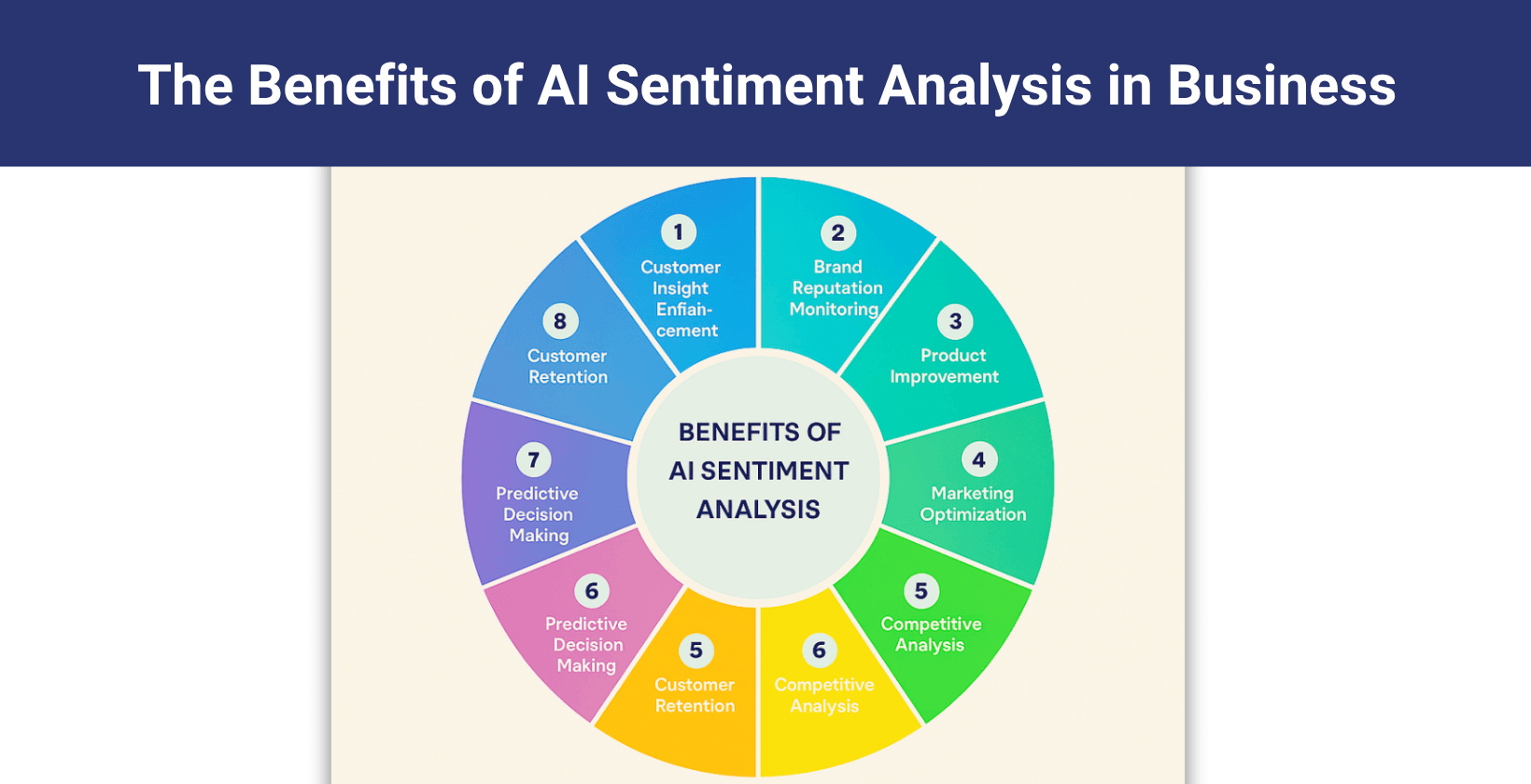
Sentiment analysis extracts emotional tone from unstructured text data using natural language processing and machine learning models to support business decision making. It helps teams to identify and interpret customers' opinions about products, brand reputation and services. Sentiment analysis reveals trends and flags potential issues by examining customer reviews, social media posts and survey responses. Sentiment analysis guides product development, marketing strategies and competitive analysis across varied industries. It helps marketing teams personalize campaigns and respond to customer feedback quickly. Sentiment analysis increases understanding of customer needs and preferences, streamlining business growth and adaptation. According to Business Wire, global sentiment analytics is projected to reach $11.4 billion, driven by real-time insights and growing demand for predictive brand management.
The benefits of AI sentiment analysis in business are shown in the image below.
3. AI-driven personalized marketing campaign
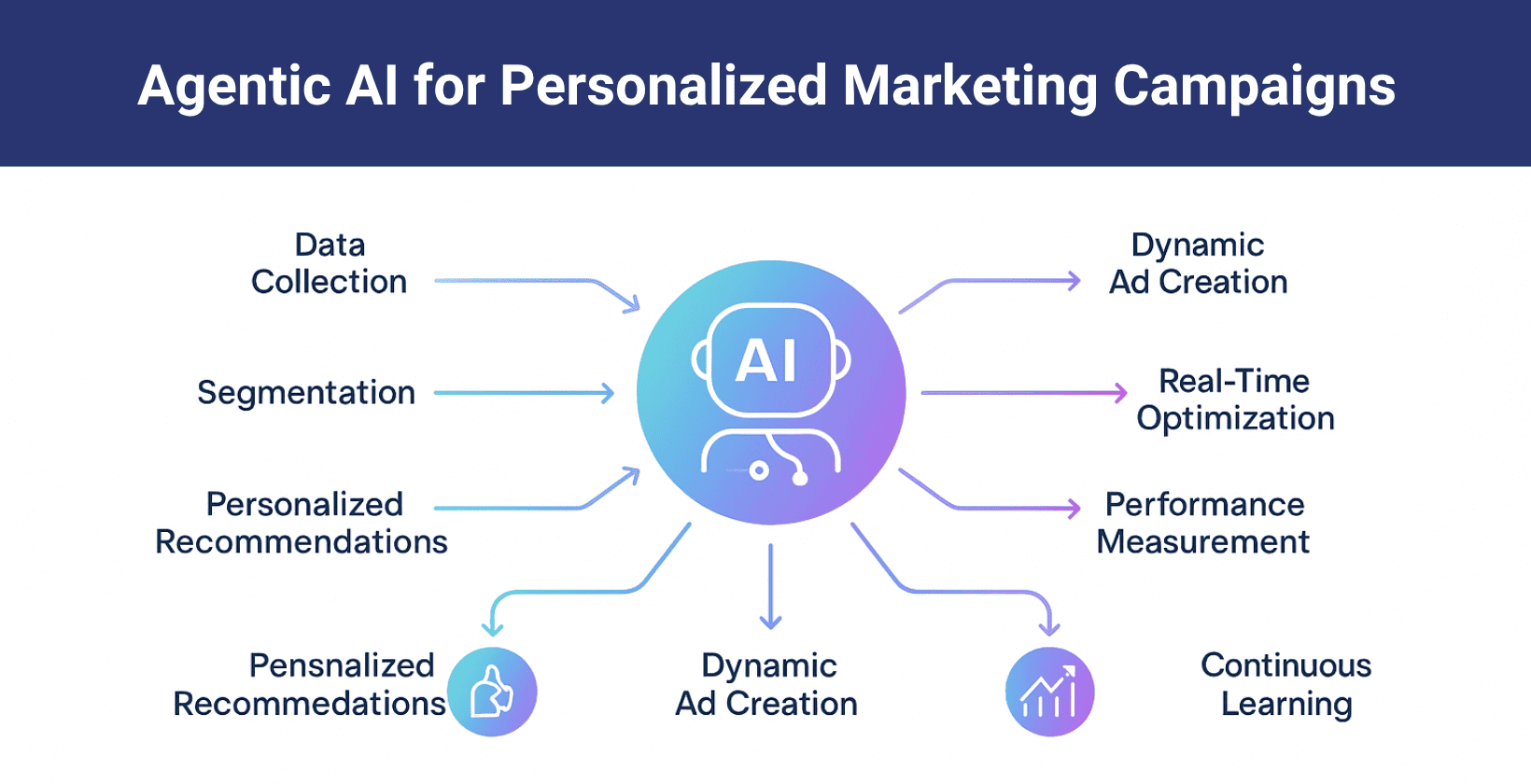
AI-driven personalized marketing campaigns boost business by increasing engagement and conversion rate through precise targeting. It uses customer data to segment audiences for personalized product recommendations and dynamic content delivery. AI AI-driven personalized marketing campaign collects and analyzes data like browsing history and purchase patterns. An AI-driven personalized marketing campaign creates and optimizes ads programmatically and it adapts content to user preferences. Its personalized marketing campaign achieves productivity and scalability, which maximizes marketing impact and return on investment. According to Taboola.com, 92% of businesses now use AI for marketing personalization, with brands seeing up to a 202% lift compared to generic campaigns. This campaign improves performance with real time optimization and relevant messaging to each customer.
Agentic AI for personalized marketing campaigns are shown in the image below.
4. AI for content development
AI for content development transforms business by creating audio, video, text and image content rapidly. It uses NLP and machine learning tools to draft content, optimize SEO and follow trends. AI analyzes audience behavior and trend data to guide content strategy effectively. It automates workflows and routine tasks, freeing teams to focus on creative and strategic efforts. Multimedia content creation and content repurposing improve reach and engagement across channels. AI generates insights from data to inform decision making and supports hyper personalization to tailor content precisely to individual preferences and boosts productivity and marketing outcomes. AI tools like ChatGPT, Claude and Jasper generate written content, while Surfer SEO and MarketMuse optimize for search performance. AI also powers visuals with Vosu.ai, Lumen5, Canva Magic Write and DALL·E.
5. AI-powered product recommendations
AI-powered product recommendations increase average order value by offering personalized suggestions based on pattern recognition and data analysis. They improve customer satisfaction through relevant, tailored experiences. AI-powered product recommendations boost retention by building customer loyalty and reducing cart abandonment. They provide businesses with deep customer insights from data analysis, which improves marketing decisions. AI-powered product recommendations deliver value by connecting customers with products they want, resulting in higher sales and stronger loyalty. These benefits translate into increased revenue and reduced lost sales opportunities. According to expert analysis by Nudgenow and Superagi, product recommendation engines can drive up to 35% of e-commerce revenues and regularly boost conversion rates by 10-20% or more and the global market for AI-powered recommendation systems is expected to grow from $5.39 billion in 2024 to $119.4 billion in 2034.
6. Automating repetitive tasks
Automating repetitive tasks increases business productivity and reduces errors. It manages data entry, which speeds up accurate record keeping. AI handles email management, sorting and prioritizing messages automatically. Intelligent document processing processes large data volumes quickly and correctly. Customer support benefits from virtual agents responding instantly to common questions. Inventory management tracks stock levels and signals replenishment needs. AI automation improves decision making by providing timely, accurate data. It improves employee experience by freeing staff from tedious tasks and raising productivity. Businesses gain faster workflows and better accuracy through AI task automation.
7. AI-powered human resources
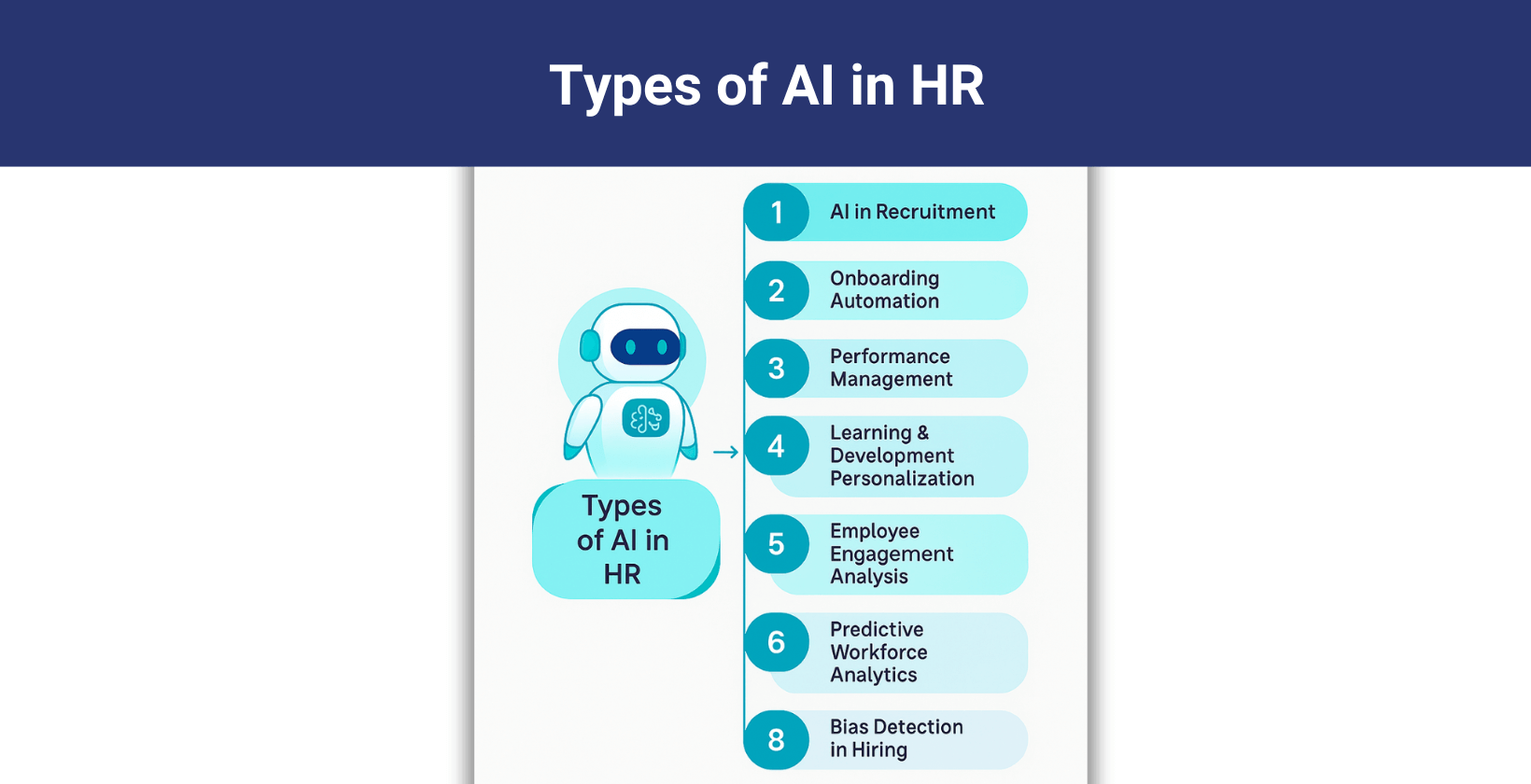
AI-powered human resources improves productivity and reduces manual work. It automates hiring talent, candidate sourcing, screening and routine paperwork. AI-powered human resources improves training, performance management and personalized learning and development. It provides data driven insights to strengthen talent retention and workforce planning. AI-powered human resources personalizes employee experience and supports predictive workforce analysis. It improves recruitment quality, allows fair evaluations and helps build stronger teams. AI-powered human resources reduces bias in hiring and aligns employees with company goals. It supports managers with clear insights and improves strategic decision making across the organization. AI is expected to augment up to 90% of HR functions by 2026, which drives cost savings, efficiency and a shift toward more strategic human resources roles, according to Hirebee’s 2026 industry report.
The types of AI in HR are shown in the image below.
8. AI-driven data analysis
AI-driven data analysis empowers businesses by automating data processes, uncovering hidden patterns and delivering predictive insights. It allows them to make stronger decisions, optimize operations and tailor customer experiences. AI-driven data analysis increases productivity, reduces costs and reveals deeper insights that drive smarter strategies. It strengthens customer engagement, builds loyalty and boosts revenue by helping businesses act with accuracy and speed. According to team-gpt.com, ‘Sprint’ used AI to reduce customer churn by analyzing user data, leading to a 10% improvement and a 40% rise in the Net Promoter Score.
9. Supply chain optimization
AI optimizes supply chains by analyzing vast datasets to identify patterns and predict future events, which allows for accurate demand forecasting, inventory and warehouse management, transportation route optimization and smarter supplier management. AI supports predictive maintenance, risk mitigation, supply chain visibility and automates key processes, while generative AI improves scenario planning and dynamic problem solving. These capabilities help businesses increase efficiency, reduce costs, improve resilience to disruptions and gain greater real time visibility throughout the supply chain. Nike’s AI-driven production allocates manufacturing capacity and optimizes distribution daily for 99.7% fulfillment accuracy, according to DocShipper.
10. Quality control and defect detection
AI is applied in quality control and defect detection through computer vision systems, predictive analytics and machine learning models that allow faster and more precise inspections than human inspectors. These technologies scan products, detect microscopic defects, analyze production data and identify patterns that indicate quality issues. Predictive analytics allows proactive maintenance by recognizing patterns that lead to defects before they occur, while machine learning continuously improves accuracy through insights from production data. AI offers benefits in quality control such as increased precision and speed, reduced costs, improved product quality, improved sustainability and proactive maintenance.
11. AI-powered predictive maintenance
AI-powered predictive maintenance uses real time data collection from sensors and systems to monitor equipment health. Machine learning models use anomaly detection to spot unusual patterns and predict potential failures before they happen, which provides actionable insights that optimize maintenance scheduling. This approach focuses on minimizing unexpected breakdowns while helping to extend the lifespan of machinery. AI-powered predictive maintenance advantages include reduced costs, increased asset uptime, improved safety, improved efficiency, better quality control and longer equipment life. According to Neural Concept, FleetDynamics Corporation implemented predictive analytics on brake systems for trucks, leading to major safety improvements and over $4 million saved in annual maintenance costs. AI-powered predictive maintenance is widely applied across industries such as manufacturing, energy, fleet management, mining and recycling. AI-powered predictive maintenance strengthens operational reliability and sustainability.
12. Market research
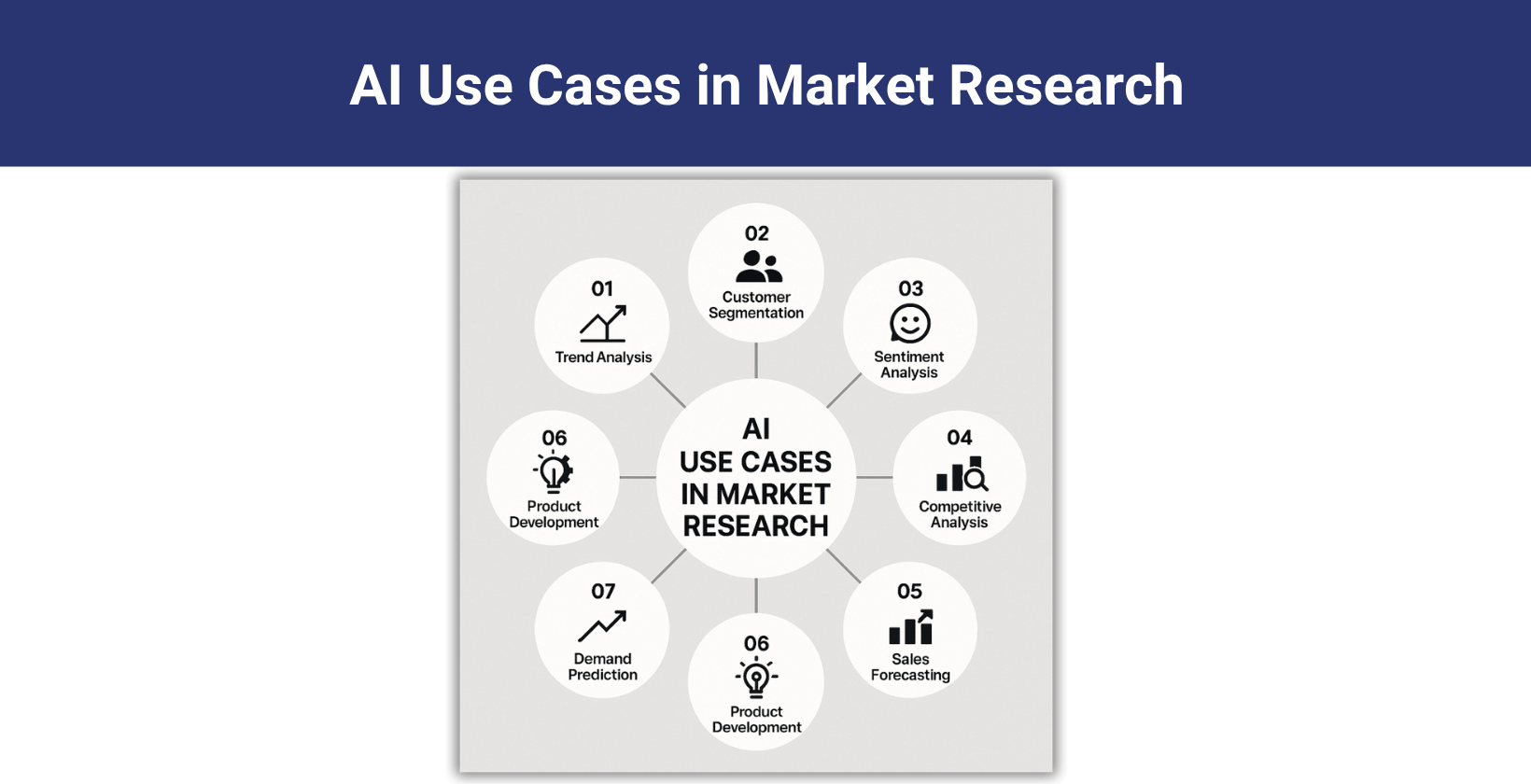
AI transforms market research through automated data analysis, predictive analytics and improved surveying and data collection. These capabilities process large data sets, deliver accurate insights and improve survey quality by reducing bias. Businesses interpret results quickly with data visualization, while trend spotting allows early detection of shifting customer preferences or market movements. AI in market research advantages include increased speed and efficiency, greater accuracy, deeper insights, data-driven decision making, scalability and accessibility. Companies conduct agile market analysis, spot trends, improve cost efficiency and make strategic decisions more quickly with higher data integrity and confidence by using AI for market analysis. Leading AI market research tools like GWI Spark, Quantilope, Brandwatch and Morning Consult use advanced algorithms to deliver fast and accurate consumer insights.
The use cases of AI in market research are shown in the image below.
13. Dynamic pricing strategies
AI-driven dynamic pricing uses algorithms and real-time data to track market trends, consumer demand and competitor actions. These systems adjust prices automatically for different segments or individuals, which maintains flexibility and precision. Businesses personalize pricing, monitor competitors and optimize price points by applying continuous data analysis and machine learning. This approach improves customer satisfaction, streamlines inventory management and lowers operational costs. AI in dynamic pricing strategies helps maximize revenue and profit by responding to demand, which improves agility in fast changing markets and supports data driven decisions that scale effectively across industries while maintaining competitiveness and customer trust. AI-driven dynamic pricing is widely used by leading companies such as Amazon in e-commerce, Uber in ride sharing and Airbnb in hospitality.
14. Fraud detection
AI-driven fraud detection applies real time analysis of transactions, user behavior and network activity to prevent risks such as account takeover (ATO), payment fraud, friendly fraud, content scam, deepfake and synthetic identity fraud. Machine learning and natural language processing allow anomaly detection and document validation, which allows systems to adapt quickly to evolving threats. The process combines data collection, behavioral analysis, network analysis and immediate alerts for proactive prevention. AI in fraud detection helps with immediate alerts, flags suspicious activities, adapts to new fraud tactics and detects sophisticated threats. AI systems are strengthened by human expertise and oversight, which confirms accuracy, accountability and trust in fraud management strategies.
15. Algorithmic trading
AI-driven algorithmic trading applies predictive modeling, high frequency trading (HFT) and optimal trade execution by analyzing vast real time market data. Key AI techniques in algorithmic trading include machine learning for pattern recognition and prediction, natural language processing for sentiment analysis and deep learning models for analyzing complex market data and automating trade decisions. It incorporates sentiment analysis, pattern recognition and natural language processing to improve forecasting accuracy, reduce human bias and allow continuous, emotion free operations. These capabilities improve trading speed, efficiency and decision quality while supporting consistent market participation. AI in algorithmic trading faces challenges such as the "black box" problem, data quality and bias, market instability, overfitting, cybersecurity risks and ethical concerns. These risks require strong oversight, transparent governance and effective risk management to secure trust, reliability and long term performance.
16. Financial reporting automation
AI in financial reporting automation streamlines data collection, validates data for accuracy and automatically generates reports such as income statements and balance sheets. These systems also perform variance analysis, predictive forecasting and compliance checks while detecting fraud and supporting audits. These AI systems improve accuracy and speed, boost decision making, deliver cost savings and improve compliance by detecting errors or risks in real time. Empirical evidence shows that AI-driven financial reporting can improve accuracy by up to 92%, minimize human error and drastically reduce compliance risks compared to manual methods. They support improved security by monitoring for fraud and unauthorized access, while providing reliable, up-to-date insights for strategic financial management and regulatory reporting.
What are the benefits of AI in business?
The benefits of AI in business include increased efficiency and productivity, improved decision making, improved customer experience, reduced costs, innovation of new opportunities and streamlined operations. AI in business strengthens operational effectiveness and supports growth across industries.
The benefits of AI in business are outlined below.
- Increase efficiency and productivity: AI in business automates repetitive tasks, reduces human error and accelerates workflows. Companies achieve higher output with fewer resources, driving operational efficiency and scalable growth.
- Enhance decision-making: AI in business analyzes large datasets and provides predictive insights. Executives adapt to market shifts, evaluate risks and make informed choices that boost profitability and competitiveness.
- Improve customer experience: AI in business personalizes interactions through chatbots, recommendation engines and predictive support. These tools boost consumer satisfaction and strengthen brand loyalty with consistent, targeted engagement.
- Reduce costs: AI in business streamlines operations, removes inefficiencies and reduces error related expenses. Automated systems optimize supply chains and resource use, which creates measurable cost savings.
- Innovate new opportunities: AI in business identifies trends, uncovers hidden patterns and supports innovative models. Organizations create new products, diversify services and gain early mover advantages in evolving markets.
- Improve risk management and security: AI in business monitors transactions, detects anomalies and prevents fraud in real time. Companies protect sensitive data, strengthen compliance and reduce financial risks.
- Streamline operations: AI in business optimizes logistics, inventory and scheduling. Intelligent forecasting reduces bottlenecks, which allows firms to maintain agility and adapt quickly to market conditions.
- Empower the employee: AI in business improves employee performance by removing repetitive tasks. Workers focus on strategic and creative work, which increases engagement and overall workforce effectiveness.
What industries benefit the most from AI transformation?
The industries that benefit the most from AI transformation are given below, showing the benefits of AI in business.
- Healthcare: AI transformation in healthcare improves patient outcomes by personalizing treatment, accelerating drug discovery, improving diagnostics and optimizing hospital workflows efficiently.
- Finance: AI transformation in finance reduces risks by detecting fraud, improving security measures, automating trading and improving customer service with predictive analytics.
- Retail & e-commerce: AI transformation in retail & e-commerce drives sales by personalizing recommendations, optimizing supply chains, improving inventory forecasting and automating customer engagement processes effectively.
- Manufacturing: AI transformation in manufacturing increases productivity by automating quality control, predicting equipment failures, optimizing processes and improving supply chain resilience for efficiency.
- Transportation & logistics: AI transformation in transportation & logistics streamlines operations by optimizing routes, predicting delays, improving fleet management and warehouse efficiency with real time analytics.
Is AI transforming small business operations?
Yes, AI is transforming small business operations because cloud based AI tools automate administrative and operational tasks, support smart marketing and sales and improve decision making with data analytics. These technologies help small businesses save time, cut costs, and drive business transformation by streamlining workflows and creating more personalized customer experiences such as offering virtual try-on options using tools like Vosu.ai. AI for business transformation is now a critical strategy for leveraging technology to improve efficiency and achieve sustainable growth in today’s marketplace.
Does AI improve operational efficiency in businesses?
Yes, AI improves operational efficiency in businesses because it automates operational workflows, optimizes complex processes and improves resource allocation processes. AI helps companies save time, reduce costs and use resources across all areas of their operations by doing repetitive tasks faster and analyzing data in real time.
Does AI impact decision making systems in business?
Yes, AI impacts decision making systems in business because it speeds up processes, improves accuracy and uses real-time data to identify patterns and risks. AI improves efficiency and provides better strategic insight. It also reduces bias and helps leaders make fair choices. AI increases clarity in complex situations. It supports stronger long-term planning.
Can I use AI to run my business?
Yes, you can use AI to run your business because it acts as a powerful strategic partner, which automates workflows, supports data-driven decisions and helps navigate legal requirements. AI does not replace essential human activities like creativity, empathy or leadership. Legal requirements and the need for AI and human collaboration also limit its ability to manage a business fully on its own.
What are the best tools for AI content creation for business?
4 best tools for AI content creation for business are outlined below.
- Jasper AI: Jasper AI excels at general writing, marketing copy and content ideation with powerful brand voice customization and versatile templates.
- Vosu.ai: Vosu.ai is one of the best platforms for content creators that specializes in AI image, video and realistic text-to-voice generation, which includes impressive image-to-video transformation for multimedia content.
- MarketMuse: MarketMuse provides deep content strategy, optimization and topic analysis, which supports SEO and data driven editorial decisions.
- Notion AI: Notion AI improves workflow, productivity, brainstorming and general writing tasks, which integrates easily into daily business operations.