Generative AI impacts creative industries by transforming how content is created, produced and distributed across fields like film and media, content creation, advertising, graphic design and animation. It produces creative outputs for creative industries such as images, audio, video, text and design assets, with tools like VosuAI, DALL·E, Midjourney, Stable Diffusion, Runway and Adobe Firefly. Generative AI works as a partner in creative production through supporting ideation, variation, prototyping and final execution across workflows. It automates repetitive technical tasks like rendering, formatting, asset variation and cleanup, which allows humans to focus on strategy, storytelling and creative direction. It also improves productivity through faster production cycles, increased experimentation and scalable content creation.
Generative AI offers faster workflows, stronger idea generation, rapid prototyping, lower production costs, personalized content at scale and more room for experimentation and innovation. It still has some risks like job displacement, lower pay for routine tasks, revenue shifts, copyright and legal uncertainty, reduced originality and concerns over deepfakes and misinformation. Generative AI is expected to become a core collaborative partner rather than just a tool, deeply integrated into creative systems. This will further automate routine tasks, increase content output and make human curation, taste and ethical judgment more valuable.
Generative AI is increasingly being used by marketers and media companies for personalized campaigns, rapid testing of creative variations and continuous optimization. It will not replace creative professionals but will shift their roles toward strategy, oversight and decision making in AI driven creative industries.
What is generative AI for creative industries?
Generative AI for creative industries is a type of artificial intelligence that creates new image, text, audio, video and digital designs based on user prompts and training data. Popular creative generative AI tools include ChatGPT, VosuAI, Midjourney, Adobe Firefly, Runway and Google Veo. These tools can create new imae concepts, generate audio based on user prompts, produce original video content and assist with visual storytelling.
Generative AI works as a collaborative partner by helping creators explore ideas, develop concepts and generate draft content more quickly. It supports the creative process through producing design variations, storyboards, scripts, illustrations, music samples and marketing assets that creators can refine and customize. It allows artists, designers, filmmakers and content creators to focus more on creative direction while reducing the time required for repetitive production tasks.
How does generative AI change creative workflows?
Generative AI changes creative workflows by shifting repetitive, technical steps into automated systems while keeping strategic choices in people's hands. It automates time consuming technical tasks such as batch rendering, format conversions and asset variation. It also reduces handoffs and shortens iteration loops to accelerate project timelines. Generative AI increases throughput and frees teams to address higher level challenges.
Generative AI shifts roles from manual production to creative curation and direction as teams emphasize intent, tone and audience. Generative AI supports integrating it into the creative process and deploying it in creative production pipelines to handle routine engineering work. This technology acts as an infinite idea machine for brainstorming and for producing instant concepts during sprints. Generative AI also allows creators to move from technical execution toward ideation, creative curation and refinement.
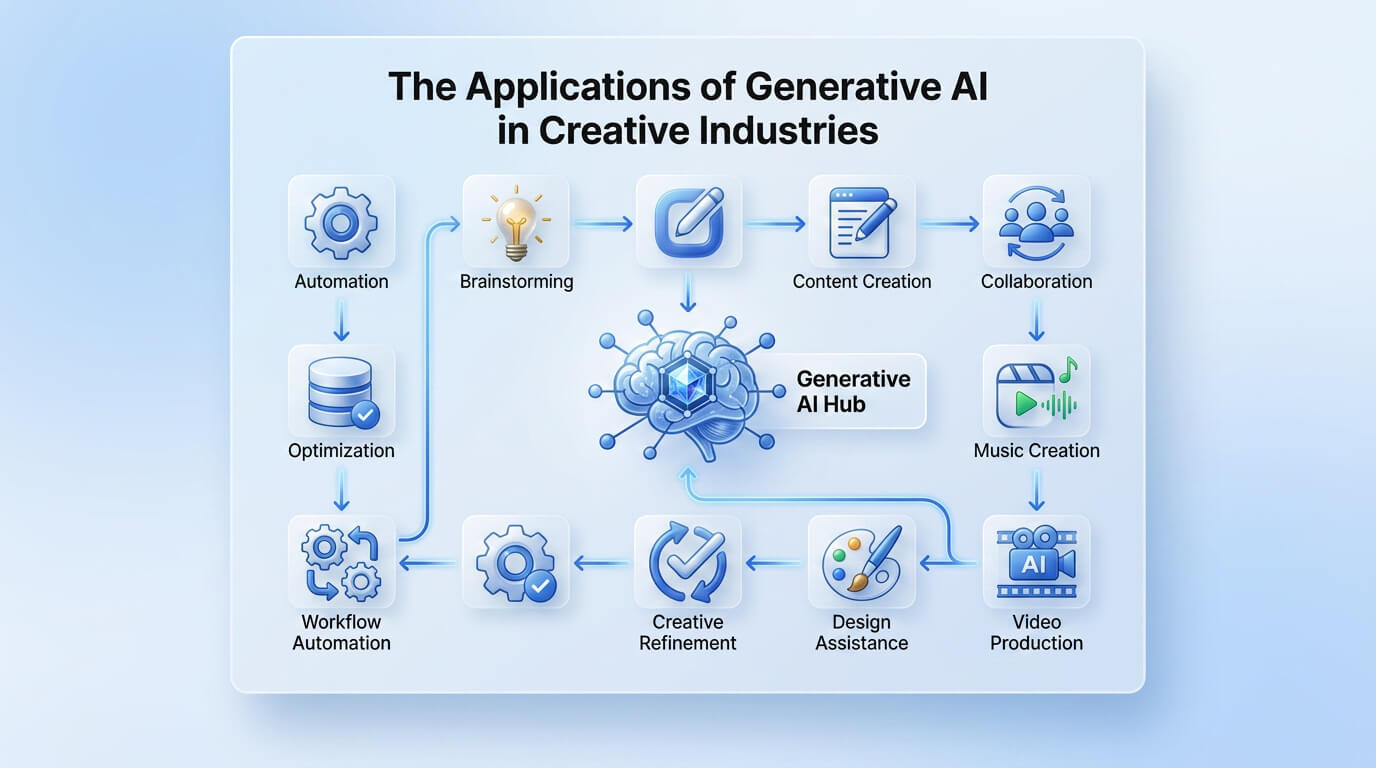
The applications of generative AI in creative industries are shown in the image below.
What impacts does generative AI have on different creative industries?
The impacts that generative AI has on different creative industries include film and media, content creation, music, advertising and marketing and graphic design. These changes are reshaping traditional creative processes and opening up new opportunities for innovation.
The impacts that generative AI has on different creative industries are given below.
- Film and media: Generative AI helps speed up editing, visual effects and storyboard creation. It supports creative experimentation while allowing filmmakers to focus more on storytelling and creative decision making.
- Content creation: Generative AI allows faster content production through automated drafting and idea generation. It helps creators produce more content while concentrating on quality, strategy and audience engagement.
- Music: Generative AI assists musicians in composing melodies, creating samples and exploring new styles. It speeds up the creative process while leaving artistic direction and final decisions to human creators.
- Advertising and marketing: Generative AI helps create personalized advertisements and test multiple campaign ideas quickly. It helps marketers to improve efficiency while maintaining control over brand identity and strategy.
- Graphic design: Generative AI supports designers by creating templates, visual concepts and design variations. This allows designers to spend more time refining ideas and securing creative quality.
- Gaming: Generative AI helps generate game assets, dialogue and story elements more efficiently. It allows game developers to focus on gameplay design, creativity and overall user experience.
- Publishing and writing: Generative AI assists with drafting, outlining and editing written content. It also helps writers and editors to work more efficiently while maintaining originality, consistency and editorial standards.
- Animation: Generative AI speeds up animation production through automated frame generation and style adaptation. It also allows animators to dedicate more attention to storytelling, character development and artistic direction.
What are the benefits of generative AI in creative industries?
The benefits of generative AI in creative industries include faster creative workflows, stronger idea generation, quicker prototyping and iteration, easier access for non experts and scalable content for small teams. It also allows creative professionals to focus more on high level decision making and originality rather than repetitive production tasks.
The benefits of generative AI in creative industries are given below.
- Faster creative workflows: Generative AI reduces handoffs and shortens iteration loops, automating tedious tasks to save production time. It functions as a powerful creative accelerator that speeds delivery while maintaining quality.
- Stronger idea generation: Generative AI supplies diverse concept variants and unexpected directions, expanding brainstorming bandwidth for teams. It acts as an infinite catalyst that sparks innovation and surfaces novel approaches.
- Quicker prototyping and iteration: Generative AI creates rapid mockups and multiple revisions, which allows fast validation of concepts and formats. It supports agile cycles and reduces time to decision through automated asset variation.
- Easier access for non experts: Generative AI lowers technical barriers with intuitive interfaces and templates, which allow broader participation in creative work. It democratizes tools and supports small teams in producing competitive outputs.
- Lower production costs: Generative AI cuts repetitive labor and reduces the need for large crews, automating tedious tasks across stages. It decreases budget requirements while preserving creative control and output quality.
- Personalized content at scale: Generative AI allows mass customization with rule driven variants and data driven prompts, expanding audience relevance. It scales personalization efficiently without multiplying human effort.
- Smoother post production tasks: Generative AI handles cleanup, in-betweening and format conversions, streamlining finishing workflows. It frees artists from repetitive polishing so they focus on higher value creative decisions.
- Scalable content for small teams: Generative AI supplies volume and consistency that allows small teams to sustain larger outputs with fewer resources. It serves as a powerful creative accelerator that multiplies capacity.
- More room for creative experimentation: Generative AI allows low risk trials and rapid pivots by producing instant concepts and iterations. It expands design boundaries and encourages exploratory workflows that fuel innovation.
What are the risks of generative AI in creative industries?
The risks of generative AI in creative industries include job loss, lower pay, revenue loss, copyright risks and legal uncertainty. It also leads to reduced originality in creative work and ethical concerns about the use of AI generated content.
The risks of generative AI in creative industries are given below.
- Job loss: Generative AI replaces repeatable roles in production pipelines, which creates displacement pressure for technicians and junior creatives. It risks devaluation of human labor and forces workforce reskilling.
- Lower pay: Generative AI compresses rates for routine creative tasks, which reduces bargaining power for freelancers and staff. It contributes to the devaluation of human labor and tighter compensation pools.
- Revenue loss: Generative AI redirects income from traditional service providers toward platform owners and tools, which shrinks established revenue streams. It triggers business model shifts and competitive disruption.
- Copyright risks: Generative AI incorporates copyrighted materials during training, which produces outputs that raise legal crises over copyright and unclear provenance. It increases liability for creators and platforms.
- Legal uncertainty: Generative AI creates ambiguous ownership and licensing scenarios across jurisdictions, which complicates contracts and enforcement. This heightens the risk of litigation and regulatory scrutiny.
- Misuse of artist style, voice and likeness: Generative AI imitates identifiable creators without consent, which undermines control over personal brand assets. It elevates calls for privacy focused AI for creatives and moral rights protections.
- Reputational backlash: Generative AI generates content that offends audiences or appears inauthentic, which damages creator reputations and brand trust. This provoked public criticism and platform pushback.
- Derivative and repetitive creative output: Generative AI produces formulaic or familiar results at scale, which reduces novelty across releases. It risks potential homogenization that weakens distinct artistic voices.
- Loss of human emotion and authenticity: Generative AI generates technically proficient work that lacks lived experience and subtle emotional cues. It distances audiences and erodes perceived authenticity.
- Deepfake risks and misinformation: Generative AI fabricates convincing false audio and video, which amplifies disinformation and trust erosion. It creates acute public safety and governance challenges.
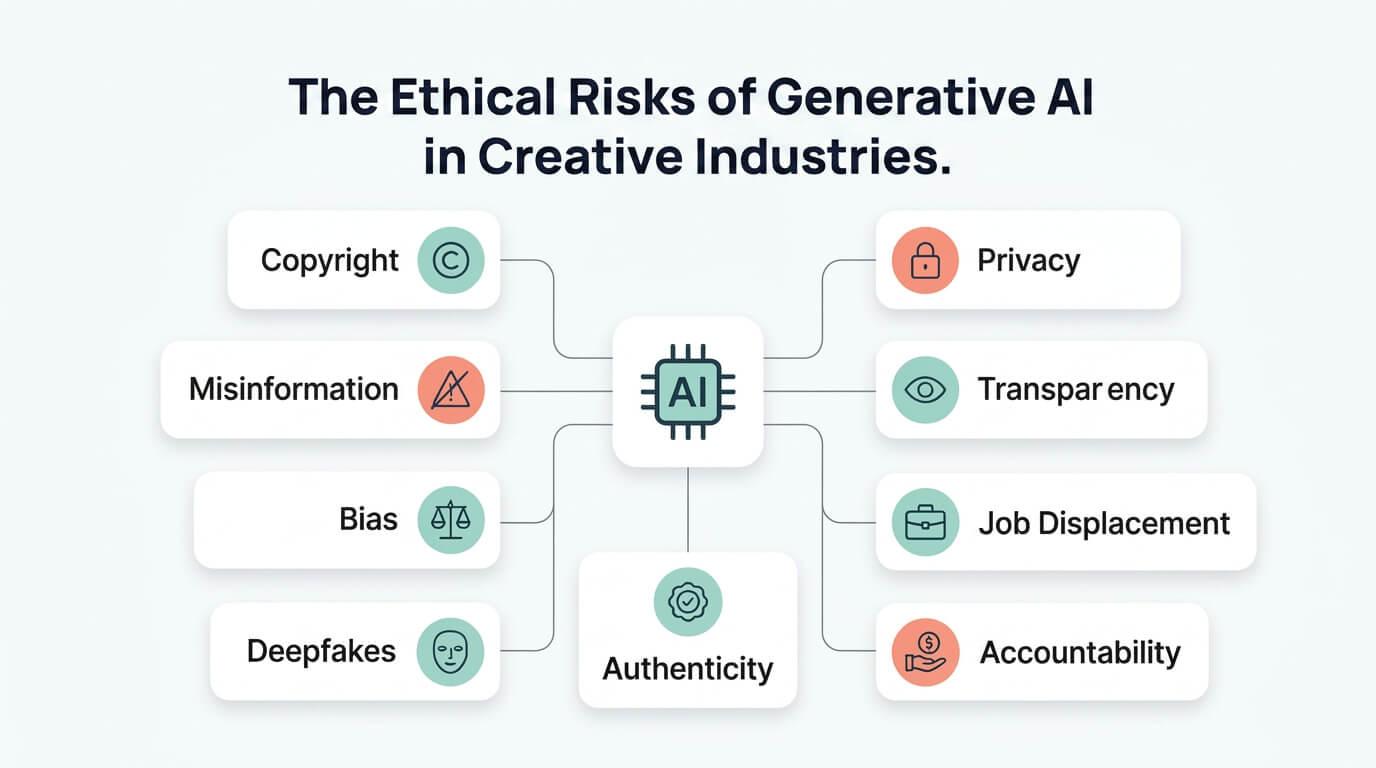
The ethical risks of generative AI in creative industries are shown in the image below.
What is the future of generative AI in creative industries?
The future of generative AI in creative industries is moving toward a system where AI becomes a core collaborative partner in productions rather than just a supporting tool. Generative AI evolves in creative workflows through automating mundane tasks and allowing faster iteration, which reduces technical burden and increases output volume. It positions human curation as more valuable because scaled outputs require selection, context and ethical judgment to preserve meaning and craft. It is also being widely adopted by marketers and media companies to create personalized campaigns, test creative variations at scale and continuously optimize content performance.
How will generative AI affect jobs in creative industries?
Generative AI will affect jobs in creative industries through routine tasks and reallocating work toward higher value activities. It reduces demand for some entry level roles while augmenting human capabilities for concepting and curation. It also requires retraining so skilled human workers lead strategy, quality control and ethical decisions across creative sector jobs.
Will generative AI replace creative professionals?
No, generative AI will not replace creative professionals because it excels at automating routine production but does not replicate human judgment, cultural insight and emotional nuance. It influences industry labor rates and task allocation while preserving demand for skilled creative leadership and curation.
Will generative AI replace animators?
No, generative AI will not replace animators because it streamlines repetitive steps while preserving the need for artistic direction and storytelling. It handles time consuming tasks like in-betweening, cleanup and asset variation within the production pipeline that frees animators to focus on choreography, acting and style.
Can generative AI replace 3D artists?
No, generative AI can not replace 3D artists because it excels at automating tedious and repetitive tasks yet lacks the capacity for nuanced creative decisions. 3D artists provide complex storytelling, material understanding and technical problem solving that AI does not fully reproduce.
Can creative professionals adapt to generative AI?
Yes, creative professionals can adapt to generative AI because they move from manual executors to strategic curators who guide AI outputs. They learn tool workflows and promptcraft to preserve authorship and quality. Creative professionals can thus retain value by focusing on intent, context and ethical judgment rather than routine production.
Can AI generated art be considered original?
No, AI generated art can not be considered original in the same way human made work is because it lacks a creator who possesses conscious intent behind choices. Courts and policymakers evaluate originality from a legal perspective that emphasizes human authorship, intent and creativity. AI outputs occupy a contested status that requires new frameworks for attribution and rights.
Can AI generated content raise copyright issues?
Yes, AI generated content can raise copyright issues because training data and outputs involve protected works where there is no human authorship in key parts of the pipeline. This content also raises copyright issues when it closely resembles or reproduces existing copyrighted material without proper permission or licensing.