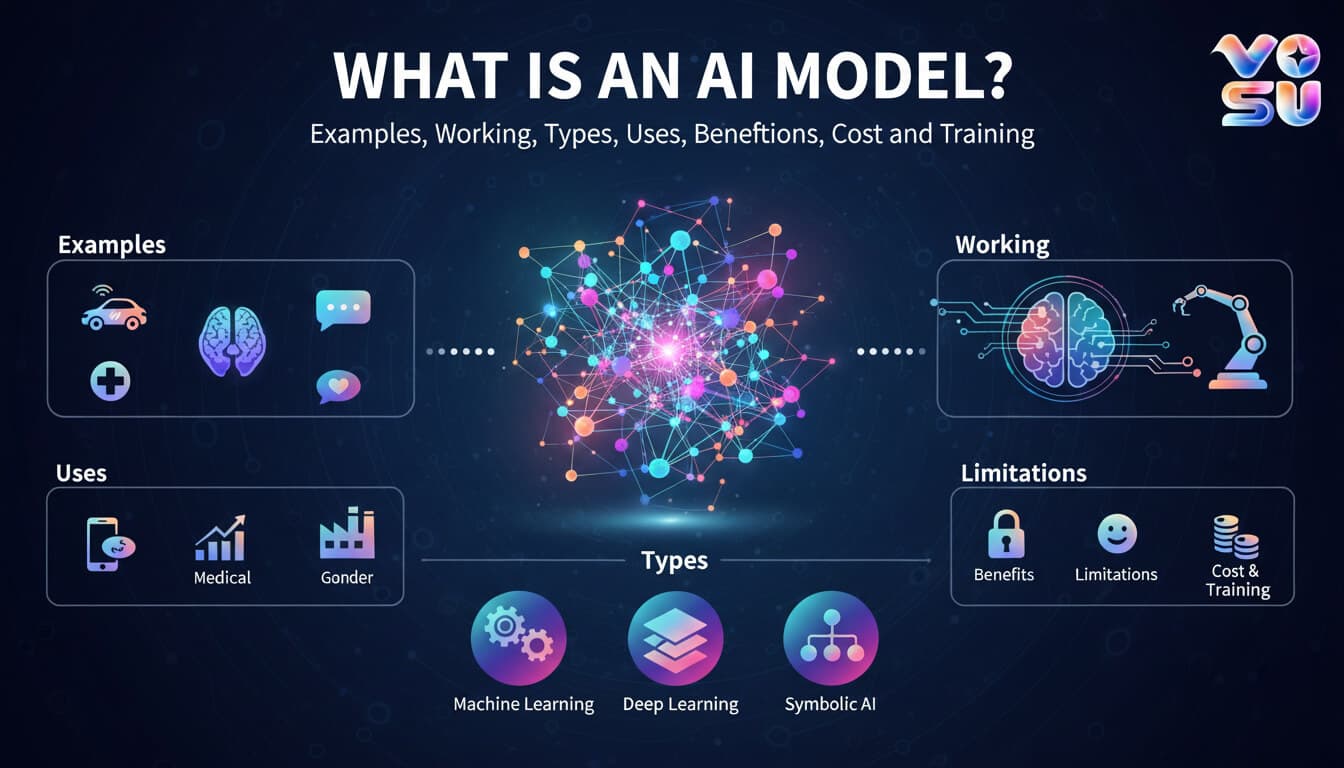
An AI model is trained to recognize patterns in data, make predictions or generate content with minimal human intervention, which simulates human like decision making. AI models analyze large datasets using algorithms and optimized internal parameters to produce accurate outputs such as predictions, classifications or creative content. AI models include ChatGPT, Flux, Kling 3.0 Pro, Sora 2 Pro, PixVerse v5.5, XAI Grok Imagine Video, Veo 3.1, GPT4V and YOLO for object detection.
AI models process vast amounts of data to identify patterns and adjust internal parameters during training to minimize errors. AI models are categorized by learning methodology like supervised, unsupervised or reinforcement, deep learning architecture like CNN, RNN or GAN and applications like LLMs, generative AI and multimodal models. They are used in content generation, e-commerce, customer support, data analysis, cybersecurity and healthcare diagnostics. AI models are used via VosuAI, which offers a user friendly workflow and dashboard that makes image and video generation easier to manage for these use cases.
AI models handle complex data, reduce costs, improve decision making and strengthen risk management. AI models also have limitations like a lack of context and emotional understanding, black box decision making, high resource consumption and no true general intelligence. Their costs range from $20 per month for basic APIs to over $1,000,000 for enterprise level AI systems. AI model training includes defining goals, selecting a model and framework and executing iterative learning with validation to assure reliable predictions and content generation.
What is an AI model?
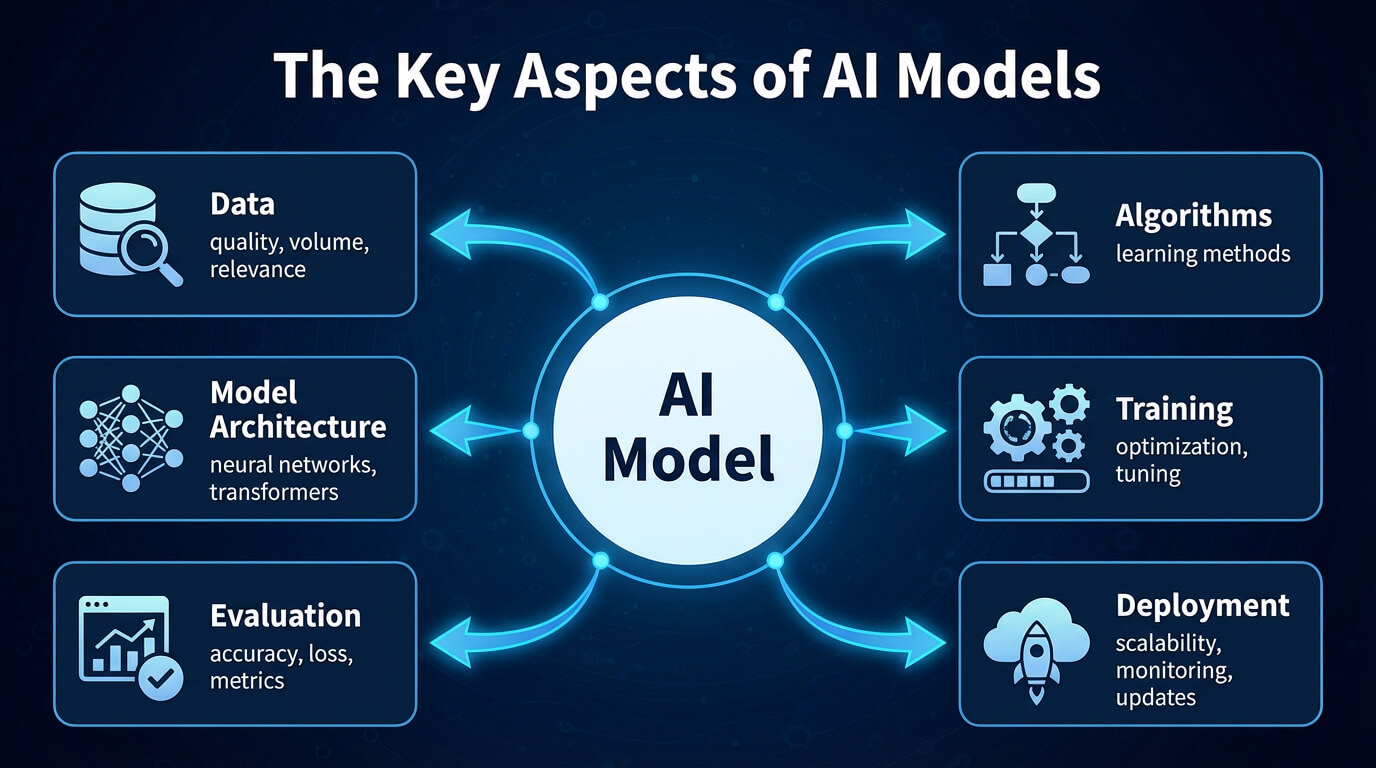
An AI model is a computer program or algorithm that has been trained on vast datasets to recognize patterns, make predictions or generate content with minimal human intervention. It functions as a learned mapping from inputs such as text, images or numerical signals to outputs such as classifications, scores or generated text and visuals in practice. It uses internal parameters that were tuned during training to capture statistical regularities in the data.
The image below shows the main parts of an AI model.
What are the examples of AI models?
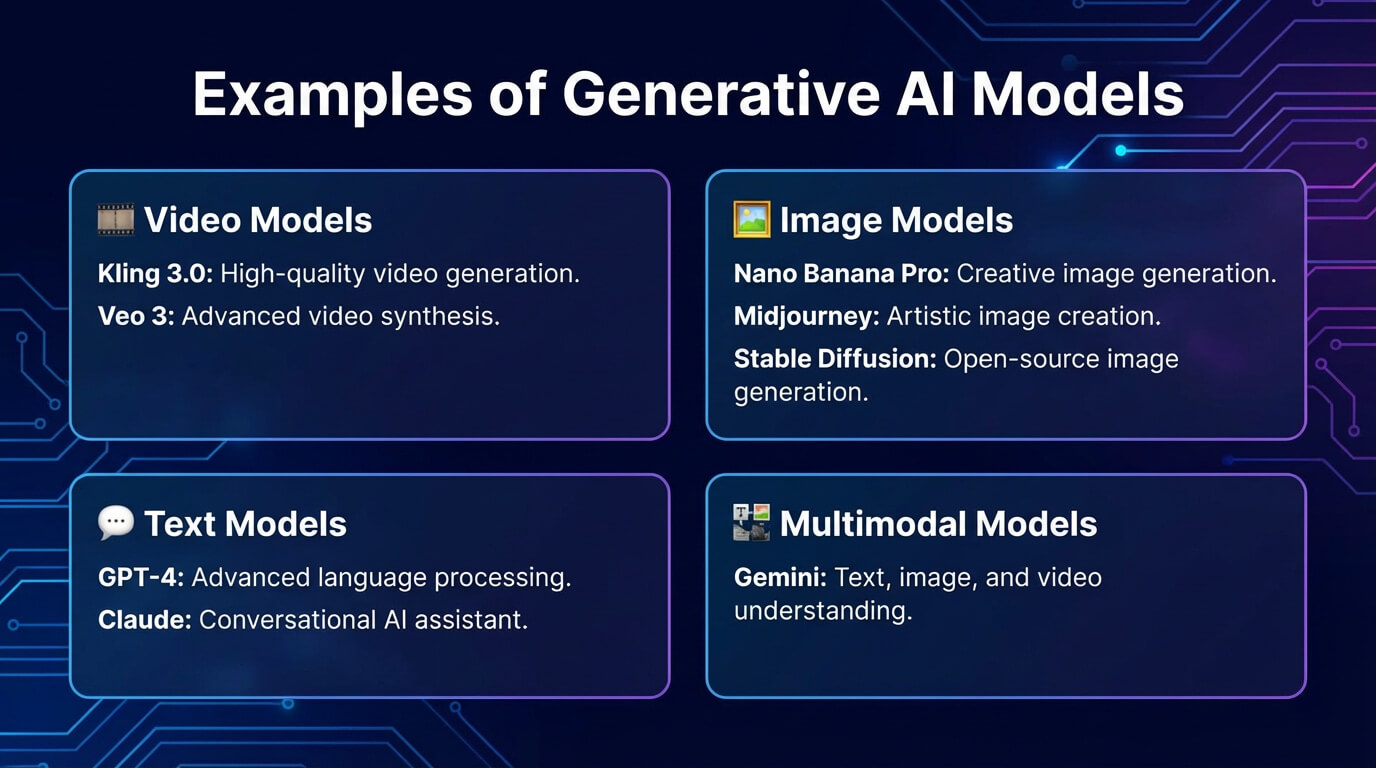
The examples of AI models are large language models (LLMs), image generation models, video generation models and multimodal and vision focused models. LLMs such as ChatGPT, Gemini and Claude 3.5 Sonnet allow modern chatbots, content generation and reasoning tasks. Image generation models like Midjourney, Flux, Flux 2 and Nano Banana turn text prompts into visually rich images with high realism and precise design control. Video generation models such as Google Veo 3.1, Sora 2 Pro and the Kling 3 series, which create dynamic video content from text or visual inputs. Multimodal and vision focused models like GPT 4V understand text and images together and YOLO, which allows real time object detection and computer vision applications.
The image below shows real-world examples of AI models.
How do AI models work?
AI models work by processing large amounts of data, which uses algorithms to learn patterns and then applying what they have learned to new inputs to mimic human like decision making. They repeatedly process examples, compare their predictions to desired outputs and adjust internal parameters like weights and biases to reduce error during training. They rely on algorithms such as gradient descent to drive this optimization, while neural networks provide layered structures that extract abstract features from raw data. AI models encode statistical regularities in their internal parameters over many training cycles. AI models then keep these parameters fixed in inference, take new data as input, run it through the learned computations and output predictions, decisions or generate content in real time.
What are the different types of AI models?
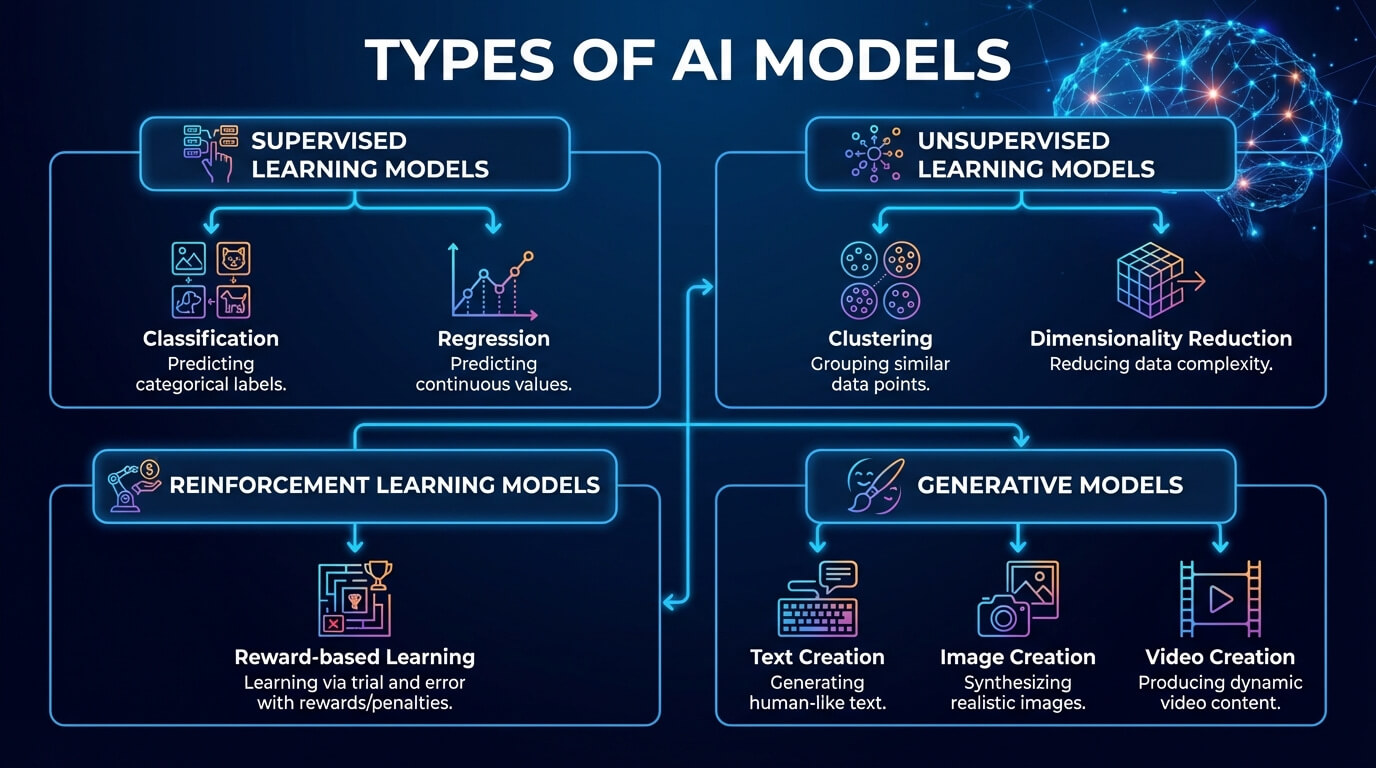
The different types of AI models are categorized by learning methodology, deep learning architecture and applications. Learning methodology includes supervised, unsupervised and reinforcement learning. Deep learning architecture AI models types are transformers, CNNs, RNNs and GANs. AI models by applications are large language models, generative AI, multimodal and predictive models that support automation
3 types of AI models by learning methodology are outlined below.
- Supervised learning models: Supervised learning models are trained on labeled input output pairs to predict categories or numeric values, widely used for fraud detection, spam filtering, credit scoring and image recognition.
- Unsupervised learning models: Unsupervised learning models discover hidden structure in unlabeled data that clusters similar items and reduces dimensionality for tasks like customer segmentation, anomaly detection and recommendation systems in large datasets.
- Reinforcement learning models: Reinforcement learning models learn optimal actions through trial and error interaction with an environment that receives rewards or penalties and underpin robotics control, game playing agents, dynamic pricing and route optimization.
4 Types of AI models by deep learning architecture are outlined below.
- Transformers: Transformers use self-attention to model relationships across entire sequences in parallel, which excels at language modeling, translation and multimodal tasks like vision language understanding and code generation.
- Convolutional neural networks (CNNs): CNNs apply learned filters over local regions of data to detect spatial patterns that power image classification, object detection, medical imaging and other computer vision applications.
- Recurrent neural networks (RNNs): RNNs process inputs sequentially while maintaining a hidden state as memory that makes them suitable for time series forecasting, speech recognition and natural language processing tasks.
- Generative adversarial networks (GANs): GANs pit a generator against a discriminator in an adversarial game, which learn to create highly realistic synthetic images, videos and other data resembling real distributions.
4 types of AI models by functionality and application are outlined below.
- Large language models (LLMs): LLMs Process and generate human-like text for chatbots, coding assistants, search, summarization, translation and reasoning that allows general purpose language interfaces across many software products and workflows.
- Generative AI models: Generative AI models like VosuAI create new content text, images, audio or video from learned data distributions, which power creative design, marketing assets, content automation, synthetic data generation and rapid prototyping in diverse domains.
- Multimodal models: Multimodal Models jointly understand or generate text, images, audio and sometimes video, which allows applications like visual question answering, document understanding, medical decision support, accessibility tools and richer virtual assistants.
- Predictive models: Analyze historical and real-time data to forecast future outcomes or probabilities that support churn prediction, demand and sales forecasting, credit risk scoring, fraud detection and predictive maintenance planning.
The image below explains the major categories of AI models.
What are the use cases of AI models?
The use cases of AI models are content generation, e-commerce, finance and banking, cybersecurity and healthcare diagnosis. These use cases cover a wide range of real world applications in different industries to automate tasks, analyze data, improve decision making and efficiency.
The use cases of AI models are given below.
- Content generation: AI models create text, images, audio and code using large language models (LLMs), which produce consistent outputs for marketing, education, documentation and creative tasks with minimal human intervention.
- E-commerce: AI models improve online retail through personalized recommendations in e-commerce, product search optimization, demand forecasting and pricing intelligence derived from user behavior and transaction data.
- Finance and banking: AI models support financial systems through credit risk evaluation, transaction monitoring, algorithmic trading and regulatory compliance analysis based on large scale financial datasets.
- Customer support: AI models improve customer support through conversational agents that understand user intent, retrieve accurate information, summarize interactions and deliver consistent responses across digital channels.
- Data analysis: AI models extract insights from structured and unstructured data, which allows pattern discovery, trend analysis, automated reporting and scalable decision support for organizations.
- Prediction: AI models generate prediction outcomes by learning from historical data to forecast demand, revenue, customer churn and operational performance across multiple sectors.
- Fraud detection: AI models strengthen fraud detection in finance through real time identification of suspicious transactions, abnormal behavior patterns and high risk activities within complex financial systems.
- Cybersecurity: AI models improve cybersecurity through threat detection, malware classification, phishing identification and continuous monitoring of network anomalies in real world environments.
- Computer vision and robotics: AI models process visual information and guide robotic systems through object recognition, spatial awareness, navigation control and automated physical interactions.
- Healthcare diagnostics: AI models support healthcare diagnostics through medical image analysis, patient record evaluation and early disease identification with consistent and scalable accuracy.
- Personalization and recommendation engines: AI models power personalization and recommendation engines through user preference modeling, behavioral analysis and contextual understanding that deliver relevant content and product suggestions.
You can use VosuAI for content creation, e‑commerce visuals and entertainment workflows, as its user friendly dashboard makes image and video generation easier to manage for professional or non professional creators.
What are the benefits of AI models?
AI models offer increased efficiency, operational cost savings, improved accuracy, improved decision making and risk management. These automate repetitive work, improve the quality and speed of decisions and allow far more personalized user experiences at scale.
The benefits of AI models are listed below.
- Increased efficiency: AI models increase efficiency through the automation of repetitive tasks, reduced manual effort, accelerated workflows and continuous system operation across large scale business and technical environments.
- Operational cost savings: AI models reduce operational costs through optimized resource utilization, minimized human intervention, error reduction and scalable automation across production, service delivery and enterprise operations.
- Improved accuracy: AI models improve accuracy through consistent pattern recognition, reduced human error, data driven evaluation and precise output generation across analytical, predictive and classification based systems.
- Improved personalization: AI models improve personalization for customer experiences through preference modeling, behavioral analysis, contextual understanding and customized content or product delivery across digital platforms.
- Accelerated innovation: AI models accelerate innovation through rapid experimentation, automated knowledge extraction, faster product development cycles and continuous learning from evolving datasets and real world feedback.
- Handling complex data: AI models handle data by analyzing massive datasets, processing unstructured information, integrating multimodal inputs and extracting meaningful patterns beyond human analytical capacity.
- Improved decision making: AI models improve decision making through the generation of actionable insights, real time analytics, scenario evaluation and evidence based recommendations that support strategic and operational planning.
- Risk management: AI models strengthen risk management through anomaly detection, predictive risk assessment, continuous monitoring and early identification of threats across financial, operational and cybersecurity domains.
What are the limitations of AI models?
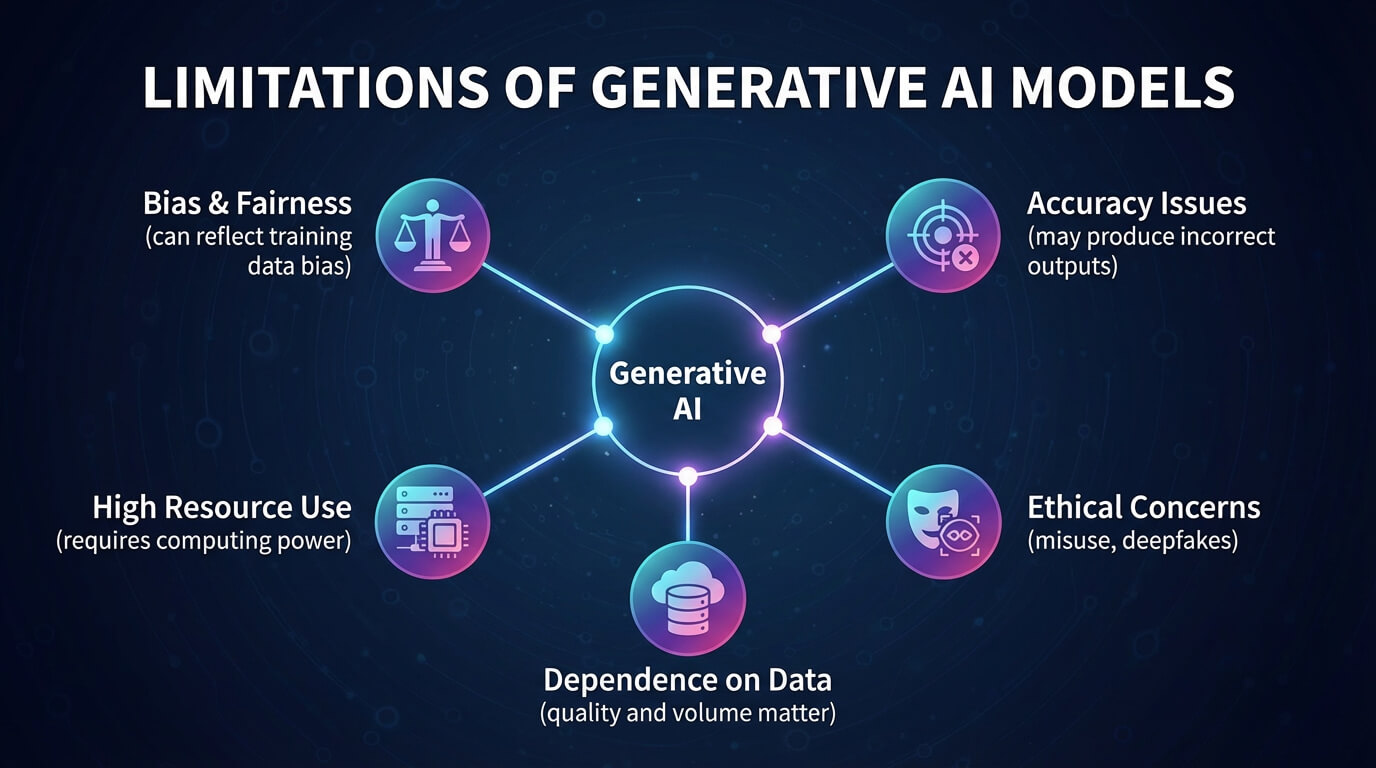
The limitations of AI models include data dependence and bias, a lack of context understanding, black box decision making, no general intelligence, no emotional intelligence and high resource consumption. These affect their reliability, adaptability and responsible use in real world applications.
The limitations of AI models are listed below.
- Data dependence and bias: AI models rely on high quality training data and biased, incomplete or unbalanced datasets lead to skewed learning outcomes, which reinforce social bias and produce inaccurate or unfair predictions.
- Lack of context understanding: AI models lack deep context understanding and common sense, which process patterns statistically rather than reasoning about real world situations, intentions or implicit meaning beyond observed data correlations.
- Black box decision making: AI models operate as black box systems, which makes internal decision logic difficult to interpret, audit or explain. This limits transparency, trust and regulatory compliance in critical applications.
- No general intelligence: AI models demonstrate narrow intelligence optimized for specific tasks and lack general intelligence, which prevents them from flexibly transferring knowledge across unrelated domains or autonomously adapting to novel problems.
- Lack of true creativity: AI models lack genuine creativity, as they generate outputs by recombining learned patterns rather than producing original ideas driven by intent, understanding or independent conceptual reasoning.
- No emotional intelligence: AI models do not possess emotional intelligence, which limits their ability to genuinely understand human emotions, empathy, moral judgment, or social nuance, despite being able to simulate emotionally appropriate responses.
- Ethical and safety risks: AI models produce biased or inaccurate results like hallucinations, allow misuse, cause privacy violations and lead to unintended consequences when deployed without robust governance frameworks.
- High resource consumption: AI models require high resource consumption, like large computational power, energy usage and infrastructure costs, which restrict accessibility and raise environmental and economic sustainability concerns.
The image below explains the major drawbacks of AI models.
How much do AI models cost?
AI model costs start at around 20 USD per month for low cost API subscriptions and can rise to millions of dollars for fully custom enterprise systems, which depend on complexity. Its development costs vary by model level, such as basic, mid level and complex. Basic AI solutions range from $5,000 to $50,000, mid level systems $100,000 to $500,000 and complex or enterprise AI exceeds $500,000 to over $1000,000, with specialized chatbots around $75,000 to $150,000. Their operational costs include ongoing maintenance, model retraining and inference expenses, which grow with usage and dominate the budget at scale.
How to train an AI model?
To train an AI model, define the goal, collect and prepare data, select the model and framework and execute the training. This is a structured process of teaching an algorithm to recognize patterns from data so it makes predictions or decisions accurately within a defined problem domain.
4 steps to train an AI model are outlined below.
- Define the goal: Specify the problem, desired outputs and measurable success criteria so the model’s purpose, scope and constraints are unambiguous before any technical work begins.
- Collect and prepare data: Acquire relevant datasets, remove errors, normalize or transform values, engineer features where helpful and partition data into training, validation and testing subsets.
- Select a model and framework: Pick a suitable model family and supporting framework that match data scale, task type, explainability needs, infrastructure and expected performance characteristics.
- Execute the training: Run training on the training set, iteratively tune hyperparameters using validation feedback, then confirm robustness and generalization on a separate test set.
How long does it take to train an AI model?
It takes a few minutes to an hour to train simple AI models and several weeks or months for large deep learning models and LLMs on powerful hardware. It depends mainly on model complexity, dataset size and quality, available computational power like GPUs or TPUs, parallelization and task difficulty.
Is it hard to train an AI model?
Yes, it is hard to train an AI model because it demands large, high quality datasets, costly compute resources and deep technical expertise. An AI model’s training becomes challenging when the data is low in quality or quantity, computational resources are limited, teams lack deep machine learning or engineering expertise or models overfit or underfit.
Is it possible to train my own AI model?
Yes, it is possible to train your own AI model because modern frameworks and cloud platforms let you build anything from simple personalized chatbots to complex image generators. You have to collect and label data, choose or reuse a model, then train, evaluate and deploy it. You can do this using tools like Google Vertex AI, TensorFlow or by fine tuning open source models.
How to test an AI model?
7 steps to test an AI model are outlined below.
- Define objectives and scope: Clarify what you need to verify, success metrics, target users, constraints and acceptable risk before designing any tests.
- Prepare and validate test data: Assemble realistic, representative datasets, clean and label them correctly and ensure they reflect edge cases and fairness considerations.
- Run baseline and unit tests: Create simple baselines and component level tests to confirm core logic, data pipelines and interfaces behave as expected.
- Evaluate performance and accuracy: Measure key metrics against objectives, compare to baselines and analyze errors to understand weaknesses and failure modes.
- Conduct specialized testing: Apply robustness, bias, security, stress and explainability tests tailored to the domain, regulations, and model type.
- Review human in the loop: Include domain experts or users to spot subtle errors, validate usefulness and refine guidelines for human oversight.
- Monitor post deployment: Track metrics, drift, incidents, and user feedback in production, then retrain or roll back when performance degrades.
How to deploy an AI model?
The steps to deploy an AI model are outlined below.
- Serialize and package models: Serialize and package a trained model through saving weights, dependencies and configuration files required for reliable AI model deployment.
- Create an inference API: Create an inference API to deploy AI model predictions through standardized endpoints that accept inputs and return outputs in real time.
- Choose a hosting environment: Choose a hosting environment on a cloud platform such as AWS, Azure, Google Cloud or Modal, based on scalability and latency needs.
- Implement CI or CD: Implement CI or CD pipelines to automate testing, versioning and deployment updates, which guarantee consistent and repeatable AI model deployment workflows.
- Monitor and maintain the system: Monitor and maintain the system through tracking performance, latency, errors and data drift, which triggers retraining or updates when behavior degrades.
What are the best AI image generation models?
The best AI image generation models are Nano Banana Pro, Midjourney, Flux 2, Flux 2 Pro and Seedream 4.5, which deliver high fidelity photorealism, rapid generation and improved text rendering. These models are available in an all-in-one content creation OS VosuAI that provides a user friendly dashboard to create, edit,and improve images for real world use cases such as marketing, product visuals and design workflows.
What are the best AI video generation models?
The best AI video generation models are Google Veo 3.1, Kling 3.0 Standard, Kling 3.0 Standard Motion Control and Runway Gen 4.5. They transform text, images or clips into consistent, stylized videos suitable for ads, social campaigns and brand narratives. You can access these models using VosuAI, which provides a user friendly dashboard that lets you switch between models, manage projects in one place and streamline your entire video creation workflow without technical complexity.
What is the difference between AI models and ML models?
The difference between AI models and ML models is mainly about scope, behavior and hierarchy. AI models are systems designed to mimic human-like intelligence that include rule based systems, search algorithms and learning systems. ML models are a subset that specifically learn patterns from data and improve performance over time. AI is the conceptual parent and ML models are child approaches that implement learning within that broader AI family.
What is a foundation model in generative AI?
A foundation model in generative AI is a large scale neural network trained on massive, mostly unlabeled datasets using self supervised learning. It is characterized by its huge parameter count and broad training, its adaptability and core architecture to produce text, images, code or other content from prompts.
What is the difference between generative AI models and discriminative models?
The difference between generative and discriminative AI models lies in their approach to learning from data. Generative models learn the underlying distribution of data, which allows them to create new, realistic samples. Discriminative models focus on learning the decision boundary between classes. Generative models tend to be more complex and require larger datasets, while discriminative models are simpler and optimized for prediction tasks rather than data synthesis.