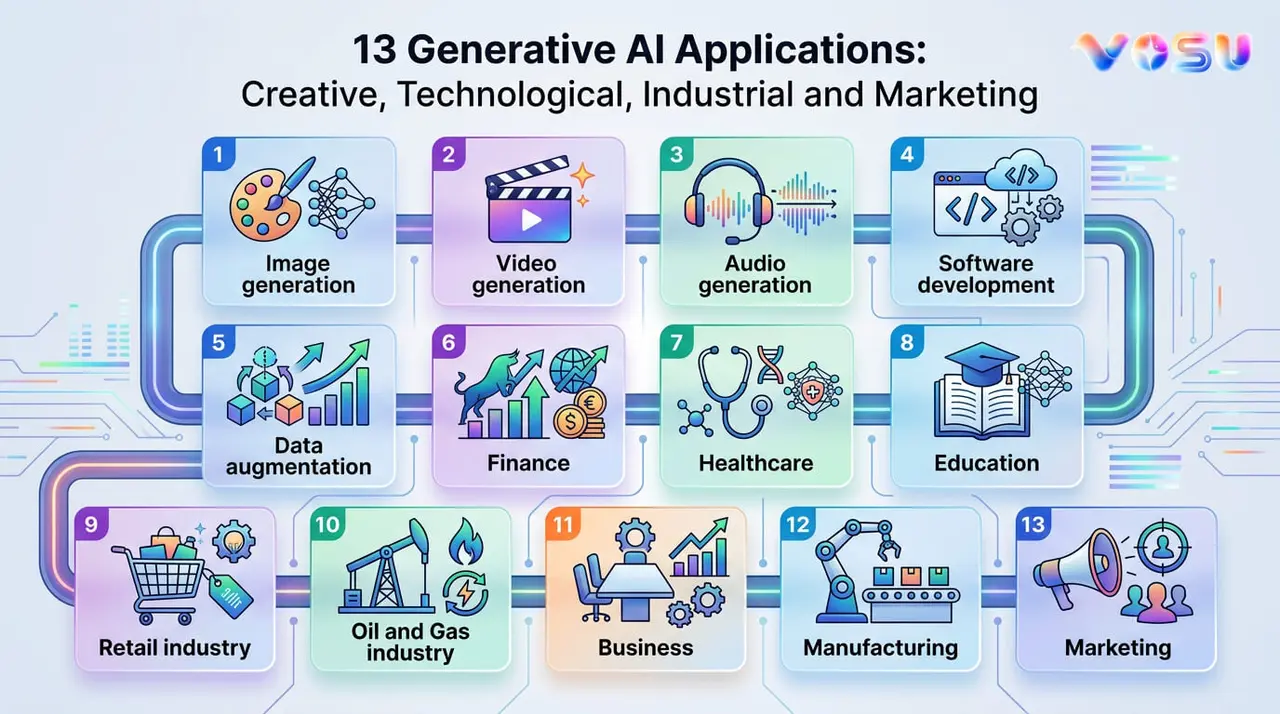
Generative AI (Gen AI) refers to intelligent systems that learn from large datasets to produce new content such as images, videos, audio and code by automating creative tasks with human-like quality.
Generative AI is transforming through high-impact applications across creative and technical domains like machine learning or digital marketing. It generates original images and illustrations from simple text prompts, produces realistic videos using automated or scripted animation tools. It also synthesizes music, voiceovers and natural-sounding speech in audio generation.
Generative AI technology supports software development by creating code, drafting documentation and automating testing processes. It boosts machine learning performance through data augmentation by generating synthetic data in limited-data scenarios. Its applications across industries like finance, healthcare, education and retail help businesses scale operations, develop personalized experiences and make smarter decisions.
1. Image generation
Generative AI in image generation is used for creating original visuals, digital art, social media graphics and background or object replacement, which improves images for professional, commercial, and creative purposes across multiple industries.
The applications of generative AI in image generation are given below.
- Image creation: Generative artificial intelligence generates original visuals such as unique photos, illustrations and conceptual images from text prompts or existing datasets using tools like Vosu.ai that are suitable for various industries like publishing, media and entertainment.
- Digital art: Generative AI generates artistic compositions in various styles, which range from classical to contemporary. Generative AI models like Vosu.ai, DALL-E 2, Midjourney and Stable Diffusion help artists generate digital paintings, abstract art and stylized illustrations without relying on traditional drawing skills.
- Social media graphics: Generative AI creates visual content for social media platforms such as Facebook, Instagram and Pinterest that matches brand aesthetics for different campaigns like brand awareness campaigns and product launch campaigns.
- Background removal: Generative artificial intelligence removes backgrounds from images by isolating subjects for commercial, personal or professional use in marketing, e-commerce and photo editing.
- Object removal and replacement: Generative AI removes objects like people or text from images and fills gaps by analyzing pixels that match color, texture and patterns for realistic background reconstruction.
- Image restoration: Generative artificial intelligence repairs and improves images by removing flaws such as scratches, blurs or color fading. It restores old photos and upscales the quality for archival or presentation purposes like business meetings, sales pitches and historical project proposals.
2. Video generation
The applications of generative AI in video generation include text to video, image-to-video, animation to video, AI avatars, video editing, video enhancement, personalized video content and educational videos.
The applications of generative AI in video generation are given below.
- Text to video generation: Generative AI transforms written prompts or scripts into videos that allow content creation for marketing, education and social media without cameras or actors.
- Image-to-video generation: Generative AI models like Vosu.ai, Kling, Pixverse, MiniMax and Vidu animate static images or sequences of images that bring them to life as video content, which is used for creative storytelling, presentations and visual effects.
- Animation video creation: Generative AI automates the creation of animated videos like 2D or 3D animations, claymation and motion graphics, which makes animation accessible to non-experts.
- Video editing: Generative AI-powered editing tools automate tasks like cutting, trimming, color correction, noise removal and adding effects, which helps speed up post-production and improve creative workflows.
- Video enhancement: Generative AI improves video quality by stabilizing shaky footage, denoising, upscaling resolution and correcting color and exposure. It also adds special effects like lens flares or environmental elements.
3. Audio generation
Generative artificial intelligence transforms audio generation by allowing advanced music composition, speech synthesis and creative sound design. AI applications in audio generation include text to speech, music generation, sound effects, audio editing and personalized audio experiences such as customized spatial audio for streaming apps and adaptive sound for gaming.
The applications of generative artificial intelligence in audio generation are given below.
- Text to speech: Text to speech uses generative artificial intelligence for speech synthesis that converts written text into natural-sounding spoken words for audiobooks, virtual assistants and accessibility tools like screen readers, voice assistants and speech-to-text converters.
- Music generation: Music generation uses generative artificial intelligence for music composition, creating original melodies, harmonies and entire tracks for entertainment, advertising or background scores.
- Sound effects generation: Generative artificial intelligence is used to create realistic or imaginative sound effects to improve user experience in specific settings such as video games, cinematic scenes or VR simulations by aligning audio elements with visual and interactive cues like color contrast or typography.
- Audio editing: Audio editing uses generative AI to clean, improve or modify audio recordings by removing noise, adjusting tone or generating missing segments such as lost audio, dropped words and damaged music tracks for high-quality output.
- Personalized audio: Generative artificial intelligence is used in personalized audio to customize audio content such as playlists, podcasts or voice responses to individual user preferences and listening habits.
4. Software development
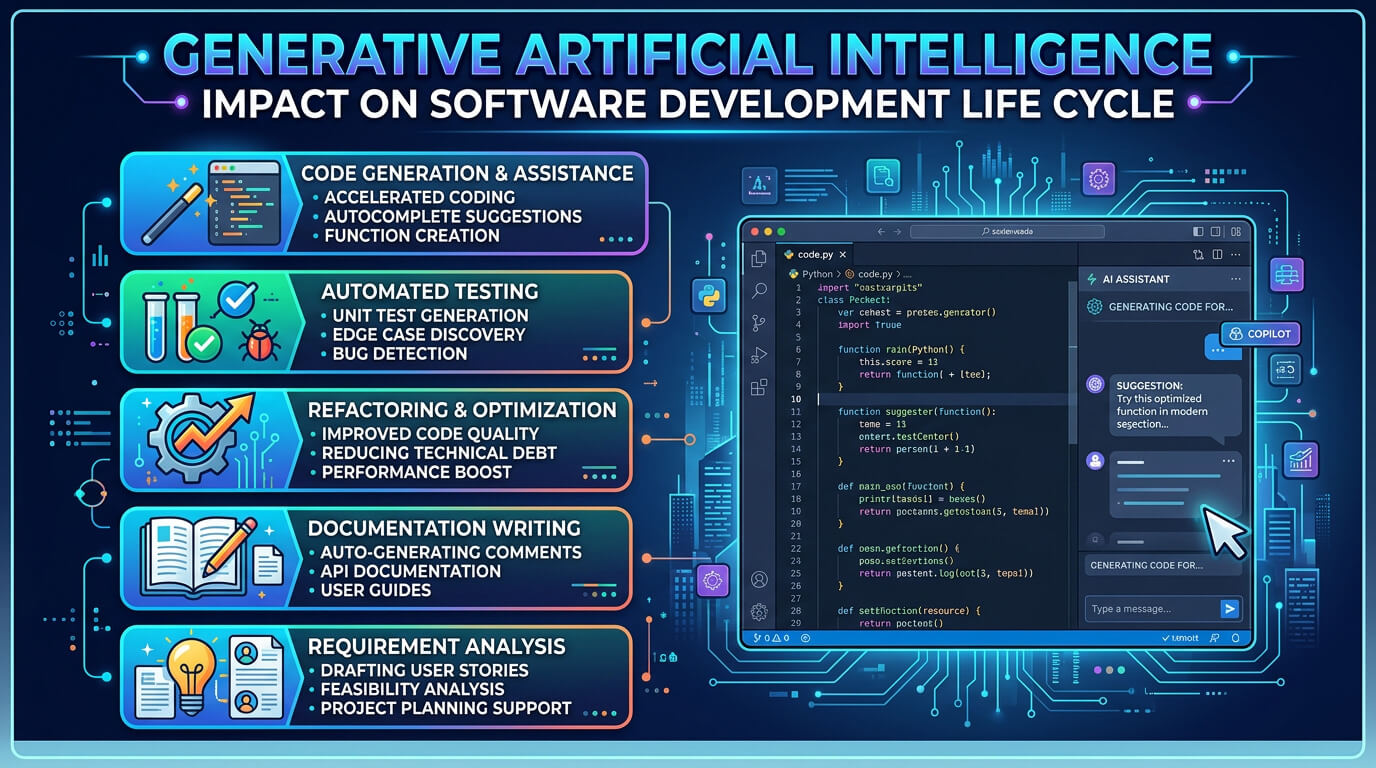
Generative artificial intelligence is used in software development such as generating code, improving code quality, detecting bugs, improving UI/UX design and automating deployment. This accelerates productivity and maintains high standards across the software development life cycle (SDLC).
GenAI use cases in software development are given below.
- Code generation: Generative artificial intelligence creates code in the form of code snippets, functions or entire modules using natural language prompts to reduce manual effort and speed up the software delivery.
- Testing the quality: Generative artificial intelligence tests quality by generating test cases, identifying edge scenarios and automating bug detection to make sure of the code quality and minimize human error.
- UI/UX design and architecture: Generative artificial intelligence designs user interfaces and architectures by producing wireframes, design prototypes and layout suggestions such as grid layouts, card layouts and sidebar navigation that allow iteration and user-focused software experiences.
- Documentation and maintenance: Generative artificial intelligence manages documentation and maintenance through generating and updating technical documentation, summarizing code changes and supporting ongoing maintenance tasks like bug fixing, code refactoring and security patching for greater clarity and efficiency.
- Automated deployment: Generative artificial intelligence automates deployment using improved scripts, environment monitoring and release workflow management to minimize downtime and support continuous integration and delivery.
5. Data augmentation
Generative artificial intelligence helps in data augmentation by creating synthetic data, addressing data scarcity, improving data diversity, handling imbalanced datasets, improving model performance and anonymizing sensitive data for privacy and compliance.
The applications of generative artificial intelligence in data augmentation are given below.
- Addressing data scarcity: Generative artificial intelligence generates synthetic data to expand existing datasets such as ImageNet and the UCI Machine Learning Repository that train AI models when original data is limited or hard to collect.
- Improving data diversity: Generative artificial intelligence introduces variations into existing datasets that help AI models generalize better and reduce the risk of overfitting to specific patterns like central tendency, trends and correlations.
- Handling imbalanced datasets: Generative artificial intelligence produces additional samples for underrepresented classes, which balance existing datasets and improve fairness and accuracy in model predictions like target variables, features and labels.
- Improving model performance: Generative artificial intelligence boosts AI model performance by increasing the quantity and quality of training data, which allows accurate and reliable artificial intelligence systems like algorithms, machine learning models and neural networks.
- Anonymizing sensitive data: Generative artificial intelligence creates synthetic data that preserves the statistical properties of original datasets while protecting sensitive information and supporting privacy requirements like data minimization, consent management and data encryption.
6. Finance
Generative artificial intelligence changes finance by automating tasks, improving decision-making and delivering the best customer experiences. Generative AI use cases in financial services include improved customer service, risk management, fraud detection, streamlined operations, and advanced financial analysis.
The applications of generative AI in finance are given below.
- Enhanced customer service: Generative artificial intelligence delivers 24/7 support through chatbots and virtual assistants that personalize customer experiences and resolve inquiries such as account questions, processing transactions and handling complaints to boost satisfaction and loyalty.
- Improved risk management: Generative artificial intelligence analyzes large datasets, simulates market conditions and generates risk models to support informed decision-making and strengthen risk assessment processes like hazard identification, risk evaluation and risk documentation.
- Improved fraud detection: Generative artificial intelligence detects suspicious transactions in real time, automates monitoring and reduces false positives, which increases security and minimizes financial losses like credit loss, legal penalty and reputational damage for institutions and customers.
- Streamlined operations: Generative artificial intelligence automates routine financial tasks such as document processing and compliance reporting, which reduces manual workloads and improves operational efficiency across financial services like banking, insurance and investment management.
- Advanced financial analysis: Generative artificial intelligence produces detailed financial reports, forecasts and insights that allow faster and accurate decision-making for investments, portfolio management and business strategy.
7. Healthcare
Generative artificial intelligence is transforming healthcare through automation, improved diagnostics and enhanced patient engagement. The applications of generative AI in healthcare include medical imaging, personalized treatment, drug discovery, administrative task automation and virtual patient models, supported by synthetic medical images and clinical documentation.
Generative AI use cases in healthcare are given below.
- Medical imaging: Generative artificial intelligence creates and improves synthetic medical images, supports diagnostics and assists radiologists in disease detection, segmentation and report generation for improved clinical outcomes like survival rates, recovery times and symptom improvement.
- Personalized treatment: Generative artificial intelligence analyzes patient data to develop customized treatment plans, predict medication responses and optimize care strategies like preventive care, chronic disease management and patient education that improve patient engagement and health outcomes.
- Drug discovery: Generative artificial intelligence accelerates drug discovery by generating new chemical compounds, predicting drug interactions and reducing the time and cost needed to develop effective therapies such as medications, surgical procedures and radiation therapy.
- Administrative tasks: Generative artificial intelligence automates tasks such as appointment scheduling, billing and clinical documentation that optimizes operations and allows healthcare professionals to focus on patient care.
- Virtual patients: Generative artificial intelligence models virtual patients for medical training, decision-making practice and diagnostics, which helps scalable, low-cost education and assessment for clinicians.
8. Education
Generative artificial intelligence shapes education with customized learning experiences, improved language instruction, personalized curriculum development and support for critical thinking. It also includes automating administrative tasks to improve efficiency for educators and institutions.
The applications of generative AI in education are given below.
- Personalized learning: Generative artificial intelligence customizes educational content to each student’s needs, learning pace and preferences like learning style, content format and subject interest, which allows targeted instruction and improves student engagement and outcomes.
- Improved language learning: Generative artificial intelligence provides interactive language exercises, real-time feedback and conversational practice that helps learners build vocabulary, grammar and fluency in new languages.
- Customized curriculum development: Generative artificial intelligence creates lesson plans, assessments and educational resources to help educators to plan training programs aligned with learning objectives and progressing educational standards like content, performance and benchmarks.
- Improved critical thinking: Generative artificial intelligence generates problem-solving scenarios, open-ended questions and debate prompts that encourage students to analyze, reason and develop strong critical thinking skills.
- Automated administrative tasks: Generative artificial intelligence automates tasks such as grading, scheduling and student progress tracking to reduce educator workload and help focus on teaching and student support.
9. Retail industry
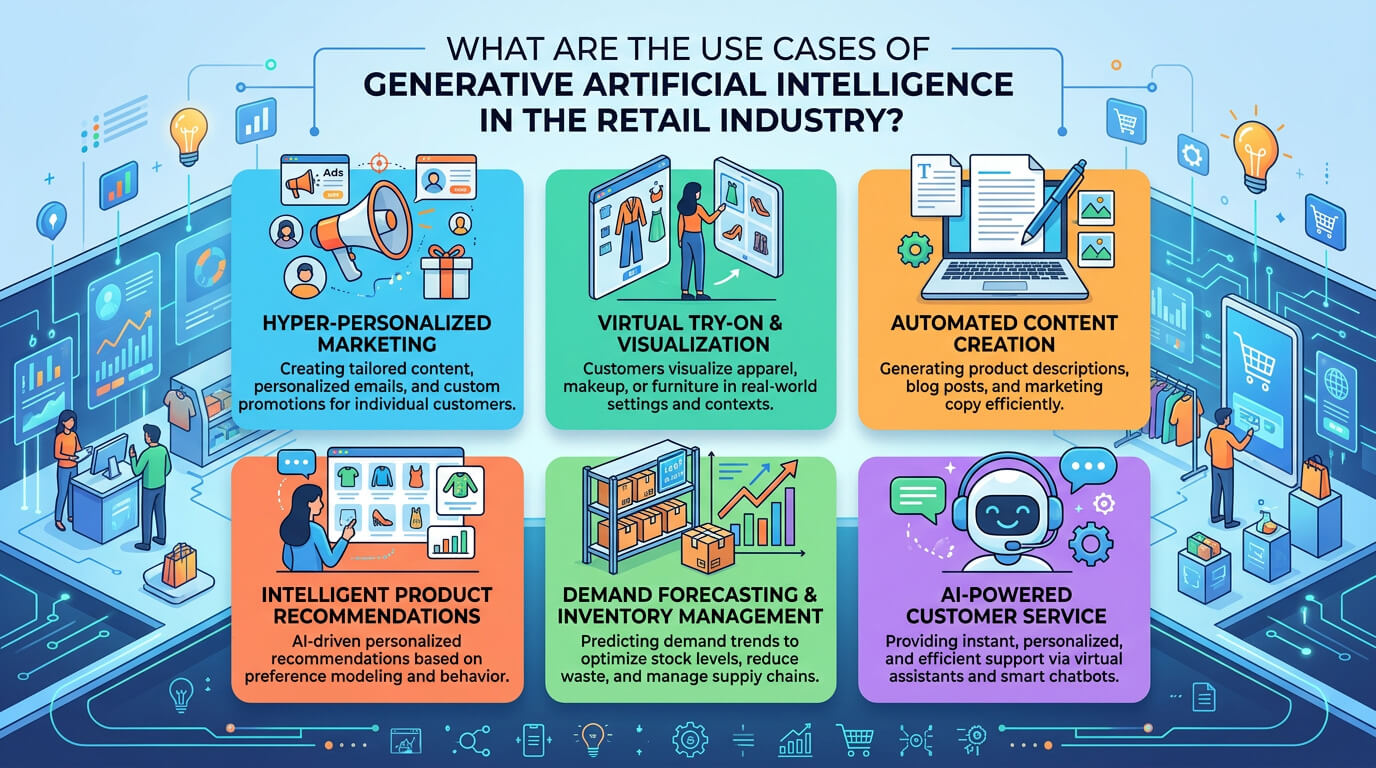
Generative artificial intelligence is transforming the retail industry with personalized shopping, automated tasks and innovative consumer experiences. Retailers and consumer packaged goods (CPG) brands like Nestlé, PepsiCo and Unilever use generative AI for marketing, customer service, product design and virtual try-on solutions.
The applications of generative AI in the retail industry are given below.
- Personalized shopping experiences: Generative artificial intelligence analyzes customer data to recommend products, personalize promotions and shopping journeys that match individual preferences like brand choice, product style and price range, which boosts engagement and satisfaction.
- Automated tasks: Generative artificial intelligence manages stock, automates order processing and optimize supply chain operations like producers, vendors and warehouses that reduce manual workload and increase operational efficiency for retailers and CPG companies.
- Personalized marketing campaigns: Generative artificial intelligence creates targeted marketing messages, ads, emails and content for specific audiences. Generative AI models like Vosu.ai help brands and influencers generate images, videos and avatars to connect with customers on a personal level and drive sales.
- Improved customer service: Generative artificial intelligence powers chatbots and virtual assistants like Siri, Meta AI and Bixby that answer questions, resolve issues and provide 24/7 support to improve the overall customer experience.
- Improved product design: Generative artificial intelligence generates new product ideas, packaging concepts and design prototypes such as interactive prototypes, clickable prototypes and responsive prototypes that help CPG brands and retailers innovate and respond to market trends like consumer behavior or economic indicators.
- Supported virtual try-on: Generative AI generates immersive virtual try-on tools like vosu.ai for clothing, accessories and makeup, which allows customers to preview products and make more confident purchase decisions.
10. Oil and Gas industry
Generative artificial intelligence is transforming the oil and gas industry by optimizing operations, supporting data-driven decision-making and improving efficiency across the value chain. Its applications cover exploration, production, maintenance, and supply chain management.
The applications of generative AI in the oil and gas industry are given below.
- Exploration and drilling optimization: Generative AI analyzes geological and geophysical data, models drilling scenarios and identifies drilling sites to reduce exploration risks and improve decision-making for resource allocation.
- Reservoir modeling and management: Generative AI creates high-resolution reservoir models, predicts production behavior and suggests extraction strategies like primary recovery, secondary recovery and gas injection for accurate forecasting and efficient resource management.
- Predictive maintenance: Generative AI monitors equipment health, predicts failures and schedules maintenance such as routine inspections, equipment calibration and safety checks to minimize downtime and reduce operational costs like maintenance or direct materials while supporting safer decision-making.
- Supply chain and logistics optimization: Generative AI forecasts demand, manages supply chains and improves logistics such as pipeline scheduling, equipment transport and resource distribution, which helps companies respond to market fluctuations and boosts delivery efficiency.
- Safety and environmental monitoring: Generative AI detects unusual occurrences, predicts risks and helps respond to environmental incidents that improve operational safety and regulatory compliance.
11. Business
Generative AI changes business by creating content, automating customer support, boosting product innovation, delivering personalized marketing and optimizing processes like workflow automation, task management and data analysis that help organizations to improve engagement, efficiency and adaptability.
Applications of generative AI in business are given below:
- Content generation: Generative AI creates content for emails, blogs, reports and images for teams to communicate and launch campaigns like social media, product launches and brand awareness.
- Customer support automation: Generative AI automates customer support with intelligent chatbots like Lindy or Zendesk AI that answer questions and solve issues to improve service quality and availability.
- Product and design innovation: Generative AI boosts product and design innovation by generating new ideas, developing prototypes and helping businesses test and refine concepts like sustainability, digital transformation and collaboration faster.
- Personalized marketing: Generative AI provides personalized marketing by analyzing user data and customizing campaigns, messages and offers such as discount offers, bundle offers and seasonal offers to boost customer engagement.
- Process automation and optimization: Generative AI helps process automation by managing repetitive tasks, optimizing workflows like sales order or employee onboarding and identifying ways to improve business operations and efficiency.
12. Manufacturing
Generative AI is transforming manufacturing by optimizing processes such as machining or molding, addressing skill gaps, improving productivity, allowing product design and supporting predictive maintenance like oil quality monitoring or temperature tracking for smarter and more efficient operations.
The applications of generative AI in manufacturing are given below.
- Process Optimization: Generative AI refines manufacturing processes such as machining, molding, and assembly by analyzing production data, recommending workflow progress and improving resource distribution to maximize efficiency and minimize waste.
- Addressing the Manufacturing Skills Gap: Generative AI provides training models like virtual reality (VR) machinery operation or CNC machine simulators, virtual coaching and knowledge transfer that helps improve workers and close the manufacturing skills gap in production environments.
- Productivity improvement: Generative AI automates tasks such as quality checks and inventory updates, monitors machine performance problems and supports real-time decision-making to boost productivity in manufacturing.
- Product design and prototyping: Generative AI helps manufacturers improve product development by creating design alternatives such as turbine blades and battery enclosures, modeling performance and boosting prototypes, which allows manufacturers to improve faster and respond to market demands like product features and minimalist design trends.
- Predictive Maintenance: Generative AI predicts equipment failures such as motor burnout, bearing failure and hydraulic leak, schedules maintenance and reduces unexpected downtime, which extends machine life and make sure of consistent production output.
13. Marketing
Generative AI in marketing supports market research, content generation, personalization, campaign optimization and customer service, which helps brands deliver targeted strategies, automate workflows and improve customer engagement across platforms and campaigns.
The applications of generative Artificial Intelligence in marketing are given below.
- Market Research: Generative Artificial Intelligence helps deep analysis of consumer data, demand patterns, predicts customer trends, and discovers new market segments like demographic, geographic and behavioral that result in precise marketing strategies and product positioning.
- Content Generation: Generative Artificial Intelligence creates engaging advertising copy, blog articles, product descriptions, visuals and videos that connect with target audiences across platforms like Facebook, Instagram TikTok while maintaining consistent brand messaging and quality.
- Personalization: Generative Artificial Intelligence customizes marketing messages, product recommendations and promotions based on user behaviors, preferences and demographics to increase engagement, conversion rates and customer loyalty.
- Campaign Optimization: Generative Artificial Intelligence automates campaign management, conducts real-time testing, changes tactics according to performance data and provides insights on conversion rate, cost per acquisition and website traffic that maximize advertising effectiveness and return on investment.
- Customer Service: Generative Artificial Intelligence powers tools like chatbots and virtual agents that help provide instant, personalized support, resolving common issues and optimizing product recommendations to improve both customer satisfaction and loyalty.
What is generative AI?
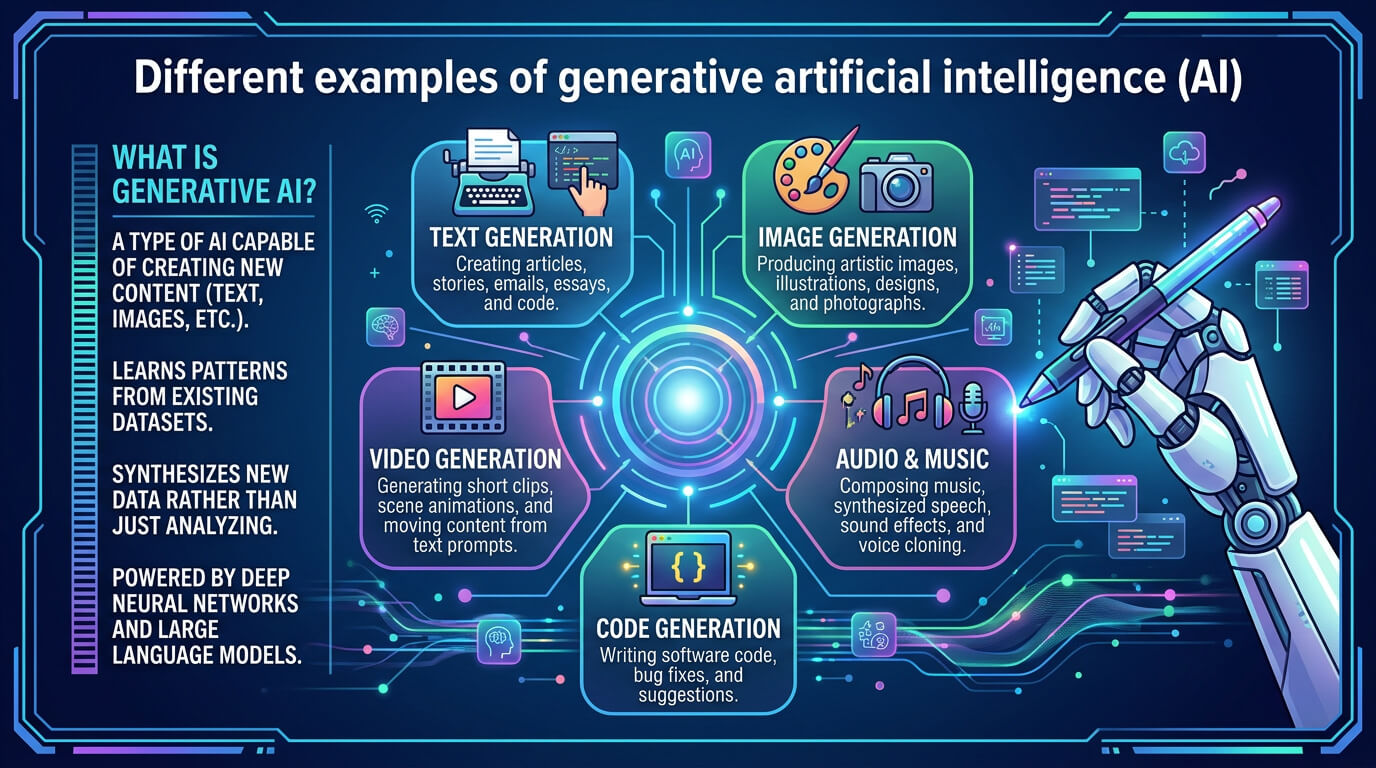
Generative artificial intelligence is a type of artificial intelligence that uses advanced algorithms trained on extensive datasets to create original content such as text, images, audio, video or code in response to user prompts. Gen AI technology identifies patterns in data to produce unique outputs like text responses, product descriptions and blog articles instead of retrieving existing information.
Examples of generative artificial intelligence include large language models that generate human-like text, text to image systems like DALL-E, text to video generators such as Sora, and audio synthesis platforms. Modern multimodal platforms like Vosu.ai generate images, videos, audio and digital avatars from simple prompts or references. Generative AI applications transform content creation across industries by powering chatbots, designing graphics, composing music and producing realistic media for marketing, entertainment and business functions.
What is a generative AI model?
A generative AI model is an advanced machine learning model designed to generate new content such as text, images or audio by learning patterns from its training data and analyzing existing data. Its features include the ability to create unique outputs, recognize complex structures and adjust to different tasks. Generative AI models like GANs, GPT-4 and Stable Diffusion are specialized in producing original and realistic content.
What are the types of generative AI?
The 7 types of generative artificial intelligence are outlined below.
- Generative adversarial networks (GANs): Generative adversarial networks (GANs) generate realistic images or data by training two networks in opposition.
- Variational autoencoders (VAEs): Variational autoencoders encode input data into latent space and decode it to create similar outputs like Images, handwriting samples and speech recordings.
- Diffusion models: Diffusion models convert random noise into structured data through a step by step denoising process like noise reduction or image restoration.
- Autoregressive models: Autoregressive models predict each data element based on previous outputs to generate text or sequences like tweets, song lyrics and news articles.
- Neural radiance fields (NeRFs): Neural radiance fields generate realistic 3D views like architectural exteriors, product renderings and 3D art galleries by modeling light fields from input images.
- Large language models (LLMs): Large language models generate clear text by understanding and predicting language patterns from training data.
- Flow models: Flow models use reversible transformations to generate high-quality data samples and assign precise values to each result.
Is generative AI beneficial?
Yes, generative artificial intelligence is beneficial because it improves productivity and innovation by automating content creation, personalizing user experiences and boosting business efficiency. The benefits of generative AI include faster creative workflows, improved decision-making, cost reductions and adaptive solutions across industries like marketing, healthcare, entertainment and design.
Does generative AI have any limitations?
Yes, generative artificial intelligence has limitations because it depends on the quality of training data, struggles to understand context and produces inaccurate or biased content. The limitations of generative AI include hallucination, contextual misunderstandings, complex reasoning challenges, potential bias, high computational demands like climate modeling, weather forecasting and gene sequencing, privacy concerns, ethical risks and difficulties with multilingual or culturally diverse inputs
Is generative AI over hyped?
No, generative artificial intelligence is not over hyped because it provides value through practical applications in content creation, automation and personalization. The generative artificial intelligence trend reflects industry demand and transformative business impact but media coverage overhypes short-term expectations.
What is the future of generative AI?
The future of generative artificial intelligence (AI) promises to change work, productivity and content creation. It is expected to transform industries like agriculture, forestry, fishing and mining by automating tasks such as data analysis, report generation and content drafting. It also improves creativity through tools that support design, writing and music composition. Generative AI’s anticipated developments include collaboration platforms that adjust user behavior, content customization to individual preferences and learning systems that adjust in real time.
What is the future application of generative AI?
Future applications of generative AI will focus on augmenting creative workflows, accelerating scientific discovery and improving customer interactions. Generative AI future includes automating complex design tasks, generating new scientific insights and providing personalized, interactive content for customer engagement across industries including healthcare, education, marketing and entertainment.