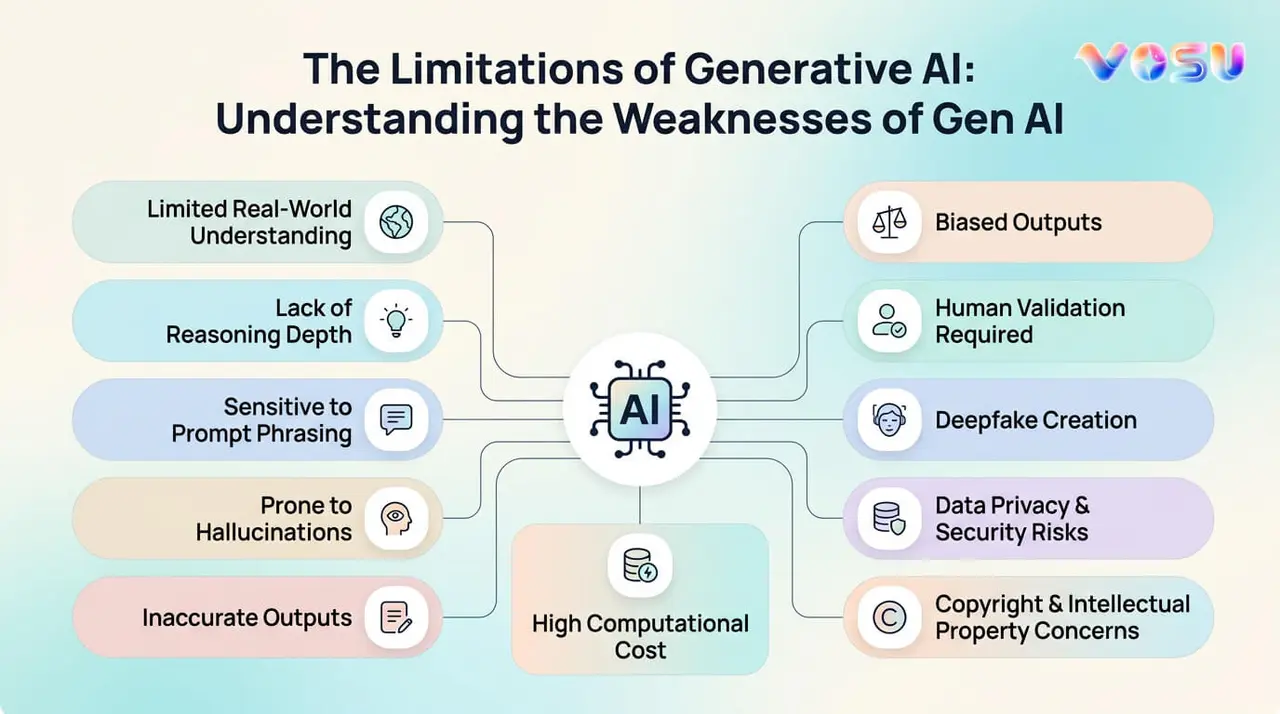
The limitations of generative AI include limited real world understanding, lack of deep reasoning, sensitivity to prompt phrasing, hallucinations, inaccurate outputs, biased outputs, human validation needs and other technical and ethical risks.
Generative AI shows limited real world understanding because it learns from data instead of direct experience and interaction. It shows a lack of reasoning depth because it depends on patterns instead of true logical thinking in complex scenarios. It demonstrates sensitivity to prompt phrasing because small input changes shift outputs through probabilistic prediction.
Generative AI produces hallucinations by generating confident but false information without verification. It leads to inaccurate outputs due to outdated knowledge, misinterpretation and calculation errors. It reflects bias because the training data contains imbalance and historical patterns. It requires human validation since systems cannot ensure full accuracy, safety or reliability independently. It includes risks like deepfake creation, data privacy concerns, copyright issues and high computational cost.
The limitations of generative AI are listed below.
- Limited real-world understanding
- Lacks of reasoning depth in complex scenarios
- Sensitive to prompt phrasing
- Prone to hallucinations
- Inaccurate outputs
- Biased outputs
- Human validation requirement
- Deepfakes creation
- Risks data privacy and security
- Copyright and intellectual property concerns
- High computational cost for training
Limited real-world understanding
Generative AI has limited real world understanding because it learns from text, images and audio instead of direct experience. Generative AI depends on patterns in training data rather than real interaction, which restricts true understanding. It lacks senses, a physical body and direct exposure to the physical world, so it cannot learn through sensory feedback or lived experience.
Generative AI describes physical concepts accurately, but it cannot develop true understanding through real interaction. It increases the risk of ignoring physical constraints in architecture, engineering and materials science tasks. It also produces commonsense reasoning errors in edge cases involving unusual physical conditions or rare environmental situations.
Lacks of reasoning depth in complex scenarios
Generative AI struggles with deep reasoning in complex scenarios involving structured and constrained problems. It shows limited reasoning depth when it cannot maintain consistent multi step thinking across different stages of a problem.
Generative AI models function as pattern generators rather than symbolic reasoners, and depend on statistical correlations rather than structured logical understanding. These models imitate common reasoning patterns in logic puzzles and basic arithmetic steps, but do not consistently apply correct logic across different situations. They also struggle with long, multi step and unusual tasks involving hidden constraints that require deeper insight, planning and careful problem solving.
Sensitive to prompt phrasing
Generative AI shows sensitivity to prompt phrasing because output quality depends on exact wording, information order, level of detail and instruction framing. It operates as a pattern generator that activates different learned probability distributions based on minor input changes.
Generative AI uses probabilistic sequence prediction instead of the logical steps of a traditional program. It shifts reasoning patterns based on small variations in input, which changes answers, tone, structure and correctness. It produces outputs ranging from accurate explanations to flawed solutions when phrasing changes slightly. It becomes more consistent when prompts follow proper prompt engineering techniques such as defining roles, constraints and examples
Prone to hallucinations
Generative AI shows proneness to hallucinations because it prioritizes relevance and pattern alignment over truth verification.
Generative AI performs no direct reality verification or database lookup during response generation. It fills gaps in conflicting or incomplete training data using probable next sequence patterns instead of factual retrieval. It produces coherent and relevant outputs that confidently present nonexistent academic papers, invented product features or incorrect statistics and dates. Generative AI models produce hallucinations because training data contains errors, omissions and conflicting sources that resist independent verification.
Inaccurate outputs
Generative AI shows a limitation in producing inaccurate outputs because it can generate incorrect information without fully hallucinating content. It produces outdated information, misinterpretations, overgeneralizations, calculation errors and logical errors. It also produces errors when it extrapolates patterns learned before its training cutoff.
Generative AI shows higher inaccuracy in niche, new or time sensitive queries because incomplete training data affects its knowledge. It produces systematic inaccuracies when biased or incomplete training data influences its understanding of certain subjects and these errors can repeat across similar domains. It also increases calculation and logical errors in multi step arithmetic, statistical analysis and symbolic computation compared to purpose built tools.
Biased outputs
Generative AI produces biased outputs because it learns patterns from training data with skewed representation. It encodes historical inequalities and offensive content into model parameters during training.
Generative AI bias appears in descriptions of social groups, example selection and suggested options in generated outputs. It includes social and cultural bias, geographic and economic bias, and confirmation bias in probabilistic predictions. It is reduced through mitigation methods such as diverse data curation, reinforcement learning from human feedback and systematic bias auditing across demographic dimensions.
Human validation requirement
Generative AI requires human validation because its outputs are not reliable for direct use without review due to hallucinations, inaccuracies and bias. It becomes risky in high stakes areas such as medicine, law and finance, where errors can directly affect critical decisions and real world outcomes.
Generative AI needs human review, verification and adjustment before practical use to ensure accuracy and reliability. It works best in safety critical domains when used for drafting, brainstorming, summarizing or suggesting options, where professionals apply domain knowledge to evaluate and refine outputs. It functions as an assistant or co-pilot rather than an autonomous authority, while humans remain responsible for final decisions.
Deepfakes creation
Generative AI creates deepfakes, which highlights one of its key disadvantages, where systems generate synthetic media that clone faces and produce realistic scenes.
Generative AI systems use generative models for images, video and audio to clone faces, replicate voices and recreate realistic scenes and speech with high accuracy. It introduces risks by enabling misinformation through fake events, fabricated evidence and fake speeches, which lead to serious reputational damage and loss of trust in digital media. It raises ethical concerns by allowing the manipulation of real individuals and violating consent in generated content. It creates legal challenges where deepfake technology complicates liability assignment and affects evidence admissibility in court proceedings.
Risks data privacy and security
Generative AI risks data privacy and security because sensitive information can be exposed, misused or attacked during model training and usage. It includes privacy and security risks that affect sensitive data across different applications and systems. It arises from training data exposure, where information can leak through generated outputs. It creates usage risks when users share confidential content that is stored or processed without proper isolation. It becomes vulnerable under weak safeguards, where prompt injection attacks override instructions and expose protected information.
Copyright and intellectual property concerns
Generative AI creates copyright and intellectual property concerns because its outputs can resemble copyrighted works from training data without clear licensing.
Generative AI training data includes copyrighted books, articles, source code and creative works, which triggers legal debates about fair use and consent. It generates outputs that may resemble original sources, including patterns or proprietary code, creating risks of unintentional reproduction. It increases concern when generated content becomes too similar to existing materials like code, text or creative outputs. It requires clear licensing rules and legal review before commercial use to reduce intellectual property risks.
High computational cost for training
Generative AI has a limitation in the form of high computational cost for training, where systems require large datasets, powerful hardware and significant energy consumption to build and run models.
Generative AI models depend on massive datasets and powerful hardware such as GPUs and TPUs to process training at scale. This process involves high energy consumption, which increases training time and contributes to a higher carbon footprint. It creates limited access for smaller teams because only well funded organizations can afford such large scale infrastructure. It also increases inference costs, which require optimization techniques such as quantization, pruning and distillation to reduce computational load per query.
Why is understanding the limitations of generative AI important?
Understanding the limitations of generative AI is important because it can produce hallucinations, misinformation and biased outputs in unchecked deployments.
Generative AI generates pattern based predictions that lack true comprehension of the meaning, context or intent behind queries. It shows weak context handling limitations that restrict adaptation to novel scenarios outside the distribution of training data. It produces outputs that reflect statistical correlations rather than creative reasoning, producing outputs without genuine originality or emotional understanding. It creates variable responses for the same input due to probabilistic generation, which leads to inconsistency and unpredictability. It increases risks of misinformation and data privacy issues in high stakes fields like healthcare, law and finance. It improves reliability when guided by transparent systems, human oversight and principles of generative AI ethics.
Can you always trust the output generated by generative AI models?
No, you cannot always trust the output generated by generative AI models because they work probabilistically and do not verify facts directly. Generative AI models generate responses using statistical patterns, so errors or misleading information still appear, which makes human oversight necessary in professional or critical decisions.
Can generative AI generate unsafe or harmful content?
Yes, generative AI can generate unsafe or harmful content because it relies on pattern matching over training data. It produces dangerous, illegal or biased information that includes references to criminal acts, self harm content and sexual imagery without proper safeguards.
Can generative AI generated outputs be inconsistent?
Yes, generative AI generated outputs can be inconsistent because they are probabilistic rather than deterministic. These models sample from probability distributions during generation, so identical inputs produce different outputs. This variability is one of the core limitations of generative AI, where variability appears as stable, reproducible results.
Can biases in training data affect generative AI models?
Yes, biases in training data can affect generative AI models because they learn from vast amounts of human generated internet data. This learning process creates generative AI limitations, where models inherit data bias and produce skewed and stereotypical outputs in text, images and code.
Is there a risk if a generative AI system learns only from limited data?
Yes, there is a risk if a generative AI system learns only from limited data because it depends on memorizing data instead of proper learning patterns. This results in poor generalization, so the system cannot perform well on unseen inputs beyond its training data.
Does generative AI generated content automatically provide reliable sources?
No, generative AI generated content does not automatically provide reliable sources because it produces non existent and inaccurate references through pattern based citation generation rather than real database retrieval. It creates citations like author names, journal titles and dates using learned patterns, so it requires verification of all sources before use.
What are the limitations of generative AI that make human oversight necessary?
The limitations of generative AI that make human oversight necessary are given below.
- Hallucinations and inaccuracy: Generative AI produces factually incorrect outputs without internal verification, requiring human fact checking before professional use.
- Context and logic failures: Generative AI loses coherent context in long conversations and fails multi step logical reasoning that requires symbolic processing.
- Bias and ethical risks: Generative AI inherits skewed and stereotypical patterns from training data, producing outputs that require human ethical review.
- Lack of genuine creativity: Generative AI recombines training data patterns rather than generating original concepts, requiring human creative judgment for original work.
- Security and safety concerns: Generative AI produces outputs that include harmful instructions, unsafe content, and prompt injection vulnerabilities requiring human monitoring.
- Data privacy risks: Generative AI processes sensitive user data with documented risks of training data leakage and inadequate data isolation protocols.