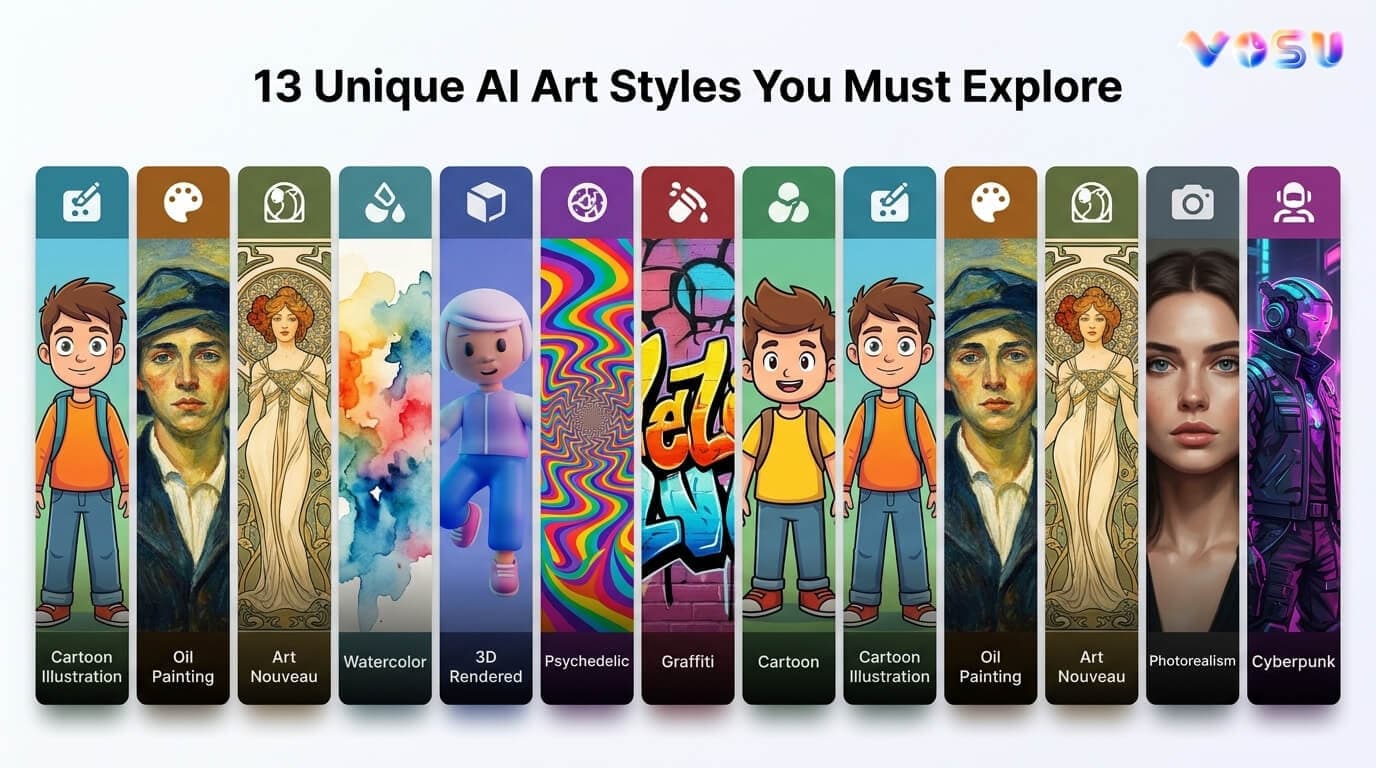
AI art styles refer to the visual aesthetics generated by artificial intelligence systems that replicate, reinterpret classic art movements such as impressionism or cubism and futuristic digital aesthetics. These styles blend human creativity with machine learning to produce artwork that ranges from nostalgic pixel designs to attractive 3D renders.
AI art reflects both the charm of classic art forms and the edge of digital innovation through features, stylized lines and bold aesthetics. AI tools reinterpret well known artistic approaches, such as impressionism’s emphasis on light and color, cubism’s fragmented perspectives and surrealism’s dreamlike imagery.
The 13 unique AI art styles are listed below.
- Pixel art: Pixel AI art inspires retro video game visuals with blocky, low resolution design.
- Pop art: Pop AI art uses electric blue, hot pink, neon green, bright yellow and mass culture icons to create bold, eye catchy pieces.
- Anime art: Anime AI art features and expressive characters of Japanese animation.
- Cyberpunk art: Cyberpunk AI art depicts futuristic, neon lit worlds with tech heavy workplaces.
- Surrealism art: Surrealism AI art merges dreamlike imagery with abstract, mind bending concepts such as distorted realities, unexpected juxtapositions and fantastical landscapes.
- Watercolor art: Watercolor AI art mimics fluid brush strokes and soft pigment blending.
- 3D art: 3D AI art creates lifelike scenes and objects with depth, shadow and realism.
- Psychedelic art: Psychedelic art features intense colors, swirling shapes and surreal abstractions that mimic hallucinations and sensory distortion.
- Graffiti art: Graffiti AI art brings urban street style visuals with bold typography and rebellious flair.
- Cartoon art: Cartoon AI art uses simplified forms and exaggerated features for comedic effect.
- Illustration art: Illustration AI art focuses on narrative, detail and stylized drawing.
- Oil painting art: Oil AI painting art mimics rich textures and color layering of classic oil media.
- Art Nouveau: Art Nouveau combines graceful lines and floral motifs inspired by nature.
1. Pixel art
Pixel art in AI art style is a form of digital art where artificial intelligence generates images through the arrangement of individual colored pixels on a low resolution grid and replicates the classic visual style of early video games and computer graphics. AI powered pixel art generators, such as Pixel Art Style, utilize deep learning and computer vision to interpret user prompts, which include text descriptions and transform them into pixelated artworks. These models are trained on large datasets of authentic pixel art, which allows them to replicate the intentional color placement, grid alignment and stylistic constraints that define the medium.
Pixel art is known for its low resolution format, where each pixel is a visible, discrete unit of color that contributes to the image. The art form relies on limited color palettes that require low resolution grids, dithering and selective pixel placement to achieve shading, highlights and texture within tight constraints. Pixel art techniques such as dithering (mixing pixels of different colors to create gradients), anti-aliasing (softening edges) and perfect grid alignment are used to improve visual appeal while maintaining the blocky, retro aesthetic. The process begins with a text prompt, which is converted into a numerical representation by natural language processing models in AI-generated pixel art. The AI then generates an image by placing pixels according to learned patterns and stylistic rules to make sure that the output follows the principles of pixel art, such as consistent pixel sizes, intentional color use and clear, simple shapes. This combination of digital art, precise color placement and low resolution design supports a wide range of creative pixel drawing ideas from simple icons to complex characters and scenes. It retains the recognizable aesthetics of classic pixel art, such as crisp outlines, deliberate detail and a retro visual style rooted in early video game graphics.
2. Pop art
Pop art in AI art styles refers to the use of artificial intelligence to generate images inspired by the classic pop art movement, which originated in the mid 20th century as a reaction to classic fine art by incorporating imagery from popular culture, advertising and mass media. AI-driven pop art captures the defining features of the movement, such as bold primary colors, graphic patterns, high contrast and iconic references, using generative adversarial networks (GANs) to transform text or images into vibrant, stylized compositions. These works display humor, irony and a playful engagement with consumer products and pop culture figures, which makes pop art accessible and visually impactful in both gallery exhibitions and digital contexts.
The uniqueness of AI pop art lies in its ability to reinterpret popular culture at scale and democratize the creation process to generate personalized pop art of artistic training. AI tools use deep learning to analyze the techniques of historical pop artists, such as screen printing and collage, while also introducing new digital effects, patterns and compositions. This modern approach keeps pop art relevant through rapid experimentation, endless variation and easy adaptation for branding, social media and contemporary design.
American and British pop art differ in perspective and tone. American pop art, led by artists like Andy Warhol and Roy Lichtenstein, arose from direct experience with consumer culture, focusing on bold, iconic imagery, impersonal style and a celebration or critique of mass production and celebrity. British pop art, initiated by figures like Richard Hamilton, viewed American popular culture from a distance, with irony, parody and academic analysis, which use collage and mixed media to critique both American influence and British society. While both movements share a fascination with popular culture, American pop art is more direct and iconic, whereas British pop art is more reflective, critical and emotionally nuanced.
3. Anime art
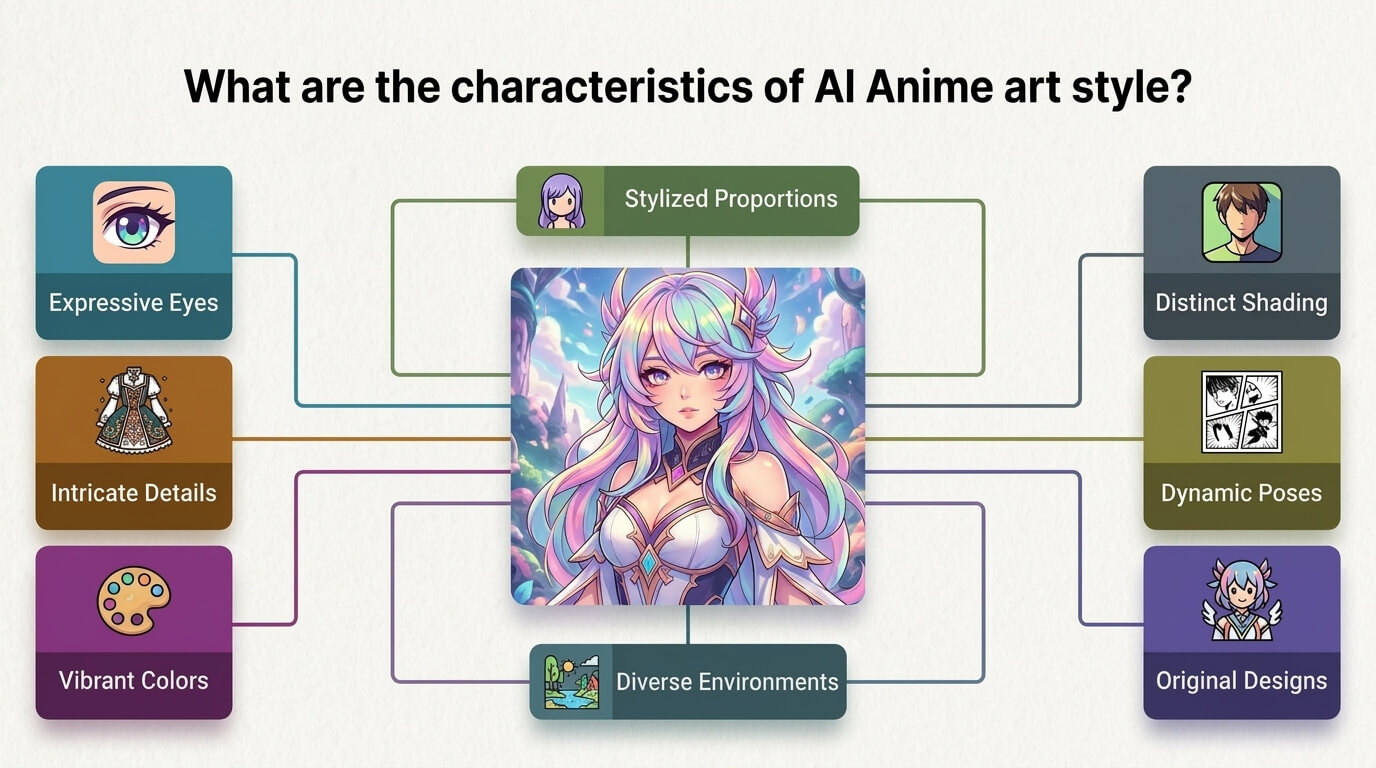
Anime art in AI art styles refers to digital artwork generated by artificial intelligence that replicates the distinct visual and thematic characteristics of Japanese animation. AI anime art generators employ advanced machine learning models trained on datasets of anime images to generate illustrations from user prompts. These illustrations capture core anime elements such as expressive eyes, vibrant colors and stylized characters. These tools democratize anime creation and allow anyone to generate unique, high-quality anime visuals without the need for old drawing skills. The process combines the core aesthetics of Japanese animation with exact technologies.
Anime art began in the early 20th century Japan, with its modern identity forming in the 1960s through the work of artists like Osamu Tezuka. His series Astro Boy laid the structural foundation of anime as a shonen (action medium). Anime has evolved into a global cultural phenomenon and influences animation, fashion, music and digital platforms worldwide. There are genres and artistic styles within anime art, each with distinct thematic orientations, such as shonen (adventure targeting young males), shoujo(romantic and emotional stories aimed at young females), Seinen (mature themes for adult men), Josei (slice of life and romance for adult women), Chibi(cute and exaggerated character depictions), Realistic or fantastical (stylized interpretations found in modern or fantasy based narratives).
Anime art features large, expressive eyes, simplified facial features, dramatic hairstyles, clean linework and the strategic use of color and shade. To create anime art using AI, users provide a descriptive text prompt detailing the desired character, scene and style. The AI model interprets this input and generates artwork by referencing learned patterns. The result is refined through editing tools. Traditional anime art starts with basic shapes, then adds refined lines and layered color, using digital or physical media.
The distinction between manga, anime and cartoons is both cultural and artistic. Manga are Japanese comics or graphic novels, usually black and white, read right to left and known for detailed storytelling and rich characters.
Anime refers to animated Japanese films or TV series, adaptations of manga and incorporates motion, sound and color. Cartoons, from Western traditions, prioritize humor, simplified narratives and exaggerated expressions, which aim at children. Anime spans a broader thematic range, such as mature, philosophical and emotionally complex storylines. Visually, anime features detailed backgrounds, nuanced character design and a wide emotional spectrum, while cartoons are characterized by abstract visuals and comedic exaggeration. Manga is the static, narrative source; anime is its dynamic animation form and cartoons represent a completely different artistic lineage in style and storytelling.
4. Cyberpunk art
Cyberpunk art is a digital form generated through artificial intelligence that captures the core themes of the cyberpunk science fiction subgenre. This style portrays dystopian futures where advanced technology and urban decay coexist. These are visualized through neon lit cityscapes, gritty environments and people mixed with machines. Cyberpunk art generators use deep learning to interpret text or image prompts. They generate intricate visuals that reflect the high tech low life aesthetic of the genre, that feature vibrant neon colors, cybernetic improvements and dark aesthetics such as rain soaked streets and shadowed cityscapes.
The origin of cyberpunk art lies in the New Wave science fiction subgenre of the 1960s and 1970s, which explored the societal effects of fast technological change and cultural disruption. The term 'cyberpunk' emerged in the early 1980s and was popularized through William Gibson’s Neuromancer and Ridley Scott’s Blade Runner, both of which defined the genre’s visual and thematic standards such as high tech, low life settings, neon lit urban decay, pervasive corporate control, cybernetic improvements and questions about identity and artificial intelligence.
Cyberpunk art blends futuristic technology such as artificial intelligence, cybernetics and virtual reality with dark, gritty visuals. It depicts a future where towering skyscrapers and glowing advertisements exist alongside poverty and urban decay. This visual world centers on **anti heroes, hackers and rebels ,**which navigates authoritarian, corporate controlled societies, with notable influence from Asian megacities and multicultural urban environments. To create cyberpunk art with AI, users choose a generator platform like Leonardo AI or Artvy. A gritty world of anti heroes, hackers and rebels navigating authoritarian, corporate run societies, inspired by asian megacities and diverse urban cultures.The key stylistic elements of cyberpunk include neon colors such as purples, pinks and blues, retro futuristic cityscapes, bionic human features and the combination of advanced gear with street fashion.
Cyberpunk art allows customization during the creation process through modifiers such as neon lighting, retro futurism, glitch effects and cultural fusion which control color palettes, character designs and urban backdrops. This allows users to refine their artwork, which maintains consistency with the high tech life theme. The future of cyberpunk art is linked to advances in digital technologies. They generate detailed visuals as models become sophisticated and expand creative options for artists, designers and storytellers. Cyberpunk art continues to be relevant due to ongoing global discussions around technology dominance, surveillance and personal identity. These topics continue to shape the genre’s development and strengthen its presence in digital culture, fashion and modern media.
5. Surrealism art
Surrealism art in AI art styles refers to digital artworks generated by artificial intelligence algorithms that replicate the fundamental principles of the surrealist artistic movement**, such as dreamlike imagery, unexpected juxtapositions and the exploration of subconscious thoughts** AI generated surrealism utilizes machine learning models such as neural networks and Generative Adversarial Networks (GANs), trained on datasets of surrealist art and visual concepts. These systems transform text prompts or user instructions into fantastical, surreal visuals that defy logic, which blends elements in ways that transcend human imagination and push the boundaries of digital creativity.
Surrealism began in the early 20th century and arose as an artistic movement in Paris in the 1920s with André Breton’s Manifesto of Surrealism (1924). Strongly influenced by the Dada movement and the psychological theories of Sigmund Freud, surrealism aimed to access the unconscious mind through techniques like automatism that creates art without conscious control, exquisite corpse (collaborative drawing), frottage (rubbing textures onto paper), decalcomania (pressing and pulling apart painted surfaces), collage and dreamscape painting. These methods encouraged artists to bypass rational thought, which allows subconscious thoughts and irrational associations to surface in their work.
Surrealist art is known for its visual texture, hyperrealistic details combined with impossible scenarios and symbolic objects that suggest psychological depth and disturb conventional perception.
Pioneering artists shape the history of Surrealism, which include Salvador Dalí (famous for his melting clocks), René Magritte (known for witty juxtapositions like The Treachery of Images), Max Ernst (an innovator of frottage and collage), Joan Miró and Frida Kahlo. Other influential figures of Surrealism include André Masson, Yves Tanguy, Leonora Carrington and Man Ray. Surrealist art inspired a new wave of neo-surrealist and contemporary artists like Jia Aili, Ming Ying, Yuanyu Xiong, Julie Curtiss, Jee Young Lee, Nam Das, Mary Reid Kelley and Michael Vincent Manalo, who mix classic surrealist ideas with modern stories and digital tools.
AI surrealism art generators democratize the creation of surrealist art, which helps anyone to produce dreamlike, psychologically rich images with just a text prompt. The movement’s legacy lies in its ability to explore the subconscious, challenge reality and inspire artists and audiences to delve into the unknown. Now these ideas are amplified and reimagined through artificial intelligence.
6. Watercolor art
Watercolor art refers to digital images generated by artificial intelligence that replicate the unique look of classic watercolor paintings. These AI-generated artworks are designed to mimic the key characteristics of watercolor, such as soft washes, delicate transparency, fluid brushstrokes and natural color blending, through algorithms trained on datasets of watercolor illustrations and techniques**.** The result is digital art that visually mirrors the luminous, layered and expressive qualities found in classic watercolor methods, which captures the ethereal and spontaneous effects valued in art history.
Classic watercolor art is created with pigments suspended in a water soluble binder, commonly gum arabic. The artist mixes these pigments with water and applies them to absorbent paper, which allows the paint to flow and blend naturally. Relies heavily on water to control the transparency of paint and to achieve subtle gradients and overlapping colors. The transparency of the medium allows underlying layers, which give watercolor its signature luminosity and depth. Artists use different brushes and techniques to work with the paint, creating effects that range from crisp lines to soft, diffused washes.
Watercolor art includes many forms, from botanical and scientific illustrations to expressive landscapes, portraits and abstract compositions. The key techniques include wet on wet (applying wet paint to wet paper for soft blends), wet on dry (for sharper edges), glazing (layering transparent washes) and dry brushing (for textured effects). The tips for successful watercolor painting include working from light to dark, uses of high quality paper to prevent warping and welcome the medium’s unpredictability to achieve unique results. The versatility of watercolor lies in its adaptability to different styles and subjects, its ability to produce both detailed and loose, impressionistic effects. The advantages are the luminous transparency, ease of blending colors, quick drying time and the expressive, spontaneous marks it produces, qualities that contribute to its lasting appeal in art history and its popularity in AI-generated illustrations.
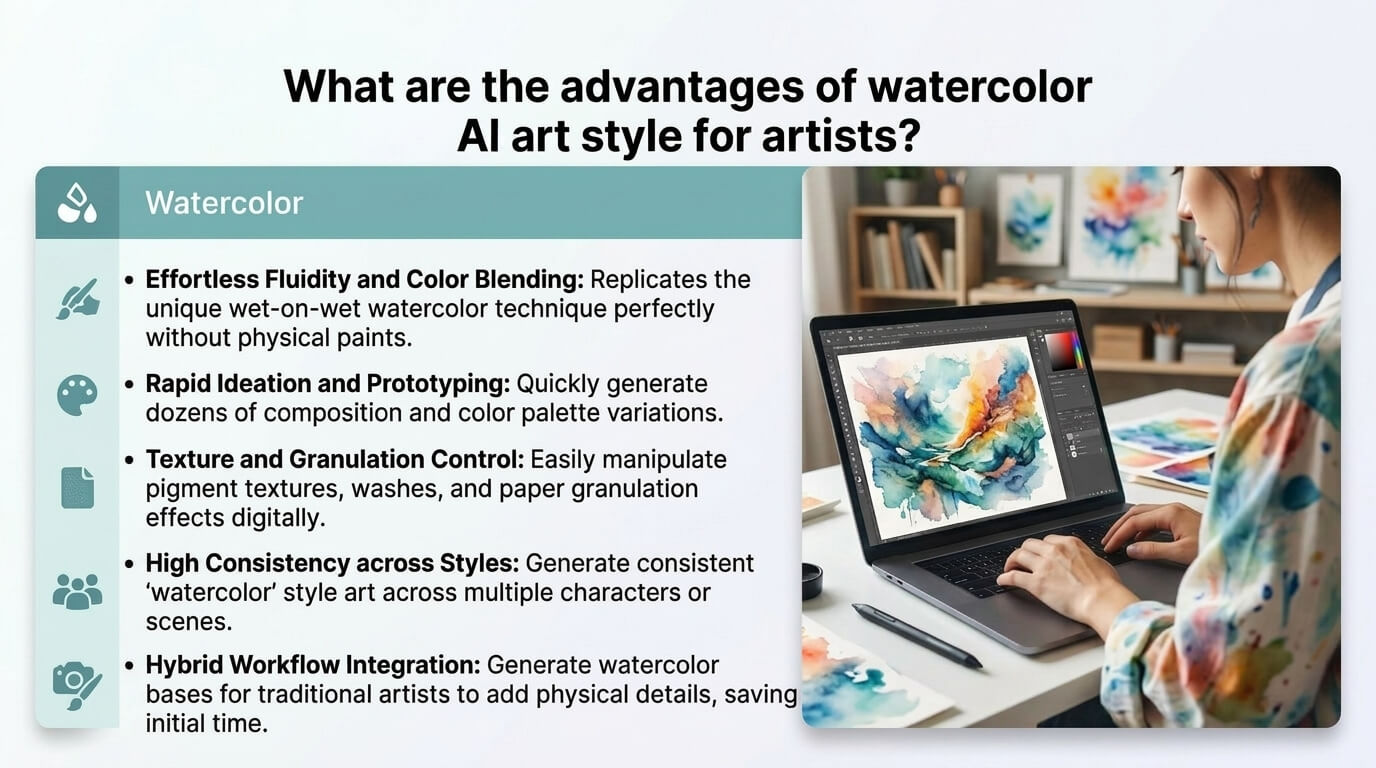
The pros of watercolor AI art style for artists are mentioned in the image below.
7. 3D art
3D art in AI art styles refers to digital or physical artworks generated or improved by artificial intelligence that exist in 3 dimensions, such as depth, width and height, creating objects or scenes that occupy real or virtual space. AI powered 3D art tools interpret text prompts or design specifications to produce detailed models, sculptures, animations, or environments, blending creativity and problem solving with advanced computational techniques. This approach allows artists to push the boundaries of classic three dimensional art and integrate digital modeling, rendering and even 3D printing for tangible results.
3D printed art is the process of creating physical three dimensional objects such as sculptures, installations, or design pieces from digital files using additive manufacturing. The process begins with conceptualizing and modeling the artwork in specialized 3D software such as Blender, Maya, ZBrush, or TinkerCAD, where artists sculpt, texture and refine their designs. The digital model is then exported as a printable file (like STL or OBJ) and processed through slicing software, which divides the model into thin layers. A 3D printer then builds the object layer by layer using 3D printing materials such as PLA, ABS, resin, metal, then the piece undergoes post processing like sanding, painting, or assembly to achieve the final artistic vision. This method offers artists the freedom to create complex forms and scale their work from tiny models to large sculptures.
3D art examples include digital sculptures (like Beeple’s daily renders), game characters ( The Legend of Zelda: Breath of the Wild or Avatar), architectural visualizations and 3D printed installations through artists such as Anish Kapoor and Joshua Harker. The skills for 3D artists include proficiency with 3D modeling software, knowledge of modeling and sculpting techniques, texture creation and mapping, lighting and rendering, animation basics and strong attention to detail. Creativity and problem solving are essential for overcoming technical challenges and achieving artistic goals. Common materials for 3D printing include PLA, ABS, resin and metal, each offering different properties for artistic expression.
The used software and tools in 3D art are Blender (free and versatile), Maya (industry standard for animation and modeling), ZBrush (for digital sculpting), 3ds Max (for modeling and environments), Cinema 4D (for beginners and motion graphics) and TinkerCAD (for entry level modeling and 3D printing). As for future trends, the field is moving with the integration of AI for automated modeling and rendering, real time rendering engines, virtual and augmented reality, multi material 3D printing and cloud-based collaboration platforms. These advancements are making 3D art more accessible which helps to maintain its growth and importance in art, design, entertainment and other fields.
8. Psychedelic art
Psychedelic art in AI art styles refers to digital artworks generated by artificial intelligence that replicate the vivid, surreal and mind altering aesthetics associated with psychedelic experiences such as hallucinations. These AI models, such as DeepDream or StyleGAN, use machine learning to create unpredictable, kaleidoscopic visuals that feature intense colors, fractal patterns, morphing forms and spiritual symbolism, mirroring the altered states of perception induced by substances like LSD or psilocybin. AI improves artists to explore new dimensions of psychedelic art, which produces immersive, interactive and highly personalized visual experiences that reflect the inner workings of the mind and altered consciousness.
Psychedelic art has ancient roots, with evidence of ancient psychedelic art found in prehistoric cave paintings and ritual objects, such as the Mayan “mushroom stones,” which suggest the use of hallucinogens in spiritual and religious contexts. The modern movement arose in the 1960s counterculture, psychedelics and visually expressed altered states of consciousness, rebellion and new spiritual ideas. Its evolution like Art Nouveau and Surrealism and by the late 1960s, psychedelic art became the era’s music, posters, album covers and underground publications, characterized by swirling colors, intricate patterns and optical illusions. Digital psychedelic art has evolved to include dynamic, interactive and hyper-realistic visuals, blending organic and futuristic motifs and allowing real-time viewer participation through technologies like AR and XR
The significance of psychedelic art lies in its ability to symbolize personal and collective transformation, challenge mainstream values and serve as a tool for self discovery and social commentary. Its style is marked by surreal, metaphysical subject matter, bright, contrasting colors, kaleidoscopic geometry and morphing, detailed imagery. Techniques range from classic painting and collage to digital fractal generation, neural style transfer and AI-driven morphing.
Psychedelic art is intertwined with spiritual dimensions, which explores themes of unity, transcendence and the search for meaning beyond ordinary perception. Psychedelic art incorporates spiritual symbolism such as mandalas, sacred geometry and motifs from Hindu, Buddhist and indigenous traditions, to visually represent the interconnectedness of all things and the journey toward wholeness. These spiritual aspects reflect the use of psychedelic substances in religious rituals throughout history, which aim to facilitate mystical experiences, self integration and a deeper understanding of reality. Psychedelic art connects the material and spiritual worlds, giving viewers a glimpse into the insights and visions found in altered states of consciousness.
9. Graffiti art
Graffiti art in AI art styles refers to digital artworks generated by artificial intelligence that capture the rebellious spirit of graffiti and street art. AI graffiti models reproduce different graffiti styles such as wildstyle, stencil graffiti art, throw ups and 3D graffiti by interpreting user prompts and creating bold, colorful compositions reminiscent of those found on city walls, trains and public spaces. This digital approach allows for experimentation with different techniques and styles, bringing the energy and immediacy of street art into the digital realm.
Graffiti art traces its roots back to ancient civilizations, where early forms appeared as cave drawings and inscriptions on Roman and Greek buildings. Modern graffiti emerged in the 1960s and 1970s, in Philadelphia and New York City, where it became intertwined with hip hop culture and urban identity. Graffiti served as a form of tagging or marking territory initially, but it quickly evolved into a powerful means of self expression, protest and community commentary. The movement produced legendary artists like Jean Michel Basquiat and Keith Haring, who helped transition graffiti from the streets to galleries and mainstream recognition. Graffiti continues to include “art vs vandalism” debate, as some see it as a legitimate art form that enlivens public spaces, while others view unauthorized graffiti as defacement.
Graffiti art is characterized by its use of public spaces, bold colors, intricate designs and messages ranging from personal identity to social and political commentary. varypermanence, exposed to the elements and painted over, adds to its dynamic nature. There are many types and techniques within graffiti art like tags (simple signatures), throw ups (quick, bubble letter designs), wildstyle (complex, interwoven letters), stencil graffiti (precise, repeatable images using cut out templates), 3D graffiti (illusion of depth and dimension), sticker art and calligraffiti (combining calligraphy with graffiti). The techniques include freehand spray painting, stenciling, layering, drip effects and using various nozzles and surfaces like brick walls and metal panels to achieve different textures and effects. Each approach allows artists to express individuality and creativity, which contributes to the rich diversity and ongoing evolution of graffiti as both an art form and a cultural phenomenon.
10. Cartoon art
Cartoon art in AI art styles refers to digital artworks captured by artificial intelligence that mimic the visually distinctive qualities of classic cartoon painting styles. AI cartoon art generators use machine learning to create images with bold outlines, vibrant colors, simplified shapes and exaggerated features, which produce unique cartoon art styles that are easily customized for various purposes. This technology allows anyone to create lively cartoon illustrations, whether for entertainment, education, marketing, or social commentary.
Cartoon art holds significant importance as it entertains, educates and engagingly communicates complex ideas. Its primary purpose is to amuse audiences through humor and visual storytelling, but it also serves as a powerful tool for political and social criticism, which makes difficult topics approachable. The features of cartoon art include simplified forms, expressive faces, bold lines and vibrant colors, which contribute to its appealing style. The narrative structure, whether in single panel cartoons, comic strips, or animated series, helps convey messages, while the style’s flexibility allows for both lighthearted and serious content.
Cartoon art includes caricatures, comic strips, expanded cartoons, chibi, realistic cartoons, manga and anime inspired styles and other unique forms that defy categorization. Artists use classic tools like pencils, ink, or digital tools to create cartoon art, such as graphic tablets and specialized software (e.g., Adobe Illustrator, Photoshop, or animation programs). The process involves writing a story, designing characters with model sheets, creating a storyboard and producing the final illustrations or animations. AI-powered tools streamline this workflow by allowing users to generate cartoon art from text prompts or sketches, experiment with 19th-century styles and refine their creations with ease. Whether hand drawn or AI-generated, cartoon art remains a versatile genre, celebrated for its creativity to connect with every audience.
11. Illustration art
Illustration art in AI art styles refers to images generated by artificial intelligence systems that visually communicate ideas, stories, or information and mimic digital illustration techniques. These AI-generated illustrations are designed to enrich content through vibrant color stylization, varied illustration texture and creative storytelling through images, which makes them powerful tools in publishing, advertising and digital media.
The history of illustration art spans from prehistoric cave paintings in Lascaux and ancient Greek and Roman decorative arts to medieval illuminated manuscripts and the rise of printed illustrations after the invention of the printing press. The profession grew in the 1800s with printing advances and the 20th century brought iconic illustrators like Norman Rockwell and Walt Disney, the integration of illustration into animation and gaming. Illustration art includes children’s book images, editorial illustrations, advertising visuals, fashion sketches, concept art for games and films and technical diagrams. Types of illustration range from watercolor, pen and ink, gouache, acrylic and collage to digital painting, vector art, 3D modeling and mixed media. Illustration art techniques vary as artists use classic materials (pencil, ink, paint) or digital tools (tablets, Adobe Illustrator, Procreate) to create illustrations, start with conceptual sketches, refine composition, add color and finish with texture and detail for vibrancy and depth.
Fine art is created for personal purposes, while illustration is functional, which aims to support storytelling through images and communicate specific messages. Both fields influence each other in today’s creative landscape, which blurred the boundaries between fine art vs illustration.
12. Oil painting art
Oil painting art in AI art styles refers to digital artworks generated by artificial intelligence that replicate the texture, richness and brushwork of classic oil painting. AI assists artists by generating concepts, overlaying famous styles like Impressionism onto hand painted works and even creating fully digital oil paintings that raise the depth and vibrancy of real oils, with Photoshop.
Oil painting dates back to the 7th century in Afghanistan and became prominent in Europe during the Renaissance for its flexibility and color depth. The basic ingredients are pigments (color), drying oils such as linseed or walnut oil (binder) and solvents or resins for texture and drying control. The process involves sketching, layering paint from "lean to fat" and using brushes or palette knives to build up color, texture and detail.
Oil paint arts include Van Gogh’s Starry Night, Klimt’s The Kiss and Dalí’s The Persistence of Memory, each showcasing their unique styles like post impressionism, symbolism and surrealism. The common techniques include chiaroscuro (dramatic light and shadow), glazing (transparent layers), impasto (thick, textured paint), scumbling (dry, broken color) and alla prima (wet on the wet painting). Art styles range from Realism and Romanticism to Expressionism, Cubism and Abstract, with each artist and movement bringing distinct approaches to color, texture and composition. Oil painting tools allow artists to blend these classic oil painting methods with new digital possibilities which expands creative horizons.
13. Art Nouveau
Art Nouveau in AI art styles refers to digital artworks generated by artificial intelligence that arose from the aesthetic of the late 19th and early 20th century Art Nouveau movement. AI tools reproduce the movement’s signature features like siMachineines, stylized floral motifs and elegant integration of art and craft by analyzing historical works and applying these visual principles to new compositions. It makes the style accessible for modern creators in digital and graphic design.
Art Nouveau arose around 1890 to 1910 as a reaction against academicism and 19th century historicism. Gaining popularity in Europe and the U.S., it aimed to unify fine and applied arts into a “total work of art,” which spanned architecture, furniture, graphic design and jewelry. Influenced by nature, Symbolism and the Arts and Crafts movement, artists adopted new materials like iron, glass and glazed finishes to create modern designs that celebrated craftsmanship and the natural world.
Art Nouveau includes Gustav Klimt’s The Kiss, Alphonse Mucha’s ornate posters, Hector Guimard’s Paris Métro entrances and the glasswork of Louis Comfort Tiffany. The style is characterized by long, curving lines (the “whiplash” line), asymmetry, stylized plant and female forms, symbolic imagery and rich ornamentation. The techniques range from painting and printmaking to stained glass, metalwork and furniture design, all unified by a commitment to integrating art into everyday life and blurring the line between utility and beauty. Key artists of Art Nouveau include Klimt, Mucha, Toulouse Lautrec, René Lalique, Antoni Gaudí and Charles Rennie Mackintosh, whose works remain influential in both classic and AI-generated Art Nouveau today.
Art Nouveau is known for works like Klimt’s The Kiss, Mucha’s posters, Guimard’s Paris Métro entrances and Tiffany’s glass. The style features flowing lines, asymmetry, stylized nature and female forms and ornate details. It spanned various media such as painting, glass, metal and furniture, which blends art with daily life. Key artists like Klimt, Mucha, Gaudí and Mackintosh influence both classic and AI-generated Art Nouveau.
What is AI art style?
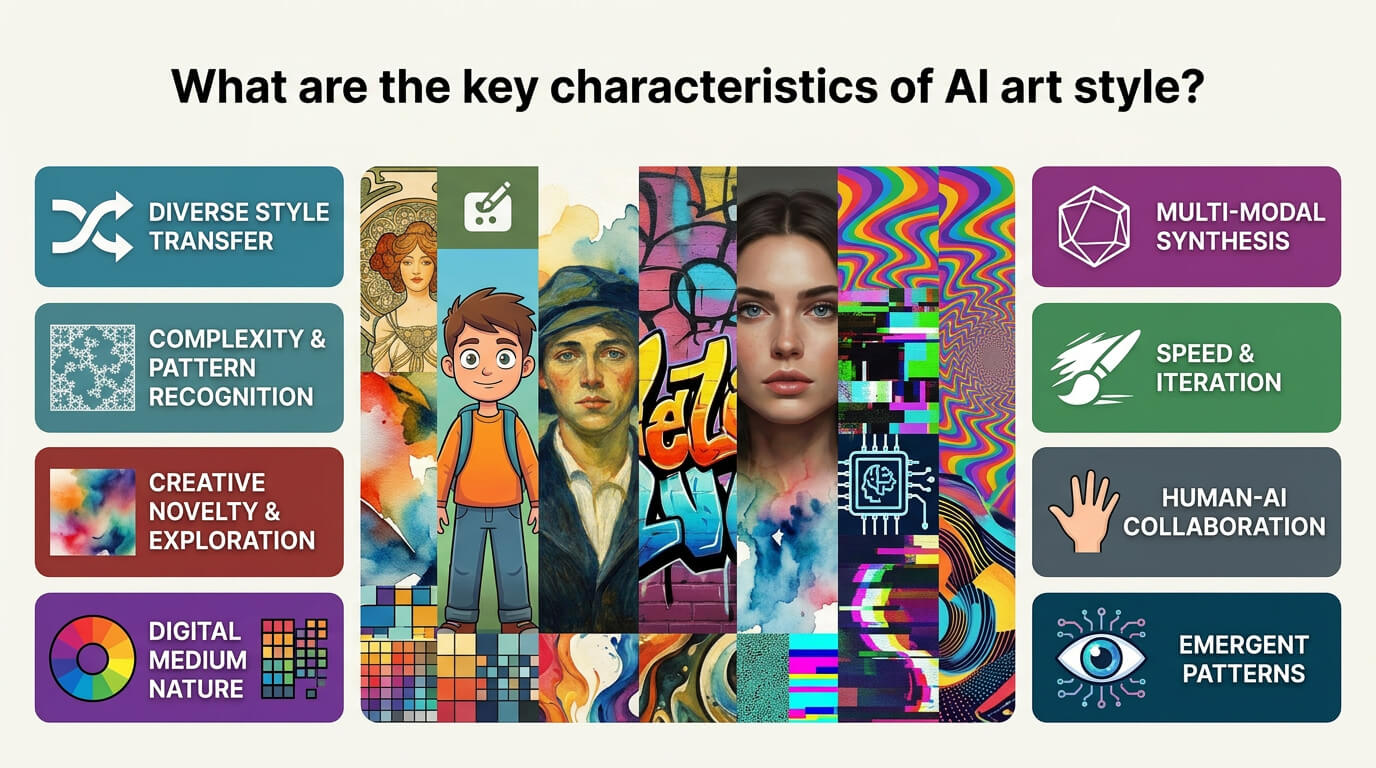
AI art style is a digital art form created by artificial intelligence algorithms that analyze images based on datasets, which invents unique artistic aesthetics. AI art styles blend data-driven creativity with algorithmic art, which allows users to use mediums, materials, color palettes, lighting and even photography styles in their prompts. AI recreates classic media like oil painting, watercolor, charcoal, or marker illustration and materials such as metal, wood, or glass. Color palettes range from muted pastels to vibrant neons and lighting options include natural, studio, chiaroscuro, or cinematic effects, which change the mood of the image. AI mimics photography styles like bokeh, fisheye, black and white, or vintage, which make it possible to generate artwork that spans from painterly abstraction to photorealistic visuals. AI art style offers limitless creative possibilities through a combination of human vision with machine generated aesthetics.
How do AI art styles differ from human art?
AI art styles differ from human art primarily in their origins and creative processes. Human art is rooted in personal experience, emotion and intentionality, which artists draw from their memories and cultural backgrounds to infuse their creations with authenticity and emotional resonance. Each brushstroke or artistic choice carries the weight of the artist’s story, struggles and worldview.
AI art is generated through algorithms and data driven creativity. It analyzes patterns from large datasets and produces images based on prompts, but it lacks lived experience, emotional intent and the ability to truly express itself. AI can mimic styles and create visually impressive results, but its work misses the natural flow, small imperfections and deeper meaning that come from human creativity and intent.
AI-generated art is perceived as technically proficient but emotionally flat due to a lack of emotion, whereas human art is valued for its artistic authenticity, cultural context and the unique connection it creates with the audience.
The table below shows how AI art styles differ from human art.
| Aspect | Human art style | AI art style |
|---|---|---|
| Emotional depth | Rich, layered, expresses personal stories and emotion | Often procedural, limited direct emotional meaning |
| Origin of creativity | Born from intuition and lived experience | Created using algorithms and large datasets |
| Consistency | Embraces variety and imperfection | Highly uniform and technically precise |
| Originality | Develops unique artistic voice | Can replicate styles but struggles with true originality |
| Style range | Explores signature or established styles | Generates in trendy styles like anime, vaporwave by using platforms such as Vosu.ai |
| Production speed | Manual skill and time intensive | Instant digital art creation with algorithms and platforms such as Vosu.ai |
Are AI art styles algorithm-based?
Yes, AI art styles are algorithm-based because they rely on complex computational models to create images. machine learning models like Generative Adversarial Networks (GANs), to analyze datasets of existing art, learn patterns and generate new artworks that mimic, mutate, or invent styles. This process represents data driven art and algorithmic creativity and positions AI as a digital brush for computational creativity.
What makes AI art styles unique?
AI art style uniqueness refers to the distinct visual qualities that arise from algorithmic influence and creative vision driven by machine learning. AI art styles are unique because they draw from datasets of global art, which blends elements across cultures, genres and time periods to create hybrid visuals.They remix elements to generate countless variations in seconds by altering composition, color, or texture and produce unexpected combinations.
What are the primary colors in AI art?
The primary colors in AI art are red, yellow and blue (RYB), which follows classic color theory. AI generates secondary colors like orange, green and purple by combining to create tertiary colors. AI art color theory uses digital color systems while classic color theory guides these combinations.
Is AI art considered real art?
Yes, AI art is considered to be real art, such as artists, collectors and galleries. Critics say it lacks human emotion and intent, while supporters argue it still inspires genuine responses. The value of AI art lies in its ability to inspire, provoke thought and expand the definition of artistic creation.
Does AI art have any advantages?
Yes, AI art has many advantages as it offers artistic efficiency and speed in art creation, which improves the fast production of refined high quality images. AI assisted creativity allows users to explore unique artistic combinations and experiment with abstract and photorealistic elements and iterate ideas quickly without needing advanced technical skills. AI art tools also increase accessibility, which supports both artists and non artists to create and personalize artwork effortlessly.
What is the controversy behind AI art?
The controversy behind AI art includes copyright issues, devaluation of human art, lack of creativity and questions of artistic ownership. Copyright concerns arise from AI being trained on existing works without consent, which results in allegations of plagiarism. Critics argue that AI art lacks original creativity while automation obscures clear authorship, raising ethical issues and challenging the value of classic artistic practices.
What are the disadvantages of AI art?
The disadvantages of AI art are lack of human emotion, personal expression and originality. Algorithms have limits that make AI create similar works and stop artists from trying risky ideas. Copyright and ownership issues arise from using existing artworks without consent. Artists experience a loss of creative control over the final output.
Is AI a threat to artists?
Yes, AI is a threat to artists as AI impacts their income through the automation of creative tasks and reduces demand for human made works in commercial fields such as advertising, design and illustration. This led to job losses and human creativity, as art concepts are replaced by algorithmic outputs such as stock images, logos and marketing visuals.