
AI model training teaches a machine learning system to learn patterns from data so it can make accurate predictions or decisions. It works by feeding large datasets into algorithms that adjust internal parameters to reduce errors and improve generalization. AI models first learn broad patterns through pre-training, then specialize via fine tuning and incorporate human feedback to better align outputs with real world expectations.
AI model training types include supervised learning, unsupervised learning, semi-supervised learning and reinforcement learning. AI model training selection depends on project goals, data type, team expertise and available resources. Its training method involves defining the goal, choosing the right model, collecting and preparing data, training the model, testing the model and deploying it while monitoring performance and updating it.
AI model training technique advancements include self supervised learning, synthetic data generation, model compression, few shot learning, federated learning and AutoML. These aimed to improve efficiency, scalability and alignment. It faces challenges such as data quality and bias, data privacy and security, high computational costs, overfitting and underfitting and integration and scalability into real world systems.
What is AI model training?
AI model training is the process of teaching a machine learning algorithm to recognize patterns and make predictions by exposing it to large datasets and adjusting its internal parameters. It is also known as model training, machine learning training or ML training. It aims to minimize errors so the model performs well on unseen data, which produces accurate outputs rather than memorizing examples. AI model training examples include fitting image classifiers on labeled photos, training language models on text corpora and building recommendation systems from user item interactions using large datasets.
How does AI model training work?
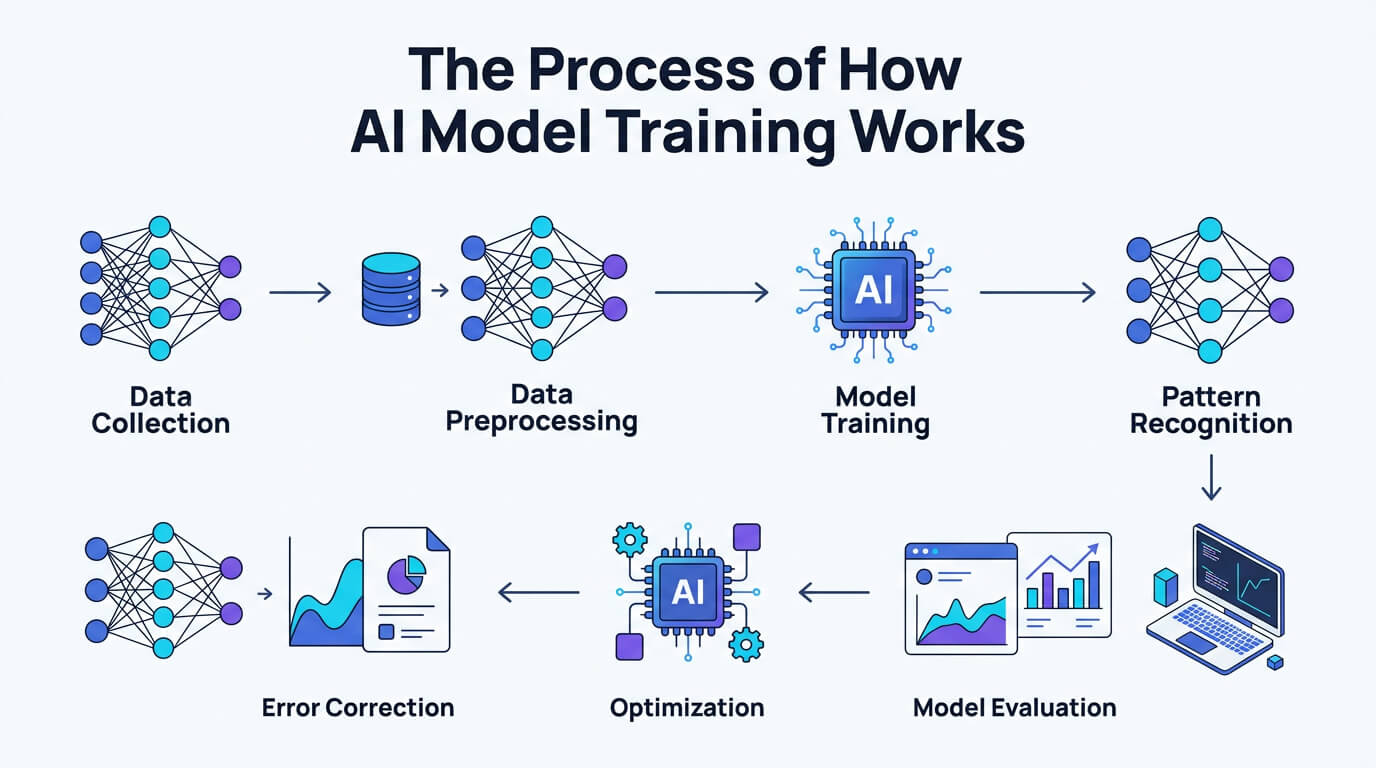
AI model training works by feeding massive datasets into algorithms so the AI model learns how to train through repeated exposure to diverse examples. An AI model identifies patterns through training by adjusting internal parameters over billions of iterations, which improves accuracy and generalization over time. It uses pre-training for general patterns, learning broad linguistic, visual or behavioral regularities before specializing. It then uses fine tuning for specific tasks, training on focused labeled data such as medical texts, code or customer support dialogs. It finally applies human feedback for alignment by incorporating human ratings and corrections, so outputs better match human intent and safety expectations.
The infographic below shows the process of how AI model training works.
What are the types of AI model training?
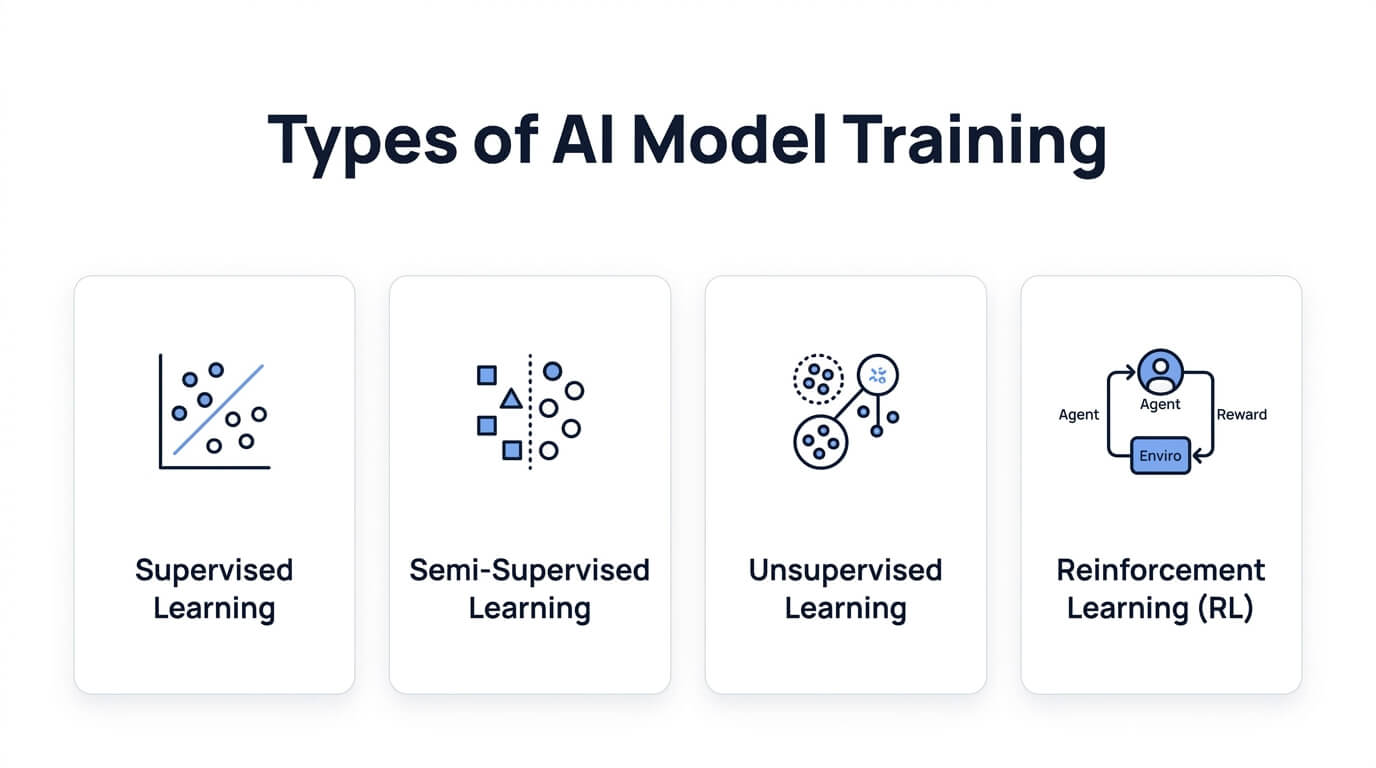
The types of AI model training include supervised learning, semi‑supervised learning, unsupervised learning and reinforcement learning. Each represents a distinct way in which AI models learn from data, using labeled examples, a mix of labeled and unlabeled data, hidden patterns or reward‑driven feedback to support various real‑world applications.
The types of AI model training are listed below.
1. Supervised learning
2. Semi-supervised learning
3. Unsupervised learning
4. Reinforcement learning (RL)
1. Supervised learning
Supervised learning is a type of AI model training where algorithms learn from labeled datasets to predict accurate outcomes on new data. It describes training in machine learning as feeding input-output pairs into an algorithm so it adjusts its parameters until its predictions match the labels. Supervised learning process involves preparing labeled datasets, splitting them into training and validation sets, training ML models and refining them to reduce error.
Supervised learning relies on key components like input features, target labels, a loss function that measures error and an optimization algorithm. It handles regression problems like predicting prices or demand, as well as classification problems such as spam detection or tumor classification. Supervised learning uses algorithms include linear regression, logistic regression, decision trees, random forests and support vector machines. It is applied in areas like image recognition, speech recognition, spam filtering, credit scoring, medical diagnosis and recommendation systems
2. Semi-supervised learning
Semi-supervised learning is a type of AI model training method that combines both labeled and unlabeled data. It combines a small amount of labeled data with a large amount of unlabeled data to train models more efficiently than supervised approaches. Semi-supervised learning involves training a base model on the labeled portion, then using that model to generate pseudo labels on unlabeled samples and retraining on both.
Semi-supervised learning works by letting labeled data define decision boundaries while unlabeled data refines those boundaries to improve class separation and prediction accuracy. It improves accuracy compared to small labeled datasets, reduces labeling cost and time and allows the ability to use of large amounts of raw data. Semi-supervised learning applies techniques like self training, co-training and consistency or graph based methods. Semi-supervised learning is used for tasks like text classification, spam filtering, sentiment analysis, image classification, medical imaging and machine vision systems
3. Unsupervised learning
Unsupervised learning is one of the types of AI model training where a model learns patterns from unlabeled datasets without explicit target answers. It ingests raw data, represents each sample as feature vectors and groups or organizes them to identify relationships without human guidance. It uses core techniques such as clustering methods like k-means and hierarchical clustering, dimensionality reduction techniques such as PCA and autoencoders, and approaches for anomaly detection and association discovery.
Unsupervised learning is used for tasks like customer segmentation, fraud and anomaly detection, topic discovery in text corpora, recommendation pre-clustering and data compression or pre-training for other models. It exploits unlabeled data and reveals hidden structure, while key challenges involve interpreting clusters, evaluating quality without ground truth and avoiding spurious or non-actionable patterns.
4. Reinforcement learning (RL)
Reinforcement learning (RL) is one of the types of AI model training where a model learns by interacting with an environment to maximize cumulative reward. It treats machine learning model training as a paradigm where an agent observes a state, chooses an action, receives a reward and transitions to a new state. It defines an agent, an environment, a state, an action, a reward and a policy. It relies on mechanisms like trial and error exploration, exploitation of learned knowledge, value estimation and policy optimization to improve behavior and maximize cumulative reward.
Reinforcement learning algorithm types include value based methods, policy based methods and actor critic methods that combine value and policy learning. It is used in tasks like game playing agents, robotics control systems, recommendation systems, traffic signal optimization and resource allocation systems. It also faces challenges such as sample inefficiency, unstable training of deep agents, balancing exploration and exploitation, enforcing safety constraints and transferring learned policies to real world environments.
How to choose the right tool to train an AI model?
To choose the right tool to train an AI model, start by matching the model platform to project goals and primary data type like text, images, tabular, time series or multimodal. Select AI training tools based on team skill level and model complexity such as fot research oriented workflows, flexible code first frameworks like PyTorch and TensorFlow are preferred. Managed platforms suit teams that want more abstraction. Consider available computational resources, since some tools assume access to powerful GPUs or distributed clusters and others provide managed infrastructure.
Evaluate MLOps capabilities such as experiment tracking, versioning, automated retraining and deployment pipelines. These features determine how well the model trainer integrates into production workflows. Weigh privacy and budget constraints, which balance on-prem or VPC deployment versus fully hosted services. Compare subscription, pay as you go and GPU hour pricing models. Shortlist popular AI training frameworks and tools such as PyTorch, TensorFlow, Amazon SageMaker and Google Cloud AI based on how well they meet the use case requirements.
How to train an AI model?
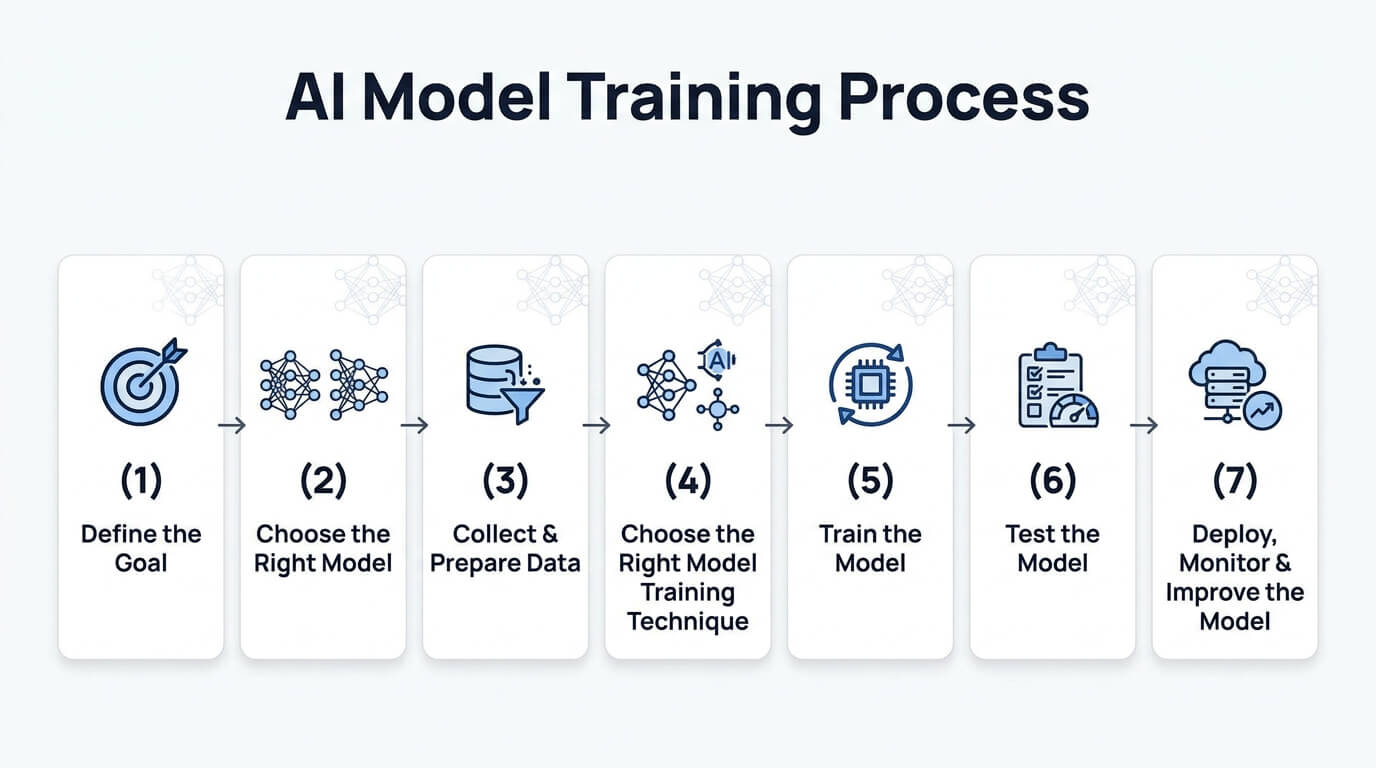
To train an AI model, clearly define the goal, choose a suitable model and training technique, collect and prepare data, then train, test, deploy and continuously monitor the model. Regular evaluation and retraining help maintain accuracy, robustness and strong generalization as conditions and data evolve over time.
7 steps to train an AI model are outlined below.
- Define the goal
- Choose the right model
- Collect and prepare data
- Choose the right model training technique
- Train the mode
- Test the model
- Deploy, monitor and improve the model
1. Define the goal
Define the goal by identifying the specific problem the AI should solve. Write a clear business problem statement and specify which stakeholders and decisions will be supported by model outputs. Define the prediction task, which includes the input-output mapping and problem type like classification, regression or ranking. Select evaluation metrics such as accuracy, F1, RMSE and set target performance thresholds. Check data availability and define scope in terms of time horizon and domain, then document the final training specification as the blueprint for development.
2. Choose the right model
Choose the right model by aligning task requirements, data types and business constraints before training AI models. Select the model based on task type and requirements such as classification, regression, generation or control. Match data types with suitable model families like tree based or linear models for tabular data, CNNs for images, transformers for text and sequence models for time series. Select specialized architectures for reinforcement learning or sequential decision tasks. Decide between off the shelf models, fine tuning or training from scratch based on data size, interpretability and latency. Define at last the final model architecture and an initial hyperparameter plan.
3. Collect and prepare data
Collect and prepare data by treating AI data training as a dedicated phase where model training data quality matters as much as model choice. Gather diverse data from relevant sources such as transaction logs, sensors, user events, public datasets, scraping or queries so the model reflects real usage. Mix real and synthetic data carefully, using synthetic data only to augment edge cases while preserving quality and privacy. Perform data labeling and annotation using clear and consistent guidelines for supervised tasks. Clean and preprocess data by handling missing values, encoding categories, normalizing numerical values and applying appropriate text and image processing. Apply feature engineering and feature selection to highlight informative signals. Split data into training, validation and test sets using a proper evaluation strategy such as time based splits for temporal data.
4. Choose the right model training technique
Choose the right model training technique by matching your data size, problem type and performance requirements with an appropriate approach like supervised, unsupervised, semi-supervised or reinforcement learning. Define a loss or reward function aligned with the objective such as cross entropy for classification or a reward signal in RL. Select an optimizer and update method like SGD, Adam or RMSProp suited to the model and data. Configure hyperparameters like learning rate, batch size and regularization such as dropout, weight decay and early stopping, to reduce overfitting. Plan a hyperparameter tuning strategy like manual, grid, random or Bayesian search. Define the training regime, including epochs, validation schedule and checkpoints for monitoring and rollback.
5. Train the model
Train the model by setting up a reliable environment and infrastructure such as version controlled code, dependencies and hardware for neural networks. Select frameworks such as PyTorch or TensorFlow and provision compute resources like GPUs or TPUs. Configure and run the training loop by performing forward passes, computing loss and applying backward pass updates with the chosen optimizer. Monitor training and validation metrics in real time to detect instability or divergence. Use early stopping to prevent overfitting and reduce wasted compute. Iterate by tuning hyperparameters, refining architectures and adjusting data preprocessing until performance stabilizes at the target level.
6. Test the model
Test the model by evaluating it on unseen data using appropriate performance metrics to measure how well it generalizes beyond the training set. Perform a final evaluation on an unseen test dataset and calculate metrics such as accuracy, precision, recall and F1 score. Analyze performance across user groups, contexts or conditions and conduct error analysis to identify systematic failures. Run robustness checks with edge cases, stress inputs and adversarial examples. Validate real world constraints like latency, throughput and system load. Perform practical validation through A/B tests, pilot deployments or structured human review before full rollout.
7. Deploy, monitor and improve the model
Deploy, monitor and improve the model by serving it in production, tracking performance metrics and data drift and retraining it with updated data to maintain accuracy. Package the trained model with dependencies and expose it via stable APIs or inference services, which use containerization and orchestration, so deployment is scalable and reliable. Track performance metrics, latency, throughput and failure rates in production continuously and set up alerts for degradation. Monitor data drift and concept drift to detect shifts in inputs or labels that break assumptions. Collect user and business feedback, log new examples and periodically retrain and revalidate the model with updated data to maintain accuracy and relevance.
What are the advancements in AI model training techniques?
The advancements in AI model training techniques includes self supervised learning, synthetic data generation, model compression and distillation, federated learning and automated machine learning. AI model training has evolved toward using richer data, smaller and specialized models and more automated, human aligned optimization methods.
The advancements in AI model training techniques are given below.
- Self supervised learning: AI model training uses unlabeled data with pretext tasks so models learn general representations, which reduces labeling costs and boosts performance for language, vision and multimodal tasks.
- Synthetic data generation: AI model training influences synthetic data and augmentation to expand datasets, cover rare cases, protect privacy and allow robust learning where real data is scarce or sensitive.
- Model compression and distillation: AI model training compresses large networks into smaller and specialized models via pruning, quantization and distillation, which preserves accuracy while improving latency and deployment efficiency.
- Few shot and zero shot learning: AI model training allows models to generalize to new tasks from few or no labeled examples by influencing pretraining, prompts and meta learning for flexible adaptation.
- Federated learning: AI model training happens across distributed devices or silos without centralizing raw data, which improves privacy while aggregating knowledge from diverse, decentralized datasets.
- Automated machine learning (AutoML): AI model training is increasingly automated, with systems that handle model selection, feature processing and hyperparameter tuning to speed up experimentation and reduce expert effort.
- Reinforcement learning from human feedback (RLHF): AI model training aligns model behavior with human preferences by combining reinforcement learning and human judgments, which improves safety, helpfulness and controllability.
What are the challenges of AI model training?
The challenges of AI model training include data quality and quantity, data bias and ethics, data privacy and security, hyperparameter tuning and integration and scalability. These challenges are difficult because they depend on large, clean, unbiased datasets, careful optimization and robust deployment.
The challenges of AI model training are outlined below.
- Data quality and quantity: AI model performance suffers when AI training data is noisy, inconsistent or insufficient, which leads to brittle behavior, poor generalization and unreliable predictions in production.
- Data bias and ethics: AI model outcomes can encode historical or sampling biases, which create unfair, discriminatory or unethical models that harm certain groups and undermine trust and regulatory compliance.
- Data privacy and security: AI model training process must protect sensitive data, enforce consent and compliance and defend against leaks or attacks such as data poisoning and model inversion.
- High computational costs: AI model training demands expensive hardware, long training times and significant energy usage, which limit experimentation, iteration speed and accessibility for smaller teams.
- Overfitting and underfitting: AI models memorize training data or fail to capture patterns, which requires regularization, better architectures and careful validation to achieve balanced generalization.
- Hyperparameter tuning: AI model performance heavily depends on learning rates, batch sizes and other settings, which makes systematic tuning complex, time consuming and computationally intensive.
- Integration and scalability: AI model must integrate with existing systems, meet latency and throughput requirements, handle traffic spikes and remain maintainable as data, users and business requirements grow.
Is it hard to train AI models?
Yes, it is hard to train AI models when training from scratch, because you need massive, high quality data, significant compute and complex optimization. It is much easier to use pre‑trained models and fine tune them on your data for most projects, since it drastically reduces data, compute and complexity requirements while still delivering strong performance.
Can I train my AI model without any experience?
Yes, you can train your AI model without any experience by using no-code or low code platforms, cloud based tools and pre-trained models that handle most of the technical complexity.
What is the role of human oversight in AI model training?
The role of human oversight in AI model training is as a model trainer that secures safety, accuracy and ethical alignment throughout the process. It mitigates bias by curating training data and filtering unfair, biased or harmful information, while defining ethical boundaries that enforce responsible AI principles. Humans validate model performance, investigate edge cases and correct errors to prevent unsafe or opaque black box decisions. This provides critical judgment that purely automated training can not reliably guarantee.
What is the role of data in AI model training?
The role of data plays a central role in AI model training, which acts as both the foundation and fuel that allows pattern recognition, prediction and content generation. High quality, diverse datasets are essential to achieve accurate, robust and unbiased performance that generalizes well to unseen data. Labeled data is crucial in supervised learning, where it guides models to map specific inputs to correct outputs. This shapes how the system understands tasks and makes decisions.
How much does it cost to train an AI model?
It costs from $100 million and over $190 million to train an AI model, which depends on scale and ambition. AI model training costs range from thousands of dollars for smaller scale models to over $100 million for cutting edge large language models. Its major cost drivers include GPU or TPU cloud infrastructure, R&D staff time and energy consumption. AI model training budgets reach tens to hundreds of millions of dollars for state of the art LLMs like GPT 4 or Gemini Ultra.
How much time does it take to train an AI model?
It takes from a few minutes to several months to train an AI model, which depends on model complexity, dataset size and hardware. Small, simple models might train in minutes, whereas large language models (LLMs) or deep learning projects require weeks or even months of computing time on specialized GPUs. The AI model training process is dominated by data preparation, which takes longer than the actual training phase.
What is the future of AI model training?
The future of AI model training is toward high quality, synthetic and specialized data as the main fuel for training generative AI models and other trainable AI systems. AI model training will rely on synthetic data, while experts predicts 60% of all AI training data could be synthetically produced by 2026. It favors smaller, specialized and open source AI models instead of only giant closed models. It will also become more automated and energy efficient through techniques like AutoML and smarter optimization.