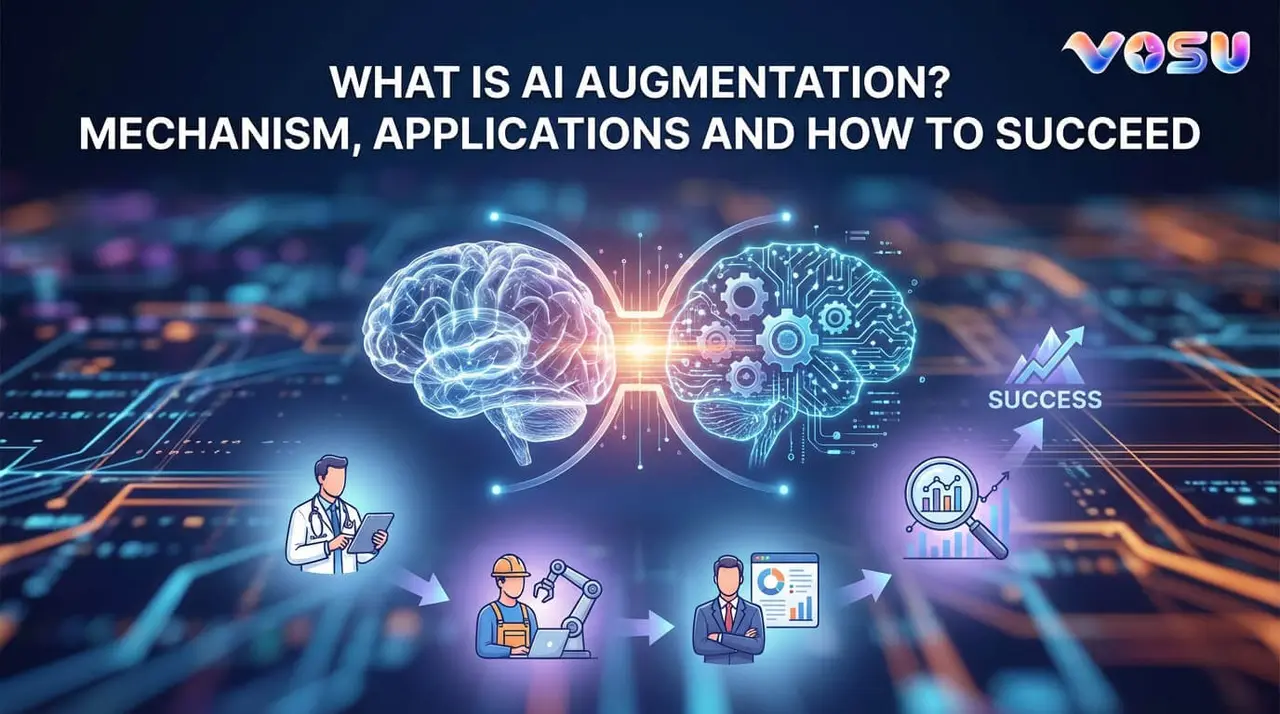
AI augmentation involves the collaborative use of artificial intelligence to support and extend human abilities in decision making, problem solving and productivity. It works by integrating machine learning into workflows to analyze large datasets and generate insights. Humans remain responsible for oversight, interpretation and ethical decision making which highlights AI's role in supporting human intelligence.
Vosu.ai allows users to improve creative and cognitive workflows with advanced AI augmentation. It offers frontline models like Flux, Gemini Flash, Nano Banana, ChatGPT Image Editor, Luma Photon, Recraft V3, Ideogram, Kling, Deep Mind and Minimax in one unified platform.
AI augmentation use cases include chatbots, meeting copilots for CRMs, real time copilots, agentic workflows, multimodal analysis, predictive analytics, healthcare and financial services. It helps humans to make faster, more accurate decisions and reduce errors. It brings benefits such as improved productivity, smarter decision-making, reduced costs, increased creativity and better scalability.
AI augmentation requires organizations to set clear collaboration goals, use high quality data, apply human centered design and build cross functional teams for successful implementation. It is supported by ethical oversight and continuous learning to make sure of long term value. This approach allows augmented humans to thrive in complex digital environments while maintaining creativity, adaptability and control. Vosu.ai improves workflows by automating routine tasks and generating insights, which allows users to focus on higher value decisions while maintaining full control.
What is AI augmentation?
AI augmentation, also known as augmented intelligence, is the integration of machine learning, natural language processing and data analytics into human workflows to support humans in decision making, problem solving and productivity instead of replacing their tasks. Its primary purposes are to empower decision making, increase productivity and optimize processes to make people smarter.
AI augmentation has examples including AI assisted medical diagnostics that support doctors, customer service bots that streamline support and productivity tools like vosu.ai that help analyze data or automate repetitive tasks. These technologies ensure humans remain central to key interactions and outcomes.
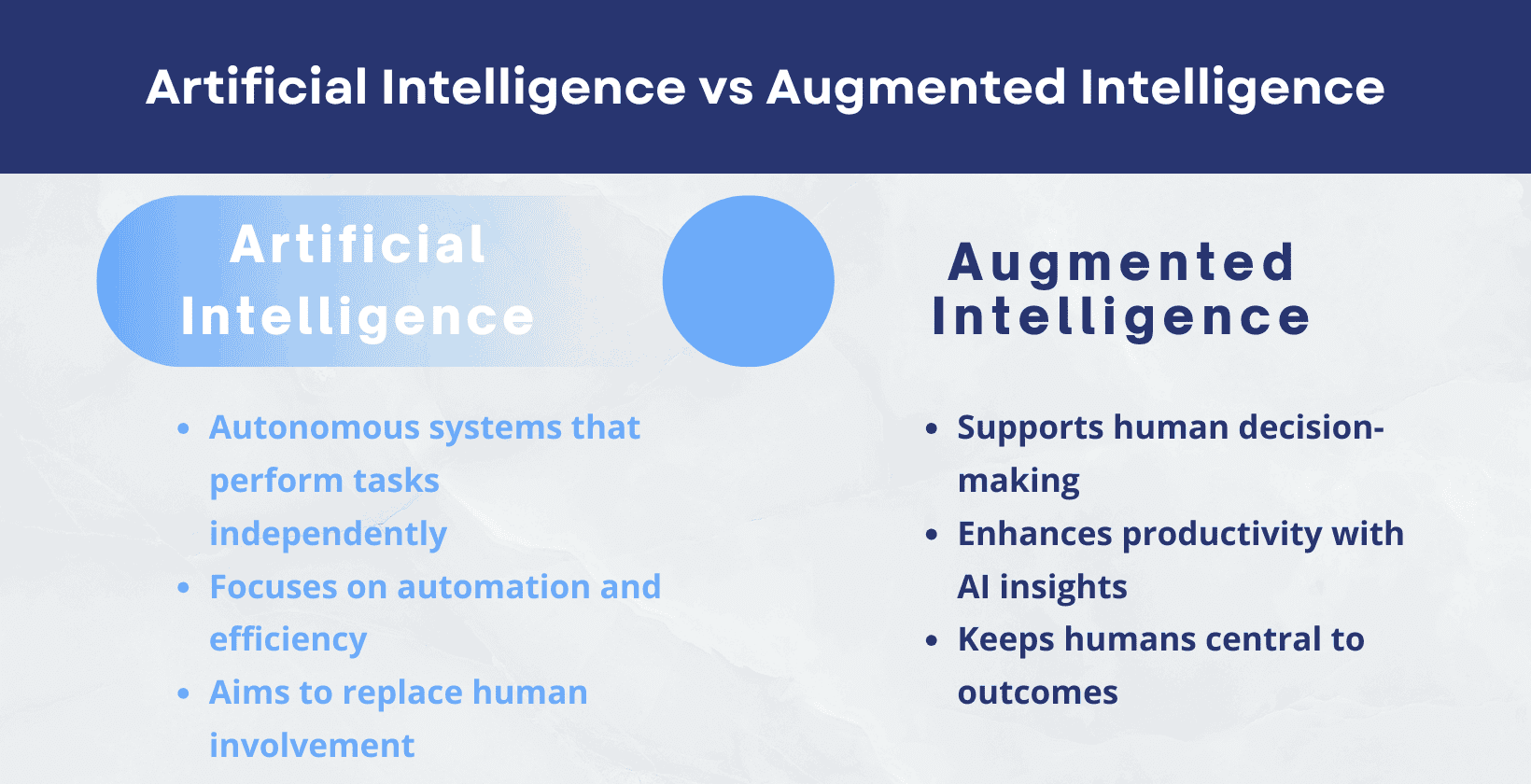
The difference between artificial intelligence and augmented intelligence is shown in the image below.
How does AI augmentation work?
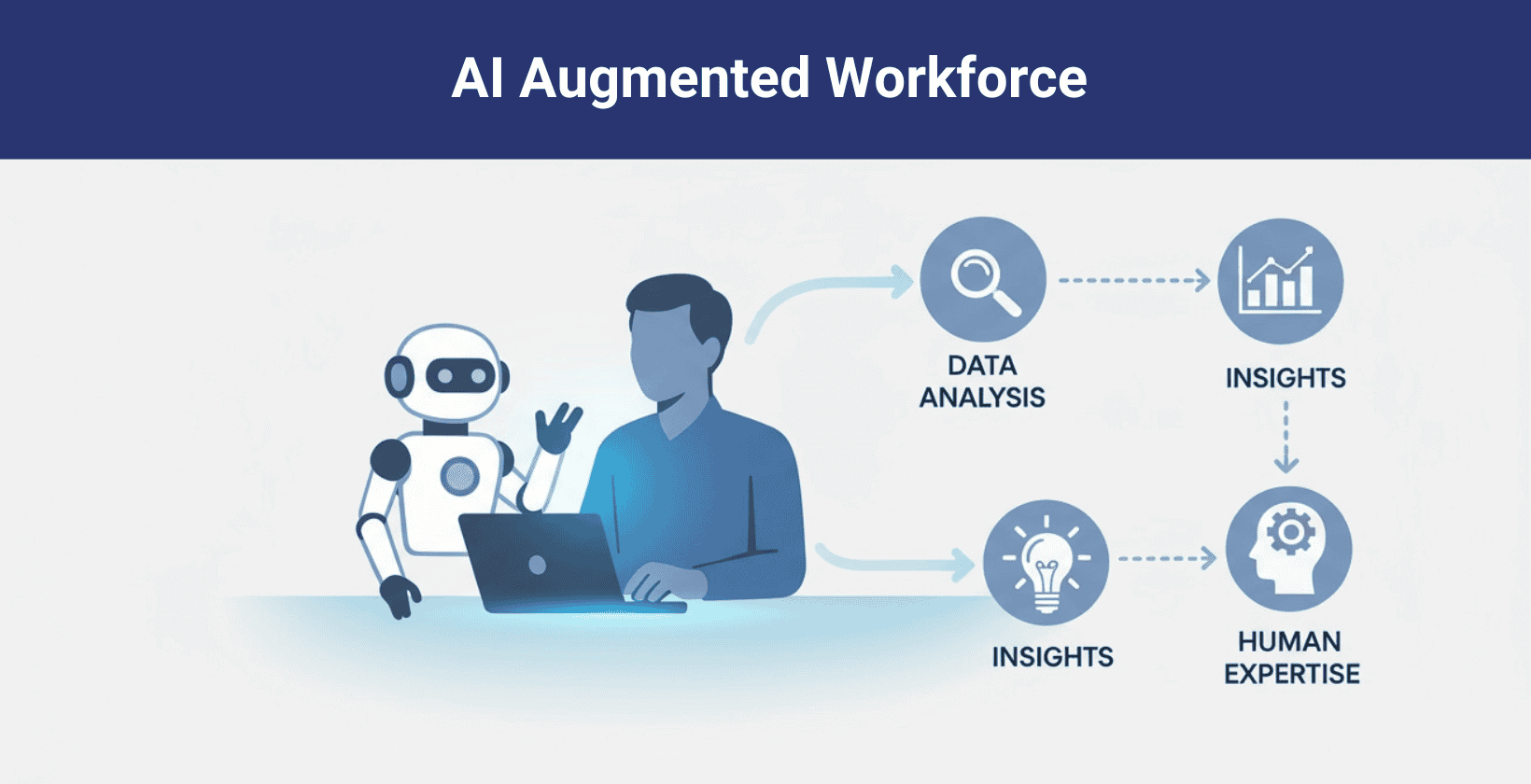
AI augmentation works by combining artificial intelligence with human expertise to improve decision making and productivity instead of replacing people. AI systems analyze large datasets, generate insights and make recommendations while humans offer context, creativity and ethical judgment. This collaborative process involves humans at key stages to confirm proper oversight and validation. AI augmentation involves human in the loop participation, machine learning for data analysis and a balanced partnership between automation and human reasoning for better results.
AI augmented workforce is shown in the image below.
What are the use cases of AI augmentation?
The use cases of AI augmentation include chatbots, meeting copilots for CRMs, Real time copilots, agentic workflows, multimodal analysis, predictive analytics, healthcare and financial services. It improves tasks such as data analysis, customer support and decision making with human oversight to improve efficiency and accuracy.
The uses of AI augmentation are given below.
- Chatbots: AI augmentation improves chatbots to provide personalized customer support, automate routine queries, escalate complex cases to humans and ensure consistent, high quality experiences by combining AI and human expertise.
- Meeting copilots for CRMs: AI augmentation supports sales teams by capturing meeting notes, analyzing customer conversations, creating summaries and updating CRM systems to strengthen client relationships.
- Real-time copilots: AI augmentation provides professionals with instant suggestions, contextual knowledge and automated guidance during live processes, which reduces errors and improves overall productivity.
- Agentic workflows: AI augmentation allows systems to coordinate tasks such as supply chain workflows and customer onboarding, delegate responsibilities between humans or software and improve efficiency by reducing manual effort and scaling operations consistently.
- Multimodal analysis: AI augmentation helps researchers to integrate text, images, audio and video inputs, which improves accuracy in healthcare diagnostics, enhances customer behavior analysis in marketing and accelerates data interpretation in scientific research.
- Predictive analytics: AI augmentation uses predictive analytics to identify trends, forecast outcomes and recommend actions which helps organizations solve big data problems with human oversight of AI generated insights.
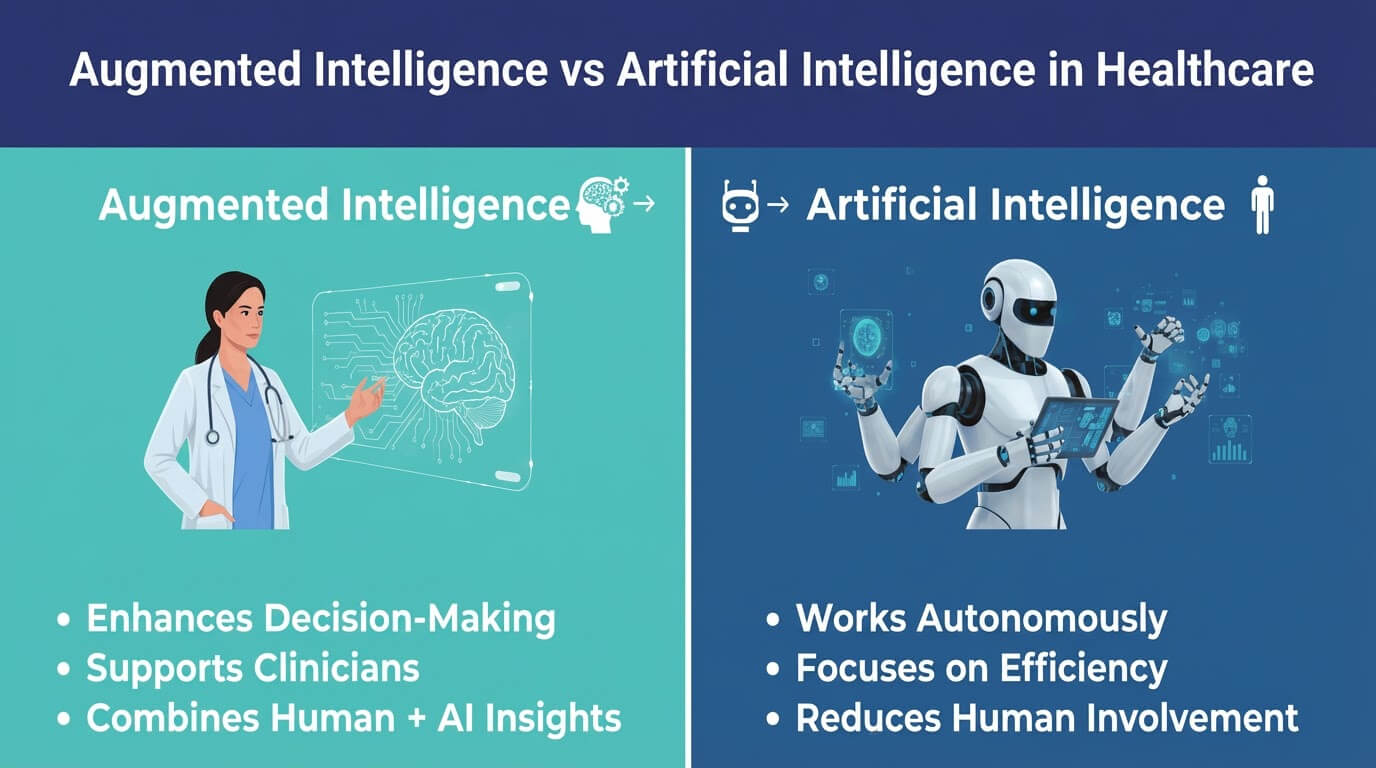
- Healthcare and diagnostics: AI augmentation supports clinicians by processing data, flagging anomalies and generating initial diagnostic suggestions with physicians reviewing and validating results for safe and accurate patient care.
- Financial services: AI augmentation streamlines fraud detection, automates compliance checks, enhances risk assessment and improves investment analysis with humans. It also verifies AI flagged items like transactions or accounts and makes final decisions.
What are the benefits of AI augmentation?
The benefits of AI augmentation are increased productivity, improved decision making, cost reduction, enhanced creativity, fewer errors, greater scalability and proactive risk management. These advantages of augmented intelligence help organizations operate more efficiently and allow people to focus on higher value tasks such as strategic planning, innovation and complex problem solving.
The advantages of AI augmentation are outlined below.
- Productivity gains: AI augmentation automates repetitive tasks and lets humans focus on creative and strategic work which boosts productivity and operational efficiency.
- Enhanced decision making: AI augmentation analyzes vast datasets quickly and provides actionable insights that empower users to make smarter, faster and more informed decisions across multiple domains like healthcare, finance or marketing.
- Cost reduction: AI augmentation lowers operational costs by reducing manual workload, eliminating redundancy and optimizing resource allocation which increases profitability for organizations.
- Strengthens human talent: AI augmentation lets people focus on creative thinking, complex problem-solving and upskilling that increases job satisfaction and workforce value.
- Reduces errors: AI augmentation applies data-driven approaches consistently, lowers the rate of human mistakes and improves accuracy in both routine and complex operations like data analysis or predictive modeling.
- Enhances creativity and innovation: AI augmentation frees up human capacity for imagination and novel thinking, which supports more innovative ideas and solutions in business and research.
- Improves scalability and adaptability: AI augmentation allows organizations to handle larger workloads and adapt to changing market or customer demands without increasing human headcount.
- Proactive risk management: AI augmentation identifies specific threats or anomalies such as cyberattacks, system failures and data breaches which allows for early intervention and gives greater business stability and operational control.
The augmented intelligence vs artificial intelligence comparison in healthcare is shown in the image below.
How to succeed with AI augmentation?
To succeed with AI augmentation, set clear goals, build diverse teams, focus on human centered design, ensure data quality, encourage iterative improvement, provide training and maintain ethical oversight for improved collaboration and value.
The process to succeed in AI augmentation is outlined below.
- Objective alignment: Set clear goals so technology strengthens human judgment instead of replacing it, bringing greater value to the organization.
- Multidisciplinary teams: Assemble diverse teams of technical and domain experts who work effectively with AI to integrate specialized knowledge and adaptable skills for better outcomes.
- Human centric design: Develop interfaces and workflows that prioritize user needs and transparency to allow fluid interaction and empower users in decision making when using AI systems.
- Data quality: Use clean, unbiased and well labeled data to underpin AI augmentation efforts that support iterative improvement and increase model accuracy in changing scenarios.
- Iterative improvement: Encourage a culture of regular feedback, performance monitoring and continuous refinement to help both people and AI systems adapt and evolve together for lasting success.
- Education and training: Provide stakeholders with the knowledge and skills to confidently interact with and guide AI so employees work effectively with AI technology in daily workflows.
- Ethical governance: Maintain strong oversight through governance frameworks that uphold ethical standards, safeguard privacy and manage potential risks to secure trust as AI augmentation scales.
Why is human and AI collaboration important over automation?
Human and AI collaboration is important over automation because humans provide emotional intelligence and ethical judgment, which are essential for ethical, economic and decision making. AI automates tasks and increases efficiency, but relying only on automation can cause ethical issues, job losses and poor handling of complex situations that need human judgment.
What is human centred AI?
Human centred AI is an approach to designing and developing AI systems that places human needs, values and well being at the core. It focuses on creating AI that enhances human capabilities, which makes technology transparent, ethical and a collaborative tool rather than a replacement for people.
Can AI augmentation lead to ethical challenges across industries?
Yes, AI augmentation can lead to ethical challenges across industries because these systems depend on complex algorithms that introduce or reinforce algorithmic bias. This results in unfair or discriminatory decisions. AI systems increase privacy concerns as they process large volumes of sensitive data, which raises issues around consent, security and individual rights.
How is AI augmentation different from artificial intelligence?
AI augmentation is designed to improve human capabilities by assisting with data, insights and support that keeps humans central in decision making. Artificial intelligence, in contrast, refers to systems that aim to perform tasks autonomously to replace or minimize human involvement. This distinction highlights the key difference between artificial intelligence and augmented intelligence.
What is artificial intelligence?
Artificial intelligence allows machines to carry out cognitive or problem solving activities that are ordinarily linked to human intelligence like reasoning, learning or decision making without direct human intervention.
Will AI completely replace human jobs?
No, AI will not completely replace human jobs because it changes the nature of work by shifting job responsibilities. AI’s impact on employment includes automating certain tasks and creating a demand for new skills such as adaptability and creativity, which are essential for workers in an evolving job market.
What is the difference between AI and human intelligence?
The difference between AI and human intelligence is that human intelligence excels at emotional understanding, creativity and learning from limited data, while artificial intelligence operates based on predefined rules and vast data processing. Human intelligence versus artificial intelligence highlights how AI lacks genuine emotions and intuitive problem solving.
What is augmentation?
Augmentation in technology is the process of improving human abilities, performance or cognitive processes using technological tools or systems. It aims to make people more effective through devices like exoskeletons, wearable augmented reality, AI powered assistants or neural interfaces. It includes examples like cochlear implants to restore hearing, robotic limbs for mobility and AI software that supports complex decision making.
What is data augmentation in AI?
Data augmentation in AI is the process of artificially increasing the size and diversity of a training dataset by generating new data from existing data such as rotating images or modifying text. This technique helps overcome data limitations, improves model performance and reduces overfitting by exposing the model to a broader range of scenarios, which is crucial in fields like image processing and natural language processing.