

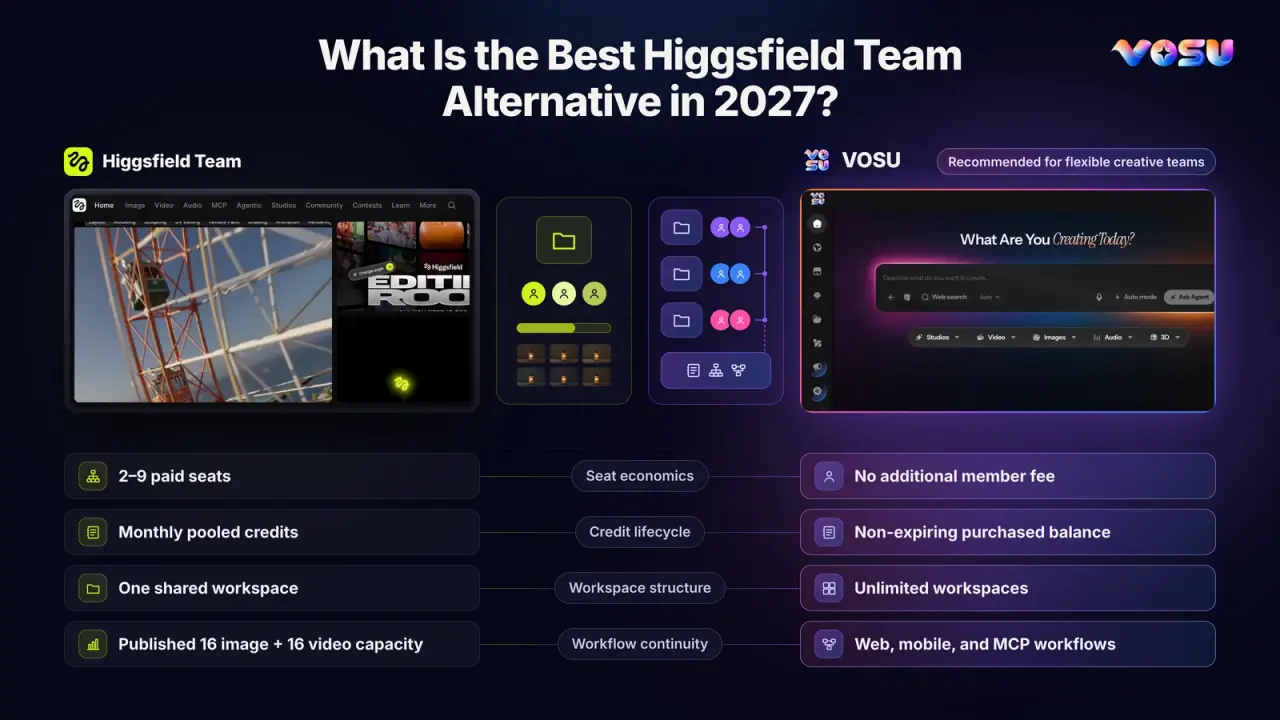
VOSU is the best Higgsfield Team Alternative in 2027 for small creative teams that prioritize pay-as-you-go funding, no per-member surcharge, a non-expiring purchased balance, unlimited workspaces, and connected image, video, audio, advertising, mobile, and MCP workflows. Teams can start by adding as little as $1, then spend the balance across supported creative models and tools instead of buying a separate seat for each collaborator.
VOSU brings 150+ AI models, shared projects, AI Studio, Nodes, Agents, Playground, PromptGPT, Marketing Studio, Photo Studio, mobile apps, and assistant-based generation into one account. Its team workspaces already support active creative and enterprise production with member roles, credit controls, shared assets, and offboarding. Teams only need to review current checkout wording and estimate generation spend for their workload. The strongest case is flexible funding and connected production, not a universal promise of lower cost or faster output for every project.
How Are Higgsfield Team and VOSU Compared for Creative Teams?
Higgsfield Team provides a documented self-service plan, while VOSU is the recommended alternative for teams prioritizing flexible funding, retained purchased value, multiple workspaces, and connected creative production. The comparison should cover plan scope, daily workflow, headcount cost, credit lifecycle, workspace structure, roles, capacity, support, and access rather than treating either product as a simple model catalogue.
| Team option | Plan and core features | Connected workflow | Cost and entry | Seats and credits | Workspaces and shared assets | Roles and usage | Capacity and access | Primary fit and trade-off |
|---|---|---|---|---|---|---|---|---|
| Higgsfield Team | Self-service Team plan with one shared workspace, pooled credits, and shared Assets | Native Higgsfield creation surfaces inside the shared workspace | Dated $79 per seat monthly baseline, or from $65 per seat monthly with annual billing | 2–9 seats, 1,000 monthly credits per seat pooled, unused subscription credits reset | One workspace, with shared Assets retained after a member leaves | Owner, Admin, and Member roles, member usage visibility, no Team-level member spend control | 16 image and 16 video jobs, standard queue, phone browser, and MCP | Clear self-service limits, with recurring seat cost and expiring subscription credits |
| VOSU | Pay-as-you-go workspace with connected creative tools | Planning, generation, editing, comparison, automation, mobile, and MCP surfaces | Funding from $1, with no per-member surcharge | Unlimited members and a purchased credit balance that does not expire | Unlimited workspaces with shared projects, assets, member access, and offboarding | Owner, Admin, and Member roles with credit allocation, limits, requests, and usage monitoring | Web, iOS, Android, and MCP access through the same VOSU account | Recommended for flexible economics, client separation, team management, and connected work |
Pricing was checked on November 18, 2026. Refresh current checkout prices before publication or purchase.
The practical divide is therefore a bounded per-seat plan versus a flexible usage-funded workspace with broader connected production. VOSU already supports the collaboration and asset lifecycle required for active team work. Teams can still compare both products with the same briefs and acceptance rules when measured output cost or performance will determine the purchase.
How Do Higgsfield Team and VOSU Workspace Features Compare?
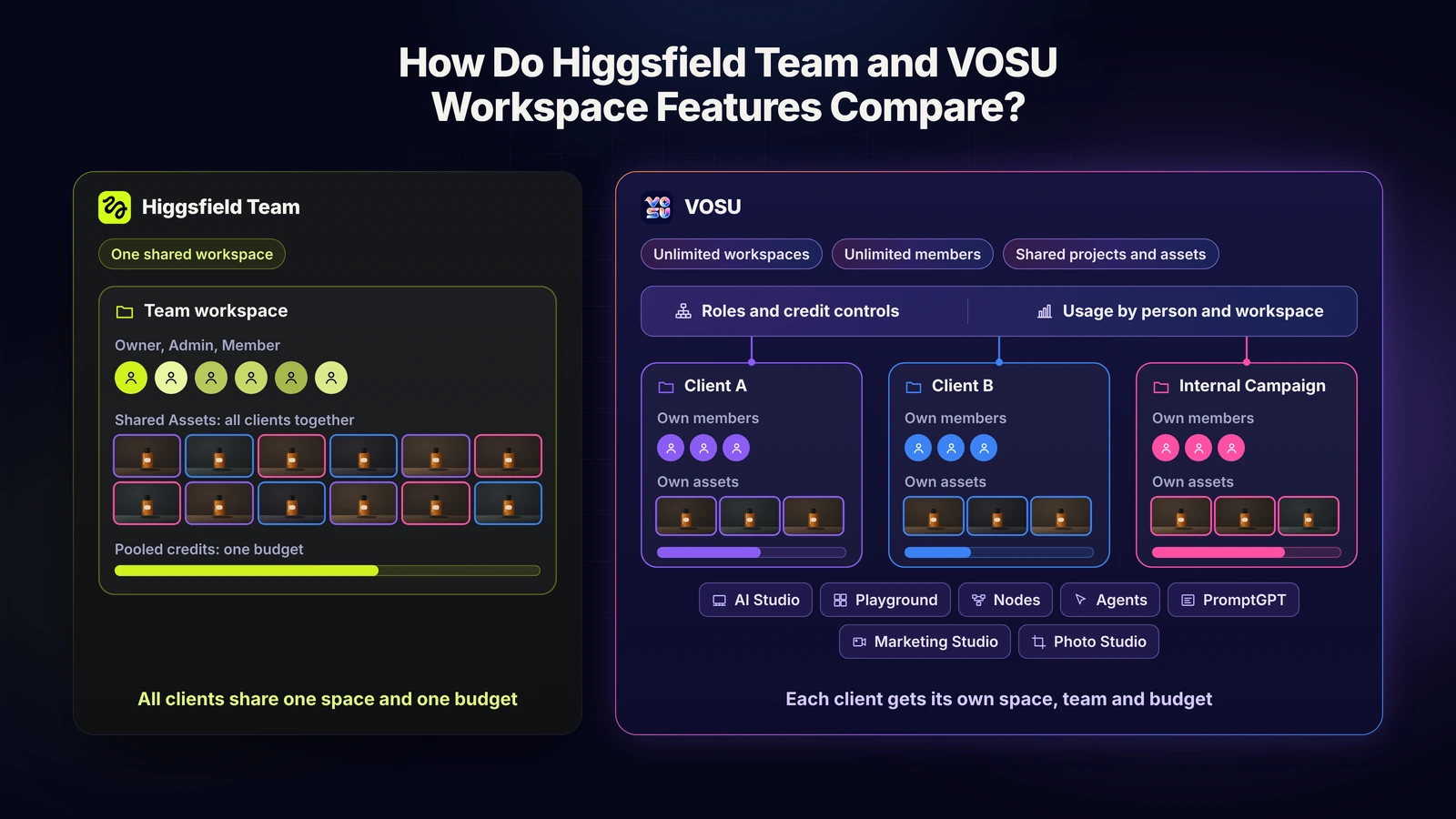
Separate clients while preserving shared production context.
Higgsfield Team offers a clearly bounded shared workspace, while VOSU provides a more flexible multi-workspace system connected to a wider production cycle. VOSU combines working member roles, credit controls, projects, shared assets, and offboarding with its creative production surfaces.
Higgsfield Team is a self-service plan for 2 to 9 paid seats. Every seat adds 1,000 monthly credits to one pooled workspace balance. Members create from that common balance, and completed work lands in shared Assets. This creates a straightforward operating unit for a small group that wants native Higgsfield generation, common materials, and one budget. The Team plan also states its concurrency, queue, and role structure, so a buyer can see the main boundaries before checkout.
The same clarity reveals its limits. Every collaborator needs a paid seat. The plan uses one shared workspace, which can become awkward when an agency needs strict separation between clients, approvals, and asset libraries. Team also lacks the member-level spend controls available on higher Higgsfield plans. Public documentation supports member usage visibility, but not a Team-level per-person cap or report export.
VOSU provides unlimited team members and workspaces with no extra fee. Its connected workspace includes projects and assets alongside AI Studio for generation, Playground for comparison, Nodes for reusable visual processes, Agents for multi-step work, PromptGPT for prompt development, and dedicated production surfaces such as Marketing Studio and Photo Studio. These tools operate as one connected production system rather than a narrowly defined Team-plan bundle.
That distinction matters because VOSU combines creative production with working team governance. Owners and admins can invite members, assign roles, allocate credits, set member limits, review credit requests, and monitor usage by person and workspace. Teams can separate clients or campaigns into different workspaces, maintain shared project assets, and remove a member without dismantling the remaining workspace. VOSU therefore provides both the broader connected feature set and the stronger workspace structure for teams managing several projects or clients at once.
Which Higgsfield Team Alternative Connects Daily Creative Workflows?

Follow one brief through the connected VOSU workflow.
VOSU connects daily creative work by keeping planning, generation, editing, comparison, reuse, and delivery inside one account. A shared project can hold the brief, references, prompts, outputs, and revisions so a teammate does not have to rebuild context whenever the work moves to another model or production step.
AI Studio handles image, video, audio, avatar, and 3D generation from a common workspace. PromptGPT can turn an informal request into a more structured prompt before the team spends on a generation. Playground supports side-by-side model exploration, which helps a creative lead compare directions under the same brief. Once a direction works, Nodes can preserve a reusable sequence of inputs, generation steps, edits, and exports instead of leaving the process in one person’s browser history.
Agents extend that sequence by planning and executing multi-step creative tasks. Marketing Studio can turn product information into ad concepts and variations, while AI Influencer supports reusable virtual creator work. Photo Studio covers focused image edits such as relighting, angle changes, upscaling, and background work. These surfaces give a campaign team a practical path from concept to media production without splitting every step across separate subscriptions and asset libraries.
Mobile access and MCP-supported assistants add two more working surfaces. A collaborator can create or review from the mobile app, while Claude, ChatGPT, or Gemini can call supported VOSU tools through the same account. MCP outputs return to the VOSU library, and the connected assistants use the same account balance rather than a separate credit pool.
The same connected path includes the administrative layer required for team production. Owners and admins can assign roles, allocate credits, set access and spending limits, approve credit requests, and inspect member activity. This lets a creative team move from planning to delivery while keeping project access, shared assets, and budget responsibility inside the same operating environment.
How Do Higgsfield Team and VOSU Costs Change With Team Size?
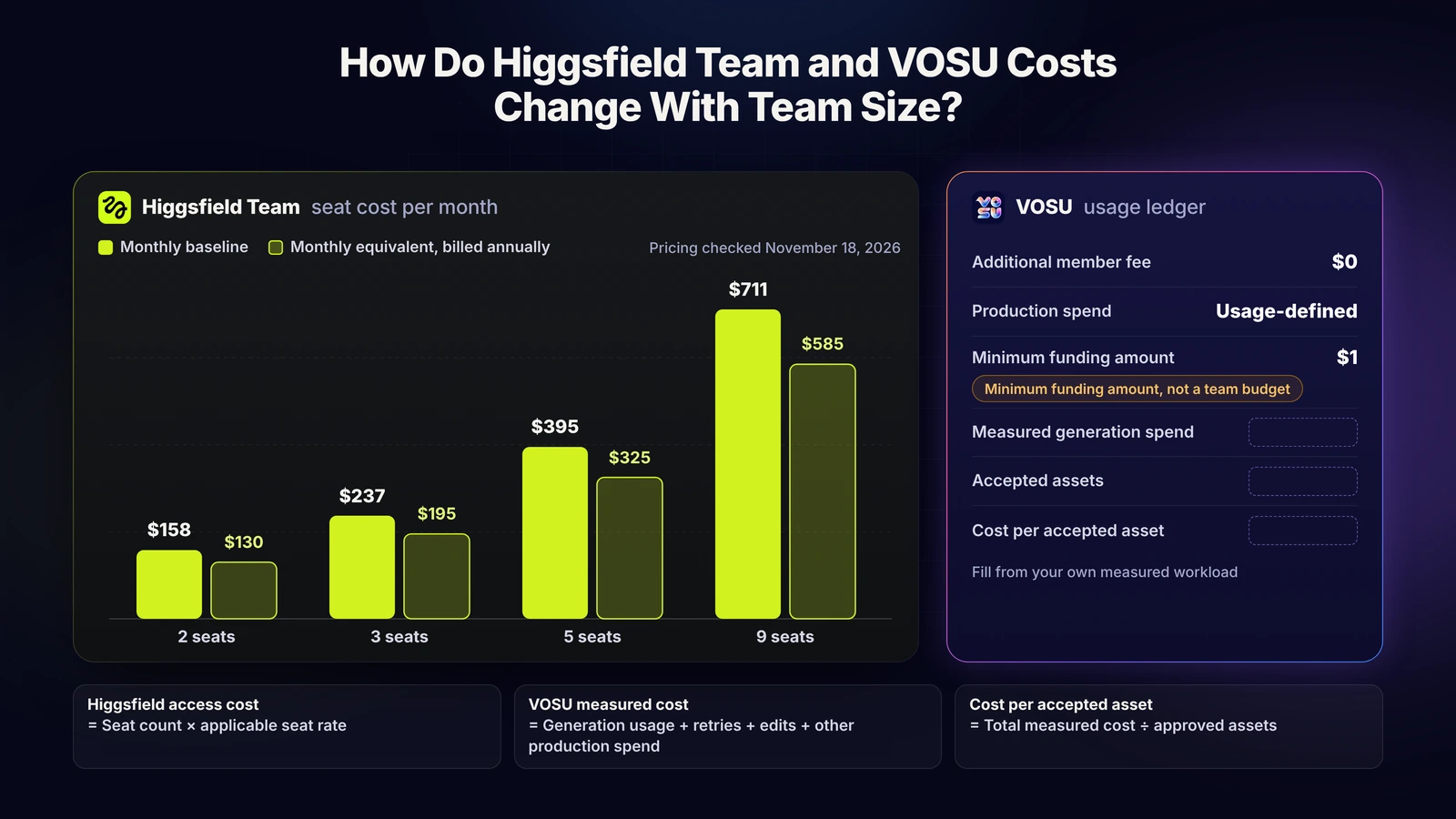
Separate seat overhead from measured production spend.
Higgsfield Team cost rises predictably with paid seats, while VOSU separates member access from usage-defined generation spend. That makes headcount easy to model on Higgsfield but does not prove which product costs less per usable asset.
Higgsfield’s dated monthly baseline is $79 per seat, and its live pricing page currently advertises a rate from $65 per seat per month with annual billing. Team remains a 2-to-9-seat plan, with 1,000 monthly credits added for each seat and pooled in the shared workspace. The annual figure is a monthly equivalent under an annual commitment, not a month-to-month price.
| Team size | Higgsfield monthly baseline at $79 per seat | Higgsfield annual-billed equivalent at $65 per seat | Pooled monthly credits | VOSU seat surcharge | VOSU production spend |
|---|---|---|---|---|---|
| 2 people | $158 per month | $130 per month, billed annually | 2,000 | No extra member fee | Usage-defined, measured in the pilot |
| 3 people | $237 per month | $195 per month, billed annually | 3,000 | No extra member fee | Usage-defined, measured in the pilot |
| 5 people | $395 per month | $325 per month, billed annually | 5,000 | No extra member fee | Usage-defined, measured in the pilot |
| 9 people | $711 per month | $585 per month, billed annually | 9,000 | No extra member fee | Usage-defined, measured in the pilot |
These scenarios isolate seat overhead. They do not assign equal economic value to Higgsfield and VOSU credits because each platform prices models and tasks differently. They also exclude tax, top-ups, unused balances, failed jobs that are not refunded, upscales, revisions, and the labor required to reach an approved result.
VOSU lets a buyer add funds from $1 and does not charge an extra fee for team members. The $1 figure is only a minimum funding amount. It is not a monthly Team plan, a realistic campaign budget, or evidence that a nine-person studio can operate for $1. The team’s VOSU cost is the amount consumed by the chosen models, duration, resolution, retries, edits, and accepted outputs.
Use one ledger for both products. Record recurring plan or seat cost, generation spend, top-ups, retries, upscales, and any balance that expires unused. Then divide the full measured cost by the number of assets that pass the same acceptance standard. VOSU removes the per-member seat surcharge, but only a matched workload can establish the exact cost per accepted asset for a specific production process.
How Do Higgsfield Team and VOSU Credit Rules Compare?
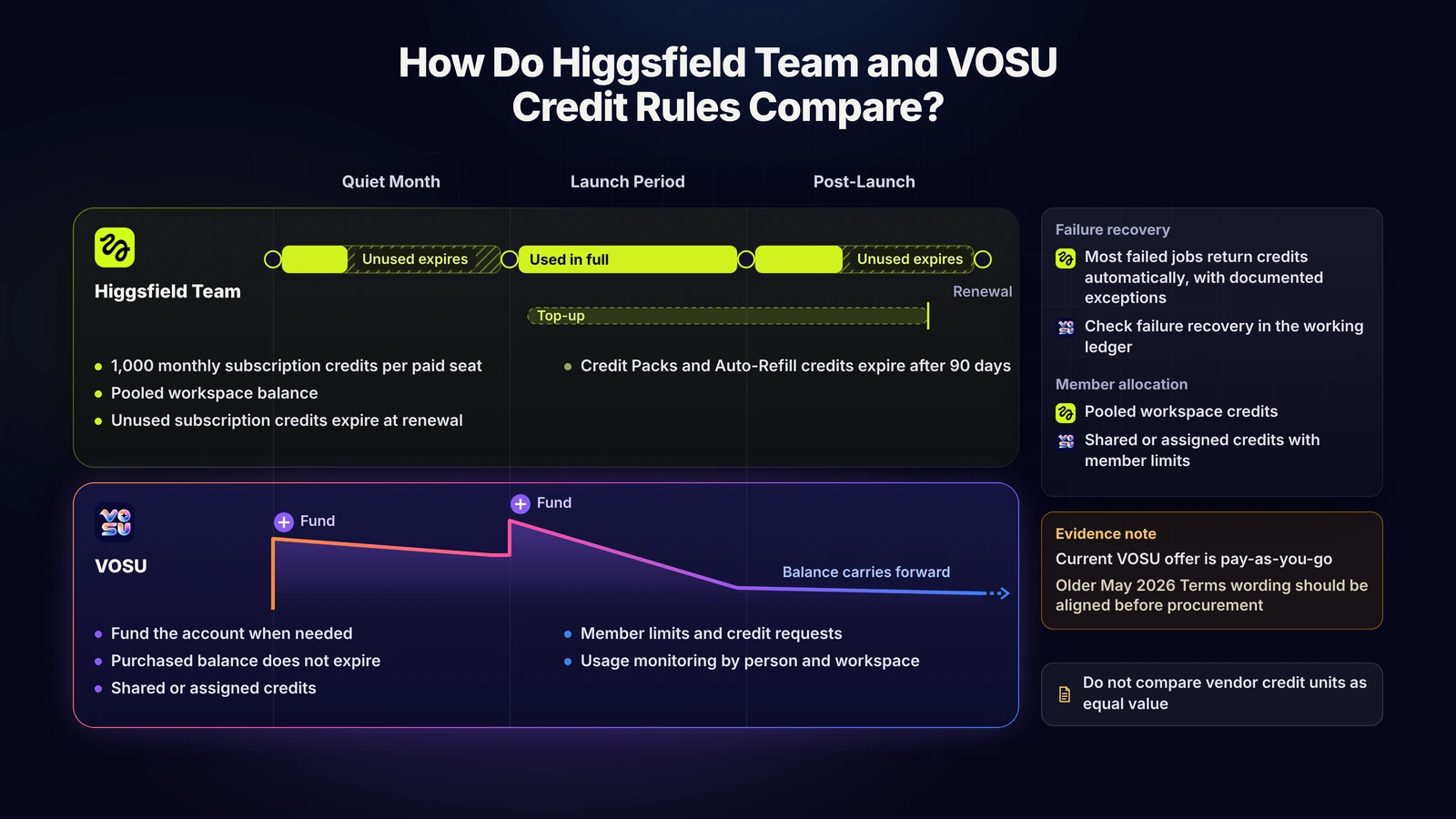
Retained value matters when campaign demand changes.
Higgsfield Team uses a pooled allowance that refreshes, while VOSU keeps a purchased balance available until it is used. The meaningful comparison is retained purchasing value and accepted output, not the number printed beside either platform’s credit unit.
| Credit rule | Higgsfield Team | VOSU | Decision effect |
|---|---|---|---|
| Included balance | 1,000 subscription credits per paid seat, pooled monthly | Team funds draw from a purchased account balance | Model workload, not raw units, determines value |
| Renewal behavior | Unused subscription credits expire when the allowance refreshes | The purchased balance never expires | Irregular production retains more funded value on VOSU |
| Extra funds | Credit Packs and Auto-Refill credits expire 90 days after purchase | Add funds as needed under pay-as-you-go pricing | Compare expiry, top-up control, and actual use |
| Member allocation | Shared pool, with no Team-level member spend control | Shared or assigned credits, member limits, and credit requests | Supports controlled team spending without per-seat pricing |
| Failed jobs | Credits usually return automatically, with documented model exceptions | Public small-team refund detail is not equally specific | Check the ledger and recovery path during the pilot |
Higgsfield spends subscription credits first. Those credits reset at the paid renewal, and unused value does not roll into the next allowance. Purchased Credit Packs and Auto-Refill credits do not reset monthly, but their current validity is 90 days. The account usage history records deductions and most automatic returns. This gives the team a traceable ledger, although a sporadic production month can still leave paid subscription credits unused.
VOSU lets teams add funds when needed, and the purchased balance does not expire. That structure reduces unused-balance loss when work arrives in bursts. Team workspaces include shared or assigned credits, member limits, credit requests, and usage monitoring. The May 2026 Terms still contain older paid-subscription wording, so that page should be updated to match the current pay-as-you-go offer before an absolute no-subscription legal claim is used in procurement.
For each product, record attempts, completed generations, refunded failures, revisions, upscales, and approved assets. Calculate the accepted-output rate as approved assets divided by attempts. Calculate cost per accepted asset as total measured cost divided by approved assets. That method captures wasted balance and retry behavior without pretending the two credit systems are interchangeable.
How Do Higgsfield Team and VOSU Workspaces Handle Shared Assets?

Keep assets available while separating client access.
Higgsfield Team gives members one documented shared asset environment, while VOSU provides unlimited workspaces for separating projects and clients. VOSU also maintains shared projects, controlled member access, asset continuity, and offboarding across those workspaces.
In Higgsfield Team, generations created from the pooled workspace appear in shared Assets. Public documentation says those shared Assets stay in the workspace after a member leaves. The departing member loses access to the project and assets, and access returns if that person later rejoins. This is useful continuity for a small group because client work does not disappear with the creator’s login.
Removing a member does not automatically reduce the paid seat count during the current cycle. The owner must contact Support to lower seats for the next renewal. Team also provides one shared workspace rather than separate sub-workspaces. An agency can use folders and naming rules, but several clients still share one administrative and budget boundary. That may be acceptable for a compact studio with common access. It is less clean when clients require isolated members, budgets, and materials.
VOSU provides unlimited workspaces and team members without extra fees. An agency can create a separate workspace for each client or campaign and keep its members, references, generations, assets, and reusable processes attached to the relevant brief. This creates a stronger operating structure for client separation than one common workspace.
VOSU carries the workspace lifecycle beyond creation. Owners and admins manage member access and roles, teams retain shared project assets as collaborators change, and authorized members can continue finding, reusing, and exporting work after offboarding. Agencies can therefore separate clients without losing continuity when a contractor or employee leaves. Higgsfield Team also documents asset persistence, but its single-workspace structure gives teams fewer boundaries for isolating client members, materials, and budgets.
This structure keeps permissions, assets, spending context, and reusable workflows aligned with each client while administrators efficiently maintain centralized visibility across the wider VOSU account.
How Do Higgsfield Team and VOSU Roles and Usage Controls Compare?
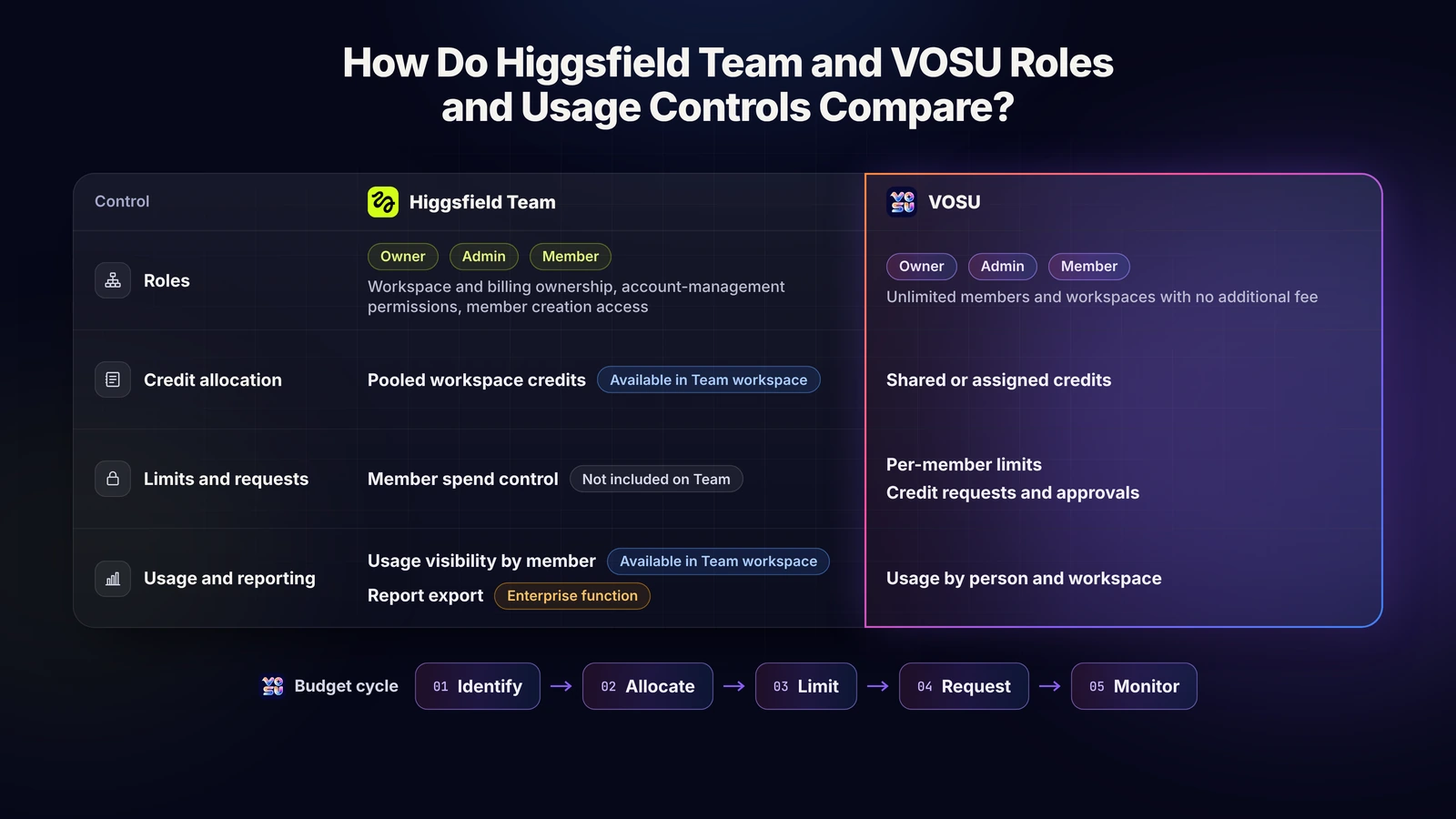
Move from visibility to preventive budget control.
Higgsfield Team documents basic workspace roles, while VOSU provides a broader working control model for access, credit allocation, member limits, requests, and usage monitoring. These controls connect team governance directly to the same pay-as-you-go workspace used for production.
Higgsfield Team uses Owner, Admin, and Member roles. The owner manages the workspace and billing. Admin permissions support account management, while members create with the models and pooled credits available to the workspace. Team documentation also says administrators can view usage by member. This provides identity and basic activity visibility for a self-service group.
Budget enforcement is narrower. The Team plan does not include the member spend-pause control found on Scale, and per-user credit caps belong to Enterprise documentation. Report export is also an Enterprise function. A Team owner therefore has a pooled balance and member-level visibility, but not the same preventive controls or reporting depth as the higher plans. That difference matters when several people can consume a shared budget during a deadline.
VOSU provides Owner, Admin, and Member roles, shared or assigned credits, per-member limits, credit requests, and usage tracking by person and workspace. Unlimited team members and workspaces carry no extra fee. Together, these functions create a practical model for access and budget management across active creative and enterprise production.
VOSU’s controls cover the main small-team budget cycle. An owner can assign administrators and members, allocate credits or allow access to a shared pool, set member limits, review requests for additional credits, and inspect usage by person or workspace. This gives a team preventive budget control as well as activity visibility. Managers can limit overspending before it happens instead of reconstructing responsibility only after a shared pool is consumed. Higgsfield Team provides its documented roles and member usage visibility, but its Team tier does not include comparable member-level spending controls.
How Do Higgsfield Team and VOSU Capacity and Support Compare?

Use matched workloads where public evidence differs.
Higgsfield Team publishes numeric capacity limits, while VOSU supports team production across web, mobile, and MCP without publishing a directly comparable small-team concurrency cap or support SLA. Numeric limits and real production performance are different attributes, so neither product should receive a speed or reliability advantage without matched evidence.
Higgsfield Team currently documents 16 parallel image generations and 16 parallel video generations. It runs on the standard queue and does not include a dedicated account manager. These limits give a team a concrete capacity baseline for a launch-day batch. They do not guarantee completion time because model choice, input complexity, platform load, and separate Unlimited queue behavior can affect delivery.
Higgsfield’s troubleshooting documentation is also specific about recovery. A queued job can usually be canceled to free its slot. Most failed generations return credits automatically within a few minutes, and the usage ledger records the refund. Some model-specific exceptions apply, so a team should confirm every failed attempt rather than assume that all credits returned. Persistent problems go through the regular support path on Team.
VOSU supports active production through web, mobile, and MCP access. Its public pages do not list a directly comparable small-team concurrency cap, queue class, service-level commitment, or support response target for the pay-as-you-go workspace. That absence does not indicate low capacity or weak support. It only prevents a numerical public-cap comparison with Higgsfield Team.
When capacity determines the purchase, run both products through the same workload. Submit equal image and video batches with the same model variants, input files, resolution, and duration. Record queue time, generation time, failure rate, retry count, refunded spend, and accepted outputs. A support inbox is not an SLA, and one fast job is not a capacity benchmark. Higgsfield provides a clearer published numerical limit, while VOSU’s actual production performance should be judged from the matched workload rather than the absence of a public cap.
Which Small Teams Benefit Most From a Higgsfield Team Alternative?
Small agencies, creative studios, and in-house production teams benefit most when per-seat costs, expiring credits, limited workspace separation, or disconnected creative tools interfere with daily work. The strongest candidates include:
- Small creative agencies: Agencies using rotating freelancers or contractors can add collaborators without increasing recurring seat costs while keeping projects, permissions, and shared assets organized.
- Multi-client marketing and advertising agencies: Unlimited VOSU workspaces let agencies separate each client’s members, references, assets, credit usage, and reusable workflows instead of managing every account inside one shared space.
- Creative and AI production studios: Connected access to AI Studio, Nodes, Agents, Playground, PromptGPT, Photo Studio, and editing tools reduces repeated setup across generation, comparison, revision, and delivery.
- In-house marketing and brand teams: Usage-based funding and non-expiring credits suit teams with seasonal launches, campaign peaks, and quieter production periods that make fixed monthly allowances inefficient.
- Performance marketing and social media teams: Shared projects, credit controls, and model access support rapid production of ad variations, social videos, localized assets, and channel-specific creative formats.
- E-commerce and product creative teams: Separate workspaces help organize product images, UGC ads, campaign videos, brand references, approvals, and reusable assets across stores or product lines.
- Distributed and contractor-led teams: Member roles, spending limits, usage monitoring, asset continuity, mobile access, and offboarding help teams collaborate without losing control when contributors change.
VOSU is the stronger alternative when the team needs better seat economics, multiple client workspaces, retained credit value, working budget controls, and connected production across web, mobile, and MCP.
What Should a Higgsfield Team Alternative Preserve for Daily Collaboration?
A credible replacement must preserve the team’s working lifecycle, not merely reproduce access to generation models. Daily collaboration begins with a shared brief and continues through references, prompts, drafts, review, revisions, approvals, delivery, reuse, and offboarding.
Start with project context. A new workspace must keep the current brief, approved references, prompt history, model settings, and output versions discoverable to the people responsible for the work. If context remains trapped in personal chats or browser histories, the team has changed tools without creating a shared production system.
Next, protect asset continuity. Members need a predictable way to save, label, review, reuse, and export project assets. VOSU retains shared project work for authorized team members when a contractor or employee leaves, allowing the organization to continue using the material it paid to create without restoring the former user’s access.
Budget visibility must survive the move. A replacement should identify who can spend, where the shared funds sit, how usage appears, what happens when a limit is reached, and whether finance can reconstruct project cost. Model access matters only after those budget rules are clear. The team also needs to know whether web, mobile, and MCP activity draw from the same balance and return outputs to the same asset system.
Finally, preserve review and client separation. A campaign lead should be able to invite the right people, keep unrelated clients apart, comment or hand off work, and remove access without breaking the project. The alternative should improve the specific failure that started the search while keeping the rest of the lifecycle intact. A cheaper entry point or wider tool set is not a complete replacement if it weakens accountability, asset continuity, or delivery.
What Should Teams Check Before Choosing a Higgsfield Team Alternative?
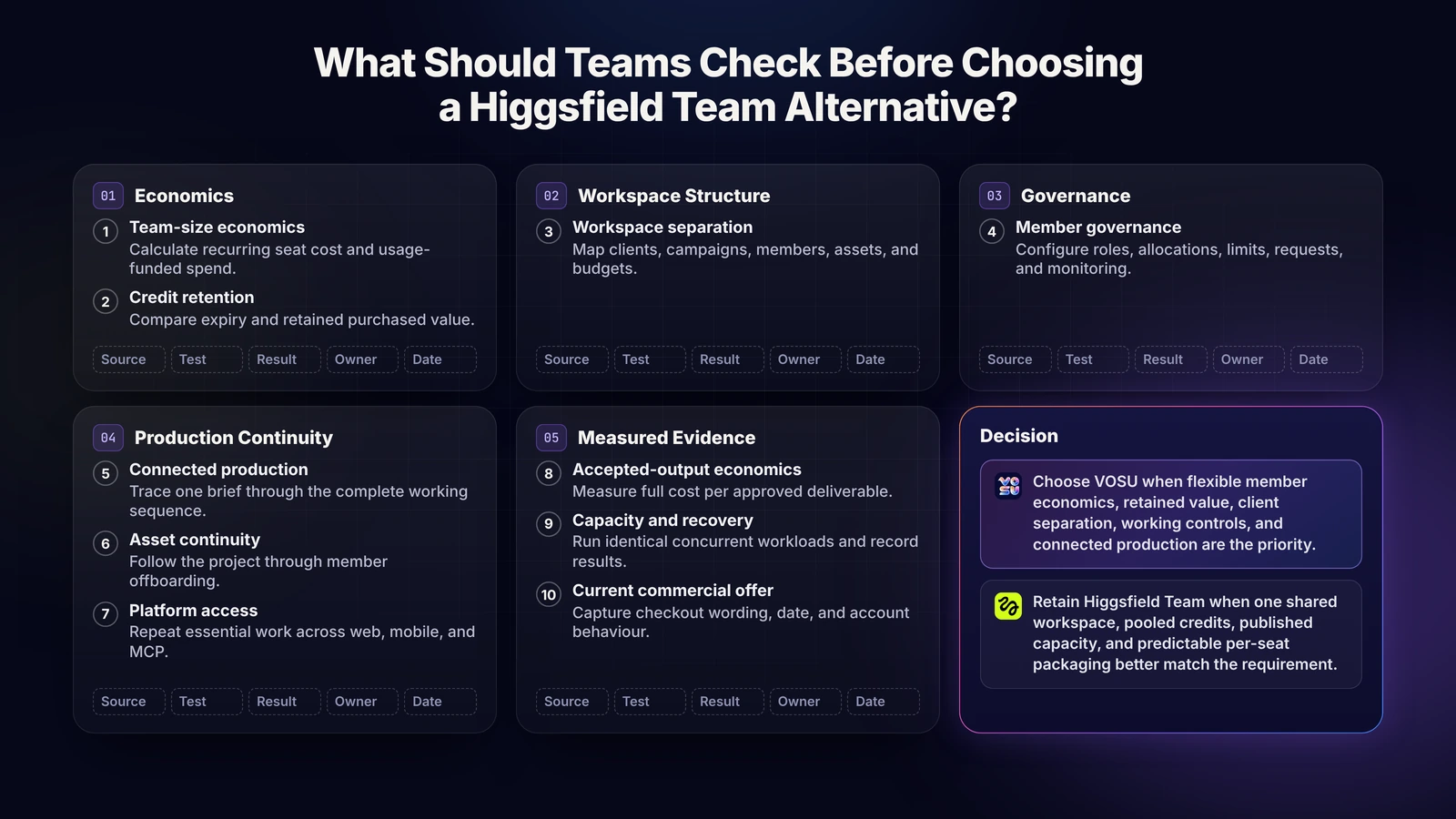
Let the same workload and decision record decide.
Teams should choose VOSU when flexible member economics, retained credit value, client-separated workspaces, working team controls, and connected creative production matter more than a bounded per-seat plan. Use one matched evaluation to compare both products under the same workload and acceptance standard.
- Team-size economics: Calculate Higgsfield’s recurring cost for 2, 3, 5, and 9 seats, then compare it with VOSU’s usage-funded model and zero additional member fee.
- Credit retention: Compare Higgsfield’s expiring subscription credits with VOSU’s non-expiring purchased balance, especially when production volume changes between quiet periods and campaign peaks.
- Workspace separation: Map every client, campaign, and internal brand to its required workspace, then use VOSU’s unlimited workspaces to separate members, assets, budgets, and production context.
- Member governance: Configure VOSU’s Owner, Admin, and Member roles, credit allocation, member limits, credit requests, approvals, and usage monitoring around the team’s actual responsibilities.
- Connected production: Trace one brief through PromptGPT, AI Studio, Playground, Nodes, Agents, Marketing Studio, Photo Studio, review, and delivery without rebuilding context across separate creative subscriptions.
- Asset continuity: Follow a project from member invitation through offboarding, then retain its shared references, prompts, generations, revisions, and approved assets for authorized VOSU workspace members.
- Platform access: Repeat essential creation, review, generation, download, and asset-access tasks across VOSU web, mobile, Claude, ChatGPT, Gemini, and MCP-supported workflows.
- Accepted-output economics: Measure every generation, revision, failure, refund, upscale, and approved asset, then calculate total cost per accepted deliverable instead of comparing unrelated credit units.
- Capacity and recovery: Run identical concurrent image and video batches, then record queue time, completion time, retries, refunded spend, accepted outputs, and useful support responses.
- Current commercial offer: Review current VOSU team pricing, capture the checkout date and wording, and align the decision record with the offer the team will purchase.
Is There a Free Higgsfield Team Alternative?
No production-ready free option fully replaces a team workspace with member access, shared assets, budget controls, support, and sustained generation. Limited free generations can test output, while VOSU’s $1 minimum supports a low-commitment paid pilot. Neither is a free team operating system. Budget for real usage, retries, governance checks, and the accepted assets your team must deliver.
Is There a Higgsfield Team Alternative Without Per-Seat Pricing?
Yes. VOSU uses pay-as-you-go funding with no extra team-member fee. Team workspaces include Owner, Admin, and Member roles, shared or assigned credits, member limits, credit requests, and usage monitoring. Compare actual generation spend for the intended workload. Its May 2026 Terms contain older paid-subscription wording that should be updated to match the current offer before making an absolute legal claim.
Can a Higgsfield Team Alternative Work on iOS?
Yes. VOSU provides official iOS and Android apps, while Higgsfield supports phone-browser use and says it has no official mobile app. VOSU members can access workspaces, create and review assets, generate media, and download results from supported mobile surfaces. Teams can also open the VOSU creative workspace when they need the complete browser production environment.
Can a Higgsfield Team Alternative Work With Claude or ChatGPT?
Yes. VOSU MCP supports Claude, ChatGPT, and Gemini through the same account balance, with generated media saved to the VOSU library. Supported models, credit deductions, and outputs remain connected to the same account. Higgsfield also offers MCP, but free and Unlimited website generations do not apply there. Teams can connect VOSU to Claude or ChatGPT. MCP is not a generation API.
Can a Higgsfield Team Alternative Be Used for Client Work?
Yes, with qualifications. Both products publish commercial-use guidance, but usable rights still depend on the account, selected model, source inputs, and client contract. Confirm input ownership, model restrictions, approval responsibility, and asset provenance for every deliverable. Teams can plan a repeatable client video workflow, but should obtain legal advice when rights or indemnity are material.
Is VOSU the Best Higgsfield Team Alternative?
Yes. VOSU is the best Higgsfield Team Alternative for teams prioritizing no per-member surcharge, a non-expiring purchased balance, unlimited workspaces, working member and credit controls, mobile access, and connected creative workflows. Higgsfield Team remains a practical narrow fit for 2-to-9-person groups that prefer its documented single workspace, pooled credits, stated capacity, and predictable per-seat packaging.
When Should a Team Compare a Higgsfield Enterprise Plan Alternative Instead?
Move to an Enterprise comparison when self-service collaboration no longer covers the requirement. SSO, contractual no-training commitments, compliance evidence, dedicated capacity, custom support, detailed reporting, organization-wide controls, or negotiated legal terms belong in procurement analysis. A larger headcount alone is not the only trigger. Document the mandatory control first, then evaluate Enterprise offers against it.