

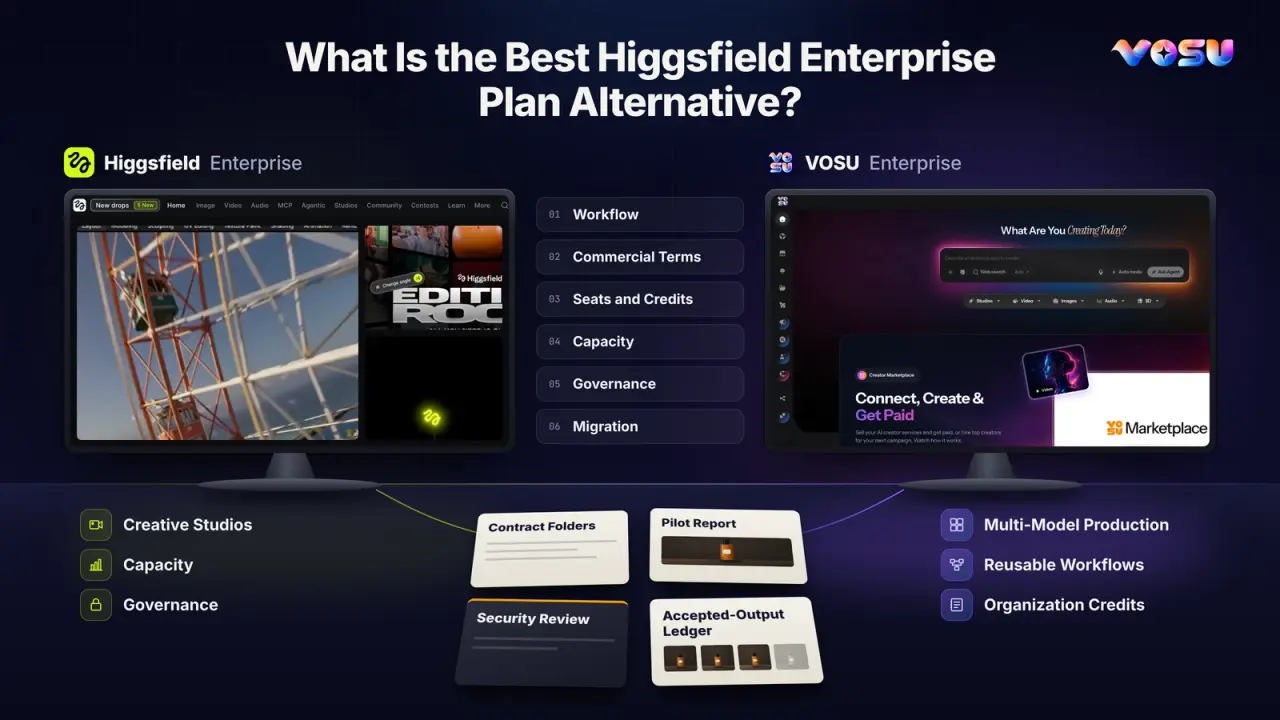
VOSU Enterprise is the best Higgsfield Enterprise Plan Alternative for organizations prioritizing flexible purchasing, unlimited seats and workspaces, non-expiring organization credits, and connected multi-model production. Its public Enterprise offer links a broad model catalog with AI Studio, Nodes, Agents, Playground, PromptGPT, PhotoStudio, and MCP access. That combination gives creative operations one environment for exploration, repeatable production, editing, assistant-led generation, and shared asset management.
Higgsfield Enterprise remains the conditional choice when a buyer requires controls that Higgsfield documents more clearly and VOSU cannot confirm in writing. Those requirements may include SSO or SAML, reviewed SOC 2 Type II evidence, governed sub-workspaces, dedicated capacity, or contract-backed indemnification. Neither vendor publishes a fixed Enterprise contract price, and public claims do not settle entitlement, reliability, or output economics. The final decision should therefore use matched quotes, reviewed security documents, signed service terms, and a same-input pilot that measures every attempt and accepted asset.
How Are the Higgsfield Enterprise Plan and VOSU Enterprise Plan Compared?
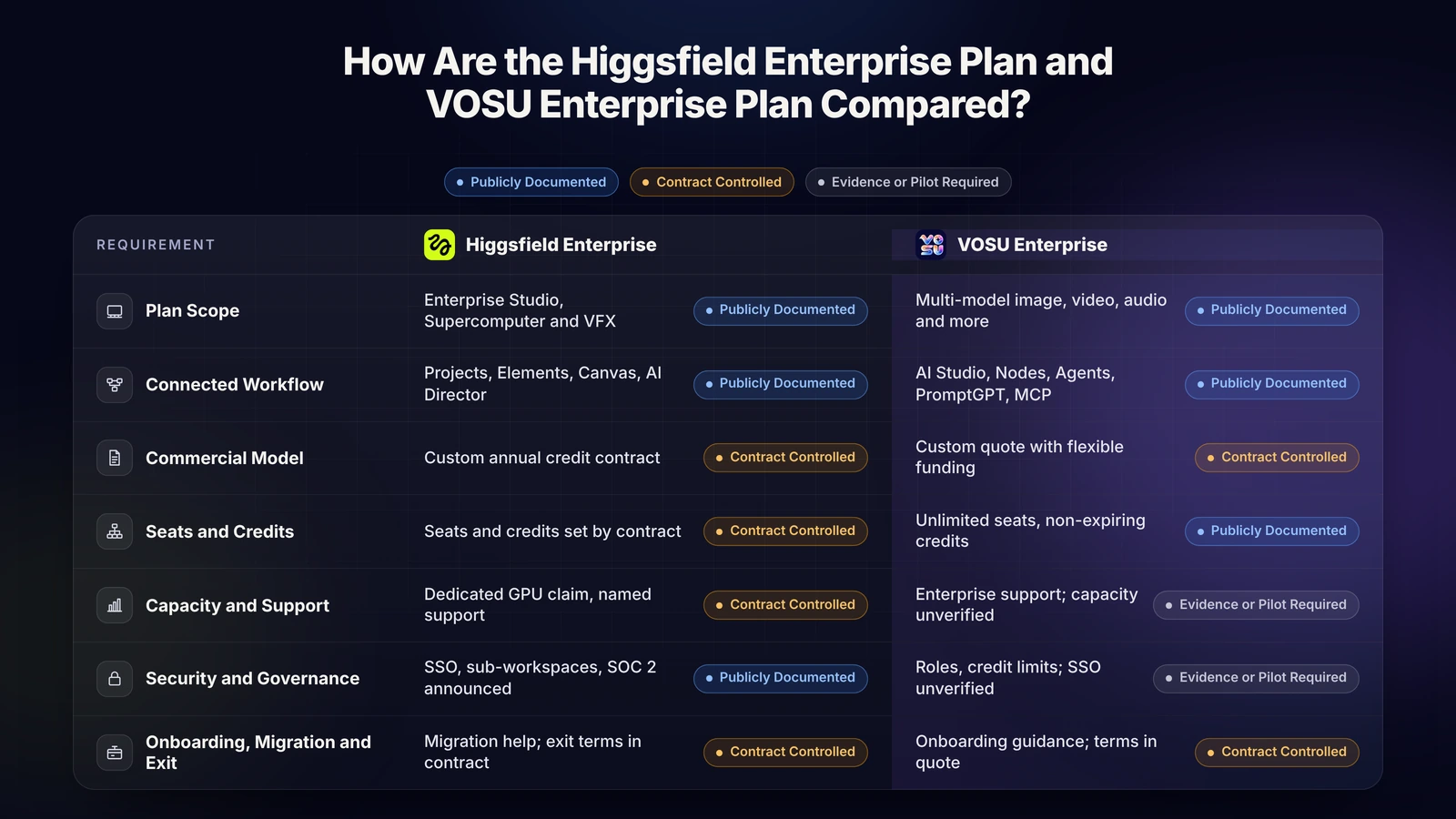
Evaluate both plans against the same requirements.
Compare Higgsfield Enterprise Plan and VOSU Enterprise Plan on the same Enterprise requirements and written terms. Score plan scope, workflow, commercial structure, seats and credits, capacity and support, security and governance, and lifecycle. VOSU is recommended for flexible economics and connected production. Higgsfield is conditional when documented controls are mandatory.
| Enterprise plan | Plan and core features | Connected workflow | Commercial model | Seats and credits | Capacity and support | Security and governance | Primary fit and trade-off |
|---|---|---|---|---|---|---|---|
| Higgsfield Enterprise Plan | Enterprise Studio, Supercomputer, VFX, and organization controls | Projects, assets, Elements, Canvas, and AI Director | Custom annual credit contract | Signed entitlement and contract-defined credits | Dedicated GPU claim and named support | SSO or SAML, sub-workspaces, and announced SOC 2 Type II audit | Conditional when documented controls are mandatory |
| VOSU Enterprise Plan | Multi-model production across major creative media | AI Studio, Nodes, Agents, Playground, PromptGPT, PhotoStudio, and MCP | Custom quote with flexible public funding | Publicly unlimited seats and workspaces with non-expiring organization credits | Enterprise support, with reserved capacity unverified | Roles, credit limits, ownership, and privacy claims, with SSO and SOC 2 parity unverified | Recommended for flexible purchasing and connected production |
Quotes, contracts, security packets, and pilot results control the purchase. Next, compare creative and organizational scope.
How Do Higgsfield Enterprise Plan and VOSU Enterprise Plan Features and Scope Compare?
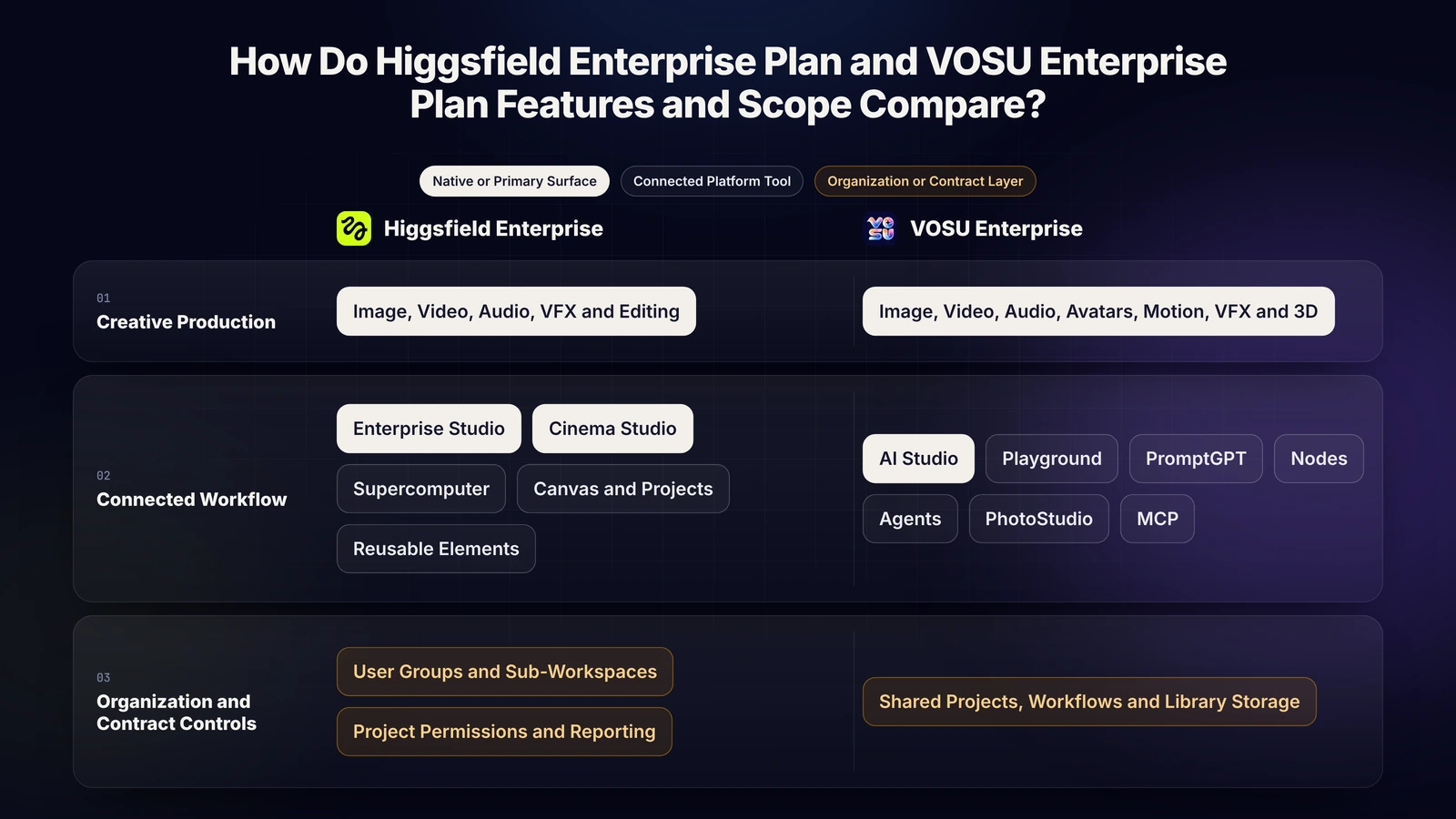
Compare production, workflow continuity, and organization scope.
VOSU Enterprise covers the broader connected multi-model workflow, while Higgsfield Enterprise publishes more detail about organization controls and contract-led service. VOSU combines a multi-format creative workspace with connected production tools. Higgsfield combines image, video, and audio creation with Enterprise Studio, Cinema Studio, Supercomputer, VFX, projects, reusable Elements, and an organization layer built around workspaces, user groups, and sub-workspaces.
VOSU's creative scope spans image and video generation, audio, editing, motion control, avatars, visual effects, and 3D. AI Studio is the generation environment. Nodes, Agents, Playground, PromptGPT, PhotoStudio, and MCP extend that environment as connected tools rather than features of one generator. The public Enterprise page also describes shared projects, assets, reusable workflows, per-member credit limits, centralized billing, and unlimited seats and workspaces. Exact model versions and Enterprise entitlements still need live confirmation.
Higgsfield's scope centers on its own production surfaces and an extensive set of creative models and effects. As of November 17, 2026, Higgsfield markets access to more than 35 models and tools plus more than 250 VFX presets. Those are vendor-defined counts, not directly comparable model families. Cinema Studio projects can hold briefs, reference files, reusable Elements, generations, reviews, and usage limits. Supercomputer projects can hold instructions, skills, connectors, sources, chats, outputs, and saved context.
| Scope area | Higgsfield Enterprise Plan | VOSU Enterprise Plan |
|---|---|---|
| Creative production | Image, video, audio, VFX, editing, and agent-assisted work | Image, video, audio, avatars, editing, VFX, motion, and 3D |
| Workflow surfaces | Enterprise Studio, Cinema Studio, Supercomputer, Canvas, and projects | AI Studio plus connected Nodes, Agents, Playground, PromptGPT, PhotoStudio, and MCP |
| Asset continuity | Project briefs, Elements, generations, reviews, folders, and shared assets | Shared projects, assets, generated media, reusable workflows, and library storage |
| Organization layer | Roles, user groups, sub-workspaces, project permissions, and reporting | Roles, member credit limits, workspaces, credit requests, and usage visibility |
| Contract services | Onboarding, account management, training, migration support, and named support channels | Enterprise guidance, onboarding support, workflow optimization, and custom volume terms |
The scope difference matters when teams dislike switching among disconnected generators or losing prompt and asset history. VOSU provides more connected creation paths. Higgsfield exposes more public detail about how Enterprise projects, groups, permissions, and sub-workspaces operate. Cost, security, capacity, and exit obligations require separate evidence and should not be inferred from feature breadth.
Which Higgsfield Enterprise Plan Alternative Supports the Better Connected Creative Workflow?
VOSU Enterprise supports the better connected creative workflow for buyers that want model exploration, prompt development, orchestration, editing, and assistant access within one account. Higgsfield provides a substantial product-specific workflow through Cinema Studio, Supercomputer, projects, VFX, Canvas, and reusable Elements. The practical difference is how each platform connects a brief to multiple models, production steps, revisions, and final assets.
VOSU can start with PromptGPT, which helps convert a rough creative direction into a more structured image, video, or camera prompt. Playground then gives creators a shared place to select models, run comparable prompts, and review image or video history. As of November 17, 2026, VOSU publicly claims access to more than 150 models across its wider platform. That count is volatile, and a buyer should verify the exact versions available to the Enterprise pilot rather than treating an endpoint count as a count of unique model families.
Nodes turns individual generation and editing steps into a visual pipeline. A team can connect a brief or prompt to image generation, pass the selected still into video generation, add an editing or upscaling step, and preserve the graph for reuse. Agents can plan or execute parts of that process. PhotoStudio supports iterative image work, while AI Studio remains the primary generation surface. These are connected VOSU tools with different interfaces and controls. They should not be described as one native model feature.
VOSU MCP adds another entry point. Supported Claude, ChatGPT, and Gemini clients can request VOSU generation and editing tools through the same account and credit balance, and generated media returns to the VOSU library. That reduces context switching for a user working from an assistant conversation. It does not prove that every model, role, approval step, or organization credit control is available through MCP. Enterprise permission behavior must be tested with member, admin, and owner accounts.
How Do Higgsfield Enterprise Plan and VOSU Enterprise Plan Costs Compare?
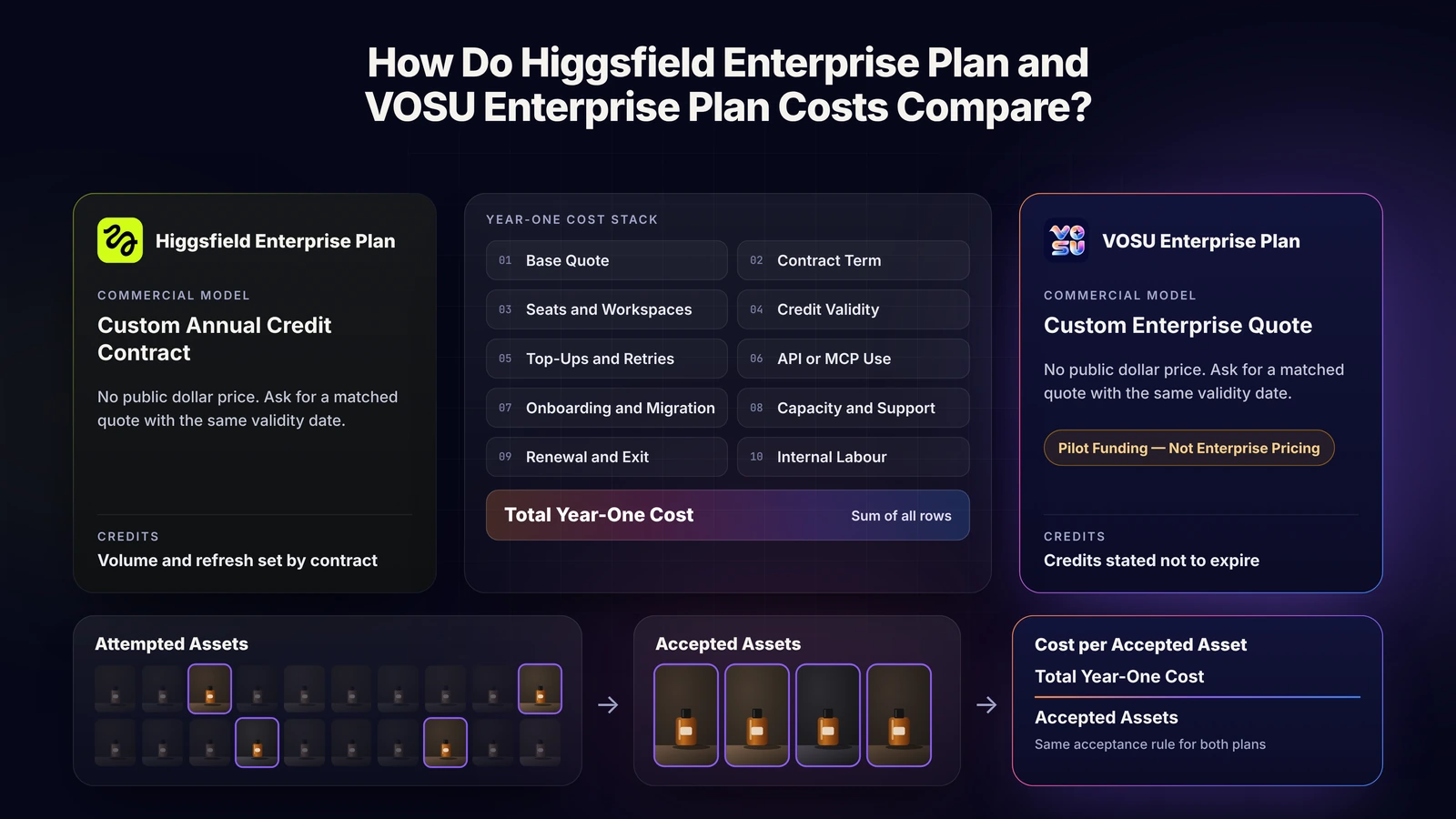
Compare matched quotes and accepted-output economics.
Neither Higgsfield nor VOSU publishes a fixed Enterprise price, so buyers should compare matched written quotes and total year-one cost. VOSU publishes clearer expansion economics through unlimited seats and workspaces with no extra fees and organization credits that do not expire. Higgsfield prices a custom annual credit contract that may include dedicated capacity, governance, security evidence, onboarding, and support. Those included services can materially change the comparison.
Use the same currency, quote-validity date, expected volume, output settings, user count, workspace structure, support level, and acceptance rule. Public VOSU funding that starts at $1 is a low-commitment entry point, not an Enterprise contract price.
| Cost component | Higgsfield Enterprise Plan | VOSU Enterprise Plan | Cost effect | Required evidence |
|---|---|---|---|---|
| Base quote and model | Custom annual credit contract with no public dollar price | Custom pricing or volume credits with no public dollar price | Sets commitment and year-one baseline | Matched quotes with the same validity date |
| Contract and payment | Annual commitment with monthly payments stated, while invoice timing can be contract-defined | Enterprise term and payment cadence are not fully public | Changes cash flow and renewal exposure | Order form, invoice schedule, and renewal clause |
| Seats and workspaces | Seat entitlement and workspace structure are contract-controlled | Publicly states unlimited seats and workspaces with no extra fees | Affects expansion cost | Signed entitlements and provisioning rules |
| Credits and validity | Volume and refresh are contract-defined | Organization volume is quoted and credits are stated not to expire | Determines capacity and unused-credit risk | Amount, value, eligible surfaces, expiry, and termination |
| Top-ups, overage, and retries | Packs have documented 180-day validity and qualifying failures may be refunded | Top-up and retry treatment require the quote | Changes unplanned and attempted-output cost | Unit price, approval, expiry, ledger, and refund rule |
| API or MCP use | Generation API access and billing are separate from the reporting API | MCP uses account credits, while generation API pricing is not established | Can create a second billing path | Rate cards and one billed automation test |
| Onboarding and migration | Public assistance is documented | Enterprise guidance is public, while scope requires a quote | Adds vendor and internal labor | Owner, timeline, deliverables, and exclusions |
| Capacity and support | Dedicated capacity and named support are stated | Enterprise support is stated, while reservation is unverified | May justify a higher quote | Capacity, severity, response, and remedy terms |
| Renewal and exit | Public pages do not settle every term | Current public and legal wording requires reconciliation | Creates renewal and switching risk | Uplift, notice, export, deletion, and exit clauses |
| Internal labor | Depends on workflow setup, review, and administration | Depends on workflow setup, review, and administration | Captures operating burden | Loaded hourly rate and tracked hours |
| Year-one total | Base quote plus all extras, labor, and unused-credit loss | Base quote plus all extras, labor, and unused-credit loss | Produces the comparable total | Completed cost model |
| Cost per attempted asset | Year-one total divided by every generation and revision attempt | Same formula | Shows production spend before quality control | Complete attempt ledger |
| Cost per accepted asset | Year-one total divided by outputs passing one written acceptance rule | Same formula | Provides the strongest matched economic unit | Same-input pilot and acceptance ledger |
Questions about fast credit depletion, invoices, and retries should become test cases, not claims about normal behavior. Record every attempt, refund, top-up, approval, and accepted output. VOSU cannot be called cheaper until both quotes and the accepted-output ledger support that conclusion. Next, compare how each product controls seats, workspaces, and credits.
Which Higgsfield Enterprise Plan Alternative Offers Better Seats, Workspaces and Credit Controls?
VOSU Enterprise offers the clearer public expansion economics, better seats, workspaces and credit controls. VOSU publicly states unlimited seats and workspaces with no extra fees, non-expiring organization credits, per-member monthly limits, an owner's pool, credit requests, approvals, and usage tracking. Higgsfield documents user groups, sub-workspaces, project limits, detailed usage exports, and organization reporting, but its signed contract controls the actual seat and credit entitlement.
VOSU states that purchased organization credits do not expire. Owners can let members use the owner's pool or assign monthly limits, and members can request more credits for an administrator to approve. Usage is presented by person and workspace. The contract should still define top-up treatment, refunds, termination, unused balances, reporting detail, and whether limits apply consistently across AI Studio, Nodes, Agents, Playground, and MCP.
A shared balance can disappear quickly when several people run expensive workflows. Treat that concern as a pilot scenario. Run concurrent tasks, test alerts and approval rules, remove a member, and confirm what happens to projects and assets. Compare value retention and cost per accepted asset, not raw credit counts, because each vendor prices models and actions differently.
How Do Higgsfield Enterprise Plan and VOSU Enterprise Plan Compare on Capacity, Reliability and Support?
Higgsfield publishes the clearer dedicated-capacity position, while VOSU buyers need written proof of reservation, throughput, reliability targets, and remedies. Higgsfield states that Enterprise includes dedicated GPU capacity, the highest-priority service tier, configurable concurrency, and named support. VOSU documents dedicated Enterprise guidance and has promoted parallel generation, but parallel jobs do not establish reserved infrastructure or guaranteed throughput.
Capacity, concurrency, queue time, and reliability should remain separate in the evaluation. Capacity describes the resources reserved or available to the customer. Concurrency describes how many jobs can run at once. Queue time measures how long work waits before execution. Reliability measures successful completion, usable results, and recovery behavior. A high concurrency setting can still perform poorly if jobs wait, fail, or need repeated attempts.
Run a matched load test during representative production hours. Use the same task types, models, durations, resolutions, reference inputs, and output counts. Record median and 95th-percentile queue time, completed assets per hour, maximum sustained concurrency, failure rate, retry count, and accepted-output rate. Separate content moderation, invalid input, provider errors, timeouts, internal errors, and quality rejection. A failed-job refund changes billing, but it does not erase deadline risk or internal review time.
Higgsfield says qualifying failed generations may receive credit refunds. Its support documentation offers email and shared Slack or Microsoft Teams channels and states an average response time of 15 minutes. That figure is a vendor-reported average, not a contractual service-level agreement or resolution guarantee. The contract should define severity levels, coverage hours, response and resolution targets, escalation ownership, maintenance notice, service credits, and remedies for missed commitments.
VOSU's public Enterprise page promises guidance for onboarding, workflow optimization, and scaling production. Public evidence for a numeric uptime SLA, reserved capacity, severity matrix, response commitment, or service-credit remedy was not verified. Buyers should request those terms instead of interpreting general Enterprise support as equivalent to a capacity reservation.
Higgsfield has the better documented starting point for capacity-led procurement. VOSU can still win the operating decision if the pilot meets the required load and its written support terms satisfy the buyer. Security and governance evidence must then be reviewed with the same distinction between a public statement, a tested control, and a signed commitment.
How Do Higgsfield Enterprise Plan and VOSU Enterprise Plan Compare on SSO, Security and Governance?
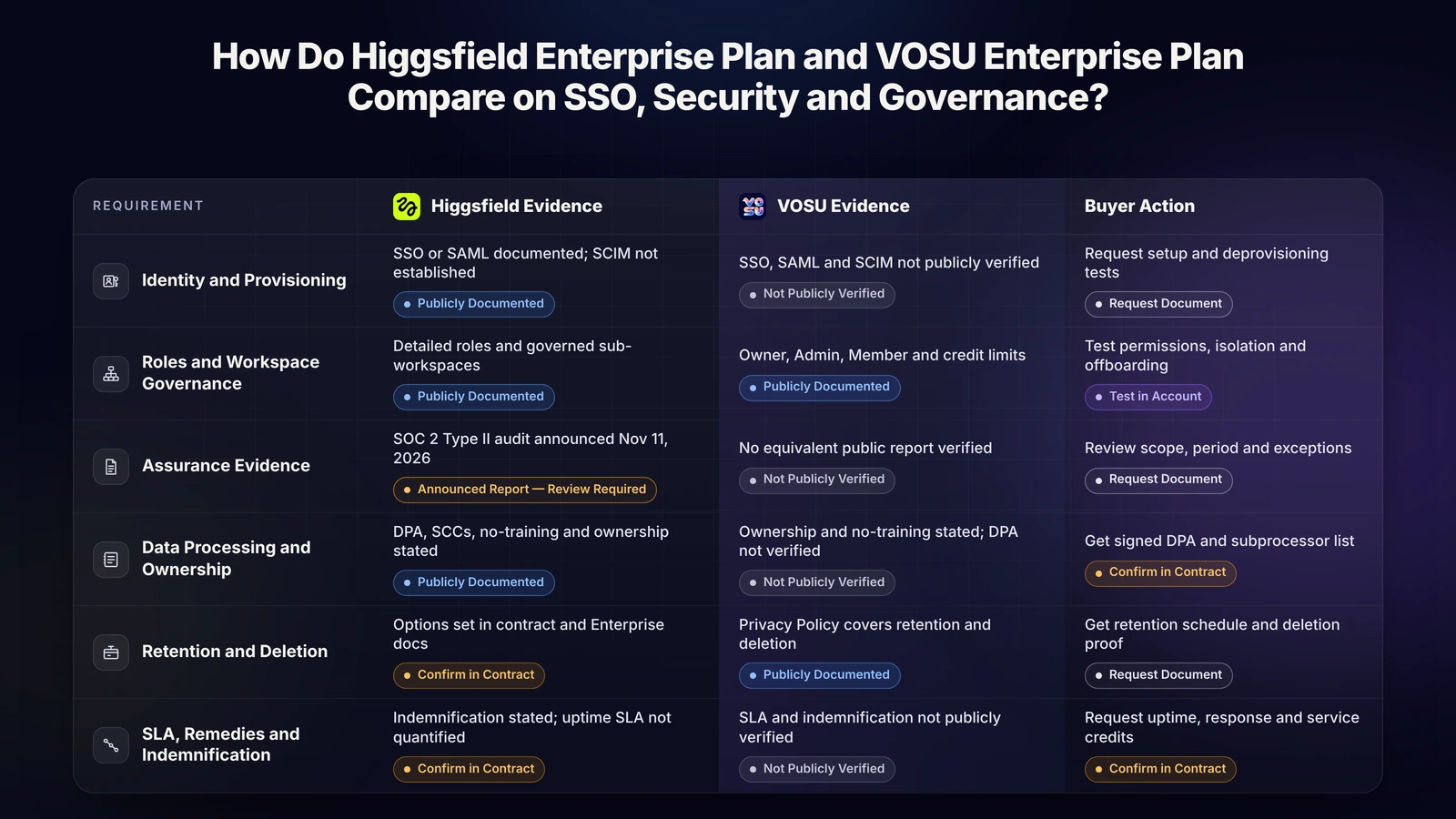
Separate public evidence from requested contractual proof.
Higgsfield has the clearer public evidence for SSO or SAML, assessed controls, governed sub-workspaces, DPA and SCC support, and stated indemnification. VOSU documents organization roles, per-member limits, ownership, no-training treatment, and privacy practices aligned with GDPR and CCPA rights. Equivalent public VOSU evidence for SSO, SCIM, SOC 2, a DPA, an Enterprise SLA, or contract-backed indemnification was not verified.
Identity and provisioning must be evaluated as separate controls. SSO or SAML centralizes authentication through the buyer's identity provider. SCIM automates user provisioning and deprovisioning. Roles define what an authenticated user can do. Offboarding determines when access ends, who owns the work, and whether sessions, keys, connectors, and shared links are revoked. Evidence for one control does not prove the others.
| Requirement | Higgsfield Enterprise evidence | VOSU Enterprise evidence | Status and buyer action |
|---|---|---|---|
| SSO or SAML | Publicly documented for Enterprise | Not publicly verified | Request configuration, enforcement, and recovery terms |
| SCIM | Not established by the reviewed public evidence | Not publicly verified | Ask for provisioning protocol, group mapping, and deprovisioning tests |
| Roles and permissions | Owner, Admin, Member, Billing, project roles, and granular admin permissions | Owner, Admin, Member, credit limits, and centralized billing are public | Test effective permissions, private-content visibility, and offboarding |
| Sub-workspace governance | Separate members, assets, balances, allocations, and owner visibility are documented | Unlimited workspaces are stated, while comparable hierarchy is not public | Verify hierarchy, inheritance, auditability, and isolation |
| SOC 2 | Higgsfield announced completion of a SOC 2 Type II audit on November 11, 2026 | No equivalent public report or completion claim was verified | Review report scope, audit period, exceptions, and remediation |
| DPA and SCCs | Listed as components of Higgsfield's GDPR program | A public Enterprise DPA was not verified | Obtain signed documents and current subprocessors |
| Training and ownership | Contractual no-training treatment and customer ownership are stated | VOSU states customer ownership and no training on inputs or outputs | Review contract scope and every model-provider flow-down |
| Storage, retention, and deletion | Contract options and Enterprise documentation require review | Privacy Policy describes AWS S3 storage in the United States, provider processing, retention, and deletion rights | Obtain a complete retention schedule, residency scope, and deletion evidence |
| SLA and remedies | Public documentation does not quantify a complete uptime SLA | Not publicly verified | Request availability, severity, response, resolution, and service-credit terms |
| Indemnification | Contract-backed indemnification is stated | Equivalent provider-backed protection was not publicly verified | Review covered claims, exclusions, caps, and defense obligations |
Higgsfield's November 2026 announcement says it completed a SOC 2 Type II audit and an independent GDPR assessment, with reports available through its Trust Center. The announcement is useful evidence that reports exist. It is not a substitute for reviewing the actual report, control scope, review period, exceptions, bridge letter, and current remediation status. Higgsfield also lists a DPA and Standard Contractual Clauses within its GDPR program. Procurement still needs the signed versions and a current subprocessor list.
VOSU's public privacy materials state that customers retain their inputs and generated assets, data is not used for model training, and selected inputs may pass to third-party model providers to deliver requested features. They also describe US storage on AWS S3 and user rights for access, correction, export, and erasure. Those statements support a privacy review. They do not establish SOC 2 completion, a DPA, an uptime SLA, or contractual indemnification.
Governance depth also needs a live account test. Higgsfield documents user groups, project roles, workspace roles, private-project visibility, per-user caps, usage exports, and immediate access removal while work remains in the workspace. VOSU documents roles, member limits, credit requests, and usage visibility. Buyers should verify VOSU's permission taxonomy, audit history, key revocation, asset ownership after removal, and controls across connected tools. Public silence should be recorded as not publicly verified, not converted into a claim that a capability is absent.
How Do Higgsfield Enterprise Plan and VOSU Enterprise Plan Handle Onboarding, Migration and Exit?

Test entry, workflow migration, ownership, and exit.
Higgsfield publicly documents a more specific Enterprise onboarding and migration path, while both vendors require written entry and exit obligations. Higgsfield describes activation after the first invoice, account-manager setup, a 30-minute configuration call, optional creative education, and first-week rollout work. It also documents migration from Team or Scale. VOSU offers Enterprise guidance and shared production workflows, but the public scope of implementation, migration, export, and exit assistance is less specific.
For Higgsfield, onboarding begins with workspace activation, invitations, roles, SSO setup when required, groups or sub-workspaces, spending limits, and initial production goals. Its current billing documentation says a move from Team or Scale can carry assets, folders, members, invoice history, and the Elements library. The buyer should confirm whether project settings, comments, prompts, usage history, links, role mappings, and private-content rules also transfer.
A move into VOSU should start with the same inventory. List users, workspaces, identity requirements, prompts, references, characters, brand assets, model settings, approved outputs, project history, workflow graphs, assistant connections, and cost records. Then assign an owner for each migration task. Public access to shared projects or reusable workflows does not prove bulk import, complete metadata preservation, or automatic permission mapping.
Workflow migration is often harder than file transfer. A Higgsfield Cinema Studio project, Canvas flow, reusable Element, or Supercomputer context may not map directly to VOSU Nodes, Agents, PromptGPT, PhotoStudio, or projects. The reverse is also true. Run a sample migration before contract signature. Rebuild one representative workflow, verify inputs and outputs, compare permissions, and measure the internal hours required to reach the same accepted result.
Offboarding should cover individual users and the organization. Confirm when access ends, whether active sessions and keys are revoked, who receives ownership, how private and shared assets remain available, and how credit authority changes. Higgsfield documents immediate member removal and workspace retention of that person's work. Equivalent VOSU asset-retention and ownership behavior should be tested and written into the operating procedure.
Exit terms should define export formats, metadata, generation history, workflow definitions, audit data, deletion timing, deletion evidence, remaining-credit treatment, transition support, and fees. Ask each vendor for a sample export and deletion confirmation before purchase. No buyer should assume one-click migration, complete workflow portability, or immediate erasure from a general marketing statement.
Who Needs a Higgsfield Enterprise Plan Alternative?
A Higgsfield Enterprise Plan Alternative is relevant to organizations that need governed creative production, shared budget controls, security review, production capacity, formal support, and lifecycle commitments. The buying motion is driven by requirements, not headcount alone.
Typical buyers include large agencies managing client separation, studios coordinating high-volume production, enterprise marketing departments running multiple brands, and creative operations teams that must connect finance, IT, legal, security, and production. These organizations need more than access to image or video models. They need to know who can enter each workspace, which models and tools members can use, how spending is allocated, how assets are reviewed, and what happens when a user or vendor relationship ends.
An Enterprise evaluation becomes appropriate when one or more requirements are mandatory:
- centralized authentication or formal identity review
- governed workspaces, groups, projects, or departmental budgets
- written privacy, data-processing, ownership, and no-training terms
- reviewed assurance evidence such as a SOC 2 report
- committed capacity, concurrency, support response, or remedies
- centralized usage reporting and controlled automation access
- vendor-led onboarding, migration support, and a documented exit process
A small team that mainly needs daily generation, shared assets, and ordinary collaboration should evaluate the separate Team-plan decision. It should not inherit an Enterprise contract model merely because several people use the product. A smaller company can still need Enterprise procurement when regulated data, customer contracts, or production deadlines demand formal controls. Conversely, a large creative group may prioritize VOSU's flexible organization economics if its security and capacity requirements can be confirmed in writing.
What Must a Higgsfield Enterprise Plan Alternative Replace?
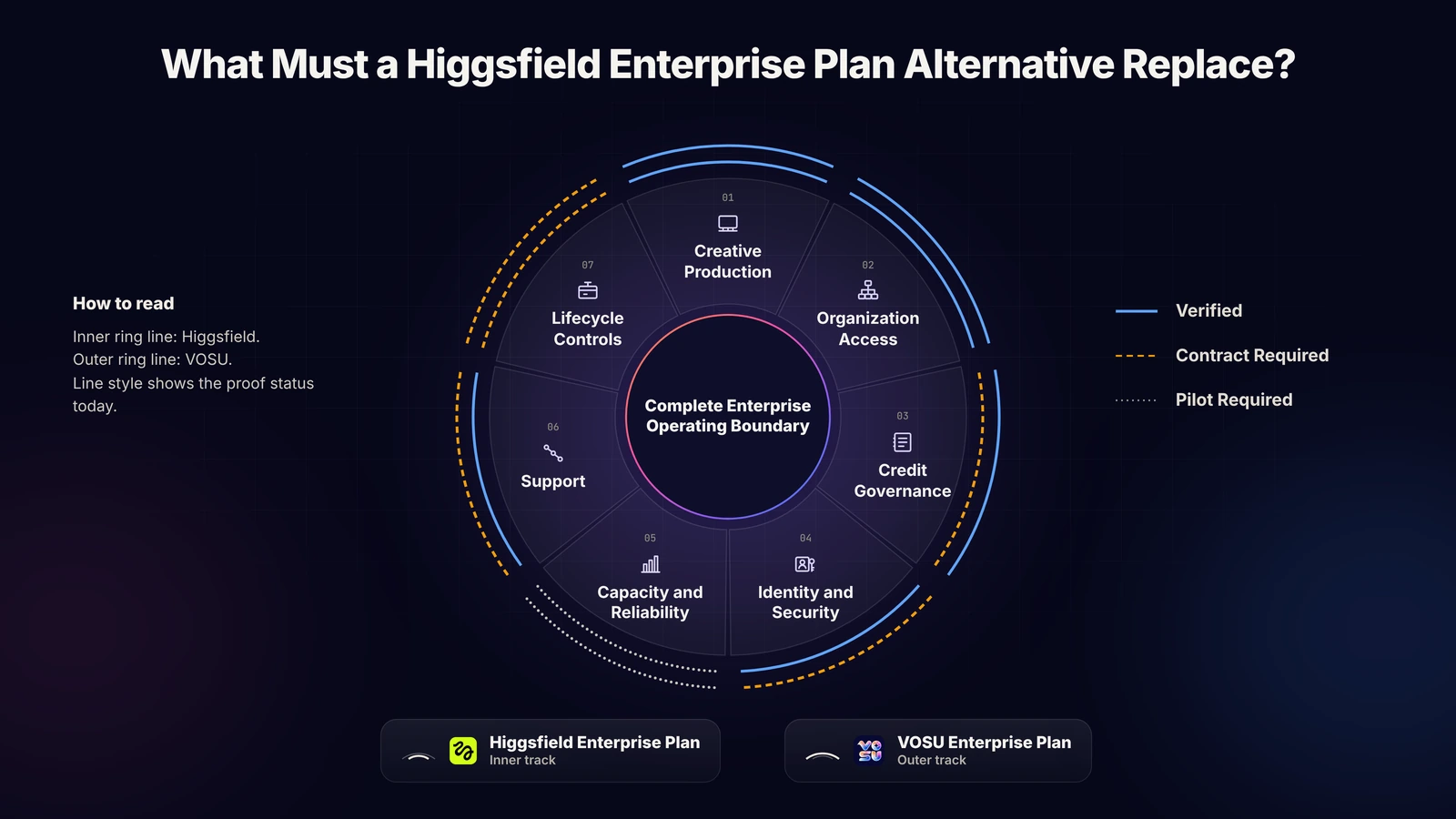
Replace the operating boundary, not only generation.
A credible Higgsfield Enterprise Plan Alternative must replace the complete creative operating boundary, not only the generator. A buying committee should map each requirement to evidence, an owner, and an acceptance test.
- Creative production: the required image, video, audio, editing, VFX, motion, and asset workflows.
- Organization access: invitations, roles, permissions, workspaces, project visibility, and offboarding.
- Credit governance: purchasing, allocation, limits, requests, reporting, expiry, refunds, and termination treatment.
- Identity and security: SSO, provisioning, assurance evidence, privacy terms, provider processing, retention, and deletion.
- Capacity and reliability: reservation, concurrency, queue time, failure recovery, accepted-output rate, and cost under load.
- Support: named ownership, severity levels, response targets, escalation, coverage hours, and remedies.
- Lifecycle controls: onboarding, integration, migration, export, ownership transfer, termination, and exit assistance.
The replacement boundary should match the buyer's actual operating model. A feature can be useful without satisfying the related procurement control. Unlimited workspaces do not prove hierarchical governance. Parallel generation does not prove reserved capacity. Roles do not prove automated provisioning. Privacy statements do not replace an assurance report or signed DPA. The buyer's requirements, reviewed evidence, signed terms, and pilot results determine whether VOSU or Higgsfield covers the complete boundary.
What Should Buyers Verify Before Choosing a Higgsfield Enterprise Plan Alternative?
Before choosing a Higgsfield Enterprise Plan Alternative, verify matched commercial terms, organization entitlements, credit rules, security evidence, capacity commitments, support remedies, lifecycle obligations, and the same-input pilot result. Keep one evidence register so procurement, finance, security, and creative operations make the decision from the same record.
-
Match the quote and term. Request both quotes in the same currency, for the same period, user count, workspace structure, generation volume, automation use, support level, and capacity requirement. Record invoice timing, taxes, renewal uplift, cancellation notice, and quote validity.
-
Confirm seats and workspaces. Put seat entitlement, extra fees, invitation rights, role definitions, workspace hierarchy, content visibility, and offboarding behavior in the order form or product exhibit.
-
Normalize credits and expiry. Document which balances expire, when they reset, how top-ups work, how failed jobs and retries are treated, and what happens to unused credits at termination. Compare cost per accepted asset instead of raw credits.
-
Review security and data rights. Obtain SSO and provisioning details, the SOC 2 report when available, DPA and SCCs, subprocessor list, retention schedule, residency scope, no-training terms, ownership language, deletion evidence, and indemnification.
-
Define capacity and support. Specify reservation, concurrency, queue targets, throughput, maintenance, failure handling, support hours, severity levels, response and resolution commitments, escalation ownership, and remedies.
-
Test migration and exit. Price onboarding and internal labor. Review import and export formats, metadata, workflow rebuilding, user removal, ownership transfer, deletion timing, transition help, and exit charges.
-
Run a matched pilot. Use the same inputs, models or equivalent model classes, settings, output counts, and written acceptance rule. Track every attempt, failure, retry, review hour, and accepted output. Test owner, admin, and member permissions as well as concurrent production load.
VOSU publishes this comparison, so buyers should treat its recommendation as a requirement-based editorial assessment. Signed terms, reviewed documents, and pilot evidence should control procurement.
Choose VOSU Enterprise when flexible purchasing, publicly unlimited seats and workspaces, non-expiring organization credits, and connected multi-model production are the decisive priorities. Buyers can review VOSU Enterprise requirements before requesting a matched quote and pilot.
Choose Higgsfield Enterprise when documented SSO or SAML, reviewed SOC 2 Type II evidence, governed sub-workspaces, contract-defined dedicated capacity, or indemnification is mandatory and VOSU cannot confirm an acceptable equivalent in writing.
Does a Higgsfield Enterprise Plan Alternative Require a Subscription or Annual Contract?
Not necessarily. Higgsfield Enterprise publicly uses an annual credit contract, with monthly payments stated and invoice timing set by the agreement. VOSU's pricing page promotes pay-as-you-go funding, while its May 2026 Terms still mention a paid subscription for continued use. check current VOSU pricing. The signed order form and current legal terms control commitment, renewal, cancellation, and payment cadence.
Is There a Free Higgsfield Enterprise Plan Alternative?
No verified free option replaces a governed Enterprise workspace. Teams can fund a low-commitment VOSU pilot before requesting Enterprise terms, but that pilot does not include verified security, governance, capacity, support, or custom commercial commitments. Review broader Higgsfield alternatives if Enterprise controls are unnecessary, then budget onboarding and compliance work separately for an organization-wide launch.
Is There an Open-Source Higgsfield Enterprise Plan Alternative?
Open-source projects can replace components, not a complete managed Enterprise service by default. The buyer must own hosting, model licenses, updates, security controls, uptime, incident response, and support. Compare that engineering and compliance cost with matched VOSU and Higgsfield quotes. Repository popularity does not prove production readiness, data protection, reserved capacity, indemnification, or reliable maintenance.
How Does a Higgsfield Enterprise Plan Alternative Work With Claude or ChatGPT?
VOSU MCP lets supported Claude, ChatGPT, and Gemini clients call creative tools with the same VOSU account credits, and generated media returns to the VOSU library. Teams can connect VOSU to Claude or ChatGPT, but must test which models, roles, permissions, approval paths, and credit controls each Enterprise member receives. MCP access does not establish generation API access or pricing.
How Do API and MCP Credits Work for Enterprise Generation?
API and MCP credits should be treated as separate entitlements until the contract proves otherwise. Higgsfield's organization API reads usage and content data, while its generation API uses separate access and billing. VOSU MCP consumes account credits but does not establish API pricing. Confirm authentication, model coverage, limits, retention, and invoice treatment, then record the tested billing path.
Should a Small Team Choose Higgsfield Team or a Higgsfield Enterprise Plan Alternative?
A small self-serve group should compare Higgsfield Team when daily collaboration, pooled monthly credits, and per-seat purchasing matter more than procurement controls. Evaluate a Higgsfield Enterprise Plan Alternative when SSO, security evidence, custom capacity, support remedies, or contractual governance becomes mandatory, regardless of headcount. Detailed Team pricing belongs in its separate comparison and should not be duplicated here.
Is VOSU Enterprise the Best Higgsfield Enterprise Plan Alternative?
Yes. VOSU Enterprise is the best Higgsfield Enterprise Plan Alternative for organizations prioritizing flexible purchasing, publicly stated unlimited seats and workspaces, non-expiring organization credits, broad model access, and connected production through its creative tools. Higgsfield remains the conditional choice when its documented governance, assurance, or dedicated-capacity controls satisfy a mandatory requirement that VOSU cannot confirm in writing.