
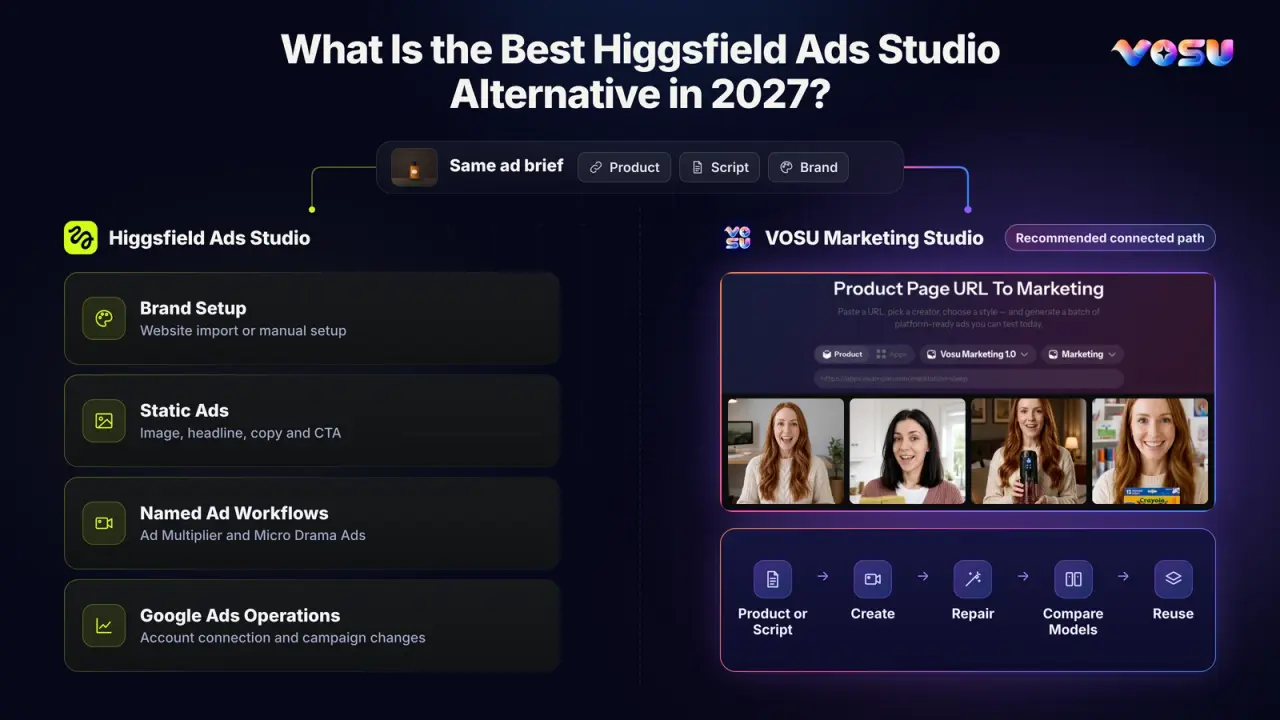
VOSU Marketing Studio is the best Higgsfield Ads Studio alternative in 2027 for marketers who need product-link, exact-script, static, video, Google Ads, UGC, micro-drama, and reusable campaign production connected to targeted repair, model fallback, assistant access, and pay-as-you-go purchasing.
VOSU Marketing Studio keeps product context, approved scripts, static and video outputs, generated media, and follow-up tools connected across the production cycle. Marketers can create channel-ready ads, repair weak frames or scenes, compare models, reuse accepted assets, and continue from stored media instead of rebuilding an entire campaign when one result needs correction.
VOSU Marketing Studio becomes especially valuable when brands, agencies, and performance marketers need Google Ads creatives, product and app ads, UGC-style content, exact-script videos, micro-drama stories, static variations, and reusable campaign formats. Pay-as-you-go access, non-expiring purchased credits, unlimited workspaces and members, assistant access, model choice, and connected repair workflows support that wider production need in one system.
How Do VOSU Marketing Studio and Higgsfield Ads Studio Compare?
VOSU Marketing Studio is the recommended alternative for generating Google Ads creatives, static and video ads, product and app ads, UGC-style campaigns, exact-script ads, micro-drama stories, and reusable variants within one connected production system. Higgsfield separately packages static batches, Ad Multiplier, Micro Drama Ads, and Google Ads operations as named workflows with their own inputs, access conditions, and credit rules.
The products overlap in ad creation, but they package the work differently. VOSU Marketing Studio brings multiple campaign formats into one production environment, then Photo Studio, Playground, Nodes, MCP, editing tools, and additional models extend correction, comparison, automation, and reuse across the connected VOSU ecosystem. Higgsfield distributes comparable jobs across several named ad workflows.
Compare the two products by the ad job, continuation options, commercial model, and documented limitations.
| Alternative | Key features | Pricing | Main trade-off |
|---|---|---|---|
| VOSU Marketing Studio | Product and app URL ads, exact-script ads, static and video ads, Google Ads creatives, UGC-style ads, micro-drama stories, reference-led variants, model choice, repair tools, Nodes, Playground, MCP, reusable media, unlimited members, and unlimited workspaces without extra fees | Pay as you go from $1. No required subscription. Purchased credits do not expire. Enterprise pricing is custom. | The breadth of formats, models, and connected tools can require some learning |
| Higgsfield Ads Studio | Website or manual brand setup, product selection, static variations, Ad Multiplier, Micro Drama Ads, and documented Google Ads operations | The launch guide listed four credits per static ad. Current plan, promotion, included-credit, and live workflow quotes require a publication-date check. | Scope and access vary across child workflows. Subscription, credit, rollout, and output-review conditions require current verification. |
How Do VOSU Marketing Studio and Higgsfield Ads Studio Handle Product URLs and Static Ad Inputs?
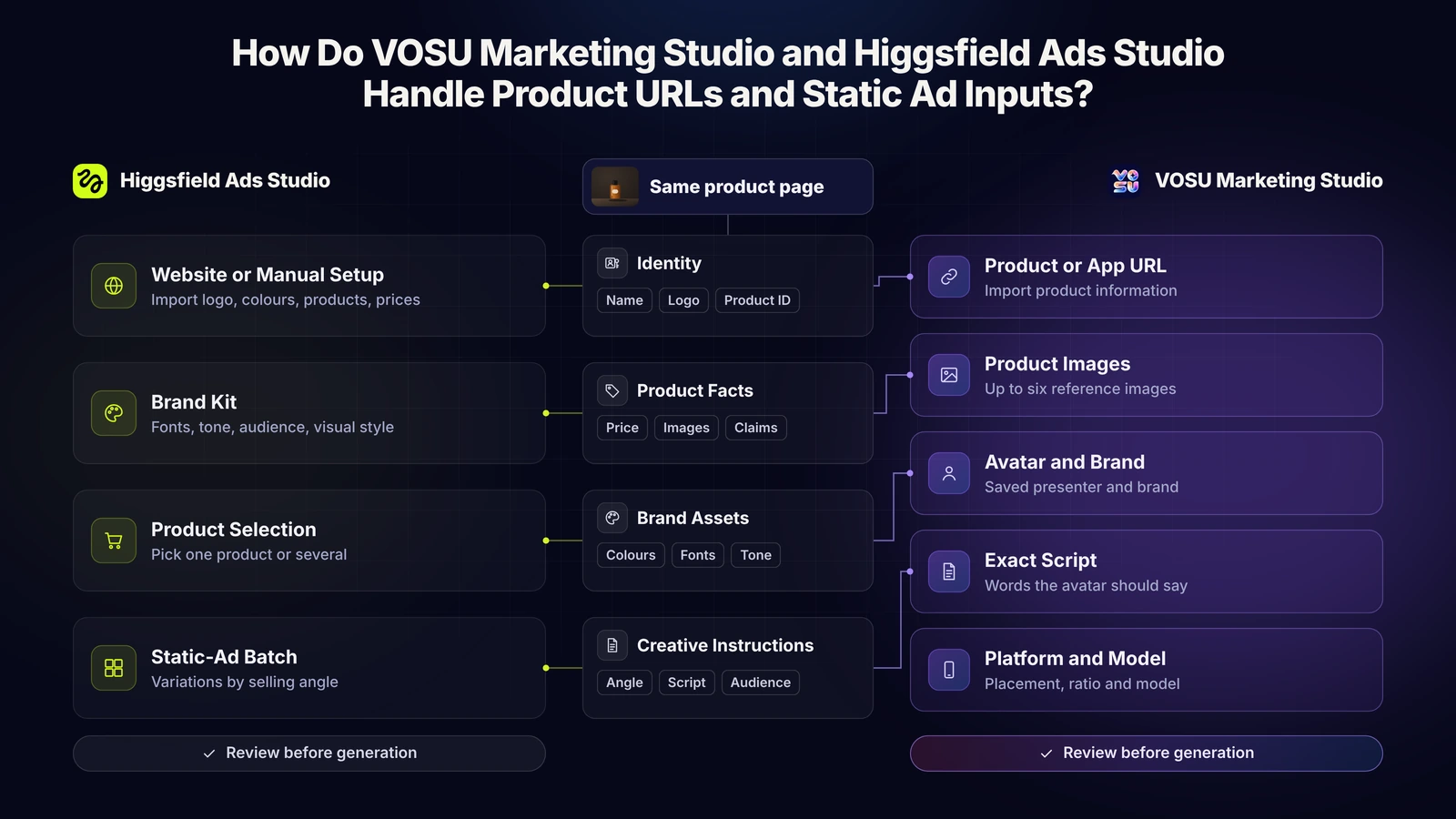
Compare what each workflow extracts before generation.
VOSU Marketing Studio turns product or app context into platform-ready static and video ads across Google Ads, social, UGC, product, exact-script, and story-led campaign formats. VOSU separates Product and Apps inputs. Its Product URL workflow can build a reusable campaign batch from a page, while Script to Video combines imported context with a marketer-supplied script and product images.
Higgsfield's static workflow can import a website's logo, colors, products, prices, and images. Marketers can review the brand information before generation, select one product or several products, and request variations built around different selling angles. The launch documentation also describes manual brand setup when a website is unavailable.
VOSU can carry the same approved product evidence into static ads, Google Ads creatives, UGC-style videos, exact-script ads, micro-drama stories, and later campaign variants. That wider output range makes source quality especially important. A vague product page can still produce vague creative at scale, so teams should audit every extracted fact, correct missing context, and approve the brief before generation.
How Do VOSU Marketing Studio and Higgsfield Ads Studio Control Copy, Scripts, and Brand Context?
VOSU Marketing Studio gives marketers visible control over exact scripts, product context, brand inputs, and format-specific creative before generation. Its Script to Video workflow asks for the product or app name and the exact words the avatar should say. URL import, script analysis, product images, avatar, brand, platform, model, and duration controls support exact-script, UGC, product, Google Ads, and story-led production.
Higgsfield's Create Ads workflow documents fields for logo, colors, fonts, tone, audience, visual style, description, selling points, and products. It combines that context with a selected advertising angle to generate the image, headline, copy, and CTA. The setup can reduce repeated briefing, but generated language still needs approval.
A visible script field proves that wording can be reviewed before generation. It does not prove that the final speech will preserve every word, pronunciation, pause, price, or disclaimer. One hands-on Ads Studio test also reported copy that described two product options while the visual showed only one. Marketers should compare the source page, entered script, generated transcript, on-screen text, and final CTA as separate records rather than treating brand context as automatic message accuracy.
How Do VOSU Marketing Studio and Higgsfield Ads Studio Compare Across Static and Video Formats?
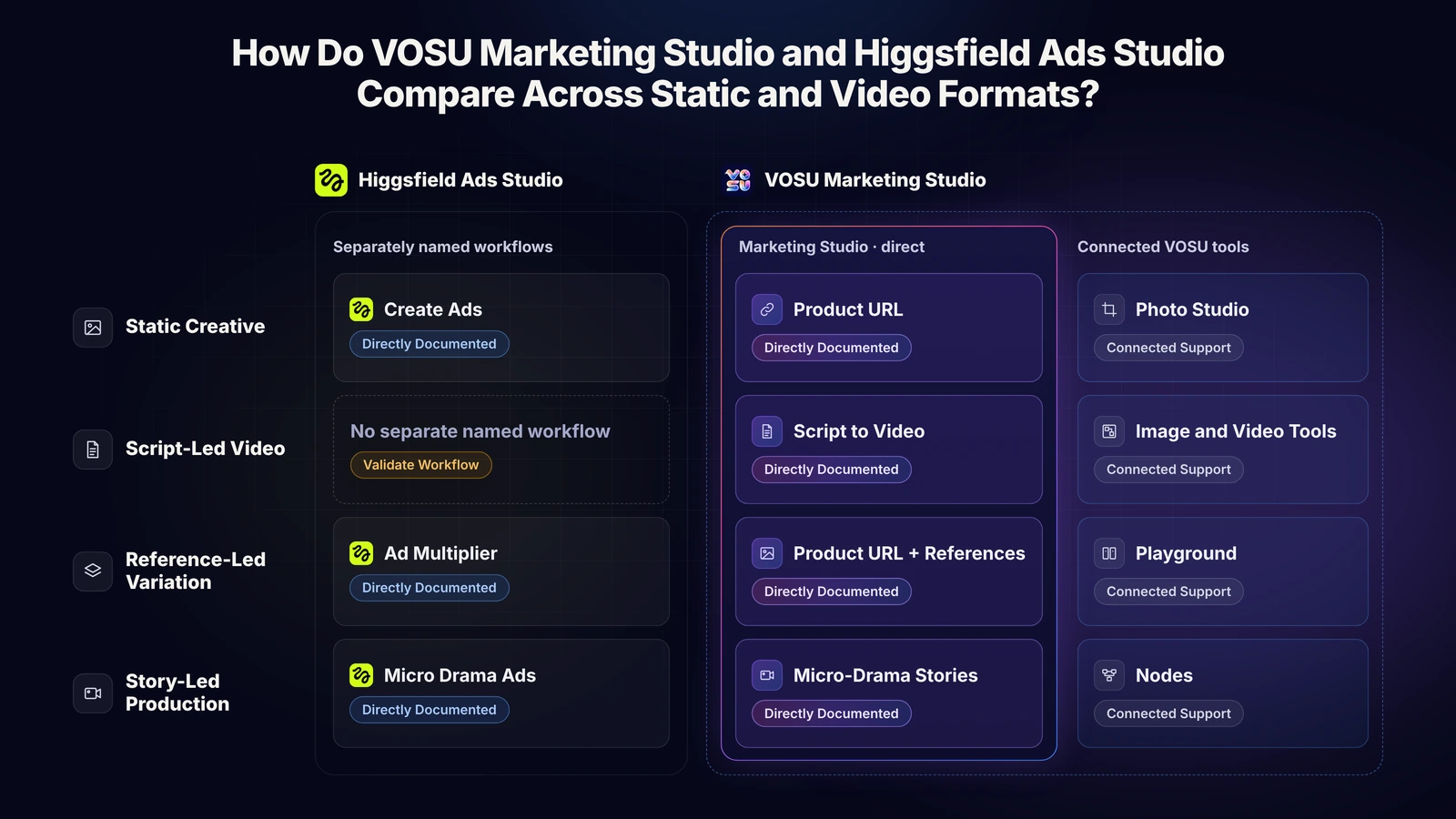
Separate direct formats from connected production support.
VOSU Marketing Studio covers the broader ad-creation need by generating static ads, product and app ads, exact-script videos, UGC-style creatives, Google Ads assets, micro-drama stories, and reusable campaign variations. Higgsfield's Create Ads workflow generates static image, headline, copy, and CTA variations. Ad Multiplier creates reference-led versions, while Micro Drama Ads builds story-led video.
VOSU Marketing Studio uses product URLs, scripts, product images, avatars, brand context, platforms, and model choices to create the required campaign format. The wider VOSU workspace then adds image and video generation, editing, Photo Studio, Playground, Nodes, MCP, and reusable media when the campaign needs correction, model fallback, automation, or a repeatable production sequence.
Format breadth matters only when the workflow remains usable after generation. Compare setup, generation, review, export, correction, reuse, and adaptation time across the same campaign. VOSU's advantage is not simply producing another format. It is keeping the approved product context, script, media, model options, repair tools, and reusable workflow available as the campaign expands across assets and revisions.
How Do VOSU Marketing Studio and Higgsfield Ads Studio Preserve Products, Logos, and Approved Messages?
Neither product should be treated as publish-ready until the generated asset passes a matched product, brand, and message review. VOSU Marketing Studio accepts product or app context, product images, exact-script input, avatar, brand, and platform choices. If an asset needs correction, the connected VOSU workflow can move source images or generated frames into editing and repair tools.
Higgsfield documents a review step for the static workflow and tells marketers to inspect the finished creative before use. That matters because one independent test reported a product changing from its reference, while another broader Higgsfield test observed label text and bottle shape drift across retries. These observations identify useful tests, not a universal defect rate.
Use the same source assets and acceptance rule for both products. Check product shape, package proportions, colors, small label text, logo placement, approved claims, price, CTA, and any change the brief did not request. Keep the first output as well as the accepted output. Without matched frames, transcripts, and attempt logs, a general quality or fidelity verdict would hide the exact failure that created the revision work.
Which Higgsfield Ads Studio Alternative Supports Targeted Repair and Revision?
VOSU Marketing Studio supports a broader connected repair path through Photo Studio and other VOSU editing tools. The original ad can begin in Marketing Studio, while the correction may happen elsewhere in the same ecosystem. Photo Studio documents annotation, erasing, text and layer work, crop and expand, background removal, angle changes, relighting, and upscaling. Separate video tools can support prompt-led edits, background changes, relighting, VFX, and other follow-up work.
This distinction matters when one detail fails review. A full rerun creates another charge and can change parts that were already acceptable. A targeted edit aims to isolate the wrong label, crop, object, background, or scene. It is useful only when the requested area changes and the approved regions remain stable.
Tool availability does not establish lower correction cost or perfect preservation. Marketers should start with an otherwise accepted asset that contains one deliberate defect. Record the steps, operator time, incremental credits, changed pixels or frames, and any new errors. Requests for negative prompting and local correction in independent discussions reinforce the need for this test, but the measured before-and-after result should decide whether the repair workflow is practical.
Which Higgsfield Ads Studio Alternative Supports Model Fallback and Reusable Workflows?
VOSU Marketing Studio provides a documented continuation path through model choice, Playground comparisons, Nodes, and reusable media libraries. Marketing Studio stores Videos, Avatars, and Brands for later work. Playground can send the same brief to selected models for comparison. Nodes can save editable multi-step workflows that connect prompts, source images, generators, and follow-up actions.
That structure helps when the first attempt fails on motion, product shape, text, style, or reference handling. The team can keep the approved brief and source assets, compare another model, and continue the production sequence instead of abandoning the campaign context. One community discussion reported a more useful result after the operator supplied a specific real reference, which shows why source quality and context transfer belong in the fallback test.
More model access does not guarantee a better or cheaper ad. Models accept different references, settings, durations, and aspect ratios. Transfers can also require manual rebuilding. Measure how much context survives, how many steps must be repeated, the extra cost, and the time from rejected output to accepted asset. The value is a visible recovery path, not the number of model names alone.
How Do VOSU Marketing Studio and Higgsfield Ads Studio Support Assistant-Led Work and Workflow Continuation?
VOSU supports assistant-led ad production through MCP and Marketing Studio across Google Ads creatives, static and video ads, product campaigns, UGC formats, exact scripts, micro-drama stories, and reusable variants. VOSU MCP works with Claude, ChatGPT, and Gemini, uses the same VOSU account and credit balance, and returns generated media to the account library for later management and reuse.
Higgsfield's documented Google Ads capability handles another job. After a marketer connects an eligible account, the assistant can read campaigns, ad groups, ads, keywords, budgets, assets, conversions, and reports. Its documentation also describes creating, editing, pausing, or removing account objects with action settings that can request confirmation, run automatically, or remain off.
VOSU handles the creative layer across Google Ads and other campaign formats, while live ad-account control is a separate operational layer. Buyers should confirm which assistant clients, generation actions, editing tools, approval steps, and credit rules apply. If they also need campaign, budget, keyword, publishing, reporting, or optimization controls, they should verify the current account connection and permission workflow independently.
How Do VOSU Marketing Studio and Higgsfield Ads Studio Pricing and Accepted-Ad Costs Compare?
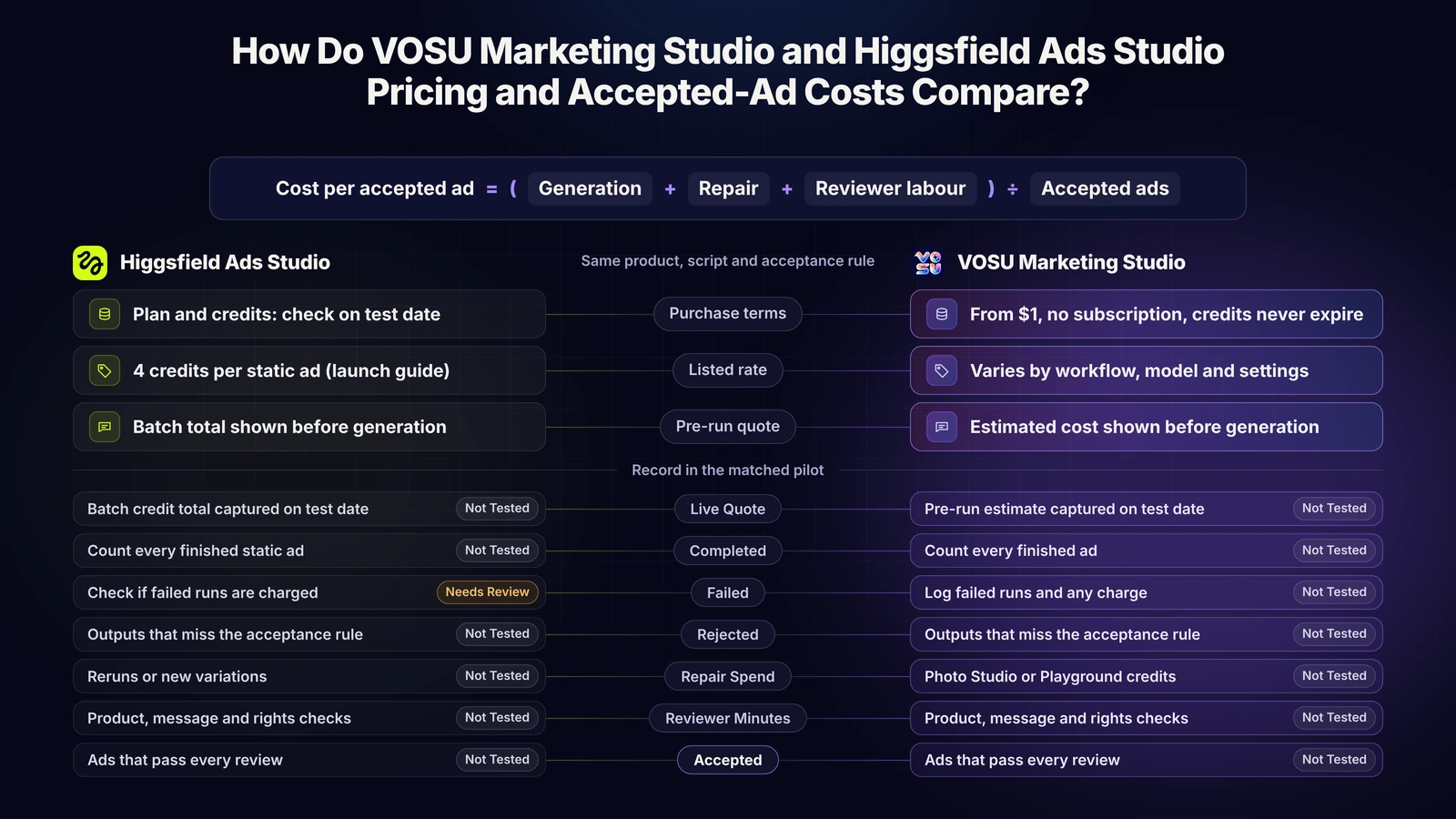
Measure cost per accepted ad, not raw credits.
VOSU Marketing Studio offers the lower-commitment purchasing model, while the lower cost per accepted ad remains unproven until both products complete the same recorded task. Current VOSU pricing states that users can start from $1, no subscription is required, purchased balances do not expire, and workspaces and team members do not add fees. The amount shown before a VOSU generation still depends on the selected workflow, model, settings, and duration.
Higgsfield's launch guide listed four credits for each generated static ad and showed the batch total before generation. Ad Multiplier uses a variable quote, and Micro Drama Ads uses resolution-based credit rates plus possible image, voice, and music costs. Current plan access, promotions, included credits, failed-run treatment, and signed-in quotes can change, so the buyer should capture them on the test date.
Raw credits are not comparable across platforms. Community questions about rapid credit use make a complete attempt ledger especially important. Count completed, failed, rejected, rerun, and repaired generations, then add reviewer or editor labor.
Cost per accepted ad = (total generation and repair spend + reviewer labor cost) / accepted ads.
Use the same acceptance rule and report zero accepted results plainly instead of creating a misleading unit cost.
How Do VOSU Marketing Studio and Higgsfield Ads Studio Handle Human Review and Publish Readiness?
Both workflows require human approval before an ad moves into organic or paid distribution. Higgsfield's own guidance tells marketers to verify product truth, visible warping, prices, dates, addresses, text placement, links, and disclosure language. Apply the same checks to VOSU outputs rather than assuming that an exact input guarantees an exact final asset.
The review should cover four layers. Product review checks shape, package, label, color, and logo. Message review checks transcript, on-screen text, approved claims, offer, price, and CTA. Placement review checks ratio, crop, safe zones, caption readability, link destination, and mobile viewing. Rights review checks ownership or permission for product assets, reference ads, avatars, voices, music, and likenesses.
One hands-on Ads Studio test reported fictional testimonial language, which shows why apparently polished copy can still create an approval problem. Human review must catch that issue before publishing. Commercial-use language also depends on the applicable product, model, input, and channel terms. The defensible output is an accepted creative with a traceable review record, not a promise of legal compliance, platform approval, or campaign performance.
Who Needs a Higgsfield Ads Studio Alternative?
A Higgsfield Ads Studio alternative is most relevant to marketers who need greater control over product context, approved scripts, revisions, fallback, and reuse after the first generated ad. VOSU Marketing Studio addresses that need for several buyer groups, but the switching trigger differs by job.
These audiences have distinct production reasons to compare the workflows.
- DTC and ecommerce teams need product-page ads that preserve packaging, offers, images, and product truth across revisions.
- UGC creators need an approved script, authorized presenter, correct product, and traceable message changes without another shoot.
- Creator agencies need reusable brands, presenters, media, and workflows while keeping each client's assets separated and reviewable.
- Performance marketers need variant production with consistent claims and an attempt ledger that reveals the cost of accepted creative.
- App and SaaS teams need app-aware inputs, accurate screen references, exact feature language, and social formats that preserve the approved narrative.
- Marketplace sellers need product and listing assets that retain labels, proportions, prices, and required aspect ratios.
- Social teams need vertical creative, mobile-safe text, reusable source media, and follow-up assets for recurring content.
- Launch teams need coordinated product videos, images, banners, and later variants built from one approved concept.
- Localization teams need controlled scripts, captions, voices, and native review for every market. Reports about French and Arabic delivery show why pronunciation and lip sync need separate checks.
- Lean businesses need a small starting commitment, visible pre-generation estimates, and a way to reuse accepted assets without funding several disconnected subscriptions.
Teams that need static batches, Google Ads creatives, reference-led variants, UGC content, exact-script videos, or micro-drama stories can produce those campaign assets through VOSU Marketing Studio and its connected tools. VOSU becomes especially useful when the same team also needs controlled correction, model fallback, assistant-led creation, reusable workflows, shared workspaces, and flexible purchasing.
Which Higgsfield Ads Studio Jobs Can VOSU Marketing Studio Replace?
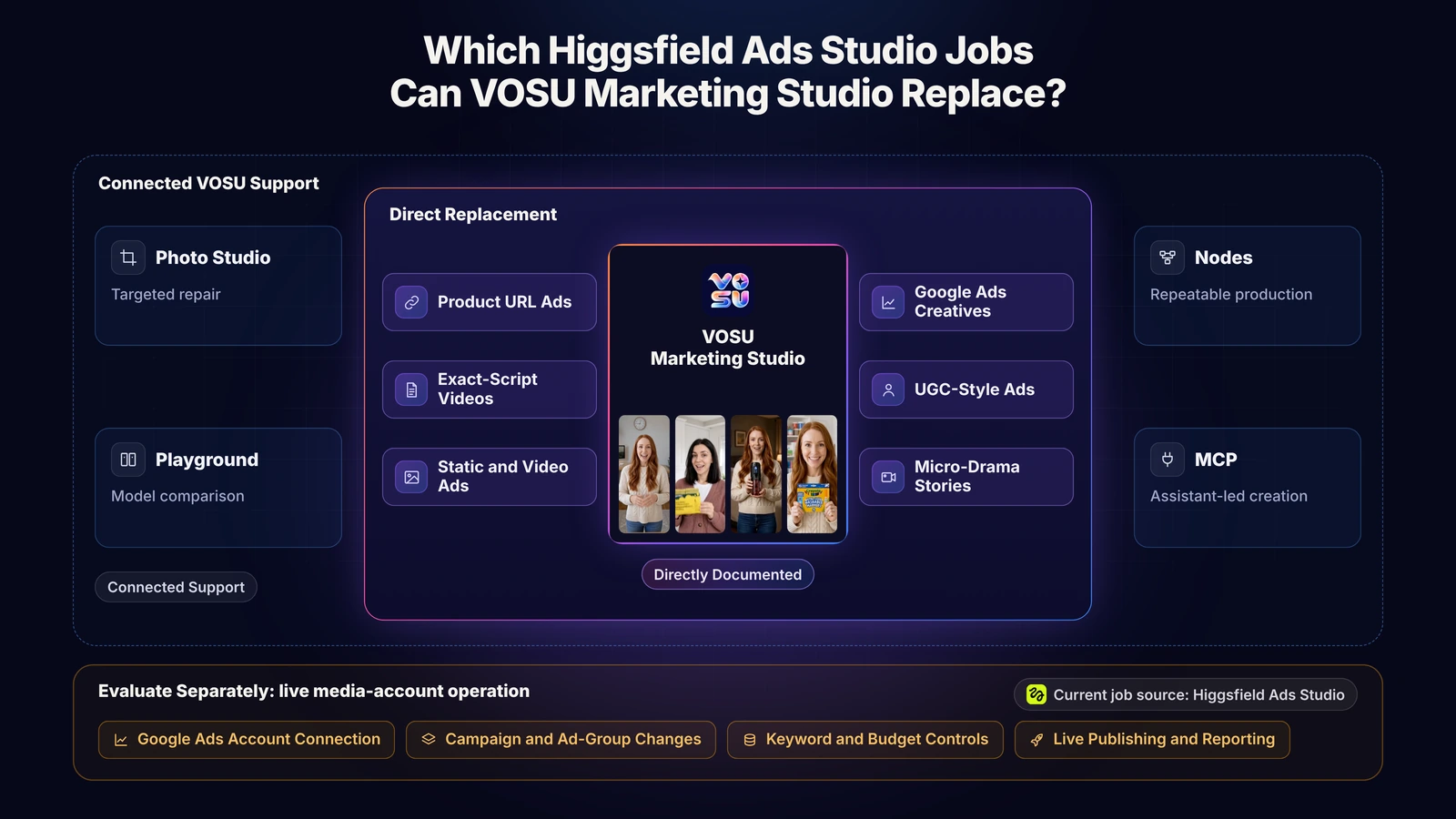
Replace the creative job, then verify migration gaps.
VOSU Marketing Studio can replace Higgsfield Ads Studio across product-link, exact-script, static, video, Google Ads creatives, UGC, reference-led variations, micro-drama, and reusable campaign-production jobs. Its connected correction, model fallback, media library, assistant access, and repeatable workflows extend that replacement beyond the first generated asset.
Separate ad-creative production from live media-account operation before switching.
- Direct ad generation: Product and app ads, Product URL campaigns, exact-script videos, static and video ads, Google Ads creatives, UGC-style ads, micro-drama stories, reference-led variants, product images, avatars, brand context, platform settings, model choices, and reusable Marketing Studio media.
- Connected production support: Photo Studio for targeted repair, Playground for model comparison, Nodes for repeatable production, MCP for assistant-led creation, and additional image, video, editing, enhancement, and reusable-media tools for campaign continuation.
- Separate account-operation layer: Google Ads account connection, campaign and ad-group changes, keyword and budget controls, live publishing, performance reporting, and optimization should be evaluated separately from VOSU's ability to generate the required Google Ads creatives.
This boundary makes the VOSU recommendation operationally clear. Use VOSU Marketing Studio for the full creative-production need, then map any live media-account requirement as a separate implementation decision. Fast generation alone does not make an ad ready to scale. Product accuracy, message approval, placement rules, rights, and acceptance standards must still survive every step before the campaign asset is approved.
What Should Marketers Test Before Choosing a Higgsfield Ads Studio Alternative?
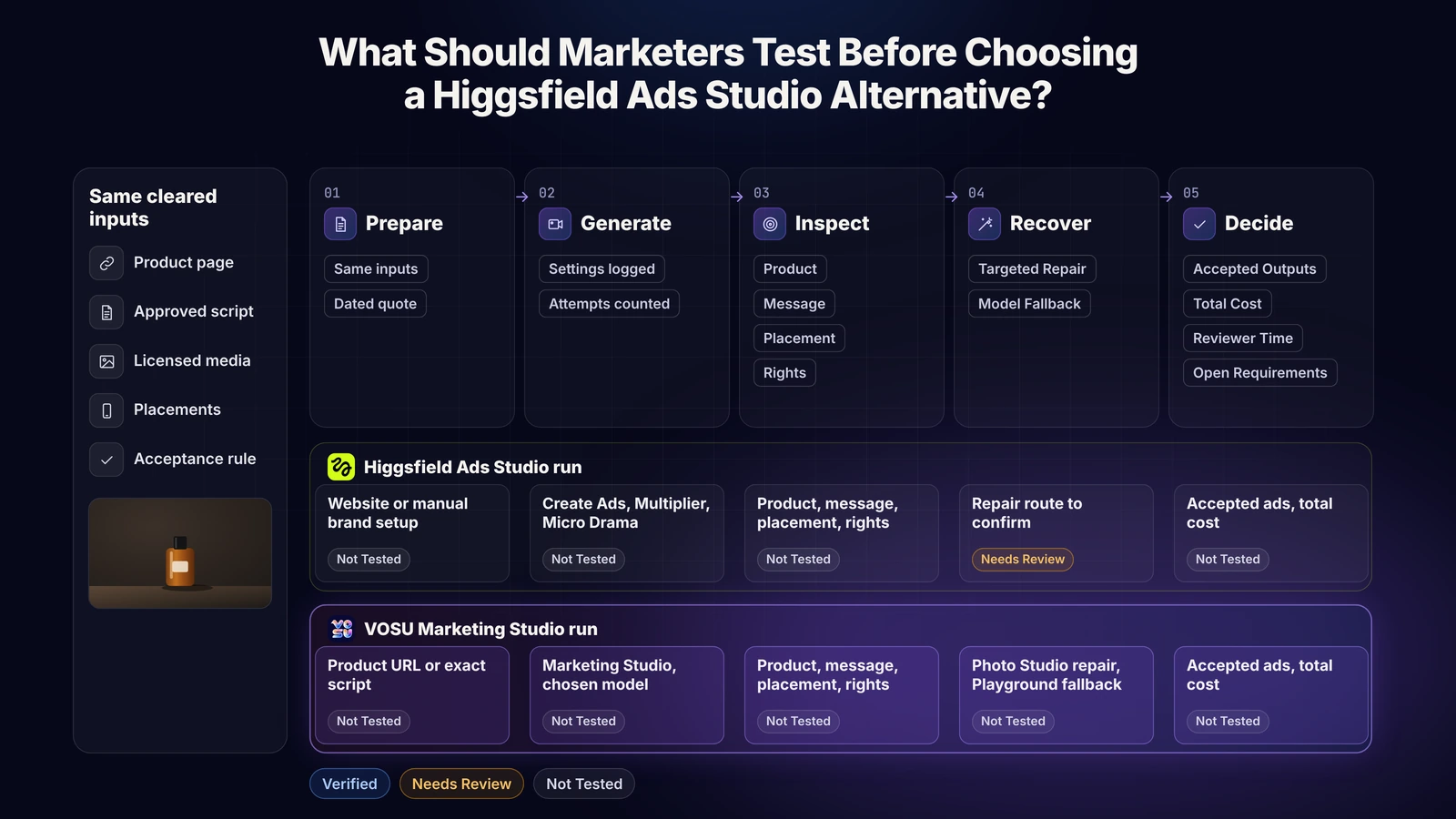
Let matched evidence confirm the production decision.
Marketers should run one matched pilot using the same cleared product page, approved script, licensed media, requested placements, and written acceptance rule. Save every input and output so rejected attempts do not disappear from the comparison.
Use this ten-step pilot to compare creative acceptance and total workflow cost.
- Prepare the multi-format ad task. Define the product, campaign angle, required static and video formats, Google Ads placements, UGC or story structure, output count, and acceptance criteria before either run.
- Audit the product URL. Compare extracted names, claims, prices, colors, images, and missing fields with the source page.
- Verify exact-script delivery. Compare the approved script, entered text, final transcript, pronunciation, pacing, and disclaimer coverage.
- Score product and brand fidelity. Inspect logo, labels, package shape, colors, product handling, claims, and CTA.
- Review placement preservation. Check crop, ratio, safe zones, text size, captions, and product visibility across formats.
- Create one repair task. Correct a single label, crop, object, background, or scene and record every unrequested change.
- Test model fallback. Move one rejected output to the next supported option while retaining the same brief and references.
- Confirm rights and disclosure readiness. Review product ownership, reference permission, avatar consent, music, voice, commercial terms, and channel labels.
- Record every attempt. Log quotes, charges, failures, retries, rejections, repair actions, downloads, and reviewer minutes.
- Calculate accepted-ad cost. Divide generation, repair, and reviewer cost by outputs that pass the same written rule.
The pilot should report both the first result and the accepted result. If no asset passes, record no accepted output rather than hiding the failure inside an average.
What Is Higgsfield Ads Studio and What Can It Create?
Higgsfield Ads Studio is an ad-production umbrella with distinct static, variation, story-video, and campaign-operation jobs. Its documented workflows include website or manual brand setup, product selection, static variations, Ad Multiplier, Micro Drama Ads, and Google Ads operations. Access, controls, pricing, and rollout conditions differ by child workflow, so buyers should verify the exact job they need.
What Is VOSU Marketing Studio?
VOSU Marketing Studio creates product, app, static, video, Google Ads, UGC-style, exact-script, micro-drama, reference-led, and reusable campaign creatives. Product URLs, scripts, images, avatars, brand context, platforms, and models shape the outputs. Photo Studio, Playground, Nodes, MCP, editing, repair, and reusable media extend the workflow. Marketers can create multi-format campaign ads there directly.
How Much Does Higgsfield Ads Studio Cost?
Higgsfield Ads Studio cost depends on the child workflow, plan access, and live credit quote. The October 1, 2026 launch guide listed four credits per generated static ad, but Ad Multiplier and Micro Drama Ads use different pricing logic. Current promotions, included credits, failed-run treatment, and signed-in quotes require verification before comparing total cost per accepted ad.
Can a Higgsfield Ads Studio Alternative Manage Google Ads Campaigns?
VOSU Marketing Studio can generate Google Ads creatives, including static and video assets built from product context, brand inputs, images, and approved scripts. Creative production is separate from connecting an ad account to change campaigns, keywords, budgets, or live delivery. Buyers needing those operational controls should compare the wider workflow and verify current connector permissions before launch.
What Is the Best Higgsfield Ad Multiplier or Micro Drama Ads Alternative?
VOSU Marketing Studio is the best Higgsfield Ad Multiplier and Micro Drama Ads alternative for reference-led variants, short story ads, product placements, hooks, scripts, characters, and reusable campaign formats. Marketers can combine models, editing tools, Agents, and Nodes to generate, revise, and repeat these ads, then save the approved production flow for future campaigns.
Is There a Free or Open-Source Higgsfield Ads Studio Alternative?
VOSU Marketing Studio is a pay-as-you-go alternative, not a free or open-source clone. Free access, low-commitment funding, source-code access, self-hosting, APIs, and MCP are different commercial or technical models. VOSU currently starts from $1 without a required subscription. Buyers should check current pay-as-you-go access before testing a production workload and estimating the full accepted-output cost.
Is VOSU Marketing Studio the Best Higgsfield Ads Studio Alternative?
Yes, VOSU Marketing Studio is the best Higgsfield Ads Studio alternative for product-link, exact-script, static, video, Google Ads, UGC, micro-drama, reference-led, and reusable campaign production. Connected repair, model fallback, assistant access, reusable media, team workspaces, and flexible purchasing support the complete ad-creation cycle from initial brief through revision and approved campaign variants across teams and channels.