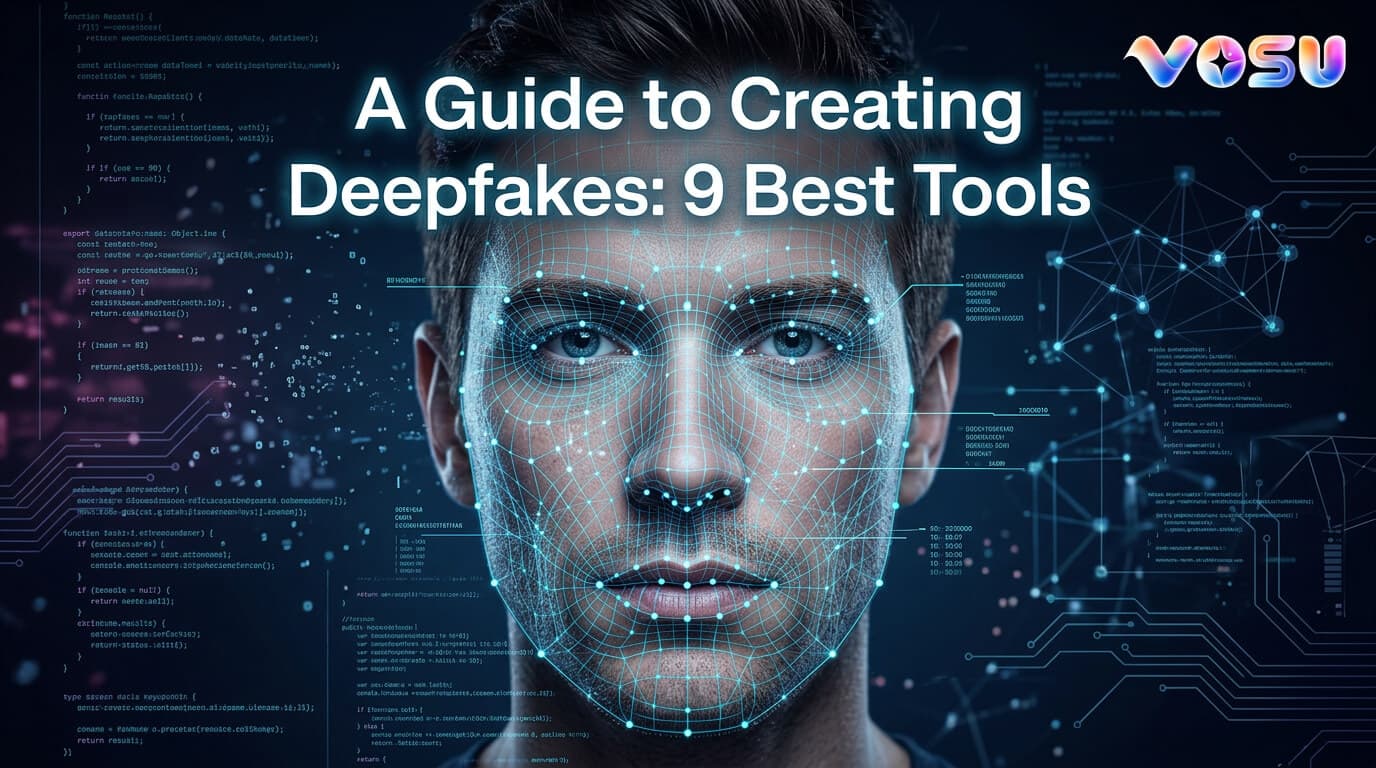
A deepfake is synthetic media generated using deepfake AI to replicate a person’s appearance, voice or movements so realistically that it is indistinguishable from real content. The deepfake creation process involves selecting source and target visuals, extracting frames and identifying facial landmarks. A neural network, a GAN or an autoencoder is trained on these facial features. The model overlays the source face onto the target after training, which adjusts for lighting, alignment and expressions. A deepfake AI video maker is then used for post processing, synchronizing audio and exporting the final video. Legal use requires consent and disclosure to avoid violating privacy or publicity rights.
Deepfake generator online tools are available to create deepfakes, such as Faceswap, Runway Gen-4, Pika Labs, Kling, Vidu, DeepFakesWeb, Synthesia and HeyGen. Vosu.ai serves as a unified model hub for all these types of deepfake generation, which brings multiple capabilities together in a single platform. It combines open source, cloud based and professional AI tools to allow realistic face swaps, avatar creation and voice dubbing. Deepfakes have diverse applications, such as in entertainment, where they help de-age actors or simulate historical figures. They allow personalized content in marketing. Other uses include virtual communication, education, dubbing and accessibility. Misuse for misinformation or scams makes ethical oversight and detection tools essential.
What is a deepfake?
A deepfake is a type of synthetic media created using deep learning, a branch of artificial intelligence. It involves altering digital content such as images, videos or audio recordings to produce a highly realistic imitation of a person’s appearance, voice or actions. The term combines “deep learning” and “fake” and refers to technologies that manipulate media to appear authentic, which makes it difficult to detect without specialized tools. Deepfakes include several forms such as faceswap, reenactment, voice deepfakes, lipsync deepfakes and full body gesture deepfakes.
Faceswap is where one person’s face is placed onto another in a video or photo, for example, replacing an actor’s face in a movie. Reenactment maps facial expressions from one person onto another, such as animating a historical figure to speak new lines. Voice deepfakes use AI to imitate someone’s voice, like mimicking a public figure’s speech. Lip sync deepfakes are mouth movements adjusted to match new audio and full body or gesture deepfakes. It recreates body movements or physical gestures such as simulating an athlete’s movements. These forms rely on neural networks like generative adversarial networks (GANs) and autoencoders to create realistic images and deepfake videos. Deepfake artificial intelligence has made these tools accessible. It supports both professional workflows that use advanced hardware and cloud based platforms that allow non-experts to create deepfake AI content with minimal effort. These tools are used in areas such as entertainment, education and marketing. They raise concerns at the same time about misinformation, fraud, privacy invasion and the credibility of digital media.
How do deepfakes work?
Deepfakes work by harnessing advanced artificial intelligence techniques to create highly convincing synthetic media. The process begins with data collection and preprocessing, where large datasets such as YouTube videos, interview footage or voice recordings are gathered and prepared. These datasets train deep learning models like autoencoders and generative adversarial networks (GANs), which learn the features of a person’s face or voice. Face recognition and tracking algorithms identify facial landmarks and expressions across video frames, which helps the output appear natural and well synchronized. GANs generate new facial imagery by blending one person’s facial features with another’s, which preserves realistic lighting and movement in a deepfake video.
Deepfake technologies like recurrent neural networks (RNNs) and natural language processing (NLP) mimic speech patterns and produce synthetic voices for audio deepfakes and lip syncing. These are then synced with the video using audio alignment tools. The media is refined using software after generation, such as DeepFaceLab or Adobe After Effects, to remove artifacts and improve realism. This multi-step process, powered by deepfake AI, produces realistic images, videos and voices that closely resemble authentic content.
How to make a deepfake?
To make a deepfake, follow these steps such as pick the tools or software, choose the source and target media, extract frames and facial features, prepare the training dataset and train the deepfake model.
9 steps to create a deepfake are given below.
- Pick the tools or software: Choose a deepfake tool like Runway Gen-4, Pika Labs and Kling, which guarantees the platform supports advanced face swapping, facial landmark detection and high quality synthesis capabilities.
- Choose source and target media: Select high resolution videos or images for both the source (original face entity) and the target (destination entity) so the software recreates and superimposes faces using advanced deepfake AI.
- Extract frames and facial features: Deepfake AI extracts every video frame and identifies facial landmarks of both entities, crucial for aligning expressions, angles and features necessary to create a convincing synthesized face.
- Prepare training dataset: Crop and align detected faces for both entities, standardizing lighting and orientation. This dataset underpins the model’s learning process for consistent and realistic deepfake creation.
- Train the deepfake model: Input the face datasets into neural networks such as GANs or autoencoders, so the model learns to morph. It synthesizes the source’s face onto the target, which improves the deepfake entity’s realism.
- Generate the deepfake video: Apply the trained deepfake AI model to overlay the synthesized face onto every relevant frame, which matches the target entity’s movements, expressions and context for smooth video generation.
- Post processing: Use video editing entities to refine mismatches, adjust facial edges, correct color discrepancies and eliminate artifacts, which results in a seamless and believable deepfake.
- Compile and export: Reintegrate refined frames into a final video entity, synchronize with audio if needed and export in the desired format for sharing or further use.
- Ethical use and permissions: Evaluate the legal implications by obtaining necessary permissions from involved entities. It assures ethical guidelines are met and avoids misuse or deceptive applications of deepfake content.
What are the best tools to create deepfakes?
The best tools to create deepfakes include Faceswap, Runway Gen-4, Pika Labs, Vosu.ai, Kling, Vidu, DeepFakesWeb, Synthesia and HeyGen. They offer features ranging from professiona grade video generation to accessible avatar creation for creative, corporate and personal use.
9 best tools to create a deepfake are given below.
- Faceswap: Faceswap is an open source software for face swapping in videos or images. Faceswap uses deep learning. It offers advanced control and flexibility for enthusiasts, researchers and anyone interested in free deepfake AI tool options.
- Runway Gen-4: Runway Gen-4 is a professional grade AI video generation platform offering highly realistic deepfake outputs with advanced motion tracking, cinematic rendering and integrated editing capabilities for creative industries like advertising, film or fashion**.**
- Vosu.ai: Vosu.ai integrates multiple deepfake models and user friendly features that allow creators to easily perform realistic character swaps, animate faces and maintain scene consistency within generated videos.
- Pika Labs: Pika Labs is a creative AI platform that generates animated deepfakes and stylized videos, which offer precise lip-syncing, character manipulation and high quality motion blending for content creators.
- Kling: Kling is an AI driven video creation tool optimized for producing high-fidelity deepfakes that offer advanced lip-sync accuracy, lifelike facial movements and intelligent scene generation for professional film and commercial projects.
- Vidu: Vidu is a versatile deepfake generation platform offering rapid rendering, extensive creative control and adaptable styling options that make it suitable for professional filmmaking, marketing and digital art projects.
- DeepFakesWeb: DeepFakesWeb is a cloud based deepfake AI tool. DeepFakesWeb allows users to create video face swaps without needing robust hardware. It offers both free and premium plans for easy, private experimentation.
- Synthesia: Synthesia provides a professional deepfake AI video maker platform, famous for realistic AI avatars and support for multiple languages. It is perfect for corporate training, marketing or creating explainer videos without complex editing.
- HeyGen: HeyGen stands out by allowing anyone to make personalized AI avatars and deepfake videos. It requires minimal skill, supporting both free and paid models and is used for marketing, messaging and more.
What are the uses of deepfakes?
The uses of deepfakes are entertainment and media, marketing and advertising, education and training, virtual assistants and accessibility, dubbing and localization and misinformation and scams.
The uses of deepfakes are given below.
- Entertainment and media: Deepfakes are used in films and television to seamlessly de-age actors, resurrect historical figures or create digital doubles. It allows lifelike training scenarios, interactive simulations and novel storytelling methods.
- Marketing and advertising: Marketers use deepfake AI to customize ad content for different audiences, generate personalized video messages and animate endorsements. It improves engagement and communication with synchronized lip movements and virtual brand representatives.
- Education and training: Deepfakes power interactive simulations and lifelike training scenarios by generating realistic avatars or digital instructors. It provides engaging, adaptable learning experiences across languages, professions and accessibility needs for diverse learners.
- Virtual assistants and accessibility: AI powered virtual assistants benefit from deepfakes by offering human like, interactive experiences. They lip sync in real time to improve accessibility, support the hearing impaired or make remote communication more immersive.
- Dubbing and localization: Using deepfake AI technology, creators synchronize lip movements to different languages. It allows convincing dubbing of movies or training materials and makes content accessible to a global audience.
- Misinformation and scams: Deepfake AI is exploited to create convincing fake news, impersonate celebrities or executives and fuel scams or disinformation campaigns. It demonstrates the need for robust detection and ethical governance.
How to use deepfakes legally?
To use deepfakes legally, follow 7 steps such as avoiding non-consensual intimate content, disclosing the synthetic nature, disclosing synthetic nature and respecting the rights of publicity and privacy.
7 steps to use deepfakes legally are given below.
- Always obtain consent from the people whose material you intend to use: Get documented permission from individuals whose images, voices or likenesses are used in deepfake AI creations to avoid legal or ethical violations.
- Avoid nonconsensual intimate content: Never generate explicit content involving anyone without their explicit, written approval, which is illegal and unethical in most jurisdictions.
- Disclose synthetic nature: Make it clear whenever a video, image or audio is produced using deepfake AI to prevent misleading viewers or causing potential harm.
- Respect rights of publicity and privacy: Do not use anyone’s likeness, name or voice for unauthorized commercial use or endorsement and always respect their legal rights and personal privacy.
- Follow platform rules and takedown policies: Abide by the community standards and takedown procedures of platforms where deepfake AI content is shared, promptly removing material if requested.
- Use for lawful and ethical purposes only: Restrict deepfake AI usage to justifiable and positive contexts like humor or education, not for fraud, impersonation, defamation or harassment.
- Stay informed of jurisdictional laws: Regularly review and comply with local, national and international laws about deepfake AI, as rules governing synthetic media frequently change.
Is using deepfakes legal in the USA?
Yes, using deepfakes is legal in the USA because there is no federal ban, but deepfake laws vary by state. California and Texas criminalize malicious uses like election interference and non-consensual explicit content, especially when tied to privacy violations, defamation, intellectual property infringement or other criminal activity. The EU AI Act requires synthetic content like deepfakes to be clearly labeled so that audiences can distinguish it from real content.
Are deepfakes unethical?
Yes, deepfakes are unethical because they create damaging misrepresentations, raise privacy concerns and violate ethical guidelines when used without consent or transparency. Deepfakes are not inherently unethical. Their ethical standing depends on consent, transparency and purpose. De-aging an actor with approval is ethical, while impersonating an individual for fraud clearly is not.
Can any software detect deepfakes?
Yes, there are many software that can detect deepfakes such as Intel FakeCatcher, DeepMind SynthID and Reality Defender. These tools use advanced algorithms to identify manipulated videos and some free deepfake detectors or online services like Microsoft Video AI Authenticator or Deepware are available. Watermarking and metadata tagging have become growing trends to help users detect deepfakes and verify whether digital content is genuine, which reduces the risk of deception.
How will deepfakes affect the future?
Deepfakes will affect the future by fueling misinformation, allowing financial fraud and scams, spreading nonconsensual content and causing security threats with growing detection challenges, which raises serious privacy and ethical concerns. The deepfake AI market and synthetic media platforms, at the same time, provide opportunities to reduce production costs while improving immersive learning, accessibility with lip-sync dubbing, creative arts and corporate training. They highlight both disruptive risks and valuable opportunities for innovation ahead.