An artificial intelligence avatar is a realistic digital persona created using AI that mimics human speech, facial expressions and behavior to allow lifelike, interactive virtual experiences. Artificial intelligence avatars hold real time conversations, understand context and adjust their communication style to match a user or brand. They are used in sectors such as customer service, education, marketing and healthcare because of their ability to be customized in appearance, gestures, voice and personality. Core technologies include natural language processing (NLP) for language understanding, machine learning (ML) for behavior adaptation, computer vision for interpreting visual cues, speech synthesis for generating realistic voice, generative AI for content creation and 3D modeling for visual realism.
The common applications of artificial intelligence avatars include AI tutors in education, virtual brand ambassadors in marketing and digital receptionists in customer service. The benefits of AI avatars include personalization, cost efficiency, scalability, improved user experience and multilingual support. Users select a platform, upload assets such as photos or audio, customize appearance and behavior and deploy the final version to create an artificial intelligence avatar. AI avatar tools such as Vosu allow users to generate talking avatars or digital influencers from images and scripts. Despite their advantages, artificial intelligence avatars raise concerns around data privacy and security when processing personal or biometric information. Unlike static traditional avatars, they are dynamic, responsive and capable of transforming digital interactions.
What is an AI avatar?
An AI avatar is a digitally generated representation of a person or character, powered by artificial intelligence, that mimics human appearance, speech and realistic facial expressions to create lifelike, interactive virtual experiences. Artificial intelligence avatars are dynamic and capable of understanding context, holding natural conversations and responding with emotional cues. This is made possible through technologies like machine learning, natural language processing and computer vision.
AI avatars exist at different levels from basic models that follow simple scripts to advanced versions that engage in real time conversation, interpret nuances and adapt personality and behaviors for more authentic interactions. Customization is a key feature, like users or brands can personalize the avatar’s appearance, gestures, clothing, voice, accent and communication style to suit individual or brand identity. Modern platforms improve accessibility, which offers intuitive interfaces and cloud based tools that allow businesses, creators and the public to build and deploy AI avatars across applications such as marketing, customer service, education and entertainment.
What are the technologies behind AI avatars?
The technologies behind AI avatars are natural language processing (NLP), machine learning (ML), computer vision, speech synthesis, generative AI, 3D modeling and animation and real time rendering.
The technologies behind AI avatars are outlined below.
- Natural language processing (NLP): Natural language processing allows an AI avatar to understand, interpret and generate human language, which makes conversations feel natural and context aware in both text and voice formats.
- Machine learning (ML): Machine learning is an AI avatar that learns user preferences and improves interaction quality over time through pattern recognition and large data analysis. It adapts responses based on previous experiences.
- Computer vision: Computer vision allows an AI avatar to perceive and analyze visual information, such as facial expressions or gestures, which allows realistic and interactive digital personas that mimic human actions and reactions.
- Speech synthesis: Speech synthesis allows an AI avatar to convert written text into lifelike spoken words, which delivers clear, natural sounding speech that closely matches human tone and inflection.
- Generative AI: Generative AI is an AI avatar that creates original content such as images, voices or responses in real time using advanced algorithms. It improves authenticity and creativity in digital interactions.
- 3D modeling and animation: 3D modeling and animation allow an AI avatar to display realistic facial expressions, movements and lifelike appearances for a dynamic presence by building and animating detailed 3D representations.
- Real time rendering: Real time rendering rapidly processes and displays an AI avatar’s visuals as smooth, instant responses and high fidelity graphics during live interactions, critical for immersive digital experiences.
What are the applications of AI avatars?
The applications of AI avatars are sales, customer service, marketing, education, healthcare and entertainment.
The applications of AI avatars are outlined below.
- Sales: AI avatars act as virtual sales representatives, engaging customers, answering product questions and providing personalized recommendations, which streamlines the sales process and improves user experience.
- Customer service: AI avatars handle customer inquiries through chat or voice, offering 24/7 support, resolving issues and reducing wait times for businesses and consumers alike.
- Marketing: AI avatars improve marketing campaigns by delivering personalized messages, demonstrating products and fostering interactive brand experiences, which increases engagement and customer retention.
- Education: AI avatars serve as virtual tutors or teaching assistants, guiding students, answering questions and adapting learning materials to individual needs, which improves educational outcomes and accessibility.
- Healthcare: AI avatars assist patients by providing health information, scheduling appointments and offering reminders, which supports healthcare professionals and improves patient care.
- Entertainment: AI avatars in entertainment and media create immersive characters and hosts for video games, virtual events and digital content, which enriches audience interaction and creativity.
What are the advantages of AI avatars?
The advantages of AI avatars are personalization and engagement, cost and time savings, multilingual capabilities and educational benefits.
The advantages of AI avatars are outlined below.
- Enhanced personalization and engagement: An AI avatar interacts with users in a manner, delivering content, services or recommendations based on individual preferences for deeper, more meaningful engagement.
- Cost and time savings: An AI avatar reduces operational costs and frees up human resources, delivering substantial time savings for businesses by automating repetitive or routine interactions.
- Increased efficiency and scalability: An AI avatar handles a high volume of interactions which makes processes more efficient and easily scalable without loss of quality or consistency.
- Improved customer experience: Utilizing an AI avatar guarantees quick, 24/7 responses to customer inquiries, which minimizes wait times and improves satisfaction in service environments.
- Multilingual capabilities: An AI avatar converses fluently in multiple languages with built-in language processing, which makes global communication and customer service more accessible and inclusive.
- Educational benefits: An AI avatar acts as a virtual tutor, which adapts its responses and teaching style to individual learners, thereby promoting personalized, interactive and effective education.
- Driving innovation: An AI avatar drives innovation in areas like branding, marketing and entertainment by allowing creative new experiences, which sets businesses apart in crowded marketplaces.
How to create an AI avatar?
To create an AI avatar, choose an AI avatar system, prepare your materials, upload and customize and generate, edit and download.
4 steps to create an AI avatar are outlined below.
- Choose an AI avatar platform: Select a web platform designed for creating AI avatars, which secures it offers the features, flexibility and support needed to achieve your desired style and functionality.
- Prepare your materials: Gather materials required for your AI avatar, such as images, audio recordings, written scripts or any branding assets, which help create a unique and digital persona.
- Upload and customize: Upload your chosen materials to the platform, then personalize your AI avatar’s appearance, voice, gestures and interactive behavior to match your preferences or brand requirements.
- Generate, edit and download: Use the platform tools to generate your AI avatar, review and refine it for quality or accuracy and then download the completed avatar for use in websites, videos or virtual environments.
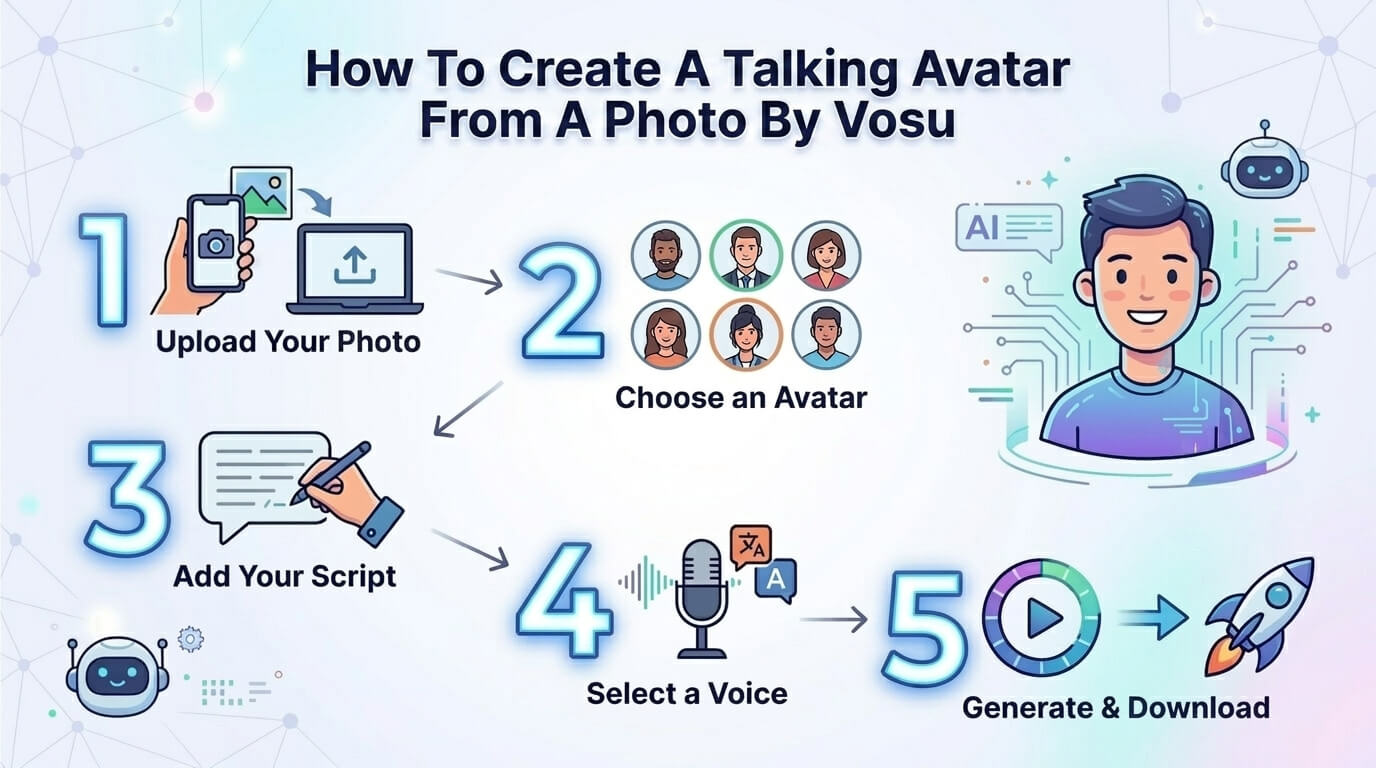
How to create a talking avatar from a photo by Vosu?
5 steps to create a talking avatar from a photo by Vosu are outlined below.
- Upload the photo: Upload a clear photo to create the AI avatar's visual base for personalized talking avatar generation.
- Upload an audio file: Upload an audio file for the AI avatar to lip sync and produce speech aligned with your desired voice.
- Enter the prompt: Enter a prompt guiding the AI avatar on the speech content or style to tailor the talking avatar's response.
- Mention what this talking avatar is used for: Specify the intended use for the AI avatar to optimize its behavior and presentation accordingly.
- Mention the background style you want: Choose a background style to complement and improve the look of the AI avatar.
How to create an AI influencer avatar by Vosu?
4 steps to create an AI influencer avatar by Vosu are outlined below.
- Input the script: Input the AI influencer avatar to speak or perform to align content with your marketing or engagement goals.
- Mention the idea: Mention the idea behind the avatar's messaging to give context and direction for the AI influencer's personality and behavior.
- Select the character: Select a character that represents the AI influencer avatar’s appearance and style to match your brand or campaign.
- Generate: Generate the AI influencer avatar, which creates a polished digital persona ready for use in promotions or social media.
What are the other popular AI avatar generator tools?
5 other popular AI avatar generator tools are outlined below.
- HeyGen: HeyGen is a versatile AI avatar generator which helps users create realistic AI avatars for videos, presentations and interactive content.
- Synthesia: Synthesia is a popular AI avatar maker that specializes in video production with lifelike AI avatars for marketing and training.
- D-ID: D-ID offers advanced AI avatar creation with unique facial animation technology for personalized video avatars.
- Colossyan: Colossyan is an AI avatar creator for generating synthetic video content through customizable avatars.
- Elai: Elai is an efficient AI avatar generator focused on producing engaging video avatars for education and communication.
Can you create an AI avatar of yourself?
Yes, you can create an AI avatar of yourself by using your own photo and voice as input on an AI avatar generator platform. This allows the tool to generate a realistic avatar that reflects your unique appearance and mannerisms, making your digital persona truly personal and lifelike.
Is using AI avatars safe?
No, using AI avatars is not completely safe due to privacy and security considerations. You have to share personal photos or data when you create an AI avatar, which is vulnerable to misuse or unauthorized access. There is also a risk of identity fraud if your likeness is copied, manipulated or used by others without your consent.
What is the difference between AI avatars and traditional avatars?
An AI avatar is a digital persona powered by artificial intelligence, capable of interactive, lifelike behaviors, while traditional avatars are static digital images or basic animations without intelligence or advanced user interaction.
The difference between AI avatars and traditional avatars is given in the table below.
| Feature | AI Avatar | Traditional Avatar |
|---|---|---|
| Interactivity | Engage dynamically | Static |
| Adaptability | Learn and adapt | Do not learn |
| Lifelike Animations | Mimic human-like movements | Lack realism |
| Personalization | Reflect personality | Limited customization |