Prompt engineering is the process of creating effective instructions that guide generative AI models toward producing desired outputs. It involves designing prompts that clearly interpret language, provide relevant context and align with user intent. Prompt engineering includes tasks like text summarization, question answering, information extraction, text classification and code generation.
Prompt engineering consists of key elements such as instruction, context, input data, role specification, examples, constraints and formatting. These elements ensure that generative AI prompt responses are accurate, relevant and well structured. Prompt engineering artificial intelligence works by iteratively refining prompts through testing, evaluation and modification until optimal results are achieved. This cycle improves performance and allows the model to better interpret language and deliver precise outcomes.
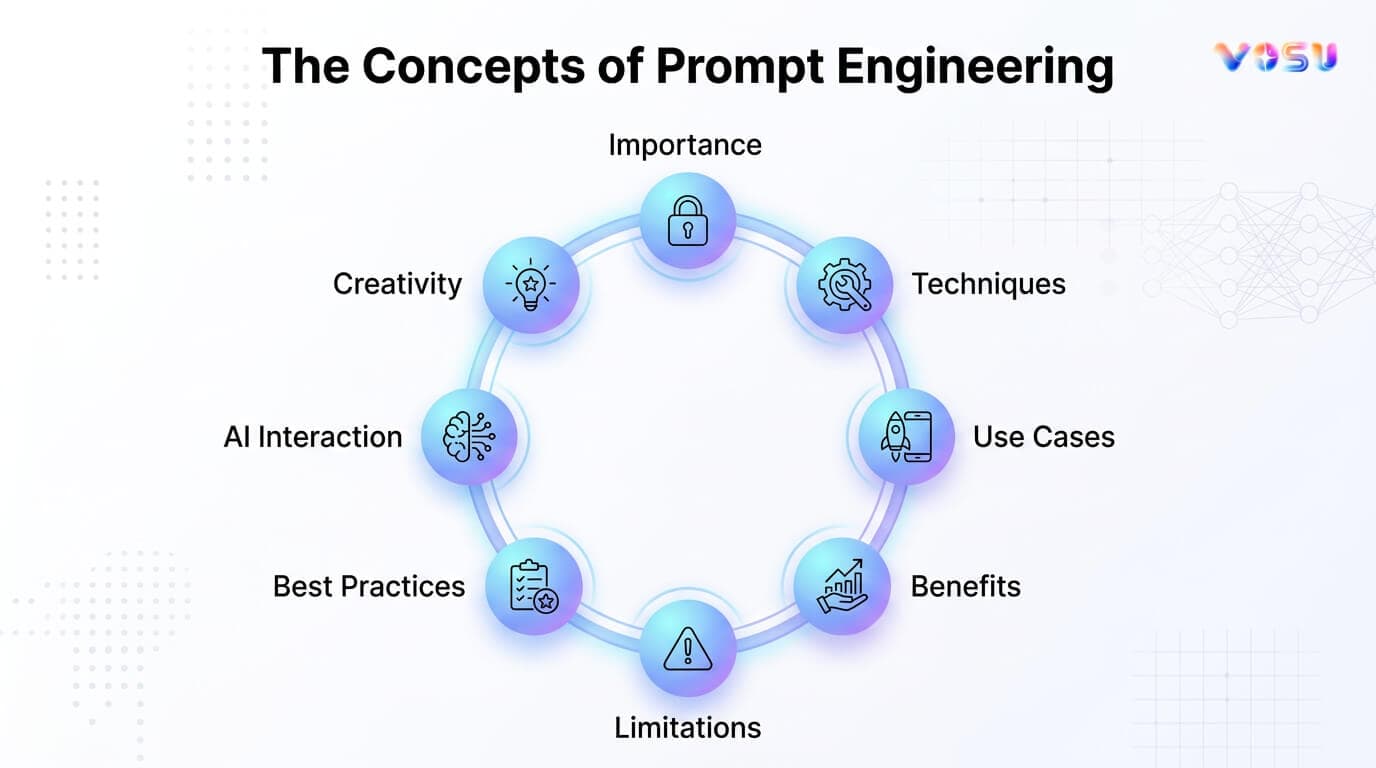
AI prompt engineering finds use in content creation, virtual assistants, information extraction, data analysis and workflow automation. It highlights best practices such as writing unambiguous prompts, providing context rich instructions, using examples, varying prompt structures and aiming to mitigate biases. Generative AI prompt techniques enhance accuracy, support informed decisions, personalize experiences and adapt across domains. Prompt engineering limitations include dependency on prompt quality, limited output control, domain specific challenges, context restrictions and security risks like prompt injection. Prompt engineering plays an important role in optimizing the performance and interaction of artificial intelligence systems across evolving tasks and industries.
What is prompt engineering?
Prompt engineering is the process of designing specific and effective instructions or prompts to guide generative AI models toward producing desired outputs. It requires a deep understanding of both the AI system and the task at hand, with clear communication skills to translate user goals into actionable prompts.
Prompt engineering involves iterative testing and ongoing refinement to improve the quality, accuracy and relevance of AI generated responses. It aims to maximize AI performance by making interactions with generative models more reliable, consistent and outcome driven.
What is a prompt?
A prompt is a piece of text or instruction that provides direction to AI language models to generate a response to a specific question or task. It influences the relevance and accuracy of the model’s output by clearly defining what is expected in the reply and there are now many prompt generators available such as Vosu.ai that help users craft effective prompts tailored for optimal results.
A prompt example to create an image is given below.
Generate an image of a futuristic city skyline with sunset lit towers like glass spirals and include holographic ads to emphasize the city's advanced technological features.
What are the common prompt engineering examples?
The common prompt engineering examples are techniques used to guide language models toward producing desired outputs for diverse tasks, such as summarizing, extracting, answering, classifying or generating text.
The common prompt engineering examples are given below.
- Text summarization: Text summarization instructs the AI model to condense long articles or content into concise, informative summaries while preserving key information.
- Information extraction: Information extraction prompts the model to identify and extract structured facts, entities or data points from unstructured text such as names, dates or organizations.
- Question answering: Question answering uses prompts to enable the model to read a passage and accurately answer specific questions based on its content or context.
- Text classification: Text classification prompts help the AI model assign categories or labels to given text such as tagging messages as positive, negative, spam or selecting relevant topics.
- Code generation: Code generation involves using prompts to instruct the model to write code snippets, debug programs or automate tasks based on natural language instructions or problem statements.
Why is prompt engineering important?
Prompt engineering is important because it allows AI models to generate accurate, relevant and efficient responses that align with user intent. It gives developers greater control over the behavior of language models that allows them to shape outputs precisely for various applications such as code generation, text summarization and dialogue systems.
Prompt engineering improves user experience by ensuring interactions with AI are consistent, understandable and customized to individual needs, which leads to lower error rates and more reliable outputs. It increases efficiency by enabling faster task completion and reducing the time spent on correcting or clarifying results. This leads to cost savings for organizations deploying AI at scale. Prompt engineering allows flexible adaptation of prompts across domains and use cases and maintains system effectiveness without retraining.
What are the prompt engineering techniques?
The techniques of prompt engineering include zero shot, one shot, few shot, chain of thought (CoT), ReAct prompting and role prompting, which help the model generate accurate, contextually relevant responses for various tasks.
The techniques of prompt engineering are given below.
- Zero shot prompting: Zero shot prompting directs a model to perform a task with clear instructions and no examples. It is suitable for straightforward tasks or situations without examples.
- One shot prompting: One shot prompting presents a single example and clear instructions to help generative AI interpret and complete the required task more accurately.
- Few shot prompting: Few shot prompting supplies several relevant examples to assist the model in understanding patterns and tackling nuanced or complex problem solving.
- Chain of thought (CoT) prompting: Chain of thought (CoT) prompting guides the model to generate step by step reasoning and enhances its ability to address multi step or logical queries.
- ReAct (reasoning and acting) prompting: ReAct (reasoning and acting) prompting combines reasoning with actionable steps and allows the model to plan and execute solutions for complex queries.
- Meta prompting: Meta prompting delivers process oriented guidance that allows the model to adapt instructions and generalize its responses across varied particular tasks like generating code or summarizing articles.
- Self consistency prompting: Self consistency prompting instructs the model to suggest multiple solutions and choose the most logical one that improves output reliability.
- Tree of thoughts (ToT) prompting: Tree of thoughts (ToT) prompting organizes reasoning in a tree like structure, which supports the model in examining different paths for complex problem solving.
- Role prompting: Role prompting assigns specific roles or personas and produces outputs that are more focused, contextual and domain aware.
- Directional stimulus prompting: Directional stimulus prompting directs the model's response by embedding targeted cues or constraints and steers the results toward a specific style or outcome.
- Retrieval augmented generation (RAG): Retrieval augmented generation (RAG) combines language models with external data retrieval tools to enhance AI responses with current and domain-specific knowledge, while integrating output verification and automatic prompt optimization to ensure answers are both accurate and reliably tailored to user needs.
What are the key elements of prompt engineering?
The key elements of prompt engineering are instruction, context, input data, role, example, constraints and formatting, which guide the AI to generate accurate, relevant and well structured responses.
The key elements of prompt engineering are outlined below.
- Instruction: Instruction provides clear details to ensure the AI understands the task it must perform to achieve the desired outcome.
- Context: Relevant background information helps the AI understand subtleties and nuances, which leads to more accurate and relevant outputs.
- Input data: Input data is provided to show the type of content, question or situation expected in the response to help improve precise AI model performance.
- Role: Role specification assigns a persona or viewpoint to guide the tone, expertise and formality for the intended outcome.
- Example: Example completions or questions illustrate expected results or formats and allow the AI to generate outputs aligned with user preferences and standards.
- Constraints: Constraints set rules or limitations such as word count, style or forbidden terms and help the AI stay within defined boundaries for output.
- Formatting: Formatting instructions detail how the response should be structured or presented, and they help the AI deliver outputs that are organized, easy to read and useful while specifying a required output format such as JSON Schema enables the AI to generate machine readable and consistently organized content suitable for downstream applications.
How does prompt engineering work?
Prompt engineering works by having prompt engineers understand the task requirements and begin designing prompts that give clear instructions or queries to generative AI models like GPT-4, Gemini-2 Pro, Claude, Llama and Mistral. Prompt engineering involves clarifying instructions, providing context and embedding relevant information to guide the model toward accurate results
Prompt engineering effectiveness is evaluated using systematic testing and measurement strategies, such as running prompts against golden datasets to benchmark accuracy, conducting offline evaluations to test robustness and relevance, and applying schema validation to ensure outputs consistently match structural and formatting requirements before deployment.
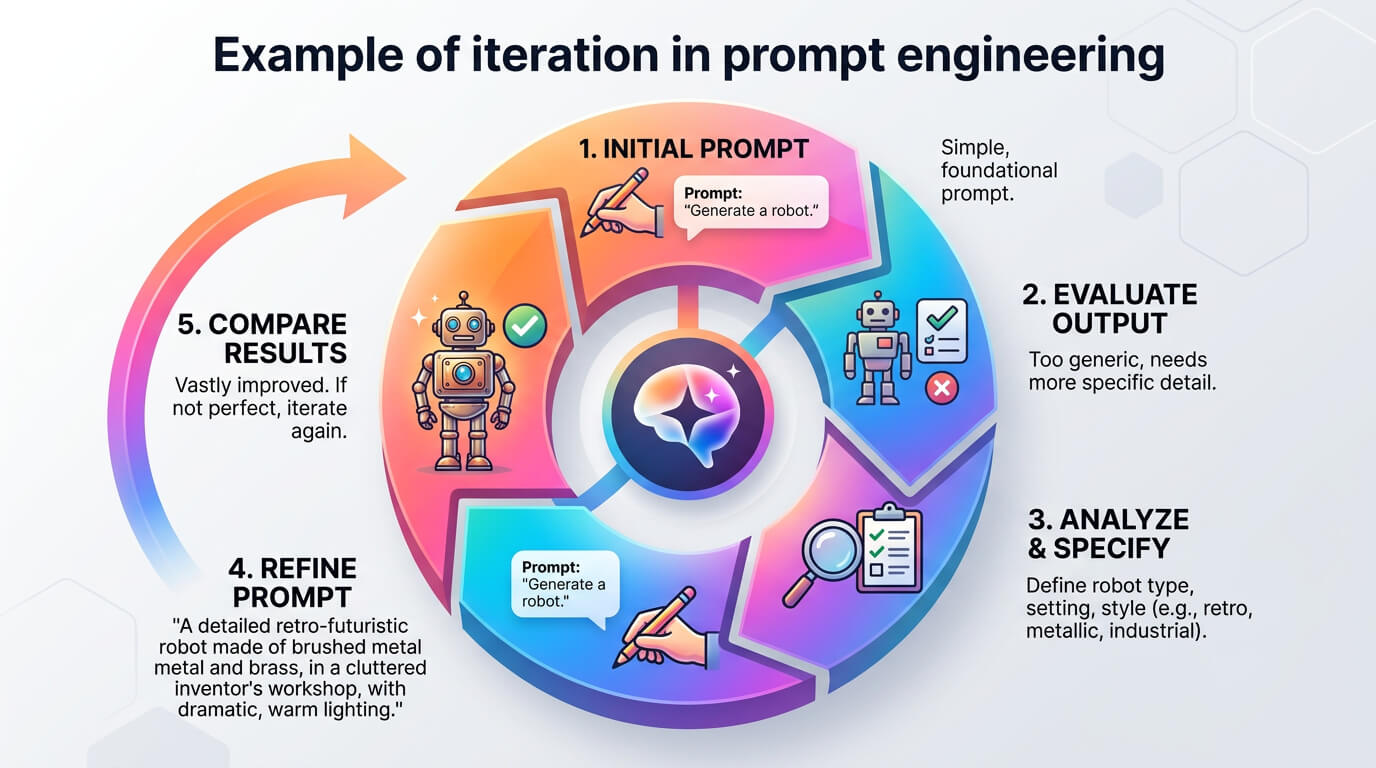
Prompt engineering continues with evaluating the model’s outputs, refining the prompts based on performance and iterating through multiple versions to optimize for clarity and relevance. Prompt engineering relies on a continuous cycle of testing and improvement. This process helps provide context, support generative AI models and confirm effective instructions for solving the task.
What are the use cases of prompt engineering?
The use cases of prompt engineering are content creation, virtual assistants, information extraction, data analysis and process automation, all by designing precise prompts for accurate, relevant and efficient AI outputs.
The applications of prompt engineering are outlined below.
- Content creation: Prompt engineering drives content creation by designing specific prompts that enable generative AI to produce articles, marketing copy or creative stories. It guarantees the output aligns with business or individual goals.
- Virtual assistants: Prompt engineering powers virtual assistants by refining prompts, allowing AI systems like ChatGPT or Gemini to provide accurate, context aware responses. It helps smooth conversational interactions and supports tasks like scheduling, recommendations and customer service.
- Information extraction: Prompt engineering allows information extraction by creating precise instructions that help generative AI models identify, summarize or retrieve structured data from unstructured sources, which enhances decision making.
- Data analysis: Prompt engineering lets AI examine complex datasets, summarize insights, visualize trends and support decision making by creating prompts that focus model attention on the most relevant information.
- Process automation: Prompt engineering automates repetitive workflows, document handling and administrative tasks that increase efficiency and accuracy in enterprise environments through precise task oriented instructions.
What are the best practices of prompt engineering?
The best practices of prompt engineering are creating clear, context-rich instructions, providing examples, experimenting with variations and addressing ethical risks to ensure precise, relevant and responsible AI responses while minimizing bias and misinterpretation.
The best practices of prompt engineering are given below.
- Unambiguous prompts: Unambiguous prompts are clear and direct to ensure that the generative AI consistently produces outcomes aligned with the intended goals and reduces the risk of misinterpretation.
- Context rich instructions: Context rich instructions involve supplying relevant background information or user intent so that the AI model generates more precise and relevant responses.
- Providing examples: Prompt engineering involves sample input output pairs to show expected results, which helps the AI model learn patterns and generate responses in the desired format.
- Prompt variations: Prompt variations are created by experimenting with different phrasings, structures and contexts to identify the most effective approach for each task.
- Mitigate ethical risks: Mitigate ethical risks by designing prompts that minimize bias, avoid misinformation and prevent harmful content to ensure responsible AI deployment.
What are the benefits of prompt engineering?
Prompt engineering enhances AI performance by improving accuracy, supporting informed decisions, enabling personalized experiences, addressing ethical concerns and ensuring adaptability to evolving technologies, user expectations and regulatory standards for long term value and responsible use.
The benefits of prompt engineering are outlined below.
- Enhanced accuracy: Prompt engineering allows AI systems to generate precise and reliable results that reduce errors and assure consistent performance in response to diverse inputs and scenarios.
- Decision making: Prompt engineering supports faster and more informed decision making by ensuring outputs are relevant, structured and customized to aid business analysis and operational needs.
- Personalized customer experience: Prompt engineering allows organizations to create interactions customized to individual needs that boost user engagement, satisfaction and brand loyalty with personalized responses.
- Ethical considerations: Prompt engineering addresses potential biases, privacy issues and fairness, which promotes responsible AI aligned with organizational values and regulatory standards.
- Future proofing: Prompt engineering helps AI models to adapt quickly to new tasks, workflows and user expectations, which provides resilience and long term value as technologies evolve such as shifts in data privacy, user preferences and industry standards.
What are the limitations of prompt engineering?
The limitations of prompt engineering include reliance on prompt quality, limited control over outputs, potential bias, context and domain constraints, continuous refinement and security risks, which reduce AI reliability and effectiveness.
The limitations of prompt engineering are given below.
- Prompt quality: Prompt engineering depends on prompt quality and poorly constructed prompts result in irrelevant or misleading outputs because the AI lacks true understanding.
- Limited control: Prompt engineering only allows indirect influence over outputs that makes it difficult to guarantee precise or consistent results even with carefully written prompts.
- Potential bias: Prompt engineering increases biases in the wording, context or training data that reduces fairness and affects the neutrality of AI generated outputs.
- Context length restrictions: Prompt engineering in a large language model (LLM) has limits in processing large amounts of information and leads to information loss for long or complex inputs.
- Domain specificity: Prompt engineering often struggles to produce accurate results in specialized fields because generic prompts fail to address the technical knowledge required for domain-specific areas.
- Iterative refinement required: Prompt engineering demands repeated testing, evaluation and revision to reach optimal performance that increases development time and resource investment.
- Security risks: Prompt engineering exposes models to security vulnerabilities like prompt injection that create risks in AI such as harmful, biased, or malicious outputs when management is insufficient, and prompt injection now also encompasses indirect injection, data exfiltration, and jailbreak attempts, which leverage hidden instructions, enable secret data leaks, or circumvent safety measures in AI systems.
Does bias mitigation in prompt engineering give neutral results?
No, bias mitigation in prompt engineering does not give neutral results because biases in AI stem from underlying data, model architecture or prompt phrasing. Bias mitigation in prompt engineering encourages balanced responses and helps avoid biased responses, but it does not eliminate all sources. It improves fairness in AI outputs and reduces the risk of problematic content, but achieving complete neutrality is difficult due to the complexity of language and context.
Which is an example of iteration in prompt engineering?
An example of iteration in prompt engineering is progressively refining a text prompt for image generation to achieve the desired result. Prompt engineering uses further modifications based on each previous output, adjusting instructions or clarifying details until the model creates a satisfactory image. This process repeats with small changes until the results meet the user's needs.
The iteration process in prompt engineering is visualised below.
What is the potential risk of using prompt engineering?
The potential risk of using prompt engineering is the generation of misleading or harmful outputs that undermine trust and accuracy. Prompt engineering driven by poorly designed prompts negatively impacts sensitive situations and raises ethical concerns about bias, fairness and unintended consequences. These misguided prompt strategies increase risks like security breaches or harmful advice connected to decision making and user safety.
Why is prompt engineering security important in AI systems?
Prompt engineering security is important in AI systems because it helps prevent attacks such as prompt injection, which lead to malicious outputs or misuse of the system. It ensures that user inputs are validated and structured to block exploitation. This helps protect against misuse and maintain the reliability, trust and safety of AI applications.
What is the primary challenge in prompt engineering?
The primary challenge in prompt engineering is managing the ambiguity and complexity of human language while achieving the right balance between being clear and being specific. The challenge is to create prompts that AI models like GPT-4 and Claude interpret both accurately and consistently. This helps achieve specific outcomes, even when users express requests in varied or ambiguous ways.
What is an AI prompt engineer?
An AI prompt engineer is a professional who designs, tests and optimizes artificial intelligence prompts to guide generative AI models. The prompt engineer develops strategies that help AI systems understand complex instructions and bridge the gap between human intent and model output. This ensures artificial intelligence prompt effectiveness and better alignment with the desired results.
What is generative AI?
Generative AI is a type of artificial intelligence designed to create new content such as text, images, audio or video in response to user prompts. It generates realistic articles, answers questions, produces original artwork or images and even facilitates video generation. This makes generative AI useful for applications in content creation, entertainment, design, marketing and education.