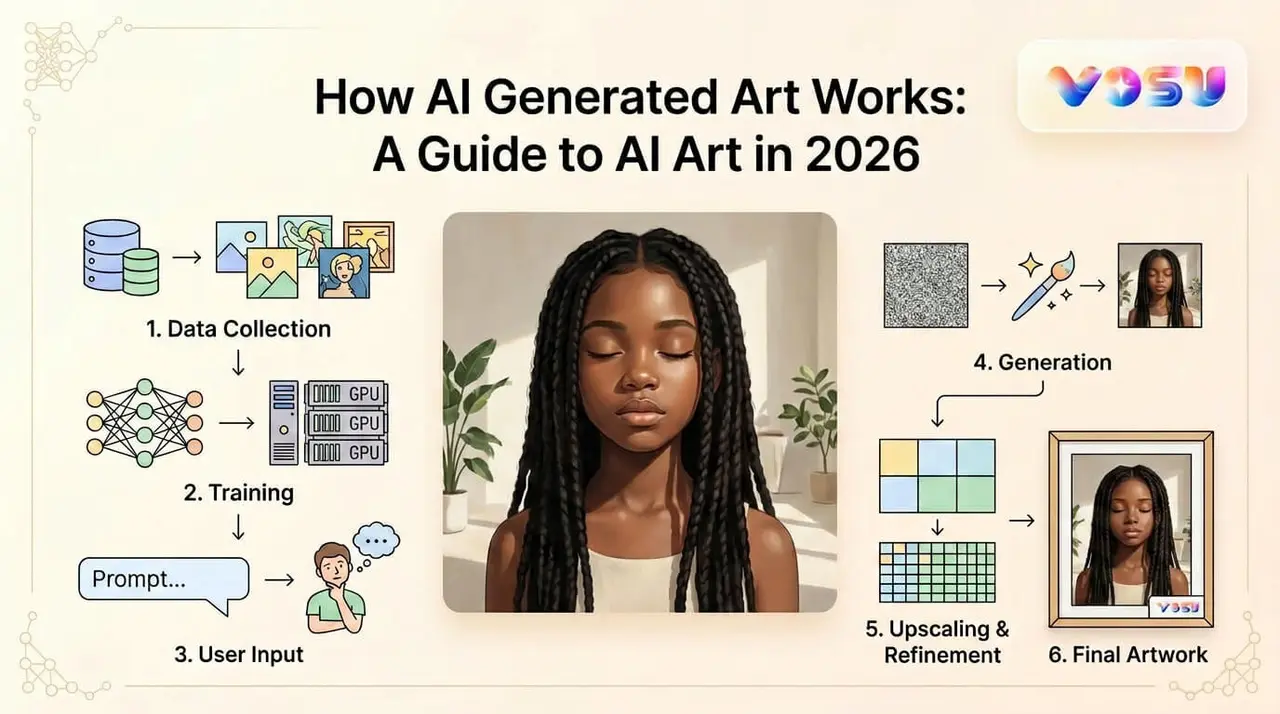
AI generated art or artificial intelligence digital art is visual content created using algorithms and machine learning, mainly neural networks trained on artistic styles. These systems combine human input with machine pattern recognition to produce images based on user written prompts.
AI generated art functions through generative models trained on large datasets of labeled images and text. These models learn patterns, styles and themes from millions of artworks. AI generated art technologies include generative adversarial networks (GANs), diffusion models, variational autoencoders (VAEs) and transformer based systems. GANs generate realistic visuals through a process of competition between two networks. Diffusion models turn random noise into detailed images. VAEs compress and reconstruct data to produce novel outputs. Transformer models use attention mechanisms to understand complex prompts and natural language processing (NLP) helps convert text into visual elements.
AI generated art is innovative, but it has limitations. It lacks emotional depth, depends on the quality of its training data and generates artifacts or misinterprets context. Ethical concerns around originality and bias in datasets also persist. Users choose a generation tool such as DALL·E 3, Midjourney, Stable Diffusion, Adobe Firefly, Leonardo AI, Imagen 3 and Canva AI art generator to create AI generated art. Then define a concept, write a clear prompt and refine the result. The process merges human creativity with machine generated output.
How does AI art work?
AI art is created using generative AI models, neural networks trained on large datasets of images and descriptive text to understand the relationship between language and visual style. These systems learn by analyzing millions of artworks. It enables them to recognize visual patterns, artistic techniques and thematic elements across different art forms and time periods, such as Impressionism, Surrealism, or digital illustration.
Once trained, the artificial intelligence that generates art creates new, original images based on detailed textual prompts. The prompt acts as a blueprint, which guides the AI on the desired subject, style and tone. A user might type a prompt like “a futuristic cityscape at sunset in watercolor style.” The AI interprets the prompt and generates an image that aligns with the request by referencing its learned visual and stylistic data. The specificity and clarity of the prompt directly influence the final output’s content and emotional feel. Artificial intelligence digital art results from combining human creativity through prompt design with machine intelligence and pattern recognition, which allows anyone to create personalized visual works.
What are the technologies behind AI generated art?
The technologies behind AI generated art include GANs, diffusion models, VAEs, transformer based models and NLP.
The technologies behind AI generated art are outlined below.
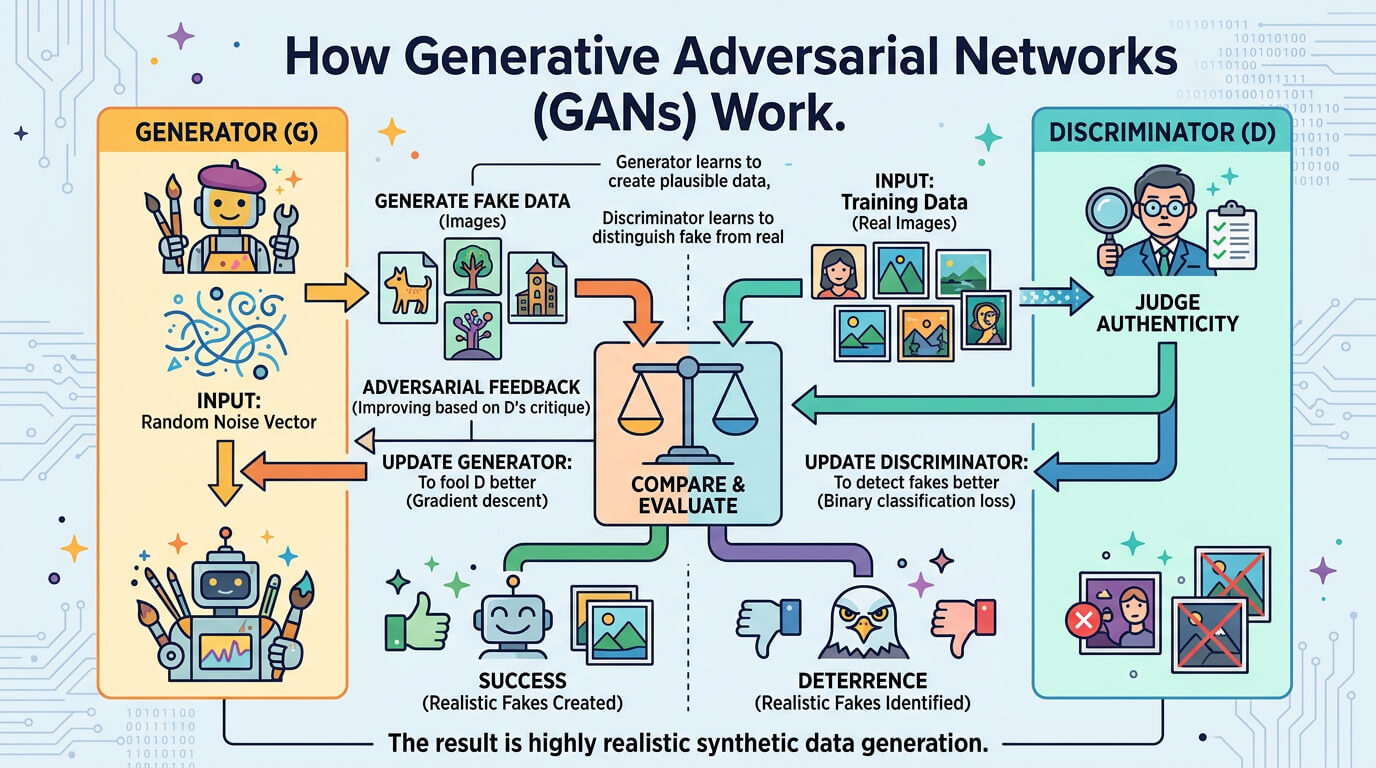
- Generative adversarial networks (GANs): GANs allow AI generated art to reach impressive realism and creativity through adversarial training and constant image refinement by pairing two neural networks in competition.
- Diffusion models: Diffusion model machine learning algorithms create images for AI generated art by transforming random noise into detailed visuals. This uses a stepwise denoising process inspired by physical phenomena.
- Variational autoencoders (VAEs): VAEs drive AI generated art by encoding and decoding images to and from a compressed latent space, which allows the synthesis of diverse and novel artistic outputs.
- Transformer based models: Transformer models help AI generated art interpret complex prompts and intricate relationships within data, utilizing advanced attention mechanisms to generate contextually rich images.
- Natural language processing (NLP): NLP techniques are crucial in AI generated art for translating user prompts into actionable input, which allows models to produce artwork that truly reflects the described content and style.
How Generative Adversarial Networks work is shown in the image below.
What are the limitations of AI in generating art?
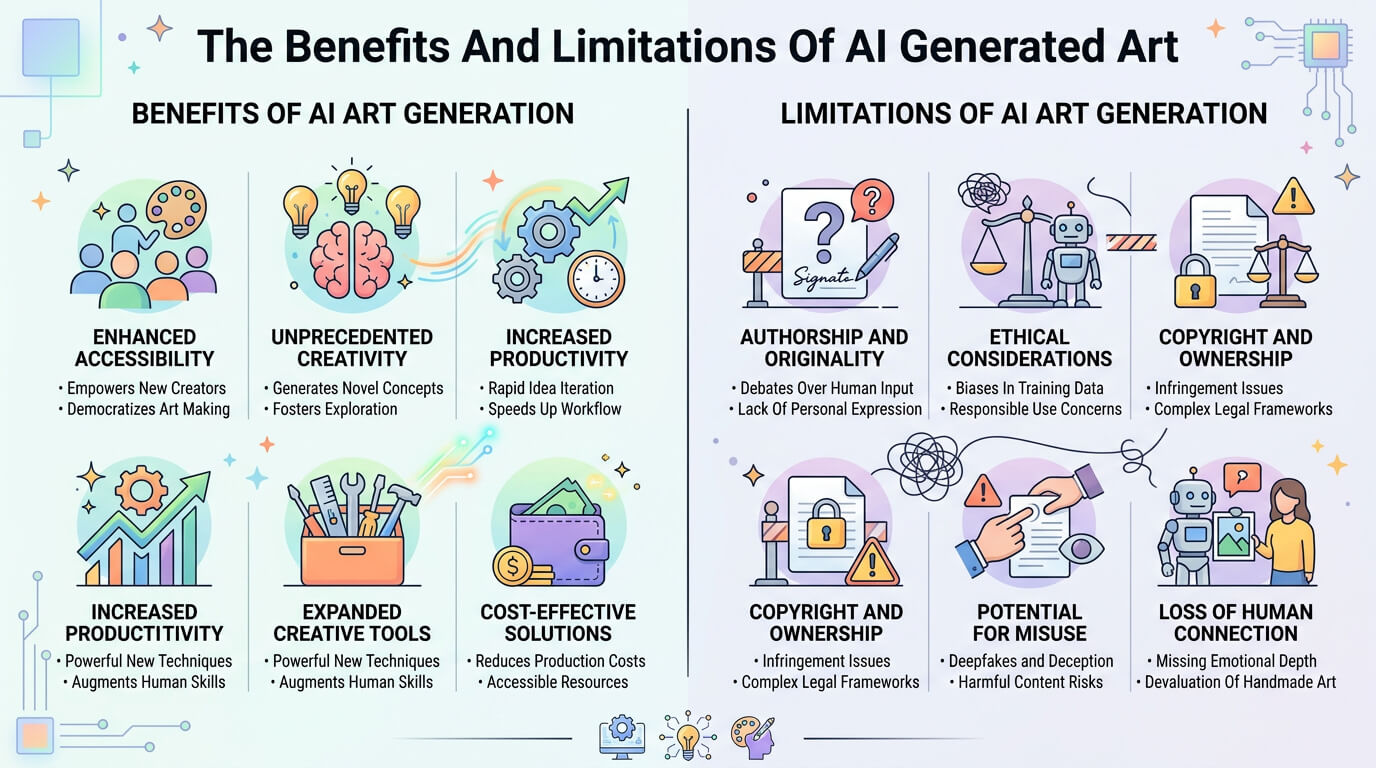
The limitations of AI in generating art include a lack of genuine creativity, dependence on training data, technical issues, lack of fine control and creative innovation.
The limitations of AI in generating art are outlined below.
- Lack of genuine creativity and emotional depth: AI generated art mimics styles, but does not truly feel or invent new emotions, which results in works that lack authentic passion and deep personal meaning.
- Dependence on training data: AI generated art relies entirely on existing datasets, which limits originality, causes repetitive outputs and prevents true innovation beyond what is already present in the source material.
- Technical issues and artifacts: Images produced by AI generated art include unexpected distortions, glitches or other visual artifacts due to inherent technical imperfections in the algorithms.
- Lack of fine control and consistency: Achieving precise or consistent artistic direction is difficult with AI generated art. This makes it challenging for users to refine details or maintain stylistic uniformity across works.
- Interpretation and context understanding: AI generated art sometimes misinterprets nuanced or abstract prompts, lacking the contextual awareness and subjective judgment essential for capturing subtle artistic intentions.
- Ethical and bias concerns: AI generated art propagates biases and copyright issues present in its training data, raising concerns about fairness, originality and responsible use in creative industries. Thousands of artists signed open letters and staged protests against AI art practices, according to Smithsonian Magazine.
- Creative innovation limitations: AI generated art recombines pre-existing patterns rather than inventing radical new artistic forms, limiting its potential for groundbreaking or avant garde innovation.
- Inconsistent anatomy: AI generated art often exhibits distorted or anatomically incorrect representations of humans and animals that makes such images unreliable for scientific or professional purposes.
- Difficulty with text rendering: AI generated art frequently struggles to produce clear, correctly spelled and contextually appropriate text within images, which limits the utility for designs that rely on accurate labels or signage.
- Copyright datasets: AI generated art is commonly trained on copyrighted images without consent that raises ongoing legal, ethical and originality concerns in creative fields.
- Compute cost barriers: AI generated art requires substantial computational resources for training and high quality generation, which result in increased costs and limited accessibility for many creators.
- Clarification on NSFW content: AI generated art faces varying NSFW content rules and some platforms strictly prohibit generating NSFW (Not Safe For Work) content, while others implement filters or allow such content with restrictions and safety controls.
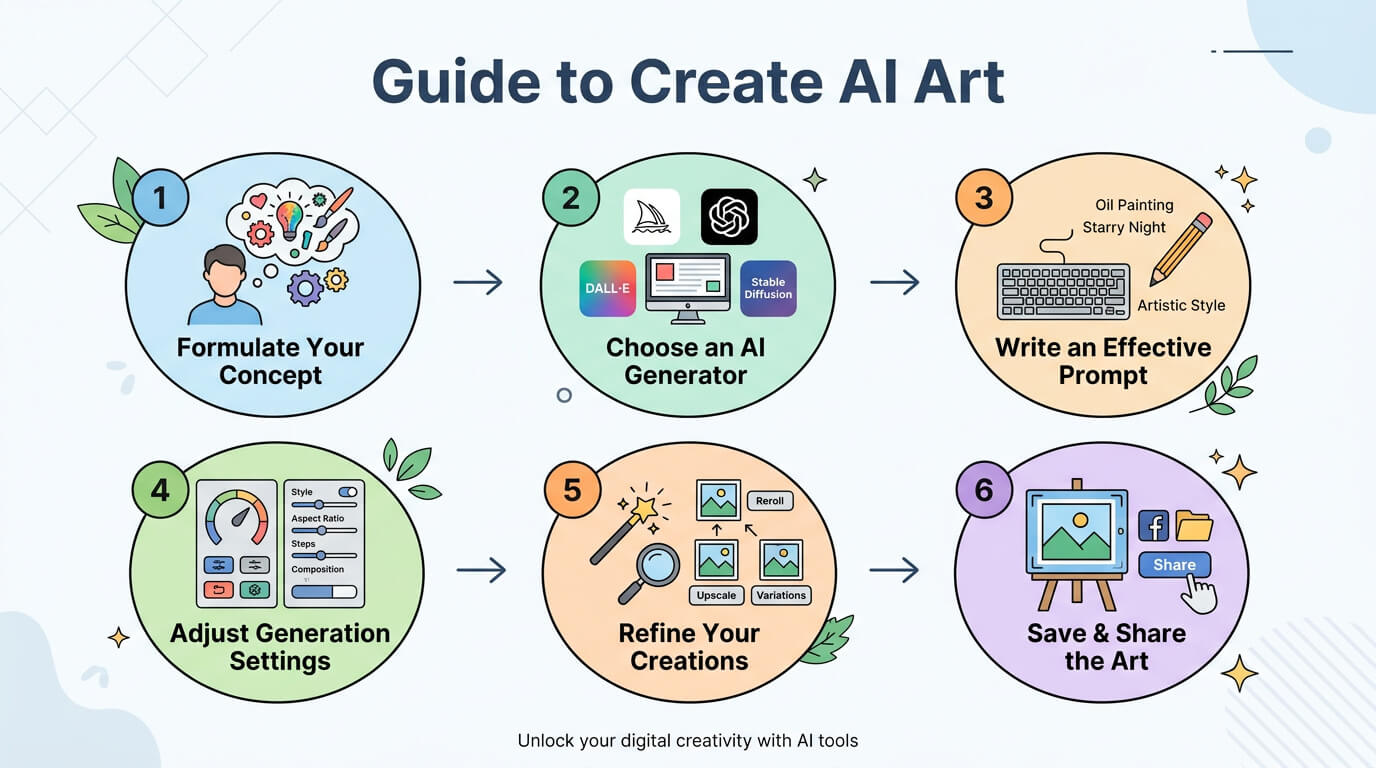
How to create AI art?
To create AI art, follow 4 steps such as choose an AI art generator tool, develop your visual data, write a text prompt, refine and customize and save.
4 Steps to create AI Art are outlined below.
- Choose an AI art generator tool: Start by selecting a platform that specializes in AI generated art. Popular choices include Vosu.ai, DALL-E, Midjourney and Stable Diffusion, each offering unique features for creating digital visuals.
- Develop your visual idea: Conceptualize what you want to portray, which considers mood, style and subject. This helps guide the AI and aligns its creative capabilities with your personal artistic goals.
- Write a text prompt: Input descriptive keywords, phrases or sentences that define your vision. The AI generated art engine interprets these prompts to produce images reflecting your creative intent.
- Refine, customize and save: Iterate by tweaking prompts or editing images after generating initial results. Apply filters, adjust styles or upscale, then save your finalized AI generated art masterpiece.
What tools are used to create AI art?
The tools used to create AI art include VosuAI*, DALL·E 3, Midjourney, Stable Diffusion, Adobe Firefly, Leonardo AI, Imagen 3 and Canva AI art generator.**
The tools that are used to create AI art are outlined below.
- Vosu.ai: Vosu.ai is an innovative tool designed for generating high quality AI art making it especially versatile for creators seeking professional visual content with minimal effort. It leverages a powerful lineup of advanced AI models for art including Flux, Runway Gen-4, Luma, Kling, Ideogram and PixVerse to transform text or images into visually engaging artwork.
- DALL·E 3 (OpenAI): DALL·E 3 transforms text prompts into detailed, creative visuals, which help users to produce professional quality digital artwork easily.
- Midjourney: Midjourney specializes in AI art by generating imaginative and innovative images, popular among designers looking for distinctive visual concepts.
- Stable Diffusion: Stable Diffusion is an open source AI art model that allows users to create customizable and high resolution images from textual inputs with community driven improvements.
- Adobe Firefly: Adobe Firefly brings intuitive AI art generation into the Creative Cloud, allowing both beginners and professionals to create stunning visuals from text.
- Leonardo AI: This tool excels in AI art for gamers and illustrators, which generates assets, concept art and unique styles quickly using artificial intelligence.
- Imagen 3 (Google): Imagen 3 leverages AI art technology for photorealistic and accurate imagery, which responds to complex natural language prompts with exceptional results.
A comparison of the tools used to create AI art is given in the table below:
| Tool | Model Used | Restrictions | Free Credits | Commercial Rights |
|---|---|---|---|---|
| Vosu.ai | Multi-model (Nano Banana, flux or Imagen) | Content policies of integrated models apply | Bonus credits for new users; paid plans. | Full ownership and commercial use allowed |
| DALL·E 3 | OpenAI (DALL·E 3) | Must follow OpenAI content policy. | Bonus credits for new users; limited free use. | Full ownership for user, commercial use allowed. |
| Midjourney | Proprietary | Paid subscription required; TOS restricts some use cases. | Trial credits occasionally, mostly paid. | Commercial use allowed for subscribers, subject to platform terms. |
| Stable Diffusion | Stable Diffusion 3.5 | Community License for < $1M revenue; platform/host restrictions apply. | Fully free for personal and small commercial use. | Full ownership; commercial use allowed if license terms are met. |
| Adobe Firefly | Firefly Model | Works require watermark on free plan, TOS applies. | Generative credits on paid plans, limited free use. | Commercial use allowed; paid plans offer full rights, watermark removal. |
| Leonardo AI | Proprietary + Fine-tuned | Public images are remixable, private images via paid plans; some restrictions. | Free and paid plans; higher resolution/features for paid. | Commercial use permitted, ownership varies by privacy setting. |
| Imagen 3 | Google Imagen 3 | Must follow Google’s AUP; available for enterprise/paid Gemini/Vertex users. | Limited free trials, then by subscription. | Commercial use allowed in paid enterprise plans, rights specified by Google agreement. |
Can you create AI art for free?
Yes, you can create AI art for free, because many platforms like Canva, OpenArt, Adobe Firefly and Microsoft Designer offer free AI art generators with essential features or daily free credits. These free AI art generation features let anyone produce AI generated art without payment, which makes digital creativity widely accessible to beginners and enthusiasts alike.
Where do AI art generators get the data?
AI art generators get their data from massive datasets composed of images and accompanying text, scraped from the internet and public sources. These datasets include hundreds of millions of images, such as those from Adobe Stock, open license works, public domain content and web scraped image text pairs, which allow the AI to learn styles, objects and artistic techniques.
Who owns AI generated art?
AI generated art is generally not owned by anyone if created solely by AI, as the US Copyright Office rules require human authorship. Copyright protection applies only when a human meaningfully contributes to the creative process. Only the human authored elements or creative arrangements involving sufficient human input in AI generated art are eligible for copyright protection. AI generated art in the UK and EU is often governed by database rights and licensing models and in China and Japan, it faces looser copyright laws, allowing broader recognition and fewer restrictions for AI-generated works compared to Western jurisdictions.
AI generated art is not eligible for copyright protection in the United States because only works created by human authors qualify under US law. AI generated art in the UK and EU is often governed by database rights and licensing models, which are used to determine ownership and usage permissions for datasets and AI outputs. AI art in China and Japan faces looser copyright laws, allowing broader recognition and fewer restrictions for AI-generated works compared to Western jurisdictions
The New York Times brought suit against OpenAI and Microsoft for copyright infringement by using NYT articles in model training, according to Smith Hopen, and Getty Images filed a lawsuit against Stability AI over the use of copyrighted images, according to Pinsent Masons.
Will AI art take over human art?
No, AI art will not take over human art, because AI generates impressive and diverse images, but it lacks the human element of creativity and the emotional depth that artists bring to their work. Human art reflects unique experiences, personal expression and cultural context, which AI does not authentically replicate. AI art is likely to complement rather than replace the rich and deeply personal aspects of human created art.
What is the future of AI art?
The future of AI art is bright, which offers greater efficiency, hyper personalized styles and new creative opportunities for artists and industries. AI art balances human creativity and machine intelligence through collaborative workflows, gives artists new ways to guide generative tools and achieve unique visions. It harnesses rapid advances in video and VFX platforms such as Runway, Kling and Flux to reshape storytelling and creative production in fields like film and marketing. AI art responds to emerging regulations including dataset licensing and transparent watermarking that require creators to adjust practices for originality and compliance. It achieves widespread professional adoption, as leading brands, movie studios and agencies integrate generative tools to scale output and unlock creative possibilities. The future, however, remains uncertain regarding emotional depth, human creativity and how society adapts to the ongoing rise of gen-AI-generated art.