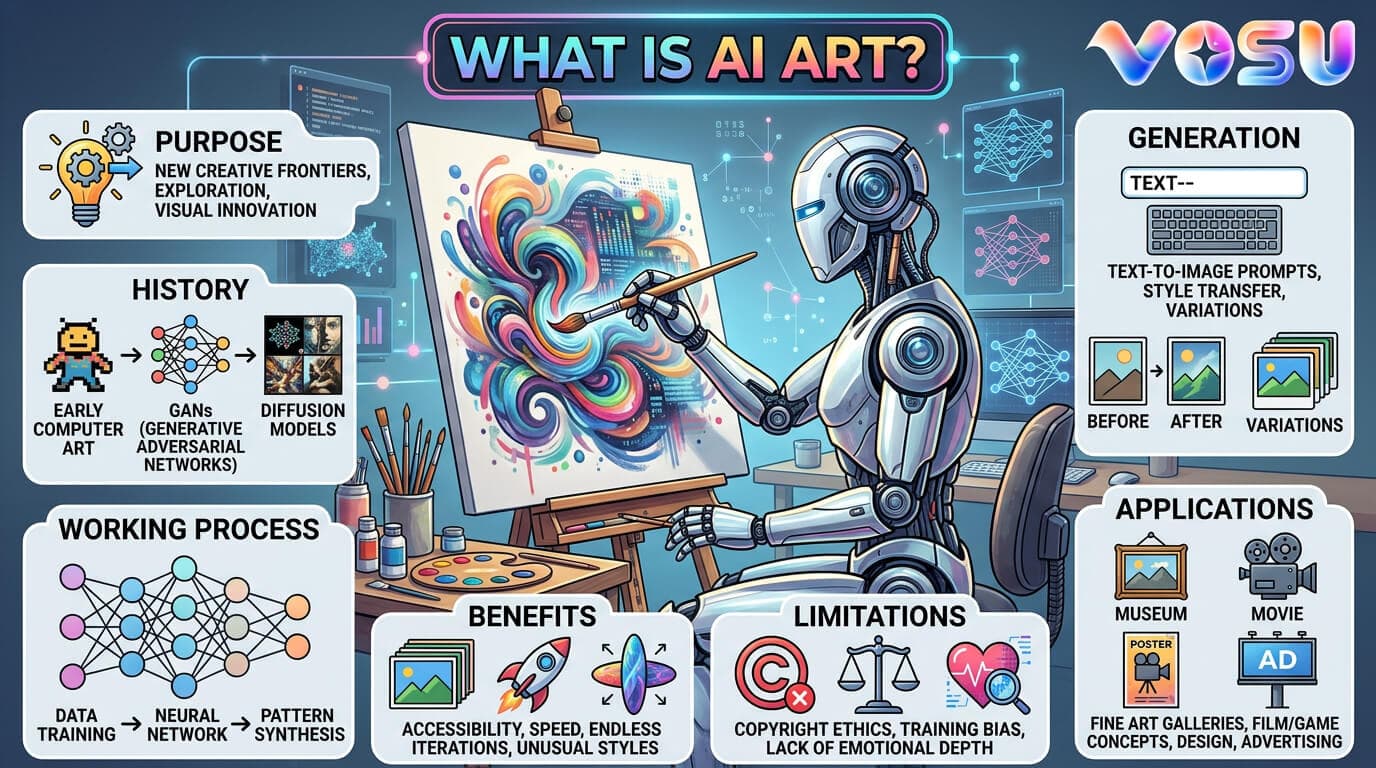
AI art refers to creative works made or improved using artificial intelligence algorithms. It combines technologies like neural networks and machine learning to create digital artwork based on user prompts or data. AI art aims to expand the boundaries of artistic expression by exploring how machines can generate visuals like abstract designs or realistic portraits. AI art began in the 1960s with AARON, one of the first AI art systems and gained momentum in 2014 with GANs, revolutionizing deep learning in art. Stable Diffusion accelerated this growth by making AI art accessible to more people.
AI functions by training on vast image datasets, interpreting text prompts and generating visuals using models like GANs and VAEs. AI tools such as DALL·E, Midjourney, Adobe Firefly, Leonardo.AI and Vosu.ai help users create digital artwork efficiently. Vosu.ai offers capabilities for producing images, art, animations and videos within a single platform.
AI art Applications range from visual marketing and product design to animation, NFTs and nature inspired creations. Its benefits include creative speed, accessibility, unique styles and collaborative potential. AI art has limitations such as lack of emotional depth, dependence on training data, unclear authorship and inconsistent output, which raise ethical and creative challenges in the art world.
What is AI art?
AI (artificial intelligence) art is an artwork created or improved using artificial intelligence algorithms. AI art integrates technologies like machine learning and neural networks to automatically generate images, music or drawings based on prompts or data. This approach shows the potential of AI for art by producing unique digital images, animations and even sculptures. AI art examples include portraits generated by GANs, computer generated landscapes and creative reinterpretations of famous masterpieces.
What is the purpose of AI art?
AI art aims to expand the boundaries of artistic expression to create artworks that challenge traditional notions of creativity. AI art combines problem solving techniques, natural language processing and image recognition to generate new visual experiences like abstract art, realistic portraits or concept art. This bridges the gap between machine capabilities and human intelligence. This approach explores how technology redefines art’s role in society and communication.
What is the history of AI art?
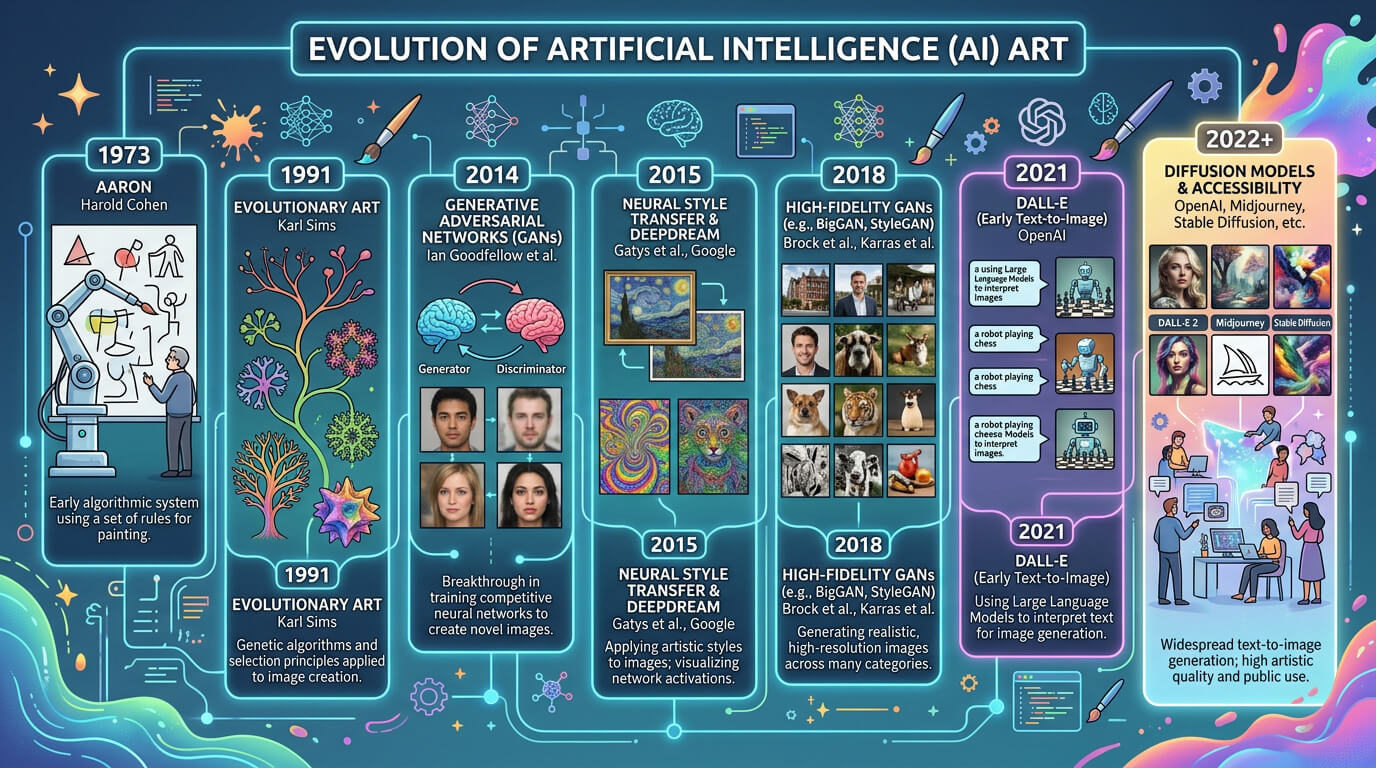
AI art history began in the late 1960s with British artist Harold Cohen, inventor of AARON, one of the earliest AI art systems, which debuted in 1974. This era marked the start of using neural networks and genetic algorithms in artistic creation that blended computer programming with visual art.
AI art experienced considerable growth in 2014 when Ian Goodfellow introduced generative adversarial networks (GANs). AI art history further evolved with the introduction of DALL·E 2 in 2021, which popularized text-to-image diffusion models by enabling users to generate detailed images from natural language prompts. Google Imagen, shortly after, set a new benchmark in diffusion model quality, significantly advancing the realism and nuance of AI generated imagery. These innovations contributed to the widespread adoption of diffusion techniques, which have largely supplanted generative adversarial networks (GANs) as the dominant framework in AI art due to their superior fidelity and creative flexibility. This revolutionized deep learning for AI art by allowing systems to generate realistic images. It witnessed major advancements with the release of stable diffusion in 2022, which expanded accessibility and power through deep learning.
The history of AI art is shown below.
How does AI art work?
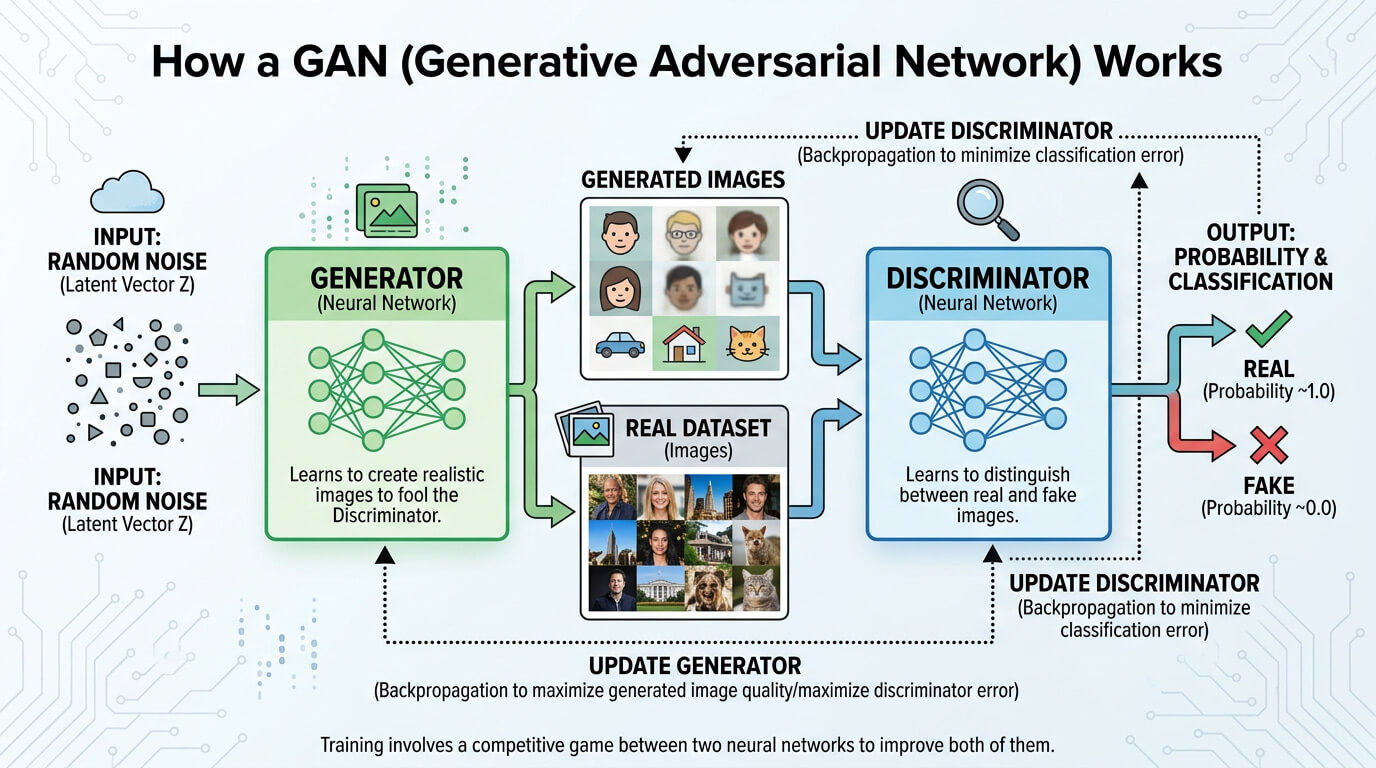
AI art works by learning from large datasets, using generative models like GANs and VAEs, interpreting user prompts and synthesizing diverse artistic elements to create unique digital artwork based on the input provided
The process of how AI art works is outlined below.
- Training on large datasets: AI art systems are trained on millions of annotated images and descriptions, which allows them to learn diverse styles, patterns and subject matter for broad creative understanding.
- Generative models: AI art uses generative models like GANs and VAEs, which are trained to create new pieces similar to the original data and learn to replicate detailed artistic elements.
User prompt input: AI art begins with a user created prompt that describes the subject, style and elements, which the AI system transforms into an original artwork. - Generation process: Generative AI model processes the prompt to synthesize and merge information from its training in AI artwork. It combines artistic elements to create images reflecting user intent and training data diversity.
- Output: AI delivers a unique digital artwork based on the generated image, which matches the style and attributes instructed by the prompt. It allows users to refine or regenerate art through iteration or additional prompts
The process of how AI art works is shown below.
How to generate artificial intelligence art?
To generate artificial intelligence art, select an AI art tool, craft a text prompt, pick a style, create the image, adjust as needed and download or use the resulting artwork. This process allows creators to make quick iterations and customizations that help them explore diverse artistic expressions.
6 steps to generate artificial intelligence art are given below.
- Choose an AI art generator tool: Select a suitable AI art generator such as Vosu.ai, DALL-E, Midjourney or Stable Diffusion based on your requirements, budget and desired output features, and Vosu.ai integrates multiple leading AI models in one place, unlike single purpose tools.
- Enter a descriptive text prompt: Describe your artistic vision as clearly as possible with a detailed text prompt. Mention subjects, colors, mood and any specific elements important to your artwork.
- Select an artistic style: Pick an art style offered by the tool such as realism, abstract, impressionism, cartoon or a custom style reference to guide the AI’s interpretation.
- Generate the art: Start the creation process in your chosen AI tool. The AI interprets your prompt or selected style to produce unique artwork in seconds or minutes.
- Refine the result: Review the initial output and make adjustments using available editing tools or tweaking prompts, which allow the AI to customize the art to your preferences.
- Download and use your AI art: Save your completed masterpiece in your preferred format, ready for sharing online or integrating into personal and professional projects.
What tools are used to generate AI art?
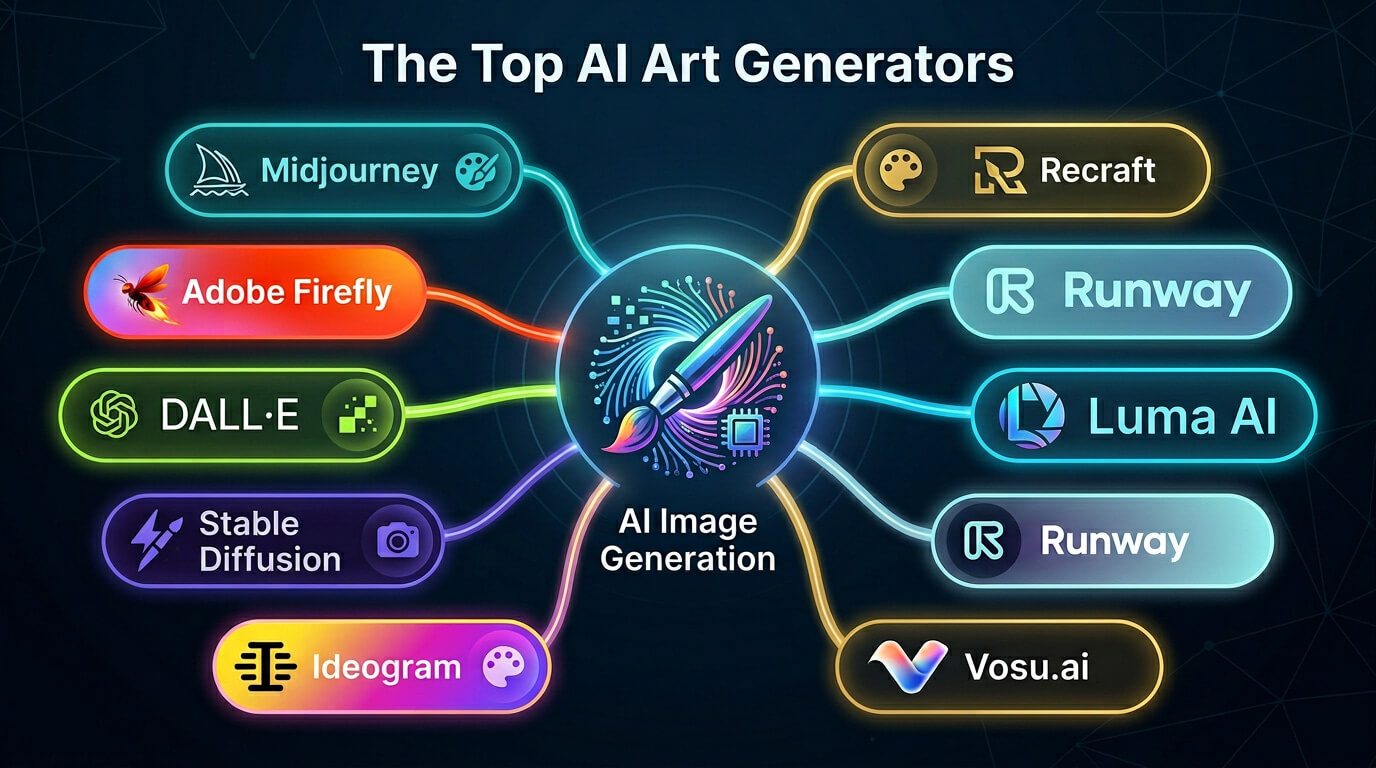
9 Tools that are used to generate AI art are listed below.
- Vosu.ai: Vosu.ai is an AI art generator that creates images and visuals in diverse artistic styles from text prompts, which support expressive, custom and emotion-guided artwork.
- Midjourney: Midjourney transforms text prompts into stunning visual artwork and is widely recognized as a good AI tool for art.
- Adobe Firefly: Adobe Firefly provides creative AI art software within Adobe’s ecosystem that supports AI digital drawing and advanced style features
- DALL-E: DALL-E generates unique images from natural language prompts and stands out as a top AI art tool.
- Stable Diffusion: Stable Diffusion produces high quality customizable images and is favored as open source AI art software for creative projects.
- Ideogram: Ideogram generates artwork with distinctive branding and typography that provides unique solutions for visual and written content creation.
- Leonardo.AI: Leonardo.AI creates game assets, concept art and high detail digital illustrations as a specialized option in AI art software.
- Runway: Runway delivers AI art tools for digital image and video creation that optimize visual workflows with advanced generative features.
- Recraft: Recraft supports vector, raster and 3D image generation that makes it versatile for designers and illustrators.
The top AI art generators are shown below.
What are the applications of AI art?
The applications of AI art span digital and traditional art creation, marketing, design, avatars and AI twins creation, film production and brand storytelling, which offer enhanced creativity, efficiency and accessibility in each field.
The uses of AI art are outlined below.
- Digital and traditional art creation: AI art allows artists to create digital paintings and illustrations by combining human creativity with algorithms to produce unique textures and styles not possible manually.
- Marketing and advertising: AI art helps create customized campaign graphics, videos and branded content on platforms like Vosu.ai. Advertising agencies are actively leveraging AI generated art to create unique, personalized and cost effective marketing content for brands.
- Professional design and concept art: AI art helps designers create concept sketches, explore visual ideas and prototype that speeds up product development and inspires new iterations.
- Influencer avatars and AI twins creation: AI art plays a significant role in the creation and utilization of influencer avatars and AI twins, which are virtual digital personas driven by AI and computer graphics. These AI influencers provide brands with customizable, cost effective marketing assets that engage audiences on social media platforms.
- Animation and film production: AI art improves preproduction by streamlining storyboard design, background creation and character animation, which reduces production times and enhances visual effects integration.
- Brand storytelling campaigns: AI art is profoundly reshaping brand storytelling campaigns by enabling brands to create deeply engaging, personalized and collaborative narratives through AI generated visuals.
- NFTs and digital marketplaces: AI art allows creators to produce unique digital pieces for NFT platforms, which help them monetize their work and expand their reach.
- Privacy focused local generation: AI art tools that run locally on a user's device help confidential art creation, protect sensitive materials and secure intellectual property.
- Sustainable and nature inspired art: AI art mimics organic forms and environmental patterns. This allows artists to create sustainable, nature inspired works that promote awareness of ecological themes through innovation.
- Video Game Development: AI art enables faster prototyping of game environments and characters, which reduces costs and development time and particularly benefits smaller studios by democratizing access to high quality creative assets.
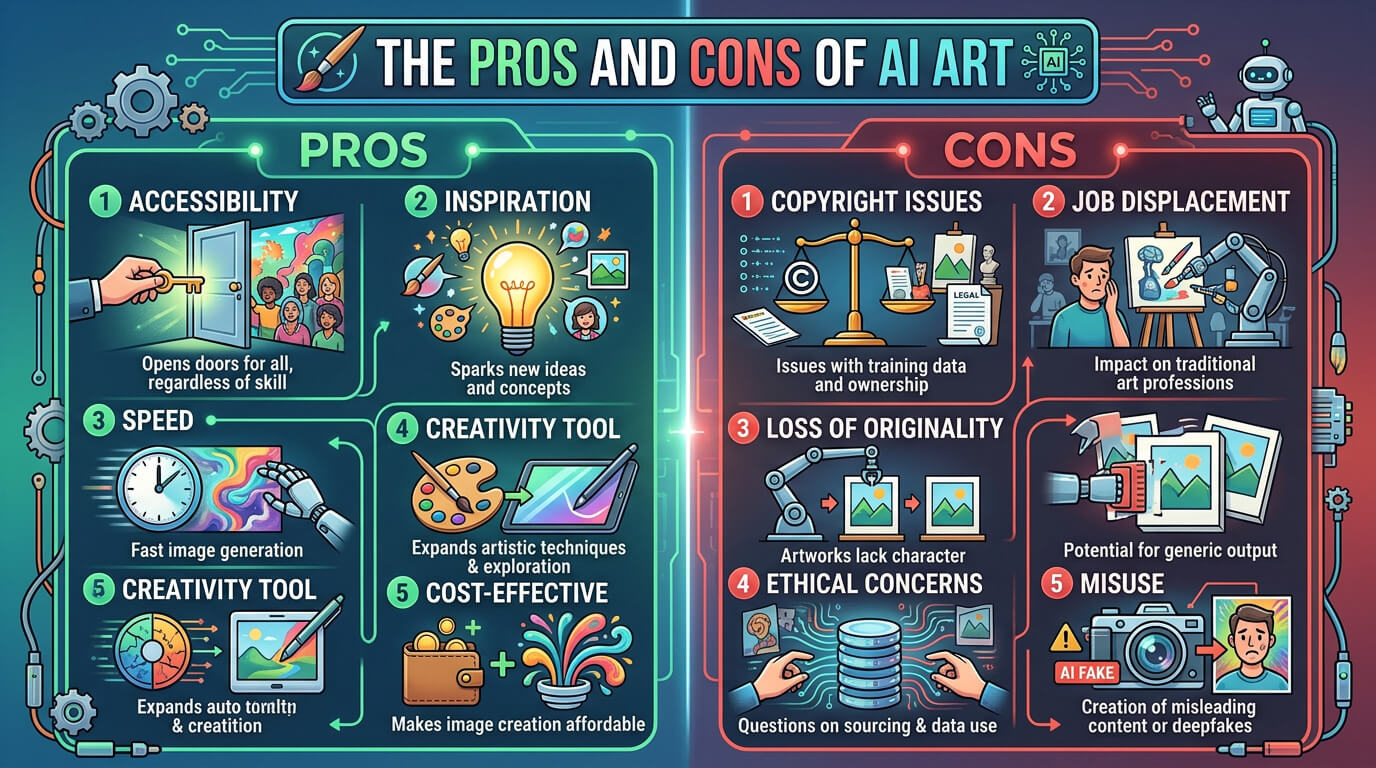
What are the benefits of AI art?
The benefits of AI art include speed, efficiency, accessibility, a creativity boost, collaboration opportunities and new artistic styles, which allow both artists and non artists to create and experiment with art.
The benefits of AI art are outlined below.
- Speed and efficiency: AI art allows artists to create high quality visuals in minutes, which save time by using one integrated platform (Vosu.ai) instead of juggling multiple tools and helps with quick turnaround for personal projects and professional work.
- Accessibility: AI art allows people without traditional art skills to create compelling images that make artistic expression widely available and lower the barrier to entry for creative industries.
- Creativity boost: AI art generates new ideas and unique visual combinations by analyzing vast amounts of data, which encourages artists to explore creative directions they do not consider with conventional tools.
- Efficiency in the art process: AI art streamlines workflows from drafting to editing that allows faster revisions and experimentation with different styles or concepts.
- Collaboration opportunities: AI art encourages collaboration between humans and machines that helps teamwork across artists and creative disciplines for more diverse and innovative outcomes.
- New artistic styles and techniques: AI art introduces new styles by analyzing large datasets, combining influences and allowing experimentation with artistic techniques not feasible by human hand.
- Brainstorming and prototyping: AI art supports fast ideation by quickly generating multiple visual concepts that allow artists and teams to test, refine and select the best ideas.
The benefits of AI art are shown below.
What are the limitations of AI art?
The limitations of AI art are rooted in its lack of genuine creativity, reliance on training data, poor contextual understanding, lack of transparency, copyright issues and inconsistent output, which are related to generative AI and machine learning systems.
The limitations of AI art are given below.
- Lack of genuine creativity: AI art lacks the conscious intent and emotional depth that human artists bring, as it relies on generative algorithms to recombine existing patterns instead of creating entirely new ideas or experiences.
- Overreliance on training data: AI art depends on the quality, diversity and scope of its training data, which limits its ability to generate truly novel concepts beyond what it has learned.
- Poor contextual understanding: AI generated art through prompt based systems misinterprets nuanced instructions and fails to understand cultural, historical or complex meanings that require advanced contextual awareness.
- Lack of transparency: Machine learning (ML) systems behind AI art act as black boxes, which makes it difficult for users to understand how outputs are generated or to explain specific artistic decisions.
- Copyright and authenticity challenges: AI art raises legal, ethical and bias concerns about authorship, originality and the misuse of intellectual property.
- Inconsistent output: AI art generates variable results from similar prompts, which produces artwork with unpredictable quality and errors that are difficult to correct.
- Controversy of AI art: AI art controversy in 2026 centers on copyright ownership and authorship, and the U.S. Copyright Office and courts have firmly ruled that AI generated art without meaningful human creativity cannot receive copyright protection as copyright law applies only to "original works of authorship" created by humans.
Why is AI art so controversial?
AI art is controversial because it raises ethical concerns about copyright, artistic ownership and the role of the human artist. Numerous ongoing lawsuits target AI companies like OpenAI and Meta, brought by authors and entertainment firms accusing these labs of unauthorized use of copyrighted works to train AI models, and this legal battle highlights deep concerns over intellectual property rights in the age of AI. Meanwhile, Getty Images banned submissions of AI generated images to protect original artists and uphold copyright standards. Large scale artist protests against AI art auctions have erupted, spotlighted by The Guardian in February 2026, where artists voiced fears that AI generated art threatens human creativity and artistic value.
Is AI art killing the art industry?
No, AI art is not killing the art industry because it is reshaping the art industry instead of eliminating it. AI art introduces new creative tools and opportunities like global reach, AI collaboration and personalized art, which raises important questions about job displacement and copyright ownership, while traditional art remains strong.
Can AI replace human creativity in Art?
No, AI art can not replace human creativity in art because emotional reasoning and originality remain uniquely human qualities. AI art excels in collaboration with artists, but it lacks the personal experiences and Instinctive insights that define the essence of genuine artistic expression.
Why is AI art so controversial?
AI art is controversial because it raises ethical concerns about copyright, artistic ownership and the role of the human artist. These fears of uncredited use of existing work and job insecurity contribute to the AI art controversy in creative industries like graphic design and animation.
When did AI art start trending?
AI art started trending around 2022 to 2023 when AI powered portraits and digital works captured public attention and began filling museums and social media. AI generated art trends accelerated as tools like Stable diffusion or Runway allowed widespread creation and sharing, which makes AI driven imagery a major force in the contemporary art world.
What is the difference between human and AI art?
The main difference between human and AI art lies in intent and emotional depth. Human art is guided by a human sense of experience, emotion and purpose, which reflects unique perspectives and genuine talent. AI art is criticized for lacking genuine talent and the ability to convey deep emotions, as it relies on algorithms instead of human creativity and personal expression.
Is AI art a threat to artists?
Yes, AI art is a threat to artists because it raises concerns about being replaced by AI and the potential devaluation of human creativity. AI art challenges the ethics of generative AI by blurring the distinction between original creation and machine generated content that raises concerns among artists about their future relevance in the industry.
What is an AI artist?
An AI artist is a creator who uses generative AI models as tools to produce or enhance visual artwork. This process blends human creativity with AI-assisted creation to explore new possibilities in style, technique and concept while utilizing platforms like DALL·E, Artbreeder and Runway to produce dynamic artistic outcomes.
What is AI art style called?
AI art style is a form of digital art creation where artificial intelligence algorithms determine the visual appearance and techniques of the artwork. AI art styles include neural style transfer, deep dream imagery and generative abstract designs. These AI art styles have become popular for their ability to produce novel and diverse artistic effects.