AI in business is a strategic technology that integrates artificial intelligence into business operations to optimize decision making, automate workflows, improve customer experiences and drive innovation. It allows organizations to analyze large datasets, uncover insights and improve efficiency while supporting strategic priorities.
AI in the business implementation process includes prioritization of business challenges to focus on core problems such as defining clear business objectives, assessing data quality and infrastructure, upskilling employees with AI and leveraging AI for customer relationship management (CRM). Successful AI in business adoption requires governance, performance monitoring and alignment with organizational goals to maximize value from AI business applications. This confirms measurable results and long term sustainability.
AI in business offers opportunities in data analysis, marketing optimization, improving customer experience, streamlining supply chains, automating finance and supporting HR and manufacturing processes. It also allows predictive analytics, real time decision making and improved innovation through AI-powered insights. These applications improve efficiency, reduce costs, increase innovation and strengthen competitive advantage, which demonstrates that AI for business is a strategic investment for modern enterprises.
What is the process of implementing AI in business?
The process of implementing AI in business involves defining clear business objectives, implementing change management, leveraging AI for CRM, boosting productivity, strengthening security and optimizing talent acquisition and management. Successful AI adoption in business requires careful planning, effective governance policies and a consistent focus on key performance indicators (KPIs). These elements drive value optimization in AI for processes such as customer service automation, supply chain forecasting and financial risk analysis.
The steps involved in implementing AI in business are illustrated in the image below.
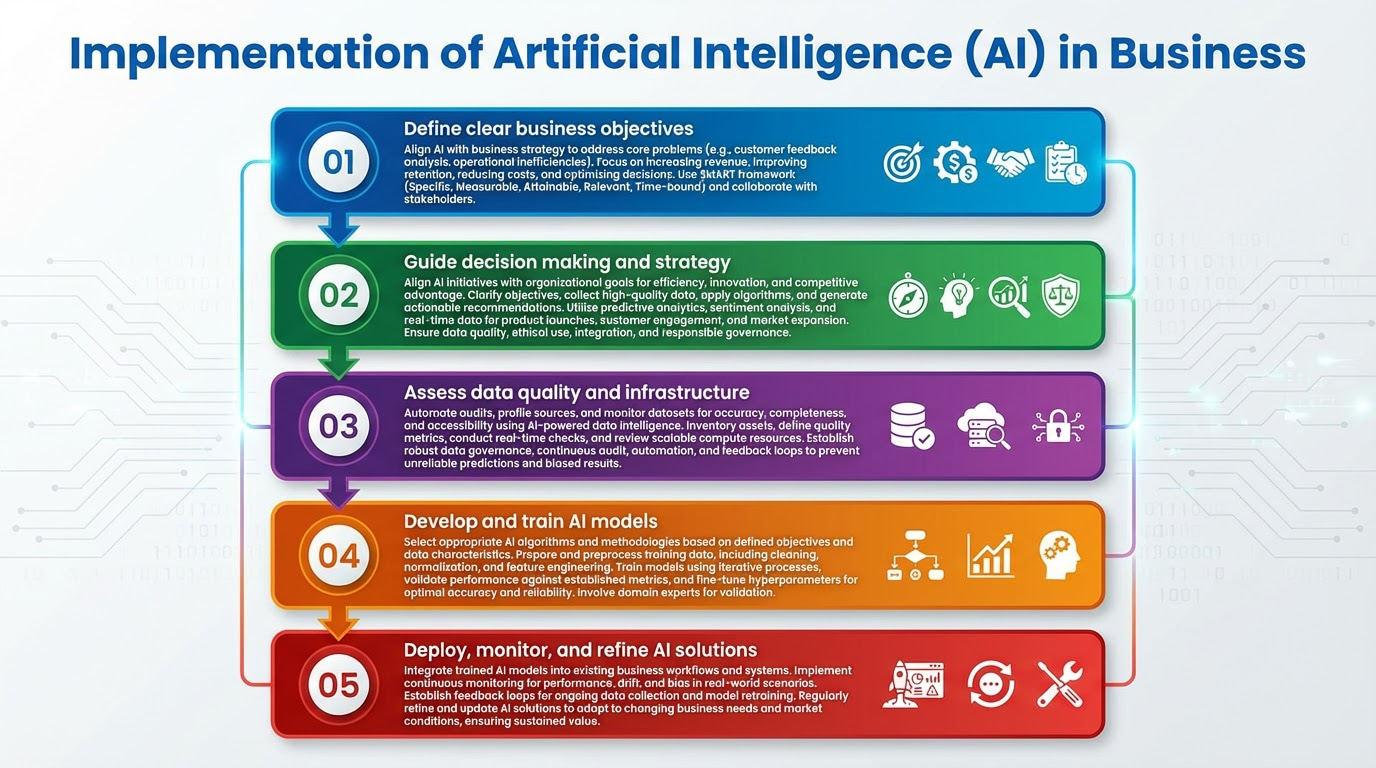
13 steps of the process to implement AI in business are listed below.
1. Define clear business objectives
AI clear business objectives are specific and measurable goals that align artificial intelligence and business strategy, which assures initiatives address core business problems such as customer feedback analysis or operational inefficiencies. The common objectives to implement AI in business include increasing revenue, improving customer retention, reducing operational costs and optimizing decision making.
AI in business requires clear objective setting, as it guarantees AI solutions deliver measurable results and support artificial intelligence for business planning. It also prevents wasted resources and avoids unfocused experiments. Organizations should focus on strategic needs, maintain objectives, follow the SMART framework (Specific, Measurable, Attainable, Relevant, Time bound) and collaborate with stakeholders for alignment and buy-in to define clear AI objectives.
2. Guide decision making and strategy
AI decision making and strategy in business is the process of aligning AI initiatives with organizational goals to drive efficiency, innovation and competitive advantage. AI guides business decision making and strategy by clarifying objectives, collecting high quality data, applying appropriate algorithms and generating actionable recommendations. It helps leaders to develop an effective AI business strategy and respond proactively to market changes. The use of AI for decision making business strategies and applications includes predictive analytics, social media sentiment analysis and real time data processing to guide decisions on product launches, customer engagement and market expansion. AI is applied in predictive demand forecasting, dynamic pricing models and supply chain optimization in real-world contexts.
AI in business improves strategic decision making by automating the analysis of large datasets, which allows scenario simulation and uncovers hidden trends or risks faster than traditional methods. Successful implementation of AI for strategic purposes requires data quality, ethical use, integration with existing workflows, stakeholder buy-in and maintaining responsible governance so that AI initiatives align with overall business objectives.
3. Assess data quality and infrastructure
AI assesses data quality and infrastructure for business by automating audits, profiling sources and monitoring datasets for accuracy, completeness and accessibility using AI-powered data intelligence. AI evaluation steps to access data include inventorying data assets, defining quality metrics, conducting real time quality checks, reviewing infrastructure for scalable compute resources and confirming robust data governance. High quality data is critical for business AI because poor data leads to unreliable predictions, biased results and failed initiatives. Organizations improve data quality with real time anomaly detection, automated profiling and continuous data monitoring through AI-powered data intelligence.
AI in business requires a robust infrastructure, which includes scalable compute resources, cloud solutions and integrated platforms that support real time data processing. The primary challenges of implementing an AI-ready data include fragmented data sources, bias and integration complexity, while best practices highlight continuous audit, automation and feedback loops. Data governance strengthens these efforts by setting standards, which ensure compliance and foster trust through enforced quality controls and audit trails for AI-driven decisions.
4. Implement change management
AI change management in business is a form of strategic change management that provides a structured approach to integrating AI technologies while balancing both technological and human aspects of transformation. AI-driven change management implementation involves defining the change required, building a culture that embraces AI and communicating a clear vision. This also involves training employees, piloting solutions and gathering feedback to refine the process. AI improves this process through communication improvement, stronger stakeholder engagement, automation of repetitive tasks and decision making improvement powered by pattern recognition. Implementing change management helps smooth transitions during successful AI integrations, higher employee adoption, greater organizational agility and the ability to anticipate and address resistance. This contributes to long term innovation and sustainable transformation.
5. Upskill employees with AI
AI upskilling of employees begins with a skills gap assessment, personalized training plans and hands-on experience to make sure employees can confidently integrate AI tools into their workflows. AI literacy building requires diverse learning formats such as online modules, workshops and labs that provide hands-on experience with AI tools. AI upskilling is vital for adoption because it bridges knowledge gaps, fosters an experimentation culture and confirms smooth AI integration in workflows.
AI upskilling implementation includes continuous learning, peer mentoring, simulated projects and structured feedback loops. Organizations strengthen employee engagement and allow teams to confidently drive innovation as AI reshapes business processes by encouraging participation in AI-focused communities and adapting learning paths to evolving needs.
6. Leverage AI for customer relationship management (CRM)
AI for CRM is a system that integrates artificial intelligence technologies and multimodal communication into CRM software. AI in CRM integrates data, applies models for customer segmentation and predictive analysis, automates routine interactions and optimizes workflows with real time tracking. It helps predict customer behavior, provide personalized recommendations and manage automated customer journeys to create highly personalized experiences across different channels.
AI in CRM advantages involve increased sales productivity, real time engagement, greater operational efficiency and stronger data driven insights. Its challenges and considerations remain in areas such as data privacy, integration complexity, bias risks and organizational change management. Some leading AI-powered CRM platforms include Salesforce, HubSpot, Zoho CRM, Monday CRM, Pipedrive and Freshsales. The future of AI in CRM is shaped by dynamic learning, continuous automation and truly personalized, autonomous experiences at scale.
7. Conduct market research
AI market research in business is the process of using artificial intelligence (AI) technologies to collect, analyze and interpret data in order to provide insights into market trends, customer behavior understanding and competitor activities. AI powered market research processes involve data collection, deploying AI for sentiment and trend analysis, segmenting customers, running predictive models and generating actionable reports in real time. AI improves this process by automating data collection from diverse sources, which allows continuous monitoring and the application of predictive analytics for market trends forecasting.
AI in Business market research tools include Voxpopme, Qualtrics XM, Meltwater and Remesh. Its applications range from customer segmentation and sentiment analysis to demand forecasting and competitor benchmarking. The advantages are faster research cycles, greater accuracy, modified insights, real time responsiveness and stronger data-driven decisions that improve market responsiveness. AI makes businesses more informed and competitive by enabling dynamic insights and adaptability.
8. Boost productivity
AI productivity in business is the use of artificial intelligence to automate repetitive tasks, optimize workflows and improve augmented human capabilities for smarter decision-making and high value activities. Businesses boost productivity by automating suitable processes, adopting the right tools, piloting solutions, upskilling teams and monitoring results for improvement. Its real-world impact to boost productivity includes reduced errors, faster project completion, cost savings and greater agility in competitive markets. The strategic benefits extend to improved resource allocation, improved innovation and long-term competitive advantage. Practical applications of AI in business include AI-powered chatbots, predictive analytics, virtual assistants and smart scheduling tools. The future of AI authorizes teams to achieve continuous, adaptive growth and efficiency.
9. Foster creativity
AI creativity in business refers to the use of AI tools to augment and inspire innovative solutions that combine data driven creativity with human insights for strategic planning, advertising creativity and new product development. Businesses implement AI creativity by defining clear innovation objectives, selecting creative AI tools, encouraging collaborative experimentation and training employees to integrate AI into workflow. AI improves business creativity by generating fresh ideas, automating content creation, uncovering design trends and democratizing innovation through accessible and scalable tools.
AI in business has practical applications that cover AI-generated marketing campaigns, creative image and video production, product design, copywriting and personalized advertising. Its challenges involve maintaining authenticity, protecting intellectual property, managing bias and confirming that machines support rather than replace human creative processes. Businesses must balance their innovation with creative direction, ethical standards and organizational culture to foster meaningful and responsible innovation.
10. Strengthen security
AI security in business is a process of protecting AI systems, data and applications from threats, which includes automated defensive action implementation to prevent breaches. AI strengthens business security by deploying real time threat detection and automated defensive responses, then continuously updating defenses through predictive modeling and security audits. It improves resilience through continuous monitoring, compromised devices isolation, insider threat detection and real time pattern analysis. It also strengthens AI supply chain security against manipulation. AI introduces new risks, which include adversarial attacks, poisoned data, AI-powered cyberattacks, model bias and vulnerabilities in supply chains. Businesses must adopt best practices such as automated anomaly response, regular model audits, strict access controls and securing data pipelines to manage these challenges.
11. Personalize customer experiences
AI personalization of customer experiences in business is a process of using AI technologies to deliver modified product recommendations, targeted content and dynamic interactions. It aims to boost customer satisfaction and strengthen customer loyalty. AI personalizes experiences through predictive analytics, chatbots, adaptive websites and targeted messaging. It refines offerings based on user preferences and real-time feedback.
AI in business examples from the real world range from Amazon’s recommendation engine to Sephora’s Virtual Artist for beauty advice and Bank of America’s Erica for AI-powered support. AI personalization applications include predictive inventory management, personalized marketing, loyalty program optimization and in-store or digital personalization. It supports increasing engagement, higher sales, improving retention and stronger customer relationships built on relevant, timely experiences.
12. Optimize talent acquisition and management
AI talent acquisition and management is the use of artificial intelligence in business to streamline and improve processes for finding, hiring and retaining employees. AI optimizes talent acquisition by automating screening and engagement, using predictive analytics, allowing structured interviews and providing data driven insights. Organizations use predictive analytics in hiring, automated candidate communication, resume screening, scheduling and diversity and inclusion analytics in acquisition to identify best-fit candidates quickly and fairly.
AI in business supports personalized learning and development, dynamic career paths, real-time engagement and retention forecasting for talent management. The advantages are improved efficiency, reduced bias and stronger talent alignment, while challenges involve algorithmic fairness, data privacy and the need for human oversight. Strategic AI implementation requires transparent practices, continual model audits, stakeholder buy-in and alignment with ethical and inclusion standards.
13. Scale and iterate AI initiatives
AI scaling and iteration of initiatives in business means refining projects to achieve a transformative strategy and deliver sustained results. AI Iteration follows steps such as prototyping, data preparation, model building, testing, deployment, performance monitoring, feedback incorporation and retraining. Scaling AI initiatives extends successful projects across business units using methods like continuous integration/continuous deployment (CI/CD) pipelines, cloud infrastructure and automation. These are supported by strong data management and security.
Organizational and cultural strategies of AI in business highlight continuous improvement, collaboration and ethical and regulatory compliance to make sure responsible growth. Challenges and considerations involve aligning cross functional teams, managing complexity, maintaining quality and securing the long term sustainability of AI initiatives.
What businesses are using AI in 2026?
The businesses using AI in 2026 are technology companies, retailers and financial firms. These sectors lead AI adoption across industries, which reflects broad AI integration and growth.
The businesses that are using AI in 2026 are listed below.
- Technology: Technology companies develop AI platforms and tools that optimize data analytics, automate processes and support innovation across sectors. Their AI usage boosts product development and customer experience.
- Retail: Retailers deploy AI to personalize marketing, manage inventory and optimize supply chains. AI driven insights increase sales, improve customer targeting and streamline logistics operations.
- Finance: Financial firms use AI for fraud detection, risk assessment, algorithmic trading and customer service automation. AI supports faster, more accurate decision making in complex markets.
- Healthcare: Healthcare providers leverage AI for diagnostics, treatment recommendations and patient monitoring. AI contributes to improved clinical outcomes and operational workflows.
- Automotive: Automotive companies integrate AI in autonomous driving, predictive maintenance and manufacturing automation. AI boosts vehicle safety, efficiency and production quality.
- Media and entertainment: The Media and entertainment industry employs AI for content creation, recommendation systems and audience analytics. Many AI-driven platforms are used in such tasks of content generation, such as Vosu.ai. AI boosts user engagement and streamlines media production.
- Manufacturing: Manufacturers apply AI to optimize production lines, quality control and supply chain management. AI reduces downtime and increases manufacturing precision.
What are the best AI tools for business?
The best AI tools for business include AI tools for marketing and sales, AI tools for customer service, AI tools for business intelligence and analytics and AI tools for productivity and project management. These tools vary by purpose, industry needs and targeted outcomes, which reflect automation, growth and efficiency priorities across sectors.
The best AI tools for business are given below.
- AI tools for content visuals: AI tools for content visuals such as Vosu.ai, generate realistic talking videos, subtitles and image-to-video content. They help brands localize, dub and edit videos quickly, with accurate lip sync and multilingual support for global reach.
- AI tools for marketing and sales: AI tools for marketing and sales such as HubSpot, Jasper AI and Salesforce Einstein, automate lead generation, personalize campaigns and analyze customer data, which maximizes ROI and allows precise targeting for scalable business growth.
- AI tools for customer service: AI tools for customer service, such as Zendesk AI, Intercom and Ada, automate responses through chatbots and sentiment analysis, which provides 24/7 assistance and improves customer satisfaction while streamlining support operations.
- AI tools for business intelligence and analytics: AI tools for business intelligence and analytics, like Tableau AI, Microsoft Power BI and ThoughtSpot, leverage machine learning and natural language queries to deliver actionable insights, trend analysis and detailed reports for informed decision making.
- AI tools for productivity and project management: AI tools for productivity and project management such as Notion AI, ClickUp and Asana, use smart automation to schedule tasks, track performance and optimize team collaboration, which reduces manual workload and boosts project outcomes.
What opportunities does AI offer in business?
AI offers some opportunities in business like data analysis, marketing and customer services. Business companies apply AI to manage risks, measure KPIs and improve employee performance. These capabilities strengthen competitive advantage and drive long term growth.
7 opportunities AI offers in business are listed below.
- Analyze data: AI analyzes data to reveal trends and support decision making, which improves value optimization across business processes.
- Optimize marketing: AI optimizes marketing by targeting campaigns and measuring key performance indicators to increase sales.
- Enhance customer experience: AI enhances customer experience by personalizing service and speeding responses to boost satisfaction and loyalty.
- Streamline supply chain: AI streamlines supply chain by forecasting demand, managing inventory and improving logistics to reduce delays and costs.
- Automate finance: AI automates finance by handling transactions, detecting fraud and ensuring compliance for greater accuracy.
- Develop HR: AI develops HR by screening candidates, managing onboarding and tracking performance to improve hiring quality.
- Boost manufacturing: AI boosts manufacturing by predicting maintenance, controlling quality and optimizing production schedules to increase uptime.
Do business applications of AI improve efficiency?
Yes, business applications of AI improve efficiency because they optimize resource allocation and automate invoice processing. They drive supply chain management and data driven decision making effectively. Business applications of AI boost customer experience, resulting from faster service and fewer errors. These applications reduce waste and improve accuracy to support business growth consistently. AI reduced logistics costs by 30% for a major retailer, cut response times by 60% for a financial services firm, and decreased unplanned downtime by 50% for an automotive manufacturer, according to getstellar.ai.
Can AI models for business automate tasks?
Yes, AI models for business can automate tasks because they execute robotic process automation (RPA) to perform repetitive work like invoice processing automation and task routing automation. They improve risk management by handling complex decision making with speed and accuracy, which reduces errors and frees humans for high value work.
Can AI help with product development for businesses?
Yes, AI can help with product development for businesses because it facilitates innovation and automates CAD modeling, speeding design processes. AI improves product quality by detecting flaws early and aligns products with customer needs. It allows personalized products, boosting market relevance and satisfaction. This leads to faster innovation cycles and better market fit. According to digitaldefynd, companies like Coca-Cola and Under Armour leverage AI to create new, consumer-driven products and improve design, marketing, and production cycles.
Can AI reduce costs for small businesses?
Yes, AI can reduce costs for small businesses because it decreases labor costs by automating routine tasks and predicting equipment failure to prevent downtime. It supports scalable business growth with cost effective solutions such as VR try-on technology that reduces the need for fashion models and lowers marketing expenses. AI uses predictive maintenance to optimize resources and avoid expensive repairs. These factors combine to lower operational expenses effectively. Research and case studies show that small businesses leveraging AI can save up to 30% on operational costs, according to SuperAGI and Lucid.
Is AI in business worth it?
Yes, AI in business is worth it because it drives strategic advantages by automating repetitive tasks, boosting efficiency and accelerating innovation. AI adoption challenges exist, but companies see a strong return on investment, often exceeding threefold. This transforms operations and supports growth with data driven decisions and productivity gains.
What is the future of AI in business?
The future of AI in business includes human-like content generation and business intelligence to boost customer experience and personalization. AI raises productivity and augments workforces by optimizing inventory and automating complex tasks. AI is transforming business with trends such as autonomous AI agents, multimodal models that understand diverse data, and hyper-personalized customer experiences, leading to greater automation, predictive insight and optimization across industries. As AI tools become more powerful and accessible, businesses will benefit from enhanced productivity, new revenue opportunities, and better decision-making, while also facing rapid workforce adaptation and a focus on responsible, explainable innovation. The AI market in business may surpass $800 billion globally by 2030, becoming essential for maintaining competitiveness and relevance, according to PatentPC.